
NEWS
India Switches On a GPS-Free Time Network to Guard Its Markets
India switched on a White Rabbit time network in Bengaluru to cut GPS dependence for markets, telecom and power grids amid a global jamming surge.

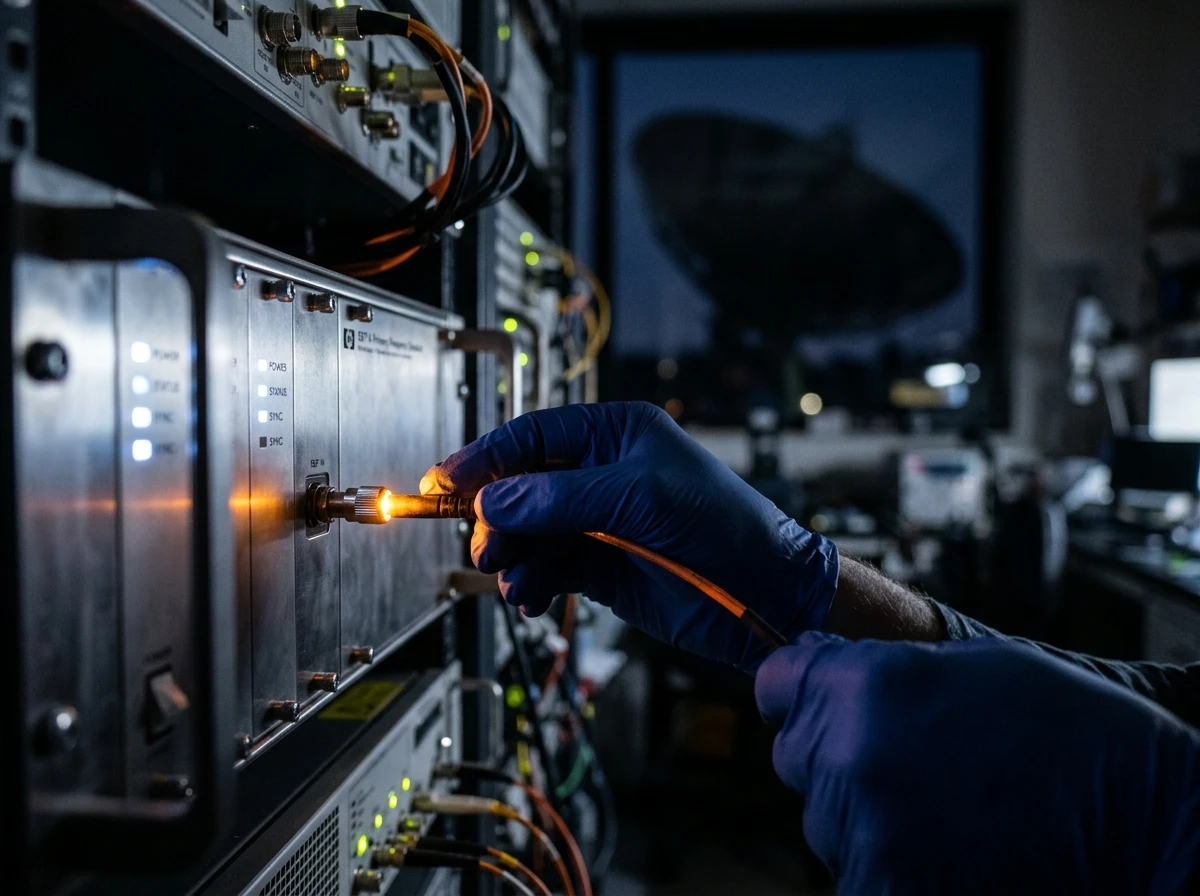
India switched on a GPS-free time network in Bengaluru on Thursday, built with technology born inside a particle collider, aiming to keep the country’s markets, banks and power grid running even if satellite signals go dark. Union Minister Pralhad Joshi inaugurated the White Rabbit Technology-based Indian Standard Time (IST) Distribution Demonstration Network at the Regional Reference Standards Laboratory (RRSL) in Jakkur, calling it a step toward one uniform, tamper-resistant time standard for the country.
The launch lands inside a wider scramble. GPS jamming and spoofing incidents have surged worldwide over the past two years, and the first live link tested under India’s new system runs straight into a stock exchange.
A Demonstration Network Goes Live in Jakkur
Joshi, who also holds the Food, Public Distribution and New and Renewable Energy portfolios, framed the Jakkur launch as part of the government’s ‘One Nation, One Time’ vision. He said the system upholds the sovereignty of India’s digital infrastructure by eliminating reliance on foreign time sources such as GPS, protecting critical sectors from cyberattacks and data manipulation.
This high-precision time synchronisation technology will be revolutionary in maintaining the stability of high-frequency financial markets, stock exchanges, digital banking payments, telecommunications networks, and national power grids.
Joshi said that at the Jakkur ceremony, where Nidhi Khare, Secretary of the Department of Consumer Affairs, Anupam Mishra, Additional Secretary, and Ashutosh Agarwal, Director of Legal Metrology, also attended, according to a report carried by the Indian news agency IANS (Indo-Asian News Service). He added that the indigenous system operates in compliance with global Coordinated Universal Time (UTC) protocols, the international reference kept by atomic clocks around the world.
IST itself runs on a bank of five cesium clocks and two active hydrogen masers housed at CSIR-National Physical Laboratory in Delhi, kept traceable to UTC with an uncertainty of less than three nanoseconds. Jakkur’s reference lab is one of five regional outposts meant to carry that precision out to the rest of the country.
Why Did a Stock Exchange Get the First Real Link?
A day after the Jakkur ceremony, engineers confirmed a live financial test of the network: a fiber link running Precision Time Protocol between the Bengaluru lab and a stock exchange facility in Chennai, making trading infrastructure the network’s first proof of concept outside a laboratory setting.
Joshi visited the Indian Space Research Organisation’s Bengaluru campus the next day and praised its role in the project, disclosing that the proof-of-concept link ran to the National Stock Exchange, India’s largest bourse. Stock exchanges depend on precise, tamper-proof timestamps to sequence trades, detect fraud and satisfy regulators, which explains why one turned up first. The Securities and Exchange Board of India sits on the high-power inter-ministerial committee that has been drafting India’s new time rules alongside CSIR-NPL, ISRO, the Indian Institute of Technology in Kanpur, the National Informatics Centre and the Indian Computer Emergency Response Team.
Other sectors have just as much riding on the switch, even without a ceremony of their own.
| Sector | What Precise IST Is Meant to Fix |
|---|---|
| Telecommunications | Nanosecond-level sync for 5G and 6G network handoffs |
| Power grids | Stable timestamps for smart grid and synchrophasor data |
| Digital payments and banking | Fraud-resistant timestamps on transaction records |
| Cyber security | Reliable timestamps for forensic diagnostics and incident response |
Those are the sectors CSIR-NPL’s own project materials list as likely to benefit first once the demonstration network scales into a nationwide grid of reference clocks.
The World’s GPS Signals Are Under Attack
Jamming and spoofing GPS signals used to be a niche military concern. It has become a mainstream infrastructure risk.
Spoofing incidents jumped 500% in 2024, according to Ivan Pisarev, regional technical lead for the Middle East, Turkey and Africa at the cybersecurity firm Group-IB, who linked the surge to rising geopolitical tension. Between mid-July and mid-August that year alone, roughly 41,000 flights ran into spoofing incidents, and GPS disruptions inside conflict zones climbed to 430,000 from 260,000 a year earlier.
A single jamming episode over the Baltic Sea affected more than 1,600 aircraft in one day. A GPS-linked collision followed near the Strait of Hormuz months later. The London Stock Exchange has weathered repeated GPS outages that hit the timestamping of financial transactions, and pilots flying into Denver International Airport reported instruments going haywire for more than a day, forcing a shift to backup navigation, The Washington Post reported.
The New York Times has reported that Russian satellites are jamming GPS signals from space, citing scientists and military experts. A sustained disruption could cost economies hundreds of billions of dollars, since GPS underpins timing for power grids, wireless networks and financial transactions well beyond ordinary navigation.
The Physics Lab Behind India’s New Clock
CERN, the European Organization for Nuclear Research, built White Rabbit to keep the Large Hadron Collider’s components synchronized to within picoseconds, since particles circulate through the accelerator more than 11,000 times a second. Released as open hardware, it delivers sub-nanosecond accuracy over ordinary fiber, a level no GPS receiver can match.
Industry noticed well before India did. The protocol’s core method was folded into the IEEE 1588 Precision Time Protocol standard used across telecom and finance. The trading firm Optiver ran a White Rabbit link spanning roughly 1,350 kilometers to connect its Chicago and New Jersey trading posts, the same kind of problem India’s new network is meant to solve for its own exchanges.
A Push That Started With the Kargil War
India’s push for its own time standard did not begin this week. Officials trace the strategic case for it back to the Kargil War in 1999, when over-reliance on foreign satellite time and navigation data exposed a gap the government has been trying to close ever since.
- 1999: The Kargil War exposes India’s dependence on foreign satellite time and navigation data, giving the eventual project its strategic rationale.
- 2024: CSIR-NPL registers a trademark for Indian Standard Time, branding it IST®, though the standard still carries no legal force.
- June 18, 2025: The Department of Consumer Affairs announces the draft Legal Metrology (Indian Standard Time) Rules, 2025, at a New Delhi round table with more than 100 stakeholders.
- July 16, 2026: Joshi inaugurates the White Rabbit demonstration network at the Jakkur reference lab in Bengaluru.
- July 17, 2026: Joshi confirms the Bengaluru-to-Chennai proof of concept during his visit to ISRO, calling it a milestone for the wider rollout.
Less than two years separate the trademark filing from a working fiber link into a stock exchange, a fast pace for government infrastructure, even allowing for the fact that the network so far reaches one financial link in one city.
What Has to Happen Before the Rules Bite
The Jakkur launch proves the concept works in one lab. Four more reference labs still need to come online before the network reaches the rest of the country.
- Ahmedabad, serving western India’s industrial and financial corridor
- Bhubaneswar, extending coverage into the east
- Faridabad, anchoring the network near the National Capital Region
- Guwahati, reaching the northeast, where regional time-zone demands have long complicated the ‘One Nation, One Time’ pitch
The draft rules that would make IST legally mandatory have been in public consultation since June 2025 and had still not been finalized as of the Jakkur launch. Once notified, the rules would bar legal and commercial use of foreign time sources without prior government approval, with periodic audits to check compliance.
Telecom carriers and internet service providers are the clearest test of how far enforcement will reach. Many still lean on GPS rather than IST for their own network clocks, by the government’s own account of the project. That gap between an atomic clock in a Bengaluru lab and a cell tower still taking its time from space is what the next phase of the rollout has to close.
Frequently Asked Questions
What is White Rabbit technology?
White Rabbit is an open-source, Ethernet-based timing system that CERN built to synchronize the Large Hadron Collider, delivering sub-nanosecond accuracy and picosecond-level precision. It now also underpins timing plans for Germany’s FAIR accelerator complex and the KM3NeT neutrino telescope, and its core method was folded into the IEEE 1588 Precision Time Protocol standard used across industry.
Why doesn’t switching to a different satellite system fix the jamming problem?
Every satellite navigation constellation, including GPS, Europe’s Galileo, Russia’s Glonass and China’s Beidou, broadcasts the same kind of weak radio signal from orbit, making all of them roughly equally easy to jam or spoof. That is why India’s plan routes time over buried fiber instead of through the sky.
Which activities can still use GPS time instead of IST?
The draft Legal Metrology Rules carve out exemptions for scientific research, astronomy and navigation, letting those fields keep using alternative time references with prior government approval. Every other legal, administrative and commercial activity would have to run on Indian Standard Time once the rules take effect.
What happens to a company that ignores the new time rules?
The draft framework calls for periodic audits to check compliance, with penalties for organizations that fail to synchronize their systems to Indian Standard Time. The government has not yet published a fee schedule or enforcement timeline alongside the draft.
Will this change the clock on an ordinary phone?
Not directly. The rules target the legal, administrative and commercial systems behind telecom networks, banks and government agencies rather than the software clock on a handset screen, so most people would notice nothing beyond networks running on tighter, harder-to-spoof timestamps behind the scenes.


Google Opens Gmail to Voice and Gates Docs Live

Lenovo Prices the IdeaPad Vibe Against Apple’s $699 Neo

Xbox Caps Game Pass Cloud Gaming at 15 Hours

GTA 6 DualSense Controllers Follow Sony’s Usual $84.99 Script

South Korea Retail Investors Face Reckoning After KOSPI AI Rally Collapses

Surrey AI Maps Three Heart Attack Paths and Their Molecular Roots

Germany Locks Neutral Apple ATT Prompts Across Most of Europe

Apple’s 5% EU Fee Quietly Rewrites Alternative App Store Math

Apple’s EU Fee Truce Cuts Complexity but Leaves Rivals Fuming

Pixel 11 Pro Fold Trades Thinness for Durability and Seven-Year Stay

Oracle Cuts 21,000 Jobs in a Year, Cites AI in 10-K Filing

Fable 5 and Mythos 5 Return as US Lifts Anthropic Export Controls

SpaceX’s Google Deal Turns a Rocket Company Into a Cloud Landlord

CD Projekt Red Co-CEO: Redemption Arc Isn’t Done, Witcher 4 in 2027

XPL Rallies 30% Ahead of Plasma One Card Tier Launch

Google Search Profiles Build a Follow Graph Inside Discover

DGO App Brings Rs 549 Mobile Pass for FIFA World Cup 2026 in Nepal

Moonshot AI Targets $30 Billion in China’s Fastest AI Funding Sprint

Oppo’s ColorOS 17 Eligibility List Leaves A-Series Buyers Behind

Microsoft Xbox Layoffs Start in July as Sharma Slams 3% Margin
-
 AI2 months ago
Oracle Cuts 21,000 Jobs in a Year, Cites AI in 10-K Filing
-
 AI2 months ago
Fable 5 and Mythos 5 Return as US Lifts Anthropic Export Controls
-
 AI3 months ago
SpaceX’s Google Deal Turns a Rocket Company Into a Cloud Landlord
-
 GAMING2 months ago
CD Projekt Red Co-CEO: Redemption Arc Isn’t Done, Witcher 4 in 2027
-
 CRYPTO3 months ago
XPL Rallies 30% Ahead of Plasma One Card Tier Launch
-
 NEWS3 months ago
Google Search Profiles Build a Follow Graph Inside Discover
-
 APPS3 months ago
DGO App Brings Rs 549 Mobile Pass for FIFA World Cup 2026 in Nepal
-
 AI3 months ago
Moonshot AI Targets $30 Billion in China’s Fastest AI Funding Sprint