
AI
Accenture Tells HR to Manage AI Agents Like Human Workers
An Accenture executive told the FT HR will manage AI agents like employees. Pulse of Change 2026 shows a 24-point C-suite vs worker gap on AI readiness.

An Accenture executive has told the Financial Times that HR departments will need to manage AI agents as well as humans, the clearest sign yet that the same corporate function that hires, trains, and disciplines people is now being asked to do the same for software. The framing matters because the popular debate around AI at work still runs through job losses and productivity gains. The consequential question is who inside the company actually runs the AI once it starts doing the work.
That is the question the Financial Times surfaced this week, and it is the one Accenture’s own research has been building toward for months. Its Pulse of Change 2026 survey found that 86% of C-suite leaders plan to increase AI investment in 2026 while only 38% of workers believe their organization can respond effectively to technological disruption. Someone has to close that gap. Accenture is arguing it should be HR.
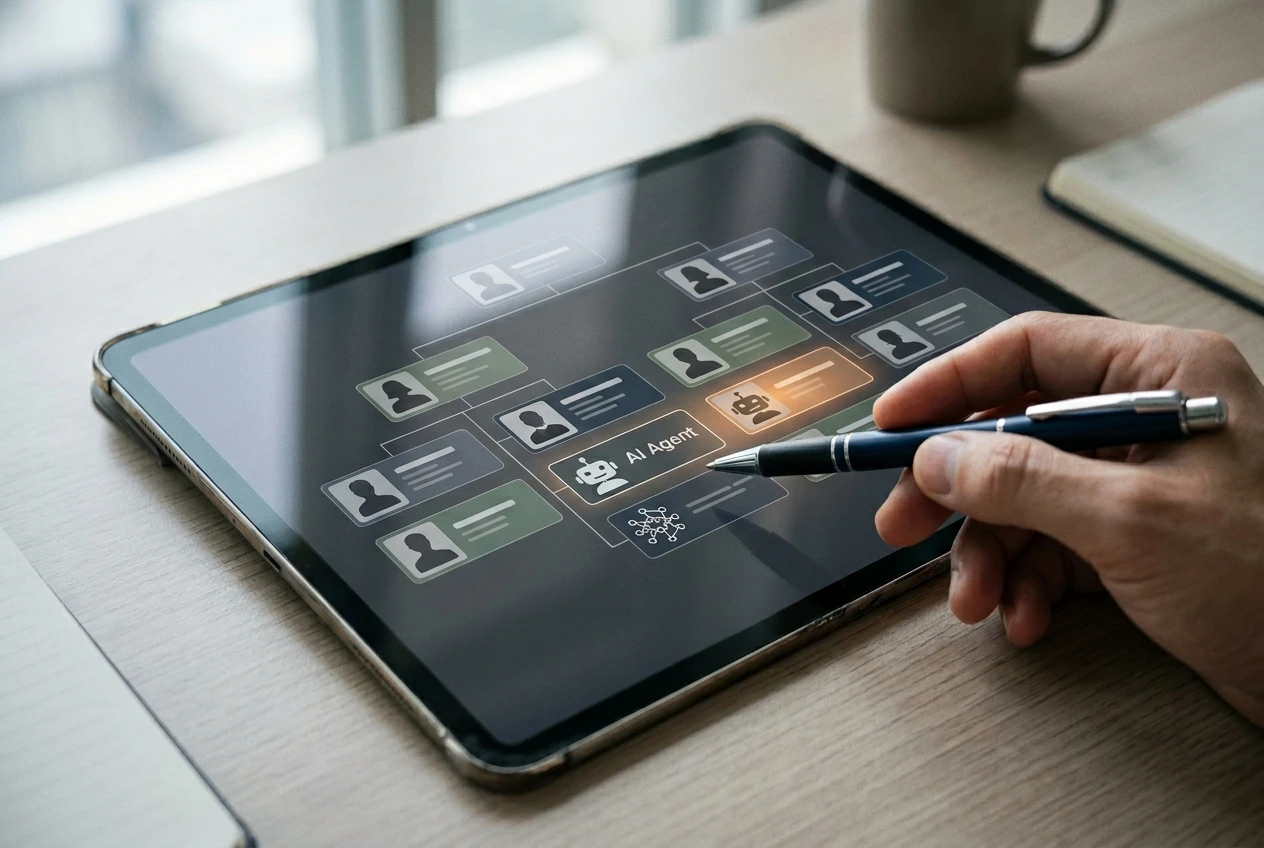
The Second Workforce Shows Up on the Org Chart
The Financial Times headline put it bluntly: HR must manage AI bots as well as humans. The story it tells is that AI agents, semi-independent pieces of software that can plan, act, and complete multi-step tasks on their own, are moving out of the IT department and into the line of business. Once they sit next to a human on a team chart, the same questions that apply to a new hire start to apply to them. Who trained them. How they are performing. What happens when they go wrong.
Accenture’s own banking blog lays out the same thesis in its own words: “Managing a workforce of people supported by AI agents requires new approaches and elevates HR’s role.” The blog argues the conversation has moved from redesigning roles to designing work for outcomes and intent, not job titles, with AI agents as capable co-workers.
The framing changes the meaning of almost every familiar HR practice. Onboarding becomes a process for spinning up and configuring an agent, not just signing a contract. Performance reviews compare the agent’s accuracy, latency, and cost against the human worker beside it. Discipline is replaced by retraining, or by switching the agent off. Offboarding is deletion, with an audit trail.
The C-Suite Sees a Different Workplace Than the Workers
Accenture’s Pulse of Change 2026 survey of executives and workers, published on January 15, 2026, polled 3,650 C-suite executives and 3,350 workers across 20 industries and 20 countries between November and December 2025. The report’s own framing is that gaps in employee sentiment, adoption patterns, and the infrastructure cracks quietly determine whether AI will deliver returns. The numbers make the gap visible.
82% of C-suite leaders expect a higher level of change in 2026 than a year ago, a 24 percentage point gap with employees on the same question. 86% of C-suite leaders plan to increase AI investment in 2026, and 78% now see AI as more beneficial to revenue growth than cost reduction, up from 65% in June 2024. C-suite use of AI tools daily has quadrupled, from 8% in March 2024 to 32% by the time of the 2026 survey. 55% of C-suite leaders feel prepared for technological disruption in 2026, up from 49% in summer 2025.
The worker side of the same survey tells a quieter story. 32% of employees say they regularly work with AI agents, and just 27% strongly agree they are comfortable delegating tasks to them. Job security has slipped. 48% of workers feel secure in their jobs, down eleven percentage points from 59% in summer 2025. 30% feel confident about how their company will handle talent disruption. 59% believe young professionals are having a harder time finding jobs due to automation and AI.
| Indicator | C-suite | Workers |
|---|---|---|
| Expect higher level of change in 2026 vs a year ago | 82% | 58% (24-point gap) |
| Plan to increase AI investment in 2026 | 86% | n/a |
| Use AI tools daily in their work | 32% | n/a |
| Regularly work with AI agents | n/a | 32% |
| Comfortable delegating tasks to AI agents | n/a | 27% |
| Feel secure in their jobs | n/a | 48% |
Source: Accenture Pulse of Change 2026, January 15, 2026. n/a indicates the question was not asked of that group.
The Skills HR Now Has to Hire For
If HR is to take on the agent workforce, it also has to rethink what skills it recruits for. Accenture’s Learning Reinvented research, cited in its banking blog, found that 84% of executives expect AI agents to work alongside humans within three years, and 80% of workers see AI as an opportunity. Only 26% of workers, though, say they have received training on how to collaborate with AI.
Accenture’s list of skills in decline is short and specific: manual data entry, summarizing correspondence, drafting routine reports and proposals, basic calculations and modelling, simple customer interactions, and basic compliance checks. The blog notes many of these trends pre-date AI, but AI accelerates them.
The skills in demand, per the same blog, are the ones HR is least set up to assess. They are: building, integrating, testing, monitoring, and explaining AI; working effectively with agents, from basic prompting to advanced collaboration; and deep human skills, listed by Accenture as empathy, communication, judgement, negotiation, leadership, and trust building. Even operational areas such as fraud, payments, claims, KYC, and lending are shifting toward smaller, more expert teams focused on complex cases and situational judgement.
Accenture’s take on reinventing work, workforce, and workers argues the shift has to happen on the team, not just the individual. Its Talent Reinventors survey found that only 19% of employees say their team experiments with AI together, and just 17% feel psychologically safe to share new ideas. The blog cites a study from Ethan Mollick and his colleagues showing that teams with AI outperform both individuals with AI and teams without it, because AI helps bridge knowledge and language gaps and generate more diverse ideas.
- Employee handled calls down 5-10%
- Average handling time down 10%
- Capacity released around 20%
- Skill level and time to competence both up
Those are the results Accenture reports from a co-learning model rolled out at a large European insurer, where a human agent leads the call, an AI agent transcribes and suggests compliant responses, and the system provides reflective feedback to the human after. Organizations using that approach, Accenture writes, are developing skills four times faster and doubling confidence in collaborating with AI.
The Trust Deficit That Could Derail the Plan
Even where the technology is working, the trust required to scale it is fragile. Job security has fallen: 48% of workers feel secure in their jobs, down eleven percentage points from summer 2025, and 30% feel confident about how their company will handle talent disruption. 59% believe young professionals are having a harder time finding jobs due to automation and AI.
The signals go the other way as well. Only 20% of employees feel like active co-creators in how AI changes their work. 17% say they enjoy using AI and seek new ways to apply it, down from 21% the year before. 13% say they frequently encounter misleading and low-quality outputs from their AI use. 39% of employees are trying AI tools first before going to a colleague, down 15 percentage points versus summer 2025. Accenture’s reading is that growing hesitation about AI output quality and the strength of organizational data foundations is a serious risk to sustained adoption.
If HR now owns the bot roster, it also owns the credibility cost when AI outputs fail or workers feel cut out of the design. The Pulse of Change 2026 report frames it bluntly: skilling alone is failing to build readiness or cement trust, putting long-term AI value at risk, and employees need a clearly communicated vision.
What HR Has Not Yet Solved
Managing the agent workforce is one problem. Managing its failure modes is a different one, and Accenture’s own research is candid that it is unsolved. The banking blog warns that as AI quality increases, there is a risk that workers form an over-reliance on AI and effectively fall asleep at the wheel. In a study of recruiters cited in the blog, Dell’Aqua found that recruiters who over-relied on AI made worse selection decisions and missed brilliant candidates. The blog adds: being a good human in the lead requires cognitive load.
If we have a human in the lead, we want them to be effective and active in this role.
The proposed fixes are structural, not aspirational. The blog lists targeted training, structured decision prompts, breaking complex judgements into logical steps, requiring AI explanations and citations, anomaly detection, and ethical monitoring of both AI and human performance. The report’s wider claim is that maximizing AI return on investment is not about maximizing AI performance in isolation but improving human and agent performance together. Accenture forecasts that by 2029, agentic AI will autonomously resolve 80% of common customer service issues without human intervention, leading to a 30% reduction in operational costs.
The cost of getting HR’s new role wrong now lands on the same people the function was built to support. Accenture’s banking blog closes the loop: AI value in 2026 will favor the organizations that align the confidence in their technological investments with commitment to workforce needs, and HR is the function that has to hold both ends.
Frequently Asked Questions
Who said HR should manage AI agents?
The Financial Times reported the framing, citing an Accenture executive. Accenture’s own banking blog on the agentic AI workforce lays out the same thesis and argues HR’s role is elevated, not diminished, by the rise of AI agents in financial services and other industries.
What does managing an AI agent actually look like?
Per Accenture, it covers onboarding, performance tracking, training on new tasks, and retiring the agent. A co-learning model used at a large European insurer cut handled calls 5-10%, trimmed average handling time 10%, and released about 20% of capacity, with skill levels and time to competence both rising at the same time.
Will AI agents replace HR staff?
The Pulse of Change 2026 data points the other way. HR’s remit expands to cover both humans and agents, and the function’s workload grows rather than shrinks as the agent roster becomes a permanent part of the org chart.
What skills are gaining and losing value?
Declining: manual data entry, summarizing correspondence, drafting routine reports, basic calculations, simple customer interactions, basic compliance checks. Gaining: building, integrating, testing, monitoring, and explaining AI; working effectively with agents; and deep human skills such as empathy, communication, judgement, negotiation, leadership, and trust building.
How should workers prepare?
43% of employees surveyed said clear training would give them more confidence with AI tools. The lever is continuous learning, internal talent marketplaces, and skills-based mobility, not waiting for the org chart to settle around you.


AMD’s Data Center Revenue Jumps 57% as Its Stock Bets on Execution

Microsoft Loses an Xbox Lawsuit Just as Sony Kills Physical Discs

Bethesda Union Says HR Tore Down Its Memorial for Laid-Off Staff

Google Pixel 11 Pro Fold Price Leaks Point Toward a $2,000 Foldable

Smart Scales Promise Lab-Grade Body Fat Numbers, and the Science Pushes Back

Amap’s Ride-Hailing Hits 1,000 Cities Amid Security Warnings

Ulys’s Automatic Toll Billing Draws Scammers to 7 Million Drivers

Google’s Veo AI Video Tools Threaten VFX Jobs Far Beyond Hollywood

Music Industry Unveils AI Labels, but Streaming Giants Haven’t Signed On

Apple Sues OpenAI and Two Ex-Employees Over Stolen Trade Secrets

Microsoft Xbox Layoffs Start in July as Sharma Slams 3% Margin

Google Search Profiles Build a Follow Graph Inside Discover

Oracle Cuts 21,000 Jobs in a Year, Cites AI in 10-K Filing

Oppo’s ColorOS 17 Eligibility List Leaves A-Series Buyers Behind

Google DeepMind and A24 Sign $75 Million AI Partnership Deal

OCC Issues AML Consent Order Against Wise and Crypto.com Sponsor Bank

DGO App Brings Rs 549 Mobile Pass for FIFA World Cup 2026 in Nepal

Anthropic Tells Senators Alibaba Ran the Largest Claude Distillation Attack

Meta’s Iris AI Chip Enters Production in September, Tests Clean

Apple Strikes Preliminary Deal For Intel To Make iPhone And Mac Chips
-
 GAMING1 month ago
Microsoft Xbox Layoffs Start in July as Sharma Slams 3% Margin
-
 NEWS1 month ago
Google Search Profiles Build a Follow Graph Inside Discover
-
 AI3 weeks ago
Oracle Cuts 21,000 Jobs in a Year, Cites AI in 10-K Filing
-
 NEWS1 month ago
Oppo’s ColorOS 17 Eligibility List Leaves A-Series Buyers Behind
-
 AI3 weeks ago
Google DeepMind and A24 Sign $75 Million AI Partnership Deal
-
 CRYPTO2 months ago
OCC Issues AML Consent Order Against Wise and Crypto.com Sponsor Bank
-
 APPS1 month ago
DGO App Brings Rs 549 Mobile Pass for FIFA World Cup 2026 in Nepal
-
 AI3 weeks ago
Anthropic Tells Senators Alibaba Ran the Largest Claude Distillation Attack