
AI
William Lee Says the Fed Should Rethink How It Reads US Jobs Data
William Lee of Global Economic Advisors says the US labor market is weaker than the 57,000 payroll figure and the Fed should rethink its framework.

The Federal Reserve may need to rethink how it reads the US jobs data, says William Lee, Chief Economist and Managing Director of Global Economic Advisors, because the headline payroll figure is not telling policymakers what they think it is. The latest jobs report, with payroll growth of just 57,000 and downward revisions to the previous two months, was the prompt for Lee’s critique on CNBC TV18. Lee’s argument is that establishment-survey prints miss the real picture, the FOMC’s hawkish drift is built on that miss, and a data rethink under Chair Kevin Warsh is coming.
Lee’s read has a second leg. The memory side of the AI trade is intact on the back of strong chipmakers, but the next phase of infrastructure spending depends on whether companies adopt smaller, more economical Chinese models or keep building around large US leaders such as Anthropic and Gemini. The fork decides whether dollars flow to hyperscale data centres or to enterprise-owned infrastructure. Lee’s full interview is the full interview transcript with William Lee.
Lee’s Reading of the Jobs Report
Last week’s report showed payroll growth of just 57,000 alongside downward revisions to the prior two months, and Lee was unmoved. The number, in his view, still overstates the actual pace of job creation in the US.
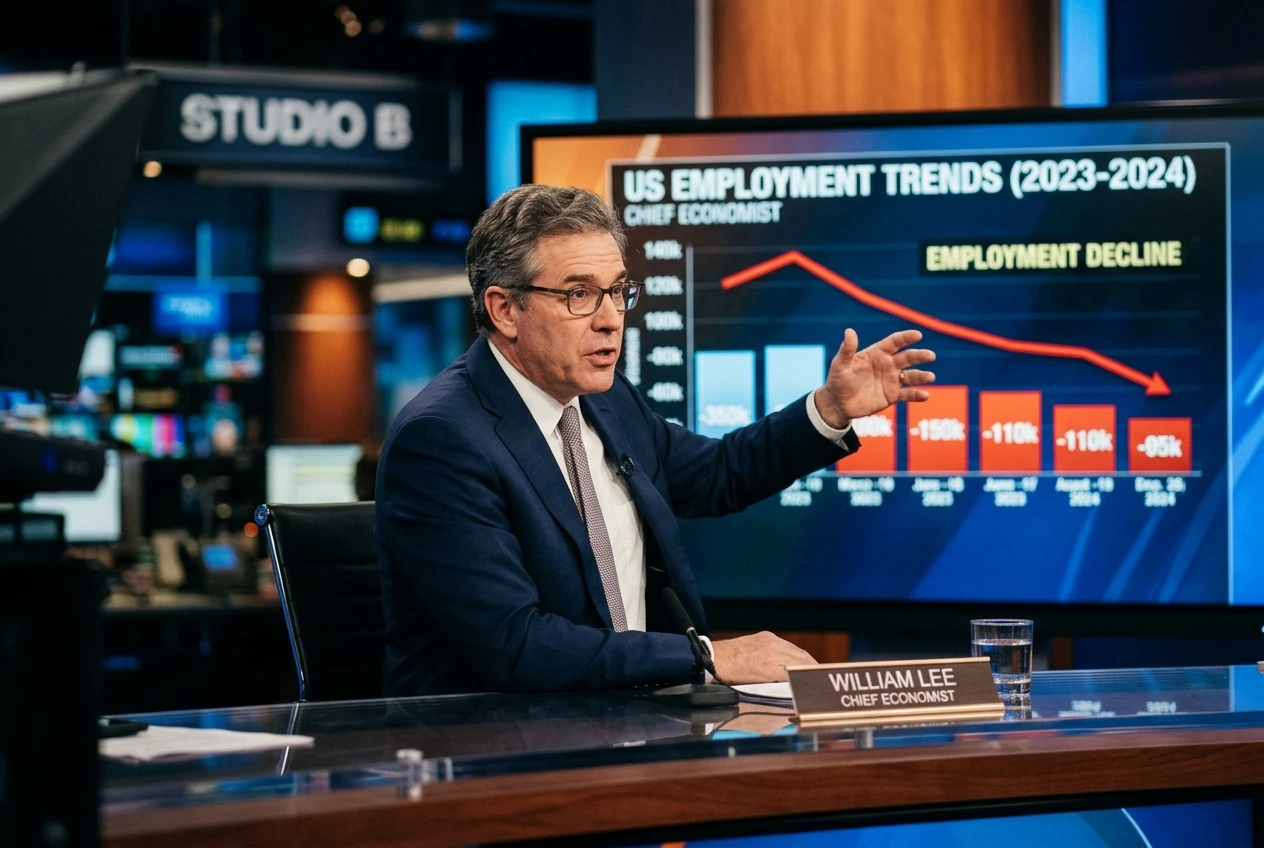
The Labour Department runs another survey, distinct from the establishment count, that asks individuals whether they are working rather than asking companies how many jobs they created. That household survey has shown a decline of about 115,000-117,000 people reporting employment every month over the past year. The gap between the two surveys is the heart of Lee’s case. A 57,000 establishment print sits alongside a household survey that has been quietly bleeding workers, and Lee reads the household side as closer to reality.
So Lee is not calling the labour market a collapse. He is calling the headline a flattering frame on a softer labour market than the FOMC is pricing in.
Inside the FOMC’s Hawkish Drift
Lee expects the Fed’s response to soften, but he sees a current positioning problem at the Federal Open Market Committee. Many FOMC members remain focused on energy- and tariff-related price increases, and the hawks have become even more hawkish. They are positioning themselves ahead of what Lee sees as a more dovish rethink that Chair Warsh could bring to the FOMC.
Lee argues that energy- and tariff-driven inflation is not the binding constraint, and that the FOMC’s posture is built on a jobs series that lags reality by months and gets revised heavily once the third release lands. The minutes later this week, in Lee’s view, will show the positioning rather than the pivot. The pivot itself has to wait on a new framework and a new data set the committee can actually trust.
The block below is how Lee framed the FOMC drift in the interview.
Many Federal Open Market Committee (FOMC) members remain focused on energy- and tariff-related price increases, and I think the hawks have become even more hawkish.
Lee expects that positioning to fade as the framework rethink arrives. The harder fight for the hawks is the one already baked into their own numbers: the survey they cite gets revised by very large margins, and the true picture only emerges at the third release.
Why the Fed’s Data Lag Could Force a Rethink
The employment survey has been revised by very large margins multiple times, and Lee argues that policymakers end up three months behind where the labour market actually is by the time they act on a given print. Two prior months got revised down in the last report alone, and that pattern is the rule rather than the exception. The payroll growth figure of 57,000 came with that baggage.
Lee’s framing is blunt. He calls being three months behind on labour-market reality unacceptable for 21st-century monetary policymaking, and he expects policymakers to eventually need to rethink their framework, reconsider their data sources and focus on how best to achieve the 2% inflation target. As that rethink arrives, in his view, the hawkish tone inside the FOMC should gradually begin to fade.
The Memory Trade Is Still On
Lee is more constructive on the AI hardware side than he is on the labour market. Samsung Electronics’ preliminary Q2 numbers showed revenues up 30% year-on-year and 28% sequentially, and the stock has already risen five-fold over the past year. For Lee, that combination is the cleanest evidence yet that the hardware side of the AI trade is firmly in place. The infrastructure build-out, in his words, is continuing.
Where the AI trade goes next, in Lee’s view, depends less on chips and more on the model architecture that sits on top of them. The memory trade is on; the question is what the next round of compute demand actually looks like.
Three sourced figures frame the hardware side of the AI trade: Samsung’s preliminary Q2 revenue is up 30% year-on-year, up 28% sequentially, and the stock has risen five-fold over the past year, on Lee’s read, evidence that the memory trade is on.
Where AI Infrastructure Dollars Go Next
The next phase of AI infrastructure spending has a fork, and the choice between two very different bets will decide where the dollars land. One path runs through the smaller, more economical, less power-hungry models coming out of China. The other stays with the large, complex, power-intensive US leaders such as Anthropic and Gemini.
Lee expects that choice to decide whether the next round of spending goes to hyperscale data centres or to enterprise-owned infrastructure. The signal he watches is whether companies want to own the model, own the data, and own the infrastructure on which they compute AI tokens. If localised computing wins, that money lands closer to the buyer.
The trade is no longer only about compute scale. Lee points to a growing focus on token security and information security, and reads that as where the AI trade is headed. The buyers who care most about owning their stack also tend to care most about who can see their tokens, and that pair of demands pushes spend toward the enterprise side of the market rather than the public-cloud side.
The two paths look like this in Lee’s framing:
| Path | Model style | Power profile | Where spending lands |
|---|---|---|---|
| Chinese-style smaller models | Localised, economical | Less power-hungry | Enterprise-owned infrastructure |
| US leaders (Anthropic, Gemini) | Large, complex | Power-intensive | Hyperscale data centres |
The line between the two paths is not academic. A shift toward localised computing reshapes who builds, who buys, and who keeps the margin.
What’s Really Behind Weak Hiring
Asked whether AI-driven productivity was the cause of weak hiring, with output rising while headcount stays flat, Lee pushed back. AI, in his framing, is only beginning to show up in the productivity numbers. The main driver is post-COVID productivity gains.
Companies have become more capital-intensive, reorganised their production processes and changed their management structures to use labour more efficiently. After COVID, there was a rush for specialised expertise; now those skill requirements are changing, companies are reluctant to hire new workers, and existing employees are being redeployed into new roles created by technological advances and AI. Lee expects weak job creation to persist for some time, and the hawkish tone inside the FOMC to fade once the framework rethink takes hold under Chair Warsh.
The composition of the hiring that is happening tells the same story as the household survey does:
- Hiring concentrated in lower-paying sectors: social services, healthcare, leisure and hospitality
- Largely absent: higher-paying manufacturing and professional services
The profile of the new jobs is narrower than the headline 57,000 suggests, and the sectors paying the higher wages are not the ones adding to it.
Frequently Asked Questions
Who is William Lee?
William Lee is the Chief Economist and Managing Director of Global Economic Advisors. The CNBC TV18 piece that anchors this article is an edited transcript of his interview on the US economy, jobs data, and the AI infrastructure outlook.
What does Lee mean by the jobs data “overstating” reality?
He is contrasting the establishment-survey print, which feeds the 57,000 figure, with the household survey the Labour Department also runs. That household series has been losing about 115,000-117,000 people reporting employment every month for a year, which is the gap Lee reads as the more honest signal.
What is the AI “fork in the road” Lee describes?
It is a choice between adopting smaller, more economical, less power-hungry Chinese models or staying with the large US leaders such as Anthropic and Gemini. The choice decides who captures the next round of AI infrastructure spending.
Why would AI spending shift from hyperscalers to enterprises?
If smaller and more efficient models win adoption, companies are more likely to keep the model, the data, and the compute infrastructure in-house, so the spend lands at the enterprise level rather than at hyperscale data centres.
Why does Lee think the Fed will rethink its data framework?
He points to repeated very large revisions, the three-month lag before the true picture emerges at the third release, and the 2% inflation target itself. In Lee’s view, that combination makes the current framework unacceptable for 21st-century monetary policymaking and sets up a rethink under Chair Warsh.


D&D Bets Big on WoW and Star Wars to Grow Its Tables

Game Pass Drops Celeste and Crusader Kings on First Net-Loss Day

Gemini Breaks Basic Calls on Foldable Phones in Android Auto

Citadel Clears AI Fund Overhang While Crypto Stays Flat

Morgan Stanley Staking ETPs Crack Open Crypto Yield for Wealth Clients

Snapdragon Price Hike Forces Premium Buyers Toward Last Year’s Phones

Croc 2 Remaster Unlocks Argonaut’s Full Revival Path

Scale AI Names Google Cloud Veteran deSouza CEO for Enterprise Push

Epic Store Hits Brazilian iPhones Amid Apple’s Familiar Friction Play

LORDNINE Helena Server Races Players Toward Real USDT Rewards

Fable 5 and Mythos 5 Return as US Lifts Anthropic Export Controls

SpaceX’s Google Deal Turns a Rocket Company Into a Cloud Landlord

Oracle Cuts 21,000 Jobs in a Year, Cites AI in 10-K Filing

CD Projekt Red Co-CEO: Redemption Arc Isn’t Done, Witcher 4 in 2027

XPL Rallies 30% Ahead of Plasma One Card Tier Launch

DGO App Brings Rs 549 Mobile Pass for FIFA World Cup 2026 in Nepal

Google Search Profiles Build a Follow Graph Inside Discover

Moonshot AI Targets $30 Billion in China’s Fastest AI Funding Sprint

Microsoft Xbox Layoffs Start in July as Sharma Slams 3% Margin

Oppo’s ColorOS 17 Eligibility List Leaves A-Series Buyers Behind
-
 AI1 month ago
Fable 5 and Mythos 5 Return as US Lifts Anthropic Export Controls
-
 AI2 months ago
SpaceX’s Google Deal Turns a Rocket Company Into a Cloud Landlord
-
 AI1 month ago
Oracle Cuts 21,000 Jobs in a Year, Cites AI in 10-K Filing
-
 GAMING1 month ago
CD Projekt Red Co-CEO: Redemption Arc Isn’t Done, Witcher 4 in 2027
-
 CRYPTO2 months ago
XPL Rallies 30% Ahead of Plasma One Card Tier Launch
-
 APPS2 months ago
DGO App Brings Rs 549 Mobile Pass for FIFA World Cup 2026 in Nepal
-
 NEWS2 months ago
Google Search Profiles Build a Follow Graph Inside Discover
-
 AI2 months ago
Moonshot AI Targets $30 Billion in China’s Fastest AI Funding Sprint