
NEWS
Nelson Mandela Bay Switches On R27m CCTV, Drone and Fibre Network
Nelson Mandela Bay’s MBDA launched an R27m CCTV network on Thursday: 360 cameras, 7 drones, 40km of fibre, and 128 Metro Police officers for 1.3m residents.

The Mandela Bay Development Agency switched on an R27m CCTV and drone network in Nelson Mandela Bay on Thursday, adding 360 new CCTV cameras, seven surveillance drones and more than 40km of fibre optic cable to the metro’s security grid. The agency’s interim chief executive, Pierre Voges, and deputy mayor Gary van Niekerk unveiled the rollout at the Nelson Mandela Bay Stadium control centre, framing it as the third phase of the agency’s broader security infrastructure project.
On Thursday, Van Niekerk tied the rollout to the policing numbers behind it. “We have become the murder capital of SA,” he said, noting a metro of 1.3 million residents served by about 128 Metro Police officers. The current ratio sits in the thousands, not the one-officer-per-125 figure the metro should be hitting. Voges called the rollout the priority he most needed to press during his five-month interim tenure.
An R27m Network of New Surveillance Hardware
The R27m expansion adds the 360 new CCTV cameras, seven surveillance drones and more than 40km of fibre optic cable to the metro’s existing surveillance footprint. Officials say the kit is built around three jobs: faster detection of suspicious activity, shorter emergency response times and protection of infrastructure from vandalism. The fibre is the spine of the build, with each camera expected to push high-resolution live footage back to the stadium control room for the reaction teams.
The launch was staged as a briefing at the stadium control centre, with Voges, Van Niekerk and the security partner Afrisec Group speaking before the live drone demo. Spokesperson Luvuyo Bangazi said the rollout would tie the metro’s existing camera networks into “a single integrated system”. The 360 cameras carry number plate recognition, thermal imaging, infrared night vision and high-powered zoom, and they are fitted for all weather and all lighting. Bangazi said the system is meant to “improve public safety while laying the groundwork for a smarter city”. Voges called it one of the “buttons” to press in his five-month stint. He listed security, cleansing, maintenance and compliance among the rollout’s targets. All of it was live on Thursday.
Bangazi said the 40km of fibre optic cable lays the groundwork for services beyond surveillance. He named smart metering and electricity-grid management as the next uses for the same backbone. The agency behind the security network is positioning the third-phase build as municipal infrastructure future applications can run on, with security as the first layer.
- Number plate recognition
- Thermal imaging
- Infrared night vision
- High-powered zoom
Where the New Network Reaches
The third-phase rollout pushes surveillance well beyond the stadium precinct. The new network reaches every major commercial, residential and tourist corridor in the metro, with the fibre backbone tying each covered area into the stadium control room.
Bangazi said the expansion will “connect existing surveillance networks into a single integrated system, improving public safety while laying the groundwork for a smarter city”. The 40km of cable, he added, will “benefit the city, start to build towards a smart city, start to allow for additional services to be delivered, whether you’re talking about smart metering or management of the infrastructure in terms of electricity”. The launch’s footprint reaches from main arterial routes through inner-city suburbs to beachfronts and parks, with the new build overlapping several of the metro’s busiest transport corridors.
- Stanford and Gail roads
- The stadium precinct
- North End
- Schauderville
- Algoa Park
- Missionvale
- KwaDwesi
- Joe Slovo
- Khayamnandi
- Kempston Road
- Walmer township
- St George’s Park
- Kings Beach
- Happy Valley
- City Hall precinct
How the Drone Fleet Is Being Deployed
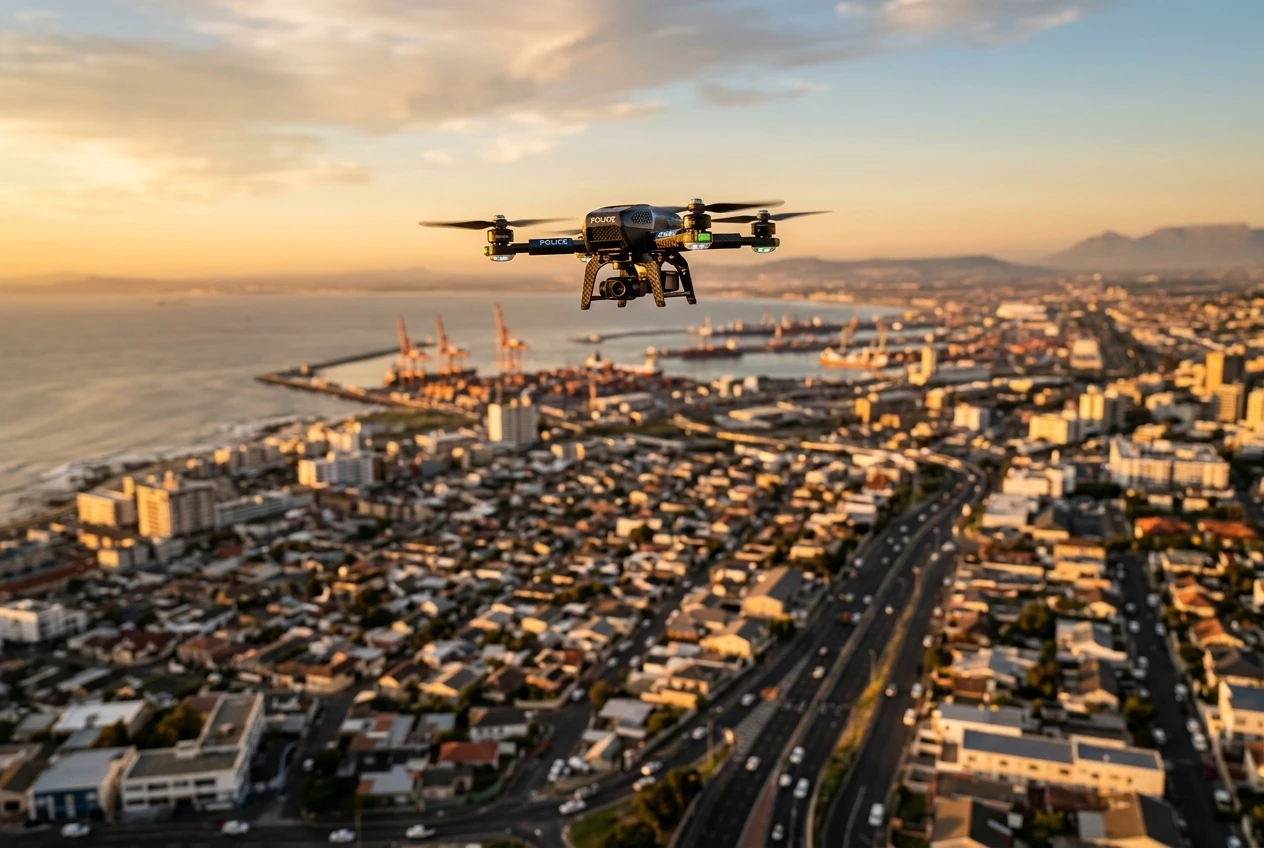
Seven drones, spaced about 5km apart, form the eye in the sky for the metro’s new security layer. Afrisec Group chief operating officer Johan Barnard said the fleet provides “active and reactive surveillance”, with units housed in secret locations and ready to launch day or night.
Barnard demonstrated the system live from the stadium control room on Thursday, calling up one of the seven drones for a real-time flight. A drone launched from one of the secret staging sites and flew over Walmer, streaming footage back to the centre. That footage was clear enough for operators to zoom in on vehicle number plates. The same feed is then pushed directly to the reaction team, the police and the on-site guards so officers don’t “go blindly into a specific scenario where they can get ambushed or hurt”.
The pitch from Barnard is opportunistic crime as a target. “Everywhere that we have deployed our drones, there is an immediate reaction that we get. We catch people immediately,” Barnard said at the launch. He listed cable theft, poaching, car theft and illegal dumping as offences the drones “sniff out very easily”. He added that the system adds to existing policing, with how cameras and drones tracked a thief to arrest in one US city showing what that layer looks like in action.
This is a tool assisting the people on the ground.
A Metro of 1.3m Served by 128 Officers
Van Niekerk used the launch to lay out the policing gap the new kit has to bridge. The metro’s 128 Metro Police officers serve a population of about 1.3 million residents, he said. The current ratio sits “in the thousands” rather than the one-officer-per-125 figure Van Niekerk said the metro should be hitting.
On safety specifically, Van Niekerk did not soften the diagnosis. “We have become the murder capital of SA.” He framed safety and vandalism as the metro’s two biggest problems, and said the new R27m rollout is meant to help with both. Millions of rand are lost to vandalism every year, he said. Van Niekerk added that infrastructure across the metro keeps being torn up without the technology to keep it safe.
Voges outlined a five-month window focused on four pain points: security, cleansing, maintenance and compliance. One practical initiative is the metro’s 100 priority routes, to be rehabilitated by repairing potholes, painting road markings, restoring faulty streetlights, curbing illegal dumping, clearing rubble, cutting grass and maintaining verges. The same routes have become the centre of a political dispute between Van Niekerk and mayor Babalwa Lobishe.
The new hardware and the new fibre link up at the stadium control room, where Barnard ran Thursday’s drone demonstration. How the technology reshapes ground-level patrol patterns was not addressed at the Thursday security briefing at the stadium.
- 1.3 million residents in the metro
- About 128 Metro Police officers on duty
- 360 new CCTV cameras deployed in this phase
- More than 40km of fibre optic cable laid in this phase
A Dispute Over Sabotaging Service Delivery
The Van Niekerk-Lobishe dispute spilled into Thursday’s briefing. Van Niekerk referenced a recent letter he had written to co-operative governance MEC Zolile Williams accusing Lobishe of sabotaging service delivery. He framed the same 100 priority routes on which the security build relies as unfinished work. The escalation had moved the spat from council chambers onto the launch platform itself.
Lobishe earlier called Van Niekerk’s letter “ridiculous” and said many of the metro’s main routes had been fixed. Van Niekerk said her response took him by surprise, calling out the comment from the launch platform on Thursday morning. “I was shocked this morning to open the newspaper and read a comment that everything is fixed on all our main routes,” he told the briefing. He argued that the priority now is making the 100 main routes safe before turning to other infrastructure programmes. “The first thing that must be fixed is the safety of our 100 main routes,” Van Niekerk said.
The Lobishe-Van Niekerk row is over routes and broader service delivery, not the cameras themselves. The new security build is funded through the MBDA, not the metro’s main budget. The two issues share a metro under pressure; they sit in separate budgets.
From Cameras to Smart-City Infrastructure
For the MBDA, the surveillance network is also a smart-city network in waiting. More than 40km of fibre optic cable now sits under the metro’s roads, and Bangazi said the build starts to put the right infrastructure in the ground for future services. He named smart metering as one application. He named electricity-grid management as another. He framed both as the first examples of a wider set of services the same backbone could carry once the security layer is operational.
Vandalism of municipal infrastructure is part of why that fibre matters. Van Niekerk said millions of rand are lost to vandalism every year, and that the new camera coverage of the 100 priority routes would help protect one set of those investments from being torn up. His rapid-turnaround programme for those routes covers pothole repair, road markings, streetlight restoration, illegal dumping clearance, rubble removal and verge maintenance. “Technology is the only way to go to protect our infrastructure and make the city safe for our residents, as well as our visitors,” Van Niekerk said.


D&D Bets Big on WoW and Star Wars to Grow Its Tables

Game Pass Drops Celeste and Crusader Kings on First Net-Loss Day

Gemini Breaks Basic Calls on Foldable Phones in Android Auto

Citadel Clears AI Fund Overhang While Crypto Stays Flat

Morgan Stanley Staking ETPs Crack Open Crypto Yield for Wealth Clients

Snapdragon Price Hike Forces Premium Buyers Toward Last Year’s Phones

Croc 2 Remaster Unlocks Argonaut’s Full Revival Path

Scale AI Names Google Cloud Veteran deSouza CEO for Enterprise Push

Epic Store Hits Brazilian iPhones Amid Apple’s Familiar Friction Play

LORDNINE Helena Server Races Players Toward Real USDT Rewards

Fable 5 and Mythos 5 Return as US Lifts Anthropic Export Controls

SpaceX’s Google Deal Turns a Rocket Company Into a Cloud Landlord

Oracle Cuts 21,000 Jobs in a Year, Cites AI in 10-K Filing

CD Projekt Red Co-CEO: Redemption Arc Isn’t Done, Witcher 4 in 2027

XPL Rallies 30% Ahead of Plasma One Card Tier Launch

DGO App Brings Rs 549 Mobile Pass for FIFA World Cup 2026 in Nepal

Google Search Profiles Build a Follow Graph Inside Discover

Moonshot AI Targets $30 Billion in China’s Fastest AI Funding Sprint

Microsoft Xbox Layoffs Start in July as Sharma Slams 3% Margin

Oppo’s ColorOS 17 Eligibility List Leaves A-Series Buyers Behind
-
 AI1 month ago
Fable 5 and Mythos 5 Return as US Lifts Anthropic Export Controls
-
 AI2 months ago
SpaceX’s Google Deal Turns a Rocket Company Into a Cloud Landlord
-
 AI1 month ago
Oracle Cuts 21,000 Jobs in a Year, Cites AI in 10-K Filing
-
 GAMING1 month ago
CD Projekt Red Co-CEO: Redemption Arc Isn’t Done, Witcher 4 in 2027
-
 CRYPTO2 months ago
XPL Rallies 30% Ahead of Plasma One Card Tier Launch
-
 APPS2 months ago
DGO App Brings Rs 549 Mobile Pass for FIFA World Cup 2026 in Nepal
-
 NEWS2 months ago
Google Search Profiles Build a Follow Graph Inside Discover
-
 AI2 months ago
Moonshot AI Targets $30 Billion in China’s Fastest AI Funding Sprint