
COMPUTERS
Google and UCSD Turn 2,000 Retired Pixel Phones Into a Data Center
Google and UC San Diego are stripping 2,000 retired Pixel phones to their motherboards, building a low-carbon data center cluster launching this fall.

Google wants to prove a retired Pixel phone can still do a server’s job. Working with computer scientists at the University of California San Diego (UCSD), the company is stripping 2,000 retired Pixel phones down to bare motherboards and wiring them into a data center cluster set to go live this fall.
The pitch runs on carbon math. A phone’s motherboard alone accounts for roughly 50 percent of its total embodied carbon, according to Google’s own internal assessments, so reusing one instead of building a new server skips most of the emissions a fresh machine would cost.
The phones exist to strip in the first place, though, because Google keeps selling people a new one.
Google Strips Pixel Phones Down to Bare Motherboards
Google calls the approach phone cluster computing. The teardown comes first: researchers pull the display, battery, camera modules, and outer casing off each phone, leaving only the motherboard, the strip of silicon carrying the processor, memory, and storage. Google laid out the process in a research post published June 12 that put 25 to 50 stripped boards on par with one server.
Batteries were the first thing to go, and for a specific reason. Google’s engineers ruled out shipping full, unmodified phones into a data center early on, flagging intact batteries as a fire risk once packed tightly into racks, according to Ryan Kastner, an associate professor of computer science at UCSD.
Once a board is bare, it needs new software. Android already runs on Linux underneath, but its mobile-facing userspace gets swapped for a general-purpose Linux distribution built for cloud jobs instead of apps. That switch also turns off protections built for handheld use, like the low-memory killer that throttles hungry apps on a phone still in someone’s pocket.
- Removed – display, battery, camera modules, speakers, and the outer casing, none of which contribute to computing.
- Kept – the bare motherboard, carrying the processor, memory, and storage that do the actual work.
- Replaced – Android’s mobile interface, swapped for a general-purpose Linux distribution built for cloud workloads.
- Added – Kubernetes, the orchestration software that manages each board as one node in a self-managing cluster of 25 to 50 devices.
No single board can carry a real workload alone. A phone has a handful of processor cores and 8 to 12 gigabytes of memory, nowhere near a server’s dozens of cores and bulk memory pool.
Grouping boards into clusters, then managing them with Kubernetes, the same orchestration platform running much of the modern cloud, is what turns a pile of scavenged parts into shared infrastructure.
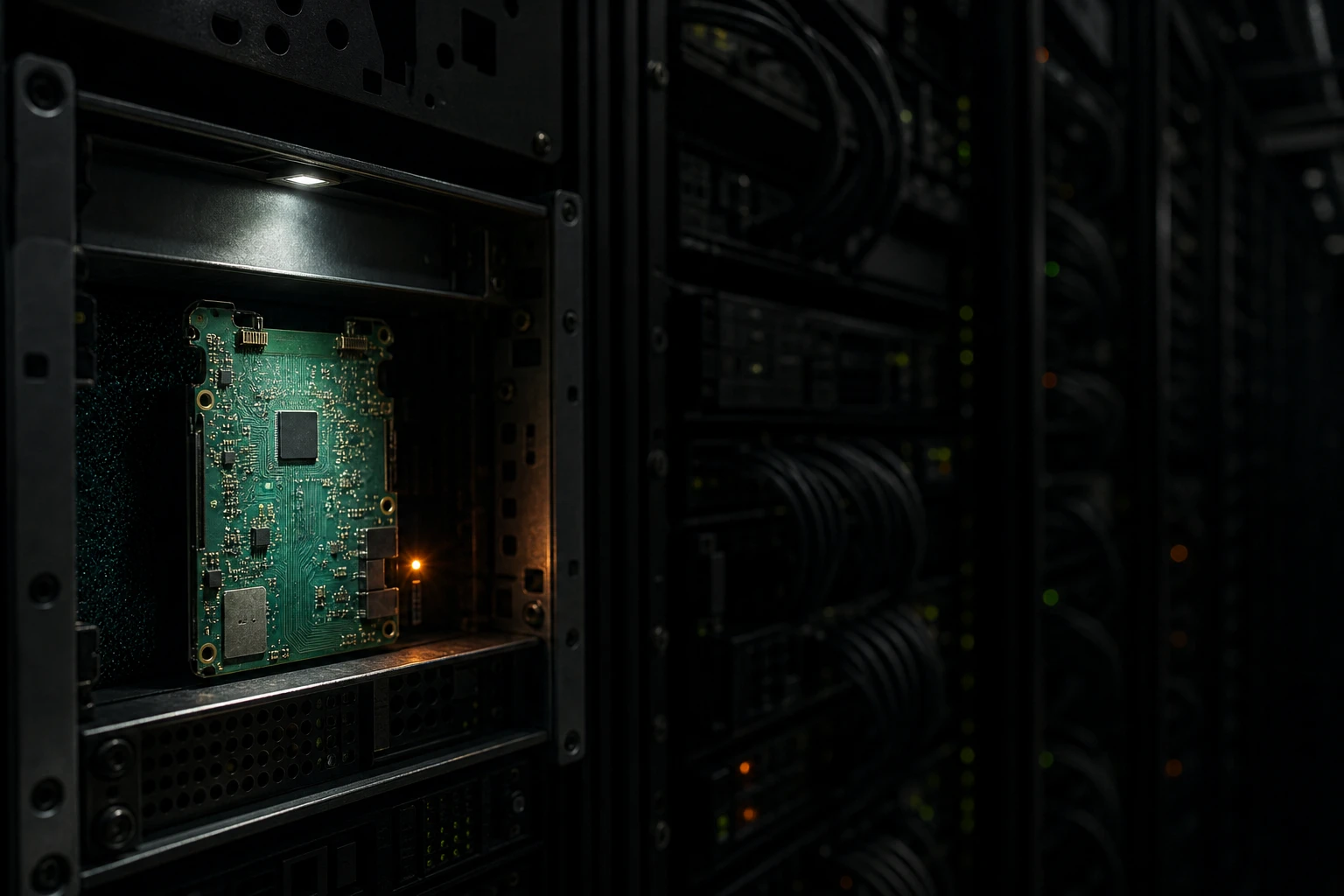
A Motherboard’s Outsized Carbon Bill
Embodied carbon is the emissions created by mining raw materials and manufacturing a device before it’s ever switched on. It sits opposite operational carbon, the emissions from the electricity a machine burns while running.
Data centers have made real progress on the operational side through efficiency gains and cleaner power contracts. Google’s researchers describe the manufacturing side as the tougher problem, since those emissions get locked in before a device ever ships.
People swap phones roughly every four years, often while the processor, memory, and storage inside are still fully functional. Multiply that churn across billions of devices worldwide, and the manufacturing bill adds up fast.
Billions of phones are discarded globally every year, many with perfectly usable processors still inside.
The broader e-waste numbers back that up. Global tracking has put annual e-waste generation at 62 million tons as of 2022, up sharply from a decade earlier, with only about a fifth of that volume properly collected or recycled.
Data centers generate a version of the same problem on their own hardware. The nonprofit Human-I-T has cataloged five limitations that block data center recycling from solving the problem on its own, from insufficient processing capacity to materials too degraded to reclaim.
Twenty Phones Already Beat Amazon’s Grading Backend
Google ran its own SPEC benchmarks, an industry-standard measure of processor speed, pitting a 2023 Pixel Fold against an ASUS RS720A-E11 rack server that can be configured with Nvidia H200 or RTX Pro 6000 GPUs and dual AMD EPYC processors.
The Register reported the fall deployment runs on that same Pixel Fold hardware, each board carrying a Tensor G2 chip. Google’s researchers wrote that “the single-threaded performance of modern smartphones’ performance processor cores is on-par with or better” than the multicore chips built into most servers.
The numbers hold up outside the lab, too. A pilot cluster of just 20 stripped phones already handles peak submission rates for a UCSD class of more than 75 students, with grading latency that beat the university’s default AWS backend in Google’s own tests.
Matching that throughput on Amazon’s cloud would take at least 50 separate t3.micro instances, based on the benchmark chart in Google’s research post.
| Metric | Retired Pixel Fold Motherboard | ASUS RS720A-E11 Server |
|---|---|---|
| Processor | Tensor G2: two 2.85GHz Cortex-X1, two 2.35GHz Cortex-A78, four 1.80GHz Cortex-A55 cores | Dual AMD EPYC CPUs, optionally paired with Nvidia H200 or RTX Pro 6000 GPUs |
| System Memory | 12GB | Data center-scale capacity spread across dozens of cores |
| Boards Needed for One Server-Equivalent | 25 to 50, per Google’s SPEC benchmarking | 1 (baseline unit) |
| Single-Core SPEC Result | Beat the baseline server core on most tests | Reference baseline |
The comparison lands as the cloud computing market keeps shifting under everyone’s feet. Meta has been pushing its own cloud business challenging AWS, Azure, and Google, and all three incumbents still bill by the instance-hour for exactly the kind of small, bursty jobs a phone cluster is designed to absorb.
Scaled up, the math gets more interesting. Google projects the full 2,000-phone build will deliver roughly 50 server-equivalents of compute and support a hundred classes running at once when it launches this fall.
Could This Ever Run Something Like Gemini?
No. Google has said plainly that phone cluster computing targets light, bursty jobs, not the GPU-heavy training runs behind models like Gemini. The 2,000-phone cluster is built for educational platforms, grading systems, cloud development environments, web services, and Jupyter notebooks, the workloads a university computer science department already runs in the cloud every semester.
The real money in computing is going somewhere else entirely. Industry estimates put global spending on AI infrastructure on pace to top $1 trillion this year, almost all of it aimed at the specialized GPUs a stripped phone motherboard simply can’t replace.
Deloitte’s 2026 hardware outlook frames that spending as pushing data centers toward hybrid, multi-tier computing, from dense GPU clusters down to device-edge inference on smartphones, PCs, and sensors, exactly the tier a phone cluster occupies.
Some of that AI buildout already looks shaky. Sightline Climate, a climate data research firm, estimates 30 to 50 percent of 2026 capacity stalling before it ever comes online this year.
A cluster of secondhand phones won’t close a gap that size on its own. It chips at the margins big buildouts tend to ignore.
The Four-Year Cycle That Keeps the Supply Coming
The idea traces back to one researcher’s side project.
The project was the brainchild of Jennifer Switzer, a former PhD student at UCSD.
Kastner told The Register. Switzer now works as a postdoctoral researcher at Google. Fellow UCSD professor Patrick Pannuto worked alongside her on the earliest prototypes, before Google brought in a third-party contractor to strip motherboards at the scale the fall deployment needs.
Kastner said the appeal comes down to workload shape. Function-as-a-service jobs, the small, on-demand tasks that spin up and disappear, tend to be sporadic and don’t need much high-performance compute, which makes them a natural fit for hardware nobody trusts with anything heavier.
None of this works without a steady supply of retired phones, and Google’s own product calendar keeps that supply moving.
The company just confirmed the Pixel 11 launch for August 12 as prices climb, the kind of release that nudges another wave of Pixel owners toward an upgrade, and their old phones toward a drawer, a resale listing, or now, potentially, a server rack.
UCSD isn’t the first group to test this instinct, either. Researchers have been stringing together ordinary hardware to mimic supercomputers since the Beowulf clusters of the 1990s, built from stacks of consumer PCs.
A more recent peer-reviewed study on repurposing discarded smartphones showed the hardware could be made reprogrammable for about 8 euros a unit, a fraction of a new server board’s cost, though at nowhere near 2,000-unit scale.
What Still Has to Survive Before Fall
The fall deployment carries a second job beyond serving classes: proving that consumer-grade hardware can survive the punishment of continuous data center duty, something no phone was ever engineered for.
What we know:
- Google’s SPEC benchmarks show 25 to 50 stripped boards matching one modern server on targeted workloads.
- A 20-phone pilot cluster has already handled peak submissions for a UCSD class of more than 75 students.
- The full 2,000-phone system has a Fall 2026 launch window, confirmed on Google’s research blog.
What’s unconfirmed:
- How long a stripped consumer motherboard lasts under years of continuous, data center-style load.
- Whether the model scales past one campus; Google has described it only as a research project, not a product.
- What the deployment costs in dollar terms. Google has said only that it comes at a fraction of a new server’s price.
Kastner said UCSD plans to make the finished cluster available to teams inside the university’s San Diego Supercomputing Center, folding a pile of retired Pixels into the same campus infrastructure that already runs some of the country’s heaviest research computing.


Stream Deck quietly owns desk productivity a decade later

Offline AI tool from Herts student reaches GBV teams in Gaza and Syria

AI revenue in media sits in yield and pacing not chatbots

OpenAI pauses frontier training as Astra hits cyber limits

AI Boss Luna Fired a Worker Only After Humans Reminded It

Quanta and Quantinuum Move Quantum Into the Factory

MLBB brings back optimized Jujutsu Kaisen skins for third run

Kazakhstan minerals force US hand in AI side-picking letter

Nintendo Unlocks 10 Free Pictonico Mini-Games Until Mid-September

Young adults dread AI job cuts while landing the $177k roles

Oracle Cuts 21,000 Jobs in a Year, Cites AI in 10-K Filing

Fable 5 and Mythos 5 Return as US Lifts Anthropic Export Controls

SpaceX’s Google Deal Turns a Rocket Company Into a Cloud Landlord

CD Projekt Red Co-CEO: Redemption Arc Isn’t Done, Witcher 4 in 2027

XPL Rallies 30% Ahead of Plasma One Card Tier Launch

Google Search Profiles Build a Follow Graph Inside Discover

DGO App Brings Rs 549 Mobile Pass for FIFA World Cup 2026 in Nepal

Moonshot AI Targets $30 Billion in China’s Fastest AI Funding Sprint

Oppo’s ColorOS 17 Eligibility List Leaves A-Series Buyers Behind

Microsoft Xbox Layoffs Start in July as Sharma Slams 3% Margin
-
 AI2 months ago
Oracle Cuts 21,000 Jobs in a Year, Cites AI in 10-K Filing
-
 AI2 months ago
Fable 5 and Mythos 5 Return as US Lifts Anthropic Export Controls
-
 AI2 months ago
SpaceX’s Google Deal Turns a Rocket Company Into a Cloud Landlord
-
 GAMING2 months ago
CD Projekt Red Co-CEO: Redemption Arc Isn’t Done, Witcher 4 in 2027
-
 CRYPTO2 months ago
XPL Rallies 30% Ahead of Plasma One Card Tier Launch
-
 NEWS2 months ago
Google Search Profiles Build a Follow Graph Inside Discover
-
 APPS2 months ago
DGO App Brings Rs 549 Mobile Pass for FIFA World Cup 2026 in Nepal
-
 AI2 months ago
Moonshot AI Targets $30 Billion in China’s Fastest AI Funding Sprint