
NEWS
St Albans Bridge Repaint Fight Exposes Network Rail’s Trust Problem
Network Rail repainted a St Albans rail bridge only after MP Daisy Cooper escalated a six-month dispute over paint to the transport secretary.

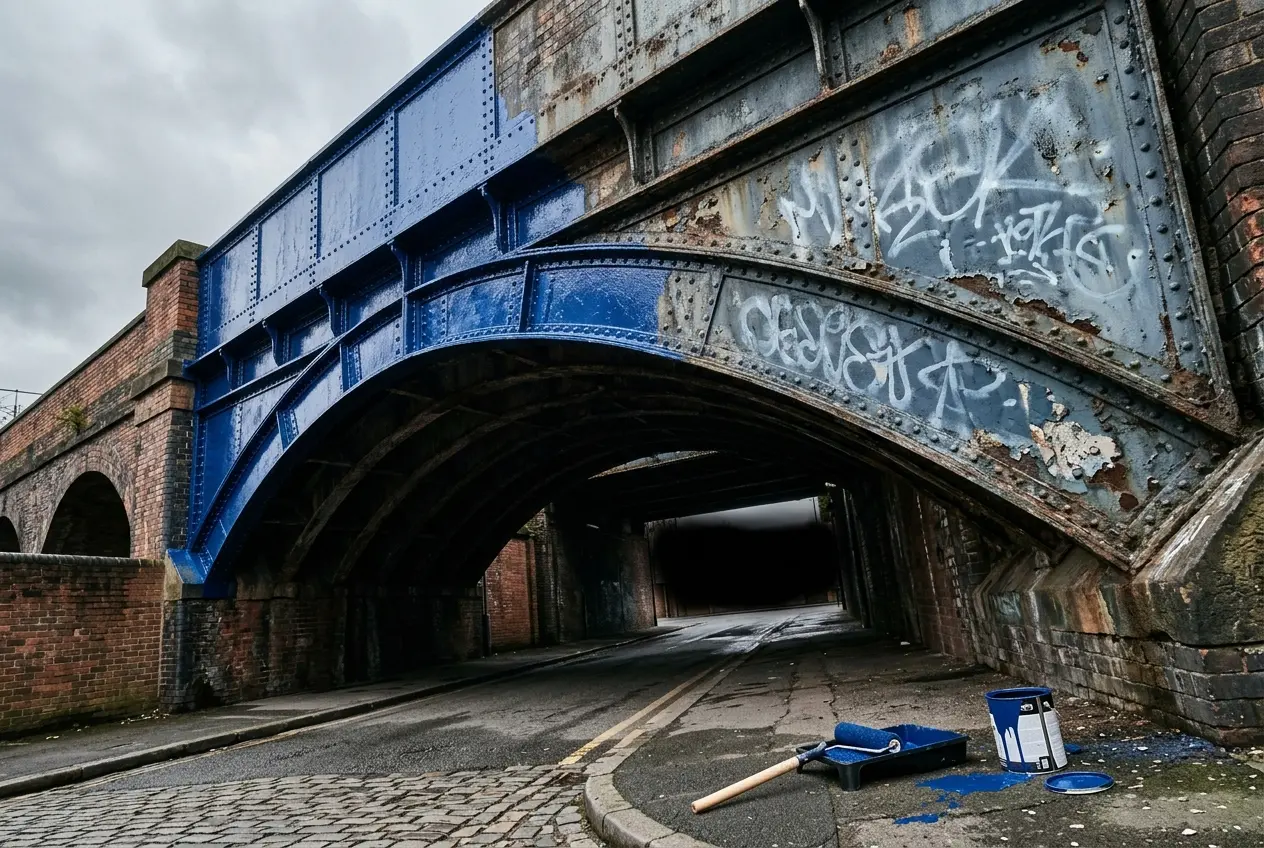
A rail bridge over St Albans City station has a fresh, even coat of blue paint. Getting it took six months, one botched graffiti cover-up, and a letter from a sitting MP to the Secretary of State for Transport.
Daisy Cooper, the Liberal Democrat MP for St Albans, forced Network Rail’s hand after the state-owned infrastructure company refused twice to fix a paint job it had already made worse. Her fight over a few square metres of steelwork lands the same year the industry’s own regulator says Network Rail is behind on structural safety checks across a network of 30,000 bridges, tunnels and viaducts.
Six Months, One Letter, One Coat of Paint
The bridge had been an eyesore for months. Network Rail, the state-owned company that owns and maintains most of Britain’s railway infrastructure, had covered graffiti on the span with paint that didn’t match the rest of the structure, leaving a patchy, mismatched surface at one of the main gateways into the city.
Sean Hughes, a newly elected councillor for St Peters, first flagged the problem to Cooper in January. The two later inspected the bridge together before the repainting finally happened.
Cooper called it “an absurd situation” that it took a Member of Parliament writing to a Secretary of State, one of the government’s most senior ministers, “to get a short rail bridge painted in a single shade of blue.”
Thankfully it’s all painted afresh now but as I said in my letter: is it any wonder that the public’s trust in politics is so low when it’s so hard to get a government owned agency to complete such a simple task.
Cooper wrote that line in her letter to the transport secretary, the escalation that finally got the job done after months of what she called a “computer says no” response from Network Rail.
Why Network Rail Said No First
Cooper first asked Network Rail to simply fix the mismatched paint job properly. The company said no. She then offered a compromise: let local volunteers repaint the bridge themselves if Network Rail supplied the paint. It said no to that too.
- Covered graffiti on the bridge with the wrong shade of blue, leaving a patchy, tatty finish.
- Declined to repaint it correctly, telling Cooper the agency was “not funded to carry out work on an aesthetic purpose.”
- Turned down a volunteer offer to do the repainting for free if Network Rail bought the paint.
Only after Cooper’s letter reached the transport secretary did Network Rail agree to send its own crews back out to finish the job right.
A Bigger Backlog Behind the Small Fix
Network Rail’s excuse, that a repaint fell outside its funding remit, lands awkwardly next to what its own regulator has been saying about structural upkeep more broadly. The Office of Rail and Road (ORR), the industry’s economic and safety regulator, published its most recent annual assessment of Network Rail covering 2024 to 2025.
It found problems that go well beyond paint. Network Rail has not delivered examinations and assessments of its structures, including bridges, in line with its own standards, the regulator said, and it escalated concerns after finding a backlog of structural assessments across the network. Left unaddressed, the ORR warned, that backlog risks undetected faults and safety hazards.
Money is part of the story. Network Rail is currently partway through Control Period 7, the five year funding cycle that runs to March 2029, under which it expects to receive £45.1 billion in total income, or roughly $57 billion at recent exchange rates.
| Funding Source | Amount (2024 to 2029) |
|---|---|
| UK Government grants | £27.4 billion |
| Scottish Government grants | £2.3 billion |
| Track access charges | £13.7 billion |
| Commercial activities | £1.7 billion |
| Total income | £45.1 billion |
Constrained funding means Network Rail is spending less on renewals and more on stopgap, life extending repairs this control period than in the last one, a shift the ORR says will shorten the expected lifespan of some assets.
Network Rail’s Own Review Called Its Practices Inflexible
The paint dispute also lines up with criticism Network Rail has aimed at itself. An independent study the company commissioned from consultancy Nichols compared its maintenance practices with other regulated industries, including water, aviation and energy.
The review found Network Rail lagged behind those sectors, particularly in how it deploys staff, and it was published under a headline Network Rail’s own media office used without flinching: the company was found guilty of restrictive and inflexible practices.
Andrew Haines, Network Rail’s chief executive, did not dispute the finding. “Britain deserves a railway maintenance regime that is modern and fit for the 21st century,” he said. “Obstructing vital changes that make the railway and its workers safer, and that improve the reliability of services we provide, is in no one’s interest.”
When an AI Hoax Moved Network Rail Faster Than an MP Could
Network Rail isn’t always slow. In December, a magnitude 3.3 earthquake shook Lancashire. Afterward, an image began circulating on social media showing the 179 year old Carlisle Rail Bridge with a section collapsed.
Rail officials treated it as real. They halted or delayed 32 services, a mix of passenger and freight trains, while crews were dispatched to inspect a structure that turned out to be completely undamaged, Futurism reported. The image had been generated by AI.
The hoax fits a wider pattern of synthetic images and video fooling people who should know better. A separate viral trailer clip mistaken for real footage made the rounds for similar reasons earlier this year. Network Rail can clearly move within hours when a threat looks urgent enough. A repaint request from a sitting MP took six months.
What’s Left to Fix Near the Station
The bridge itself is done, but the wider list of complaints Cooper and Hughes raised isn’t fully closed out.
- January: Sean Hughes raises the state of the bridge with Cooper after residents complain about the mismatched paint.
- Following months: Network Rail declines to repaint the bridge properly and turns down a volunteer offer to do it for free.
- Recent weeks: Cooper writes to the Secretary of State for Transport, calling out the delay directly.
- This month: Network Rail repaints the bridge, and Hertfordshire County Council confirms the road beneath it will be resurfaced.
Hughes welcomed the repaint but isn’t finished pushing. “It’s shocking that it took six whole months of back and forth for Network Rail to complete this quick and easy task,” he said, adding that he will keep pressing for repairs to broken railings near the bridge that haven’t been addressed yet.
Hertfordshire County Council has confirmed the resurfacing will go ahead this month, responding to Cooper’s separate calls for action on the road surface. The bridge remains one of the more visible entry points into St Albans, the kind of first impression visitors and local businesses notice whether or not anyone in government does.
Frequently Asked Questions
Is Network Rail a Government Agency or a Private Company?
Network Rail is a not-for-profit, arm’s length public body of the Department for Transport rather than a private company. It has no shareholders and reinvests its income into the railway, a structure that followed its reclassification as a public sector body in 2014.
How Many Bridges and Miles of Track Does Network Rail Maintain?
Network Rail owns and operates 20,000 miles of track and 30,000 structures, including bridges, tunnels and viaducts, across Britain. It directly runs 20 of the country’s largest stations, while more than 2,500 others are run by individual train operating companies.
What Is a Network Rail Control Period?
A Control Period is the five year window in which government ministers set out what they want Network Rail to achieve and how much public money is available for it. The Office of Rail and Road then turns those targets into a binding funding settlement. The current cycle, Control Period 7, runs from April 2024 to March 2029.


South Korea Retail Investors Face Reckoning After KOSPI AI Rally Collapses

Surrey AI Maps Three Heart Attack Paths and Their Molecular Roots

Germany Locks Neutral Apple ATT Prompts Across Most of Europe

Apple’s 5% EU Fee Quietly Rewrites Alternative App Store Math

Apple’s EU Fee Truce Cuts Complexity but Leaves Rivals Fuming

Pixel 11 Pro Fold Trades Thinness for Durability and Seven-Year Stay

Mayo AI Flags HCM Obstruction From Everyday Ultrasound Videos

Indian Brands Quietly Scale Landmark Screens and Home Tech

Navin Vatsa Turns Grief Into a Lifetime of Quiet Seeing

Google Bets Pixel 11 Agentic AI Will Redefine Phones

Oracle Cuts 21,000 Jobs in a Year, Cites AI in 10-K Filing

Fable 5 and Mythos 5 Return as US Lifts Anthropic Export Controls

SpaceX’s Google Deal Turns a Rocket Company Into a Cloud Landlord

CD Projekt Red Co-CEO: Redemption Arc Isn’t Done, Witcher 4 in 2027

XPL Rallies 30% Ahead of Plasma One Card Tier Launch

Google Search Profiles Build a Follow Graph Inside Discover

DGO App Brings Rs 549 Mobile Pass for FIFA World Cup 2026 in Nepal

Moonshot AI Targets $30 Billion in China’s Fastest AI Funding Sprint

Oppo’s ColorOS 17 Eligibility List Leaves A-Series Buyers Behind

Microsoft Xbox Layoffs Start in July as Sharma Slams 3% Margin
-
 AI2 months ago
Oracle Cuts 21,000 Jobs in a Year, Cites AI in 10-K Filing
-
 AI2 months ago
Fable 5 and Mythos 5 Return as US Lifts Anthropic Export Controls
-
 AI3 months ago
SpaceX’s Google Deal Turns a Rocket Company Into a Cloud Landlord
-
 GAMING2 months ago
CD Projekt Red Co-CEO: Redemption Arc Isn’t Done, Witcher 4 in 2027
-
 CRYPTO3 months ago
XPL Rallies 30% Ahead of Plasma One Card Tier Launch
-
 NEWS3 months ago
Google Search Profiles Build a Follow Graph Inside Discover
-
 APPS3 months ago
DGO App Brings Rs 549 Mobile Pass for FIFA World Cup 2026 in Nepal
-
 AI3 months ago
Moonshot AI Targets $30 Billion in China’s Fastest AI Funding Sprint