
AI
Google’s Veo AI Video Tools Threaten VFX Jobs Far Beyond Hollywood
Google’s Veo video generator can build a scored movie scene from one prompt, and the VFX workers with the least protection sit outside Hollywood’s unions.

Google’s Veo video generator can turn a single sentence into a fully scored, lip-synced movie scene. Hollywood’s visual effects workers are already counting what that costs in jobs. Los Angeles County has shed 41,000 entertainment jobs in three years.
That anxiety is now spreading past Hollywood’s union halls to visual effects hubs in India and South Korea, where workers face the heaviest exposure with no union behind them. Coverage of Veo 3 has largely tracked the fight between studios and unions in Los Angeles. The workers with the least leverage in that fight sit almost entirely outside it.
Flow Turns a Text Prompt into a Finished Scene
Veo 3 debuted at Google I/O in May 2025, generating eight-second clips with synchronized dialogue, sound effects, and ambient noise built directly into the model rather than added in post. Google DeepMind’s product page for the model highlights its handling of physics, realism, and prompt adherence, with every clip marked using the company’s SynthID watermarking system.
Veo 3.1 followed through late 2025 and into early 2026, adding vertical formats built for short-form platforms, an “ingredients to video” mode for blending reference images and characters, and higher-resolution output. Flow, the timeline-based interface built around the model, lets creators define recurring characters and environments across multiple linked shots.
Enterprise customers reach the same underlying model through Vertex AI, Google’s cloud platform, built for production pipelines that need to scale beyond a single creator’s account.
Los Angeles Already Lost 41,000 Jobs
The backlash against generative video did not start in a vacuum. That job count comes from Bureau of Labor Statistics data analyzed by the entertainment newsletter the Ankler, which put the loss at about a quarter of the county’s entertainment workforce. Production activity in Los Angeles has fallen to its lowest level since 1995, per CNBC.
“Right now, we’ve just come out of the worst year on record, excluding Covid, for on-location filming,” FilmLA president Paul Audley said this spring.
Entertainment attorney Jonathan Handel points to a longer list of causes than any single AI tool. “This industry has been battered by one shock after another. Construction, consolidation, cost cutting, cuts in content spending,” he told CNBC. “Everything is down by 25% to 35% compared to pre-COVID.”
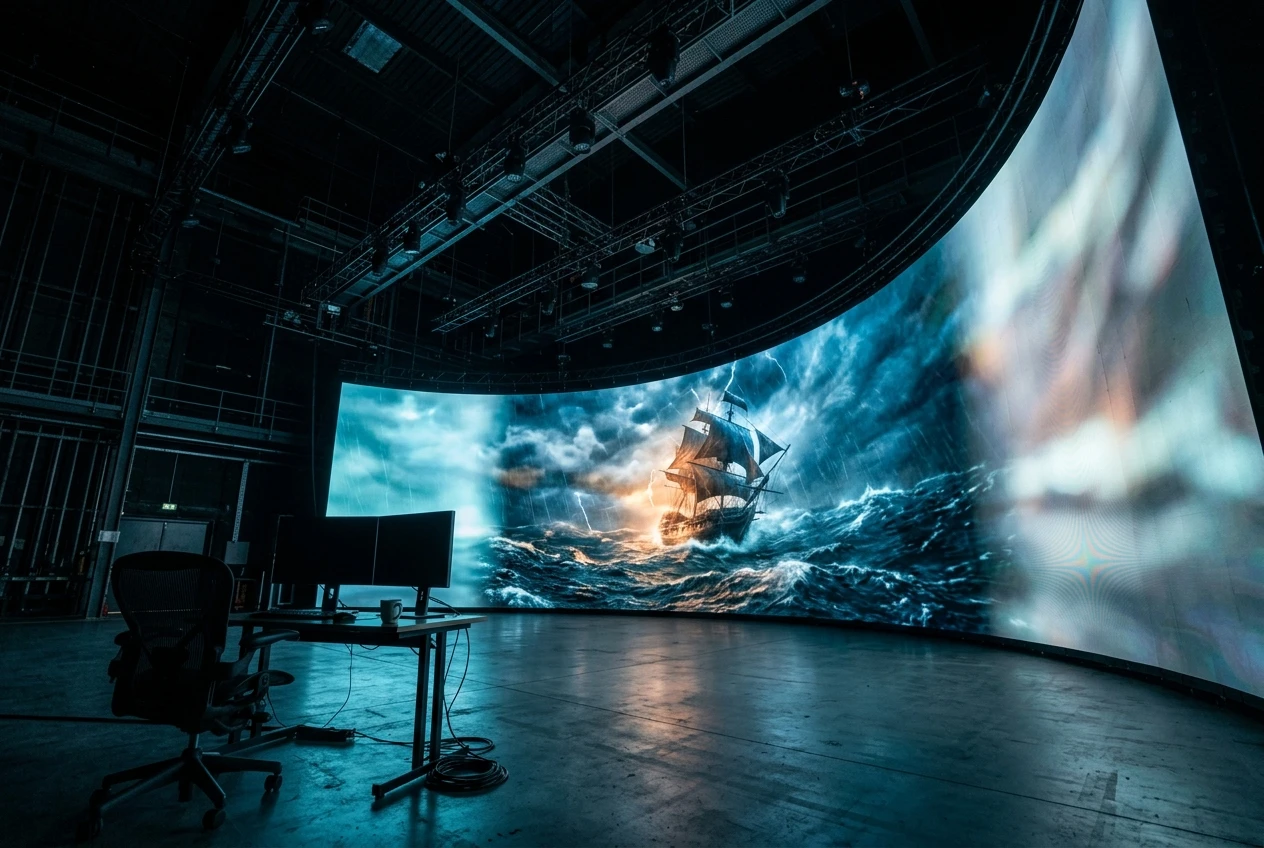
New entrants are betting AI accelerates the recovery. Innovative Dreams, a production startup backed by Amazon Web Services and the AI company Luma, combines a giant LED soundstage wall with tools including Luma’s own models, Google’s Nano Banana, and ByteDance’s SeeDream.
The combination compresses shoots that once took five or six weeks into a single week, according to CNBC. Luma itself is now valued at more than $4 billion.
Similar tension between AI investment and headcount already surfaced elsewhere in tech. Microsoft cut 4,800 jobs while pouring $2.5 billion into AI in the same stretch, the kind of pairing entertainment executives are now replicating.
The Workforce with No Seat at the Table
Netflix’s acquisition of Ben Affleck’s company, InterPositive, turned a shift already underway in visual effects work into a global conversation, according to Rest of World. Netflix has not said whether VFX studios and production houses in India, South Korea, or Latin America that currently work on its originals will qualify as “creative partners” with access to InterPositive’s tools.
Netflix said in a statement from chief product and technology officer Elizabeth Stone that its approach to AI is focused on “meaningfully serving the needs of the creative community.”
In the United States, studios are negotiating directly with the Screen Actors Guild-American Federation of Television and Radio Artists, the Writers Guild of America, and the International Alliance of Theatrical Stage Employees, with AI protections a central demand. Post-production workers across India, South Korea, and elsewhere, who serve many of the same studios and streamers, have no equivalent representation at the table.
If AI tools begin handling tasks like cleanup, relighting, or even base compositing, the biggest impact will be at that entry level.
Mohsin Kazi, a compositing supervisor at DNEG, the eight-time Oscar-winning effects house behind Dune, Interstellar, and Blade Runner 2049, told Rest of World that the earliest and lowest-paid rungs of the career ladder disappear first. “Those early-stage opportunities are where artists traditionally learn by doing,” he added.
Google is separately spending on India’s AI capacity in a different corner of its business. The company’s $15 billion Visakhapatnam hub now targets local server manufacturing, an investment in the same country whose VFX workforce faces some of the earliest exposure to automation, per consulting analysis of the sector.
Why Entry-Level Work Disappears First
Rotoscoping, paint work, and matchmove, the frame-by-frame cleanup jobs that isolate elements and track camera motion, are the tasks most likely to be automated within the next few years, according to consulting analysis of the VFX sector. These jobs are rules-based and repetitive, exactly the kind of pattern recognition generative models already handle well.
They are also concentrated in lower-cost labor markets. Studios in Los Angeles, Vancouver, and London increasingly find it just as efficient to run this work through an AI tool in house as to send it overseas. That shift closes off one of the main paths junior artists have used to enter the industry for two decades.
Roughly 75% of entertainment industry executives said generative AI tools had already contributed to eliminating, reducing, or consolidating jobs in their divisions, according to a study commissioned by the Animation Guild, the Concept Art Association, and other labor groups that surveyed 300 industry leaders.
Generalist artists at smaller studios sit on the other side of that shift. Off-the-shelf AI tools let a single generalist take on tasks, like advanced facial rigging or cloth simulation, that once required bringing in a dedicated specialist, giving small shops a way to compete for work that used to flow only to larger houses.
Which Jobs Are Most Exposed?
VFX artists, film editors, sound editors, and concept artists face the steepest exposure because generative video models already perform passable versions of their core tasks. Compensation across these roles runs roughly from $39,000 to $166,000 a year in the United States, and a third of entertainment executives expect AI to displace 3D modelers by the end of 2026, per a CVL Economics study.
| Role | Typical U.S. Salary Range | Most Exposed Task |
|---|---|---|
| VFX artists and animators | $57,000 to $166,000 (median $99,800) | Rotoscoping and 3D modeling |
| Film and video editors | $39,000 to $146,000 (median $70,980) | Rough-cut assembly |
| Sound editors | $66,000 to $150,000 | Foley and dialogue sync |
| Concept artists and illustrators | $50,000 to $120,000 | High-volume variant art |
The pattern already shows up in production budgets. A Variety survey found that 36% of film productions reported using AI tools to reduce staffing in pre-production and post-production phases in 2024, a share likely to climb now that rival tools from China and OpenAI have pushed video quality further. One analysis put the number of U.S. jobs across these salary bands at risk at 118,500.
The software and services built to do this work are growing fast in their own right. The AI-in-VFX market is on pace to reach $714.2 million in annual value by 2030, according to IndustryARC’s forecast, expanding at a 25% yearly clip from 2023.
Cameron’s Contradiction on Generative Effects
James Cameron sits on the board of the AI company Stability AI. He believes generative tools can help visual effects artists build bigger spectacles without losing their jobs to it, according to the Hollywood Reporter. He opened his own film, Avatar: Fire and Ash, with a title card stating that no generative AI was used in making it.
That split runs through the rest of the industry too. Some Hollywood creatives are now paid to train AI systems in their own specialties, hedging against the moment those systems take over their work, the Hollywood Reporter has reported.
Others are simply watching rival tools crowd into the space Google occupied first. A Chinese tool called Seedance 2.0, built by ByteDance, produced viral clips this year using the likenesses of Brad Pitt and Tom Cruise, prompting Disney and Paramount to accuse ByteDance of copyright infringement, according to Metaintro. Google’s own rules already block generating real public figures without consent, but rival tools are not bound by them.
Contract Talks Will Decide the Rules for AI Replicas
The Screen Actors Guild-American Federation of Television and Radio Artists represents roughly 160,000 actors, voice performers, and broadcast journalists. Its 2023 strike secured the first AI protections, and studios are now negotiating an expanded version of those rules in 2026. The current contract already bars studios from creating or reusing a digital replica of a performer, whether a face swap, voice clone, or full-body double, without informed consent.
Those rules rest on four ideas the union calls its pillars.
- Transparency – the right for a performer to know when their likeness is used
- Consent – the right to approve each specific use in advance
- Compensation – the right to be paid for every use
- Control – the right to set limits on how long and how a likeness can appear
None of those four protections extend to a compositor in Mumbai or a rotoscope artist in Seoul. Whatever the 2026 negotiations settle for performers and crews in Los Angeles, the workers processing the same footage overseas will still be negotiating from nothing.
Frequently Asked Questions
What Is Google Flow?
Flow is Google’s dedicated interface for working with Veo, described by the company as an “AI filmmaking tool built for creatives, by creatives.” It sits alongside the Gemini app and Vertex AI as one of three main routes into the underlying model, and it is the only one of the three built specifically around a production timeline.
How Much Does Veo 3 Cost?
Flow and Veo 3 are available in the United States through two Google subscription tiers. The AI Pro plan includes 100 video generations a month. The pricier AI Ultra plan, priced at $249 a month, adds higher usage limits and earlier access to native audio, according to eWeek. Developers can also reach the model through Google’s AI Studio, pitched as the fastest path from prompt to production.
Will AI Completely Replace VFX Jobs?
Full replacement remains limited for now. Veo 3 still struggles to hold consistent lighting, character detail, and continuity across multiple linked scenes, a gap several early reviewers flagged as its clearest limitation next to full production pipelines.
Which VFX Roles Are Safest from Automation?
Senior supervisory and complex simulation work face less pressure than entry-level cleanup tasks right now. Consulting analysis of the sector notes that large studios keep pushing the complexity and scale of their highest-end work even as routine tasks move to automation, sustaining demand for specialists who handle that top tier of difficulty.
Do Overseas VFX Workers Have Any AI Protections?
Formal protections remain limited outside the United States. SAG-AFTRA, the WGA, and IATSE are negotiating AI rules for American performers and crews through 2026, but VFX studios in India, South Korea, and Latin America currently bargain without that kind of union leverage. Some governments are weighing disclosure rules for synthetic media instead, a separate track from any labor contract, though enforcement remains uneven.


AMD’s Data Center Revenue Jumps 57% as Its Stock Bets on Execution

Microsoft Loses an Xbox Lawsuit Just as Sony Kills Physical Discs

Bethesda Union Says HR Tore Down Its Memorial for Laid-Off Staff

Google Pixel 11 Pro Fold Price Leaks Point Toward a $2,000 Foldable

Smart Scales Promise Lab-Grade Body Fat Numbers, and the Science Pushes Back

Amap’s Ride-Hailing Hits 1,000 Cities Amid Security Warnings

Ulys’s Automatic Toll Billing Draws Scammers to 7 Million Drivers

Google’s Veo AI Video Tools Threaten VFX Jobs Far Beyond Hollywood

Music Industry Unveils AI Labels, but Streaming Giants Haven’t Signed On

Apple Sues OpenAI and Two Ex-Employees Over Stolen Trade Secrets

Microsoft Xbox Layoffs Start in July as Sharma Slams 3% Margin

Google Search Profiles Build a Follow Graph Inside Discover

Oppo’s ColorOS 17 Eligibility List Leaves A-Series Buyers Behind

Oracle Cuts 21,000 Jobs in a Year, Cites AI in 10-K Filing

Google DeepMind and A24 Sign $75 Million AI Partnership Deal

OCC Issues AML Consent Order Against Wise and Crypto.com Sponsor Bank

DGO App Brings Rs 549 Mobile Pass for FIFA World Cup 2026 in Nepal

Anthropic Tells Senators Alibaba Ran the Largest Claude Distillation Attack

Apple Strikes Preliminary Deal For Intel To Make iPhone And Mac Chips

Google Home Spring Update Adds Gemini 3.1 And Old Nest Cam AI
-
 GAMING1 month ago
Microsoft Xbox Layoffs Start in July as Sharma Slams 3% Margin
-
 NEWS1 month ago
Google Search Profiles Build a Follow Graph Inside Discover
-
 NEWS1 month ago
Oppo’s ColorOS 17 Eligibility List Leaves A-Series Buyers Behind
-
 AI3 weeks ago
Oracle Cuts 21,000 Jobs in a Year, Cites AI in 10-K Filing
-
 AI3 weeks ago
Google DeepMind and A24 Sign $75 Million AI Partnership Deal
-
 CRYPTO2 months ago
OCC Issues AML Consent Order Against Wise and Crypto.com Sponsor Bank
-
 APPS1 month ago
DGO App Brings Rs 549 Mobile Pass for FIFA World Cup 2026 in Nepal
-
 AI2 weeks ago
Anthropic Tells Senators Alibaba Ran the Largest Claude Distillation Attack