
AI
NotebookLM Becomes Gemini Notebook, and Its New Power Has a Catch
Google renamed NotebookLM to Gemini Notebook on July 16, adding code execution for Pro users and raising new trust questions for educators.

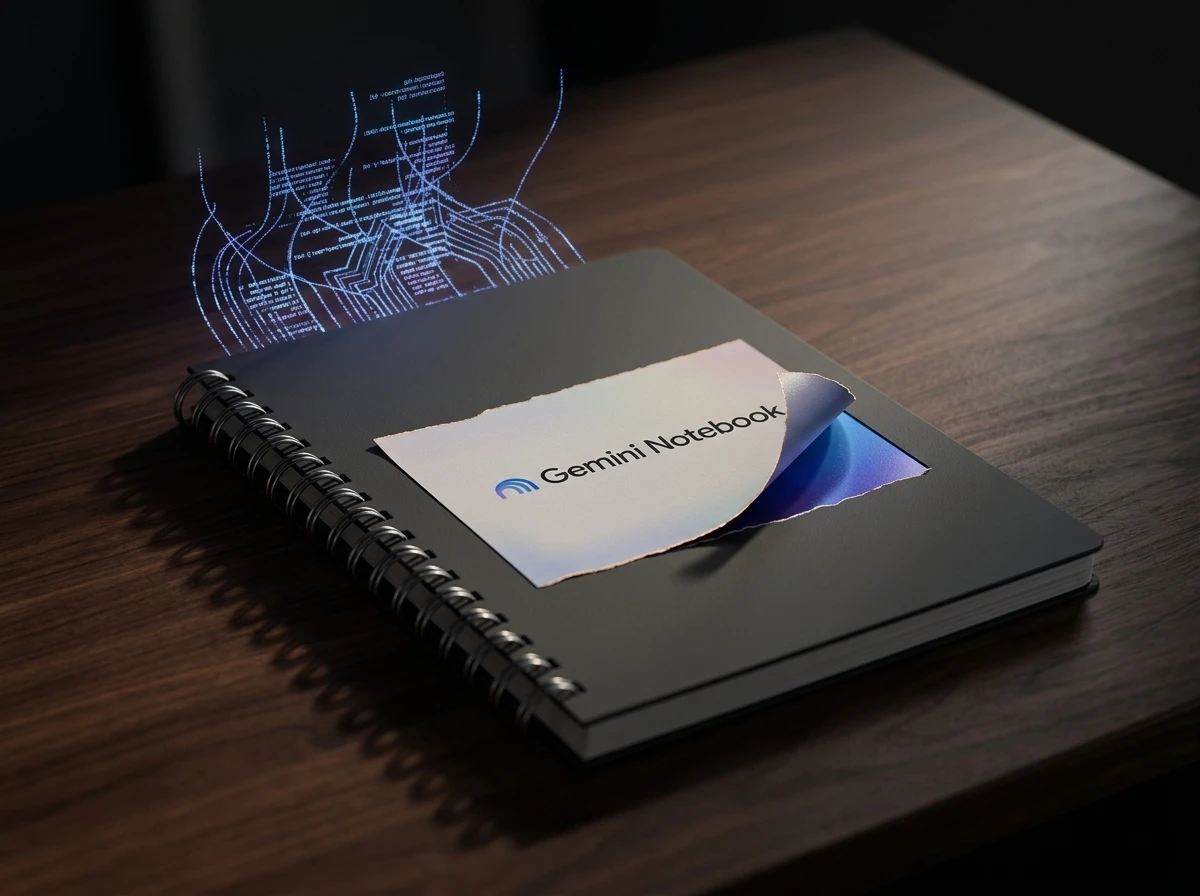
Google renamed its NotebookLM research assistant Gemini Notebook on July 16, folding one of its most popular standalone AI products deeper into the Gemini brand. The change brings a new blue-purple gradient logo and gives every notebook a secure cloud computer that can write and run its own code against a user’s files.
Josh Woodward, vice president of Google Labs, the Gemini app, and AI Studio, announced the change in a company blog post. The tool built its following on refusing to guess past its own sources, and the feature that just went wide asks users to trust it with far more than a citation.
A Blue-Purple Gradient Replaces the “LM”
Google says the app underneath has not changed, just its name and its coat of paint. The research tool now serves more than 30 million people and 600,000 organizations, a scale it built almost entirely under the NotebookLM name before retiring it this week.
- New identity – the app swaps its wordmark and icon for Google’s blue-to-purple Gemini gradient across every surface.
- Automatic redirects – existing shared notebook links and URLs point to the new name without any action from admins or end users.
- Live cross-app sync – notebooks created inside the Gemini app already sync fully with the standalone Gemini Notebook experience.
- A Search tie-in still pending – Google says notebooks are coming to AI Mode inside Google Search, with no firm date attached.
Mobile users may need to update their apps before the new branding shows up, according to Tech Times’ rundown of the announcement.
From Project Tailwind to a Rebrand Three Years Later
The product has worn three names in three years, and each change tracked a real jump in capability.
- May 2023: Google unveils the tool at I/O as Project Tailwind, an experiment meant to help people learn from their own documents.
- 2024: Google rebrands it NotebookLM and drops its experimental tag that October, treating it as a stable product.
- December 2024: A paid tier, NotebookLM Plus, launches for enterprise and Workspace customers.
- February 2025: NotebookLM Plus opens to individual subscribers through the Google One AI Premium plan.
- June 8, 2026: Google overhauls the architecture, moving from Gemini 1.5 to Gemini 3.5 and wiring in Antigravity, the agentic orchestration system Google introduced at I/O 2026, along with a secure cloud computer for every notebook.
- July 16, 2026: The product becomes Gemini Notebook, and the June upgrade starts reaching AI Pro subscribers.
Tech Times summed up what the architecture shift actually changed: “It could tell you what a spreadsheet said; it could not compute on the spreadsheet.” Google’s own cloud documentation describes the infrastructure behind that shift, noting that sandboxes spin up and execute code in under a second.
Three Different Surfaces Now Share One Name
The rename does not erase the confusion it was supposed to fix. Google’s Gemini app has had its own Notebooks feature since April, for organizing chats and long-running projects. That feature syncs with the standalone Gemini Notebook app, but it is not the same product.
“One is a chat-organization feature inside a general assistant; the other is a standalone document-analysis and code-execution environment,” Tech Times explained in its breakdown of Thursday’s announcement.
Even the parts that sync are not identical. Video overviews still require the standalone Gemini Notebook app even for a project started inside Gemini, Android Authority noted. Add notebooks heading to AI Mode in Search on top of that, and several outlets covering the announcement counted three overlapping surfaces carrying some version of the same name.
Does Letting the AI Write Its Own Code Undercut the Pitch?
Gemini Notebook’s appeal always rested on refusing to guess. Every answer traced back to a cited source, and the tool would say so when it couldn’t find one. Native code execution changes that contract. The tool can now choose a method, write the code, run it and explain the result, all before a user sees a single line of it.
Mahnoor Faisal, a technology journalist who covers AI and productivity tools, called the rename her biggest disappointment yet from the product. Of its original design, she wrote that it “won’t guess, it won’t reach for the web.” Folding the app into a brand built for open-ended chat, she argued, blurs exactly what made it different.
Dan Fitzpatrick, a Forbes contributor who runs AI training workshops for educators, raised a sharper concern about the code-execution feature itself. If the notebook chooses the method, writes the code and explains the result, he asked, “what exactly has the student learned?”
He pointed to research on code generated by six different language models that found errors stretching across several lines and needing substantial repair, some of it in programs that still ran without crashing. A convincing chart, he wrote, can hide a bad decision about missing data or a wrong method entirely, especially for someone who never looks at the underlying code.
The risk lands on a population already deep into AI use. The Higher Education Policy Institute (HEPI, a UK think tank) surveyed full-time undergraduates in late 2025 and found:
- 1,054 students took part in the survey, all full-time undergraduates in the UK.
- 95% had used AI in some form, and 94% had used generative AI for assessed work.
- Fewer than half felt their teaching staff were helping them build the AI skills their careers will need.
“AI literacy and capability must be embedded across the curriculum,” said Charlotte Armstrong, HEPI’s policy manager.
Who Gets the Cloud Computer First
Code execution has existed inside Gemini Notebook since June 8, but only for subscribers willing to pay for Google’s top tier. That is changing, gradually.
| Tier | Code Execution Access | Monthly Price |
|---|---|---|
| Google AI Ultra | Live now | $99.99, per Technobezz |
| Workspace (AI Ultra / AI Expanded Access) | Live now | Included in business plan |
| Google AI Pro | Rolling out on the web over the coming weeks | $19.99, per Technobezz |
| Free tier | No timeline announced | $0 |
Google has not said when, or whether, free-tier users will get access to the feature. For now, the free version gets the rename and the new logo. The code stays behind a paywall.
A Crowded Race to Own the Research Workspace
Google is not folding NotebookLM into Gemini purely for tidiness. OpenAI, Anthropic, Microsoft and Perplexity are each building their own version of a workspace that reads files, remembers context and increasingly acts on both. Whoever owns that layer shapes how millions of people gather information and finish work, not just how they chat.
Search is the next battleground. Google plans to bring Gemini Notebook directly into AI Mode, the conversational layer inside Google Search, though the company has not said when that will ship.
Google has committed to weeks for the Pro rollout. It has offered no timeline at all for Search.
Frequently Asked Questions
Is NotebookLM Still Around?
NotebookLM did not disappear. Google renamed it Gemini Notebook on July 16, 2026, keeping the same account, notebooks and sources intact. Existing shared links and URLs redirect automatically, and Google has said no one needs to take any action to keep using their existing notebooks.
What’s the Difference Between Gemini Notebook and Gemini’s Notebooks Feature?
The Gemini app’s Notebooks feature organizes chats and ongoing projects inside the general assistant, while Gemini Notebook is the standalone research app with document analysis and code execution. The two sync, but certain features, including video overviews, still only work inside the standalone Gemini Notebook app.
Who Can Use the Code Execution Feature Right Now?
Google AI Ultra subscribers and Workspace business customers with AI Ultra Access or AI Expanded Access already have it. Google AI Pro subscribers get it on the web over the coming weeks, and Google has not said whether or when the free tier will receive the feature.
Does Gemini Notebook Still Only Use My Own Sources?
Yes. Grounding responses exclusively in a user’s uploaded material, rather than pulling from the open web, remains the product’s core design even with code execution added. The tool is still built to say when a question falls outside a notebook’s sources rather than filling the gap with outside information.
When Will Gemini Notebook Work Inside Google Search?
Google says notebooks are coming to AI Mode inside Google Search, but the company has not attached a date to that rollout. Full cross-app sync already works between the Gemini app and the standalone Gemini Notebook experience, so Search would become the third surface to carry notebooks once it ships.
What Does the New Cloud Computer Do?
It gives each notebook a sandboxed, isolated environment that can write and run Python code against a user’s uploaded documents, producing charts, spreadsheets, slide decks and other structured output the old NotebookLM could only describe in text. The sandbox supports a library of more than 100 curated software skills.


Workers Still Trust Judgment Over the AI Tools They Use

DigitalOcean’s $894 Million Backlog Rewrites the Old Cloud

Companies Froze Job Design and Called AI a People Problem

AI Capex Looks Unique Because the Chips Wear Out

Samsung Medison’s HERA Z10 Aims at the Sonographer Shortage

GPT-6 Astra Ships as OpenAI’s First Critical Cyber Model

Palms Sells Clean Air Without Ending Casino Smoking

OnlyFans Promo Bots on X Now Pass the Humanity Tests

Datamaran Drops the ESG Label After Winning the Argument

Xiaomi’s Own Chip Lands While Apple Argues Over Color

Oracle Cuts 21,000 Jobs in a Year, Cites AI in 10-K Filing

Fable 5 and Mythos 5 Return as US Lifts Anthropic Export Controls

SpaceX’s Google Deal Turns a Rocket Company Into a Cloud Landlord

CD Projekt Red Co-CEO: Redemption Arc Isn’t Done, Witcher 4 in 2027

XPL Rallies 30% Ahead of Plasma One Card Tier Launch

Google Search Profiles Build a Follow Graph Inside Discover

DGO App Brings Rs 549 Mobile Pass for FIFA World Cup 2026 in Nepal

Moonshot AI Targets $30 Billion in China’s Fastest AI Funding Sprint

Oppo’s ColorOS 17 Eligibility List Leaves A-Series Buyers Behind

Microsoft Xbox Layoffs Start in July as Sharma Slams 3% Margin
-
 AI3 months ago
Oracle Cuts 21,000 Jobs in a Year, Cites AI in 10-K Filing
-
 AI2 months ago
Fable 5 and Mythos 5 Return as US Lifts Anthropic Export Controls
-
 AI3 months ago
SpaceX’s Google Deal Turns a Rocket Company Into a Cloud Landlord
-
 GAMING3 months ago
CD Projekt Red Co-CEO: Redemption Arc Isn’t Done, Witcher 4 in 2027
-
 CRYPTO3 months ago
XPL Rallies 30% Ahead of Plasma One Card Tier Launch
-
 NEWS3 months ago
Google Search Profiles Build a Follow Graph Inside Discover
-
 APPS3 months ago
DGO App Brings Rs 549 Mobile Pass for FIFA World Cup 2026 in Nepal
-
 AI3 months ago
Moonshot AI Targets $30 Billion in China’s Fastest AI Funding Sprint