
AI
Microsoft Copilot Super App Collapses Tools Into One Agent Home
Nadella confirms Copilot super app this quarter uniting chat, Cowork, Code and Autopilots as Microsoft turns 30 million seats into a single agent runtime.

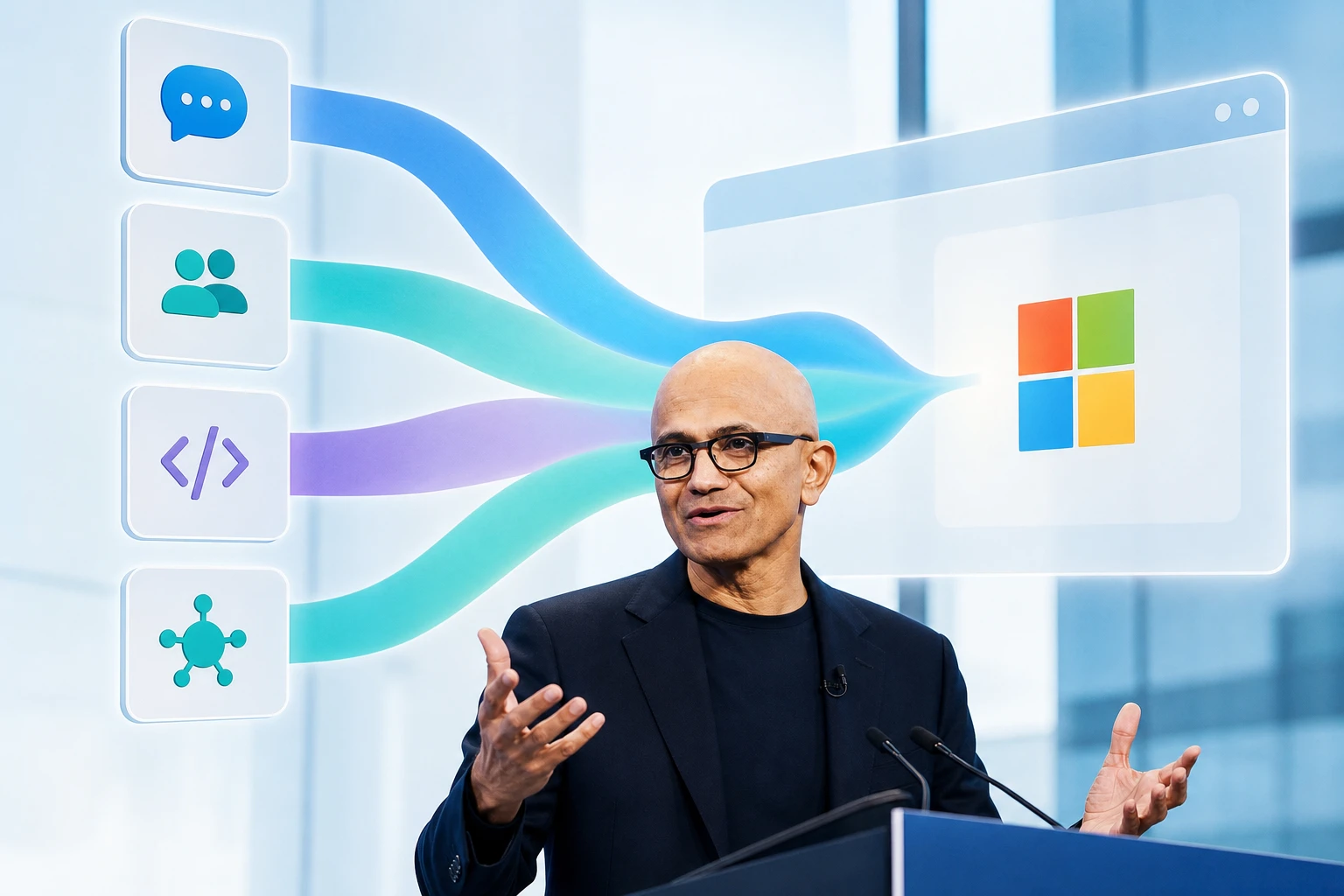
Microsoft will ship a Copilot “super app” this quarter that folds its chatbot, Cowork multi-step workflows, Code tools and Autopilots into one experience spanning consumer and commercial use, CEO Satya Nadella said on the company’s fiscal 2026 fourth-quarter earnings call.
The move answers years of scattered Copilot surfaces that left many users hopping between apps and left paid penetration low. It also arrives as OpenAI and Anthropic push their own all-in-one work agents.
What Lands Inside the New Copilot Container
Nadella described the product as the place where chat, Cowork, Autopilots and Code come together. Fortune first reported the internal effort in May under the slogan “Delivering one Copilot,” led by Jacob Andreou after Microsoft unified its consumer and commercial Copilot teams.
According to that reporting and Nadella’s confirmation, the app is meant to serve as a single destination rather than another silo. Users should still reach the same tools from Windows, Office and other entry points, with a possible toggle between personal and Microsoft 365 enterprise accounts.
- Chat remains the conversational front door for questions, summaries and creation.
- Cowork handles multi-step tasks grounded in work data under enterprise controls; it reached general availability in June 2026.
- Code brings GitHub Copilot-style coding, review and debugging into the same surface.
- Autopilots are the new long-running autonomous agents, including an always-on personal agent, that keep working with full compliance.
The second-order change is not the UI polish. It is the shared container that can hold long-running task state, tool permissions and Microsoft-graph context instead of resetting every time a user switches apps.
Thirty Million Seats and Doubled Satisfaction Scores
Microsoft now has over 30 million paid Microsoft 365 Copilot seats, with net seat adds more than doubling quarter-over-quarter. User satisfaction scores have doubled over the last three quarters and sit at an all-time high. Conversations per user nearly doubled year-over-year. Average weekly engagement now matches Outlook and Teams.
The time from deployment to high usage (monthly active use above 80 percent of a customer’s base) has fallen from months to days. Customers with more than 50,000 seats rose over 7X year-over-year. Large wins include NHS England rolling out to 505,000 clinicians after a trial that saved 43 minutes per day on average, plus big commits from KPMG, HSBC, EY’s 400,000-seat E7 deal and dozens of other enterprises buying 60,000-plus seats.
Those figures sit against an earlier reality Fortune cited: less than 4.5 percent of roughly 450 million Microsoft 365 commercial seats paid for Copilot features. Fragmentation and uneven quality had limited the upsell. The super app is the product response.
| Metric | Latest figure | Trend noted |
|---|---|---|
| Paid M365 Copilot seats | Over 30 million | Net adds more than doubled QoQ |
| User satisfaction | Doubled in three quarters | All-time high |
| Conversations per user | Nearly doubled YoY | Usage intensity record |
| Weekly engagement | On par with Outlook and Teams | Habit formation signal |
| Customers >50k seats | Up over 7X YoY | Enterprise depth |
Latency also dropped 25 percent this quarter alone. Microsoft is pairing the product push with a shift toward per-seat-plus-consumption pricing and the new E7 suite that bundles Copilot with E5, Entra and Agent 365.
OpenAI and Anthropic Already Moved First
OpenAI recently introduced ChatGPT Work as its own super-app style offering. Anthropic’s Claude Cowork likewise combines advanced agent tools with its chatbot and can act on local files. Many AI companies now treat the all-encompassing work surface as the next interface layer after pure chat.
Microsoft’s counter is Work IQ grounding plus native Microsoft 365 integration and governance. Its own comparison materials stress that Copilot Cowork enterprise security comparison runs inside protected cloud boundaries, enforces Purview policies, and completes actions across Outlook, Teams, Excel and PowerPoint without dumping files locally the way Claude Cowork can.
| Capability | Microsoft Copilot Super App direction | ChatGPT Work / Claude Cowork notes |
|---|---|---|
| Core surfaces | Chat + Cowork + Code + Autopilots | Chat + agent/work modes + coding tools |
| Enterprise data grounding | Work IQ across M365 graph | Connectors; less native depth claimed by MS |
| Long-running agents | Autopilots with compliance | Agentic workflows, varying governance |
| Security model | Inherits M365 permissions and DLP | Separate or local-file risk profiles |
| Account span | Consumer + commercial toggle planned | Primarily consumer or enterprise tiers |
After the Nadella earnings call transcript remarks, the company framed the super app as “a major step forward.” Details beyond the high-level bundle remain forthcoming.
Windows Users Already Forced One Retreat
The super app lands after a stretch of pushback against AI surfaces that felt forced into Windows 11. Earlier in 2026 Microsoft scaled back certain Copilot integrations, removed the assistant from less useful locations in April, and rethought broader AI ambitions in the OS after user dissatisfaction and privacy concerns around features such as Recall.
Nadella still pointed to doubled satisfaction and engagement parity with core apps. The bet is that a dedicated, optional-feeling super app will feel more like a destination users choose than another icon that appears uninvited in File Explorer or Notepad. If the app ships as part of Windows 11, it could arrive without a separate download, which will test that theory quickly.
Crowd reaction on X has split between excitement for a true command center and residual skepticism that Copilot still under-delivers relative to the hype. One sharp observation circulating is that the real upgrade is the container itself: once long-running agents and tool permissions live in one place, “do this for me” becomes a standardized contract across Windows, Office and line-of-business systems.
Autopilots Turn Agents Into Background Workers
Last month Microsoft made Cowork generally available so customers could complete multi-step tasks against work data while staying inside security and compliance boundaries. This quarter it introduced Autopilots: autonomous, long-running agents with full enterprise compliance, including an always-on personal agent.
Microsoft MVP Josh Cook sketched the lanes cleanly after earlier reports: chat for ask-and-create, Cowork for delegated real work, Code for build-review-debug, and Autopilots for background agents that keep moving with their own identity. The whole game, he noted, is context across people, files, meetings, email, apps and systems.
Copilot is evolving rapidly, from chat to Cowork to Autopilots. And this quarter we will bring these Copilot experiences together, including Code, in one “super app” spanning both consumer and commercial experiences. This is a major step forward, and I look forward to sharing more soon.
Nadella said that on the July 29 call. The company also highlighted Agent 365 as a control plane that already has nearly 40 million agents registered across tens of thousands of companies just two months in. The super app becomes the human-facing front end for that agent fleet.
For students and lighter users already stacking multiple AI study tools, a single Microsoft surface that can switch personal and school or work contexts could reduce the tool sprawl that currently forces constant copy-paste and context loss.
Personal and Work Accounts Share One Roof
Fortune’s sources said the design includes a toggle so a user can move between personal Copilot and enterprise Microsoft 365 Copilot without leaving the app. That is a practical fix for the split personality Microsoft itself created by running separate consumer and commercial teams for years.
It also raises familiar questions about data boundaries, memory and which model family handles which request. Microsoft now emphasizes multi-model choice (OpenAI, Anthropic, Mistral, xAI and its own MAI models) and a harness that keeps context and action space separate from any single model. The super app is where that system meets the end user.
On the commercial side the company is seeing the E7 suite take hold quickly, with hundreds of enterprises already buying millions of seats. The super app gives those seats a clearer flagship surface while the underlying Azure, Foundry and Fabric layers keep feeding agents real-time data and memory.
Microsoft’s broader fiscal 2026 numbers underscore the room to run: annual revenue topped $331 billion, Microsoft Cloud passed $214 billion, and Azure crossed $100 billion. The Microsoft FY26 earnings and cash position give the company capital to keep iterating the agent stack even if early super-app reviews are mixed.
What Users Will See This Quarter
Nadella promised more details soon. The public timeline is simply “this quarter.” Earlier Fortune reporting had targeted end of summer 2026; the earnings confirmation compresses that window. Expect a progressive rollout that first unifies the existing Copilot app experiences, then layers deeper Autopilot capabilities and the personal-commercial toggle.
Cowork general availability notes already show new models, image generation, browser use and consumption billing. Those pieces will likely surface inside the super app rather than remaining separate destinations.
For Windows users the practical test is whether the super app reduces the feeling of AI creep or simply concentrates it. For IT the test is whether one governed surface plus Agent 365 finally makes seat-wide deployment the default instead of the exception. For Microsoft the test is whether doubled satisfaction and Outlook-level engagement hold once the product is no longer a collection of features but a single place people open every day.
The container is the product. Everything else is a tab inside it.


Scale AI Names Google Cloud Veteran deSouza CEO for Enterprise Push

Epic Store Hits Brazilian iPhones Amid Apple’s Familiar Friction Play

LORDNINE Helena Server Races Players Toward Real USDT Rewards

Perplexity Numbat Makes Coding Agents Auditable Endpoints

Gemini Setup Assistant Turns Android Onboarding Into a Live Funnel

Huawei’s Active Cooling Plan Could Quietly Reset Mid-Range Phones

Pixel 11 Pro Fold Thins Out While Rivals Go Wider and Lighter

Hanwha Life Turns IOI Gold into Its AI Talent Pipeline

Zuckerberg Rails at AI Centralization While Meta Sells Closed Models

Nothing Phone 4a Price Hike Hits Buyers as Memory Costs Climb

Fable 5 and Mythos 5 Return as US Lifts Anthropic Export Controls

SpaceX’s Google Deal Turns a Rocket Company Into a Cloud Landlord

Oracle Cuts 21,000 Jobs in a Year, Cites AI in 10-K Filing

CD Projekt Red Co-CEO: Redemption Arc Isn’t Done, Witcher 4 in 2027

XPL Rallies 30% Ahead of Plasma One Card Tier Launch

DGO App Brings Rs 549 Mobile Pass for FIFA World Cup 2026 in Nepal

Google Search Profiles Build a Follow Graph Inside Discover

Moonshot AI Targets $30 Billion in China’s Fastest AI Funding Sprint

Microsoft Xbox Layoffs Start in July as Sharma Slams 3% Margin

Oppo’s ColorOS 17 Eligibility List Leaves A-Series Buyers Behind
-
 AI1 month ago
Fable 5 and Mythos 5 Return as US Lifts Anthropic Export Controls
-
 AI2 months ago
SpaceX’s Google Deal Turns a Rocket Company Into a Cloud Landlord
-
 AI1 month ago
Oracle Cuts 21,000 Jobs in a Year, Cites AI in 10-K Filing
-
 GAMING1 month ago
CD Projekt Red Co-CEO: Redemption Arc Isn’t Done, Witcher 4 in 2027
-
 CRYPTO2 months ago
XPL Rallies 30% Ahead of Plasma One Card Tier Launch
-
 APPS2 months ago
DGO App Brings Rs 549 Mobile Pass for FIFA World Cup 2026 in Nepal
-
 NEWS2 months ago
Google Search Profiles Build a Follow Graph Inside Discover
-
 AI2 months ago
Moonshot AI Targets $30 Billion in China’s Fastest AI Funding Sprint