
CRYPTO
Equity Perpetuals Set To Eclipse Crypto Perps Within Three Years

Mike Harvey thinks stock perpetual futures will overtake crypto perps within three years. The Galaxy Digital head of franchise trading made the call this week at Consensus Miami 2026 during a panel on digital asset derivatives, alongside Krista Lynch of Grayscale and Griffin Sears of FalconX. All three argued that the line between crypto and traditional finance has effectively dissolved, that perpetuals built originally for crypto are now the natural rail for stocks, commodities and indices, and that the regulatory groundwork is much further along than most of the buy side realizes.
The panel’s title was “Digital Asset Derivatives: Building Ecosystems and Establishing Opportunities.” Its substance was bigger than that. Three executives from very different market lanes converged on a single forecast: equity perps go mainstream first, billion-dollar IPOs go onchain next, and the infrastructure carrying that shift is already running daily volume in the trillions.
The Numbers Already Backing The Forecast
The math gives Harvey’s forecast more support than a typical conference soundbite gets. Derivatives now make up more than 70% of global crypto trading by early 2026, with perpetual futures leading the mix. Monthly volumes routinely cross the trillion-dollar mark. Binance alone cleared $13.6 trillion in perpetual futures volume in a single month earlier this year, according to The Block’s monthly perpetual volume tracking for Hyperliquid versus Binance.
What changed in 2026 is what’s listed on those rails. Stock and commodity perps weren’t a meaningful product line a year ago. Now they’re the fastest-growing segment in derivatives.
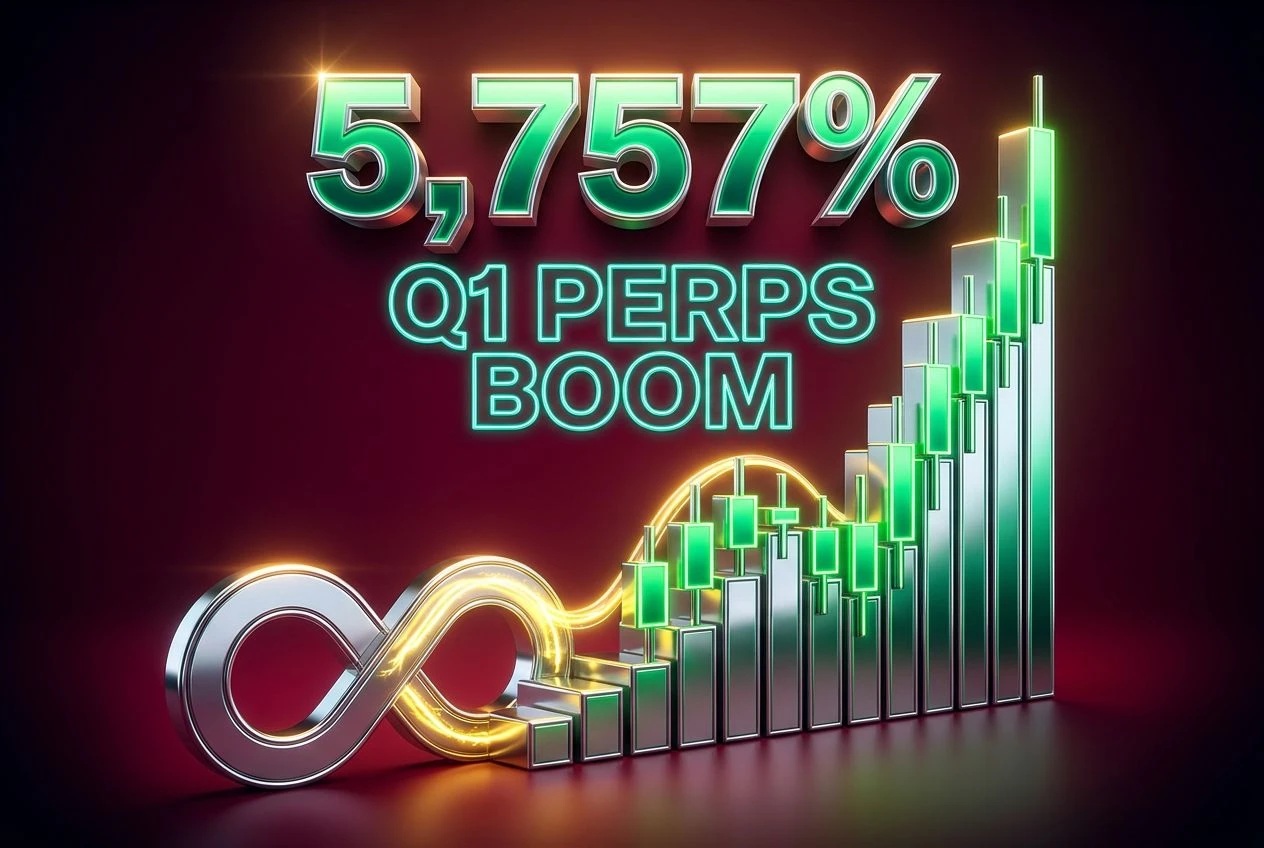
Across Q1 2026, weekly tradfi perp volume jumped from $525.8 million to $30.7 billion. That’s a 5,757% increase in three months. Block Scholes called 2026 “the year of RWA perps” in its Block Scholes premium research note on real-world-asset perpetuals, citing the same vertical leap. Stock perpetual swaps alone grew 908% over the quarter to roughly $4.9 billion in weekly volume.
Binance currently lists more than ten tradfi perp contracts spanning metals and U.S. equities, including Tesla, Intel, Robinhood, Strategy, Amazon, Circle, Coinbase and Palantir. Hyperliquid hosts more than fifty tradfi perps via its HIP-3 partner trade.xyz, including silver, gold, oil and a series of equity-index baskets.
Harvey expects the segment to keep compounding because the operational plumbing already exists. “As dealers, we’re the glue that holds those markets together. We have to have the ability to move natively between an offshore exchange, an onshore exchange, futures, ETFs,” he said.
- 5,757% growth in weekly tradfi perpetual volume across Q1 2026
- $30.7 billion weekly tradfi perp volume by end of Q1, up from $525.8 million
- 70%+ derivatives share of total global crypto trading by early 2026
- $2.01 trillion in Q1 onchain perpetual volume across the top ten DEXs
How The SEC Quietly Cleared The Runway
The regulatory base for this convergence sat down in September 2025, and Lynch said most market participants still underestimate how much it changed. On September 17, 2025, the U.S. Securities and Exchange Commission approved generic listing standards for commodity-based trust shares, including digital assets, per the SEC press release on generic listing standards for commodity-based trust shares. Exchanges including NYSE Arca, Nasdaq and Cboe BZX can now list eligible spot crypto ETPs without filing a Section 19(b) rule change for each one. Approval timelines compressed from many months to roughly 60 to 75 days.
Lynch said the standards quietly created a direct link between derivatives and spot eligibility. Two of the three approved paths to spot ETF qualification run through derivative markets. One requires a CFTC-regulated futures contract on the underlying asset that has been actively traded for at least six months. The other allows spot eligibility when an existing ETF already delivers meaningful exposure through swaps or similar instruments.
“Having a derivative on an underlying crypto token is kind of indicative that it should also be available in the spot format,” Lynch said. The path she called “a little bit hairier” is the swaps route, but its existence means a derivatives market on a token can pull a spot ETF through behind it.
Cross-Margining Changes The Capital Math
Sears of FalconX kept returning to one specific structural feature. Cross-margining, where a trader uses different asset classes as collateral against each other inside a single account, is what makes the convergence operationally interesting rather than just thematic.
“What’s really powerful for all of the participants in the space is going to be the cross-margining potential that RWA can unlock,” Sears said. “And I think that benefits the industry as a whole.”
Tokenized real-world assets, excluding stablecoins, sit between $19 billion and $36 billion in early 2026, per RWA.xyz’s analytics dashboard for tokenized real-world assets. Six asset classes have crossed the $1 billion threshold. Tokenized U.S. Treasuries lead with onchain value of $9 to $11 billion.
That collateral pool changes the math for traders. BlackRock’s BUIDL fund, integrated by Securitize into the collateral systems at Binance and Deribit, lets institutions post tokenized T-bills as margin. The yield on the T-bills offsets a portion of the funding rate on a long perpetual position. If long-funding costs 10% annualized and the collateral earns 5% risk-free, effective borrowing cost roughly halves.
Crypto Is Pulling TradFi Onto Its Rails
Most coverage of this convergence frames it as Wall Street swallowing crypto. The panel rejected that framing flatly. Harvey put it the other way around: TradFi is being pulled onto crypto rails because the rails are better.
It’s crypto actually bringing the TradFi rails on chain and forcing all these traditional exchanges to innovate up to the level of where crypto derivatives are.
Harvey said as much during his panel remarks, pointing to 24/7 settlement and continuous price discovery as the features traditional venues have publicly committed to copy. NYSE, Nasdaq and CME have each signaled plans to extend trading hours toward continuous markets. None has matched the always-on settlement crypto exchanges have run since 2017. The catch-up sets the direction of innovation.
What IBIT Options Already Prove
The IBIT options market is the cleanest worked example of how fast crypto derivatives can scale into mainstream products. BlackRock’s iShares Bitcoin Trust ETF launched options in November 2024. By December 2025 they had cracked the U.S. top 10 by open interest with 7.7 million active contracts.
By April 2026, IBIT options open interest hit $27.61 billion and briefly overtook Deribit, the crypto-native venue running since 2016. Sears called it out specifically. “In under two years, options on BlackRock’s spot bitcoin ETF became a top-five ETF globally by options volume,” he said.
The pattern matters because IBIT options behaved exactly the way Harvey is forecasting equity perps will behave. A regulated derivative product on a previously offshore-only asset class scaled past the original venue inside 24 months.
| Metric | IBIT Options | Deribit BTC Options |
|---|---|---|
| Launch | November 2024 | 2016 |
| Active contracts (peak 2026) | 7.7 million | Sub-7 million |
| Open interest (April 2026) | $27.61 billion | Briefly trailed IBIT |
| Primary regulator | SEC, OCC | Dubai VARA |
| Settlement window | U.S. trading hours | 24/7 |
Hyperliquid offers another data point. Its 30-day perpetual volume runs above $180 billion, accounting for roughly 70% of all on-chain perpetual futures volume across every chain. The exchange’s growth caught Galaxy’s attention enough that hedging activity on Hyperliquid was cited in the firm’s Q1 2026 commentary.
Kraken made the most concrete move toward equity perps. The exchange listed regulated tokenized-equity perpetual futures on February 24, 2026 via xStocks, per Kraken’s announcement of the world’s first regulated tokenized-equity perpetual futures. Initial listings cover the S&P 500, Nasdaq 100, Apple, Nvidia, Tesla and SPDR’s GLD gold ETF. Leverage runs to 20x. The product is open to non-U.S. clients across more than 110 countries.
Direct IPOs Onchain Are The Next Frontier
Sears closed his panel remarks with a sharper prediction than even Harvey’s. He expects a traditional finance asset to crack the top five by volume on a crypto exchange. Then he went further.
“Not only will the trading volume grow, but I think we’re also going to see direct IPOs, direct listings of equities on chain instead of traditional venues,” Sears said. “And that’s going to be an extremely exciting moment to see billion-dollar IPOs happen completely onchain.”
The pre-conditions are already arriving. Securitize, Jump Trading Group and Jupiter announced fully onchain regulated trading for tokenized equities the day before Consensus Miami opened. Galaxy holds a UK FCA derivatives license that lets it offer hedging products tied to tokenized real-world assets. The Consensus Miami 2026 agenda set aside an entire institutional summit track to discuss exactly this transition.
Frequently Asked Questions
Can U.S. Traders Buy Tokenized Equity Perps Yet?
Not on U.S.-regulated exchanges. Kraken’s xStocks perpetuals launched February 24, 2026 for non-U.S. clients across more than 110 countries, but U.S. residents are blocked. Domestic access waits on either CFTC product approval or new SEC pathways. For now, U.S. traders looking at equity-perp data are limited to watching offshore venues like Binance and Hyperliquid for indicative pricing through their public dashboards.
How Are Equity Perps Different From Regular Stock Trading?
Equity perpetuals trade 24/7, never expire and offer up to 20x leverage on Kraken’s xStocks contracts. Regular stocks trade only during exchange hours, settle on T+1 and require separate margin or options approvals for similar leverage. Perps also use a funding-rate mechanism to keep their price tracking the underlying, which cash equities don’t have. The exposure looks similar, the wrapper is fundamentally different.
When Will The First Onchain IPO Happen?
No firm date yet, but Sears predicted billion-dollar onchain IPOs are coming. Securitize, Jump Trading and Jupiter already launched fully onchain regulated trading for tokenized equities on May 5, 2026, the infrastructure layer a direct listing would need. Watch late 2026 or 2027 if regulators stay accommodative. The first attempt will likely be a smaller crypto-native firm before any billion-dollar listing tests the model.
Is It Legal To Trade Stock Perps On Crypto Exchanges?
It depends on your jurisdiction. In the United Kingdom, the UAE, Cayman Islands and Switzerland, regulated venues now offer them through licensed entities. The U.S., Canada and Singapore restrict retail access pending further rulemaking. The CFTC and SEC haven’t cleared equity perpetuals for U.S. retail. Verify your venue’s license against your local regulator before trading, and don’t assume offshore access counts as U.S. compliance.
The convergence story has been told for years, mostly as theory. The Q1 2026 numbers are the first stretch where the volume curve actually does what the forecasts said it would. Harvey gave equity perps three years to overtake crypto perps. Sears gave the broader shift less.
Whether the SEC’s generic listing standards survive the next political cycle is a separate question. So is whether U.S. retail traders ever get the same access non-U.S. clients already have on Kraken’s xStocks. The infrastructure is built. The volume is following. The remaining variables are policy and timing.
Disclaimer: This article reports on industry forecasts and trading volume data and does not constitute investment advice. Perpetual futures, tokenized equities and crypto derivatives carry significant risk, including total loss of capital, particularly when traded with leverage. Regulatory treatment varies sharply by jurisdiction, and access on offshore venues may not be permitted in your region. Readers should consult a licensed financial advisor before trading any derivative product. Figures cited reflect publicly available data as of May 2026 and may change without notice.


NotebookLM Becomes Gemini Notebook, and Its New Power Has a Catch

Epic Games Store’s Mobile Freebies Mask a Bigger App Store War

OnePlus Keeps Supporting Existing Owners as Its US Forum Closes

Apple’s Siri AI Reaches the Public, Two Years and $250 Million Later

Honor Bets Its AI Comeback on a Robot Phone That Nods and Dances

Blue Angels Pilot Faces No Discipline After Low Pensacola Beach Pass

OpenAI’s $230 Codex Micro Keypad Signals a Bigger AI Hardware Trend

Apple’s First OLED iPad Mini Arrives by October With a 60Hz Catch

Newgen Software Targets 23-25% Margins as Profit Beats, Stock Slips

HYPE Drops 9% and Robinhood’s CASHCAT Meme Coin Crashes 52%

SpaceX’s Google Deal Turns a Rocket Company Into a Cloud Landlord

XPL Rallies 30% Ahead of Plasma One Card Tier Launch

Google Search Profiles Build a Follow Graph Inside Discover

Oracle Cuts 21,000 Jobs in a Year, Cites AI in 10-K Filing

Microsoft Xbox Layoffs Start in July as Sharma Slams 3% Margin

Moonshot AI Targets $30 Billion in China’s Fastest AI Funding Sprint

WhatsApp Meta Business Agent Reaches India, With a New Pricing Meter

Oppo’s ColorOS 17 Eligibility List Leaves A-Series Buyers Behind

Google DeepMind and A24 Sign $75 Million AI Partnership Deal

CD Projekt Red Co-CEO: Redemption Arc Isn’t Done, Witcher 4 in 2027
-
 AI1 month ago
SpaceX’s Google Deal Turns a Rocket Company Into a Cloud Landlord
-
 CRYPTO1 month ago
XPL Rallies 30% Ahead of Plasma One Card Tier Launch
-
 NEWS1 month ago
Google Search Profiles Build a Follow Graph Inside Discover
-
 AI3 weeks ago
Oracle Cuts 21,000 Jobs in a Year, Cites AI in 10-K Filing
-
 GAMING1 month ago
Microsoft Xbox Layoffs Start in July as Sharma Slams 3% Margin
-
 AI1 month ago
Moonshot AI Targets $30 Billion in China’s Fastest AI Funding Sprint
-
 AI1 week ago
WhatsApp Meta Business Agent Reaches India, With a New Pricing Meter
-
 NEWS1 month ago
Oppo’s ColorOS 17 Eligibility List Leaves A-Series Buyers Behind