
NEWS
OnePlus 16 Leak: 9,000mAh Battery, 240Hz Display, Dual 200MP Cameras

The OnePlus 16 leak doing rounds this week reads less like a phone spec sheet and more like a stress test for what 2026 silicon, batteries, and displays can physically deliver. A 9,000mAh cell. A 240Hz LTPO panel. Dual 200-megapixel sensors. A 2nm Snapdragon chip rumored to cost more than $300 per unit. Weibo tipster Digital Chat Station, the source of the original post, has a track record on OnePlus internals strong enough that most major outlets ran the leak straight. The harder question is what it actually costs to build a phone like this, and who will get to buy one.
Here is the floor of what Digital Chat Station claimed, why the components matter, and where independent analyst data either backs the leak up or quietly raises a flag.
What the Digital Chat Station Leak Actually Says
The tipster posted the OnePlus 16 specs to Weibo in late April, and Gizmochina’s translation of the original Weibo post is the cleanest English version. The headline numbers: a 6.78-inch BOE LTPO panel running 1.5K resolution at a variable 200Hz to 240Hz, bezels around 1.1mm on all four sides, a 9,000mAh silicon-carbon battery, and Qualcomm’s unreleased Snapdragon 8 Elite Gen 6 Pro inside.
The camera array is the part that caught photographers’ attention. A 200MP main sensor with optical stabilization. A 200MP periscope telephoto, also stabilized. A 50MP ultrawide. No current OnePlus, Vivo, or Oppo flagship ships with a 200MP telephoto today.
Storage is UFS 4.1, RAM is LPDDR5X on the standard tier with LPDDR6 reserved for the top configuration. The phone keeps the Plus Key shortcut button OnePlus introduced last cycle, adds dual symmetrical stereo speakers, and is rated IP68 plus IP69 for high-pressure water jets.
Specs at a Glance
| Component | Leaked Spec | OnePlus 15 (Current) |
|---|---|---|
| Display | 6.78″ BOE LTPO, 1.5K, 200-240Hz | 6.78″ 165Hz |
| Bezels | ~1.1mm all sides | 1.15mm |
| Processor | Snapdragon 8 Elite Gen 6 Pro (SM8975) | Snapdragon 8 Elite Gen 5 |
| Main Camera | 200MP + OIS | 50MP + OIS |
| Telephoto | 200MP periscope + OIS | 50MP periscope |
| Battery | 9,000mAh silicon-carbon | 7,300mAh |
| Water Rating | IP68 + IP69 | IP68 |
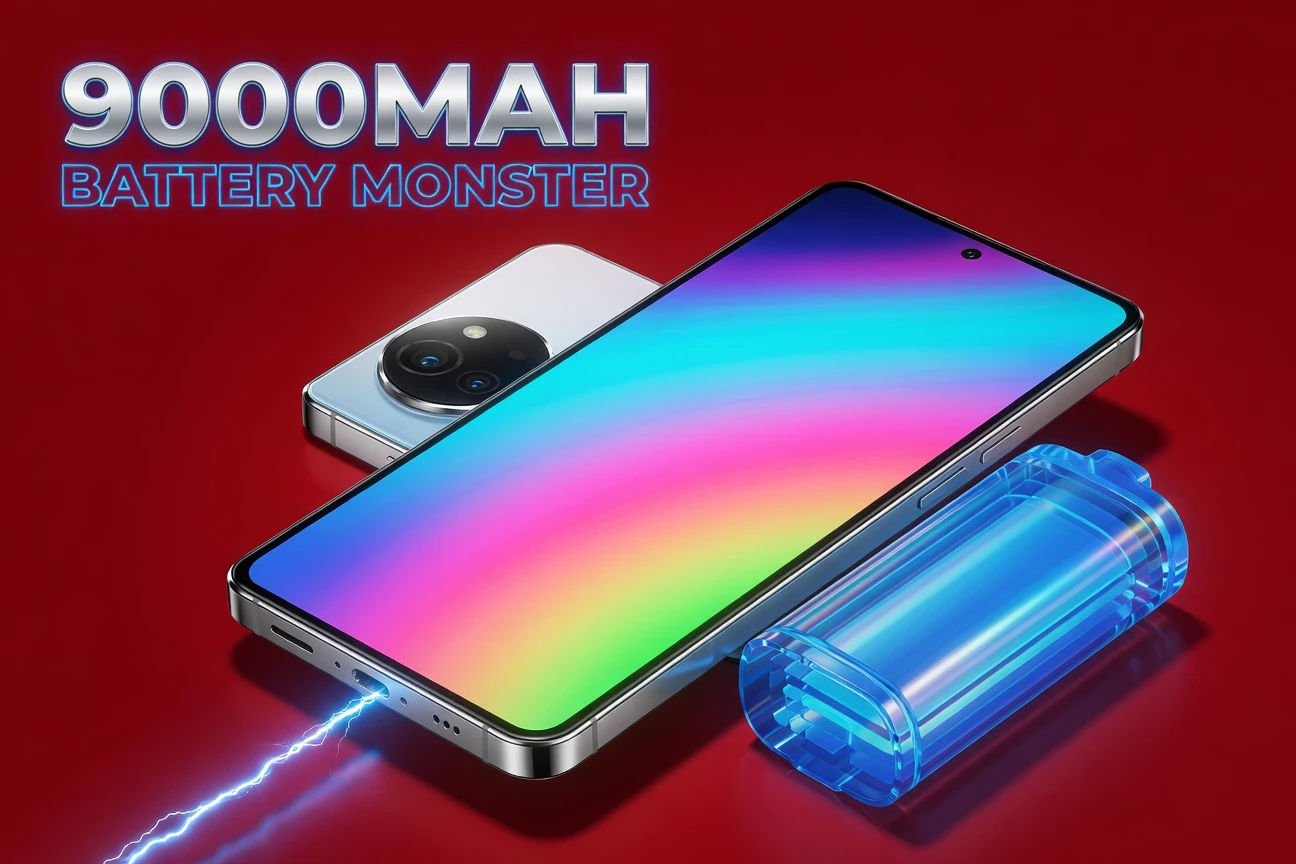
The 9,000mAh Number Is Not the Outlier It Sounds Like
If you only read the iPhone and Galaxy world, 9,000mAh feels absurd. Apple’s iPhone 17 Pro Max ships with a 5,088mAh cell. Samsung’s Galaxy S26 Ultra is in the same neighborhood. So a near-doubling reads like fantasy.
The Chinese flagship market tells a completely different story. Counterpoint Research’s January 2026 analysis on high-capacity smartphone batteries found that six of the ten highest-capacity phones shipping that month used silicon-carbon anodes, and every one of them was Chinese-built. The Honor Magic Win and Realme P4 Power both ship with a 10,001mAh silicon-carbon cell in an 8.3mm body. Counterpoint also reports that more than 60 percent of flagships launched in China during the first half of 2025 already used silicon-carbon chemistry.
Silicon-carbon density now reaches roughly 901 Wh/L at the cell level on the newest commercial designs, compared with 650 to 750 Wh/L for traditional graphite-anode lithium-ion. A 9,000mAh cell in a phone-sized chassis is no longer a physics problem. It is a procurement problem.
Why Apple and Samsung Are Not There Yet
Honor’s Qinghai Lake Blade Battery uses a 25 percent high-silicon anode, the highest commercially shipping silicon ratio on a phone, and the company claims a 15 to 30 percent battery-life gain over its prior generation. Western OEMs have stayed at 5 to 15 percent silicon content because higher ratios introduce electrode swelling that complicates long-term warranty math.
That gap is structural, not technical. Samsung and Apple do not have an in-house silicon-carbon supply chain matching the scale of CATL, ATL, or Sunwoda. Counterpoint’s read is that Western flagships will not catch up in volume until late 2026 at the earliest, and broad adoption is more likely a 2027 story.
The Snapdragon 8 Elite Gen 6 Pro Is the Most Expensive Piece of This Phone
The chip Digital Chat Station named, model number SM8975, is the high-tier sibling in Qualcomm’s first dual-flagship lineup. Gizchina’s economic breakdown of the Snapdragon 8 Elite Gen 6 Pro pricing puts the unit cost above $300, against roughly $280 for the current Snapdragon 8 Elite Gen 5. The driver is TSMC’s 2nm wafer cost, which industry estimates peg at about $30,000 per wafer, nearly double the 3nm process the current generation runs on.
The Pro variant uses a 2+3+3 CPU cluster instead of the 2+6 layout Qualcomm has shipped for the past three generations. Two prime cores. Three performance cores. Three efficiency cores running at lower clocks for background work. Peak clock is rumored at 5GHz. The GPU is the new Adreno 850 with 18MB of dedicated graphics memory, paired with LPDDR6 support that the standard Gen 6 will not get.
Smartphone manufacturers may need to spend nearly a third of their total production budget just on the processor when they reach for the Pro tier, according to component-cost analysis circulating in supply-chain circles ahead of Qualcomm’s late-2026 launch.
That is the part the spec sheet hides. A phone with a $300 chip, a high-binned silicon-carbon cell, a 200MP periscope module, and dual 200MP sensors has a bill of materials that punches well above what OnePlus has historically priced its flagships at. The OnePlus 13 launched at $899 in the United States. The OnePlus 16, if it reaches the United States at all, will be a different price conversation.
The Regional Availability Problem Nobody Wants to Discuss
Here is where the leak gets uncomfortable. Multiple coverage threads, including the Notebookcheck summary of the OnePlus 16 leak and global rollout chances, raise the possibility that the OnePlus 16 may not ship in Europe or the United States the way prior generations have. The framing is consistent across outlets: Asia-first, Asia-only as a real risk, with European fans potentially limited to grey-market imports without warranty support.
This is not an out-of-context fear. OnePlus has trimmed European retail relationships steadily since 2024, and the parent company BBK has been concentrating its highest-spec hardware inside China where regulatory carrier subsidies and local-payment integration favor Chinese-built models.
If the 9,000mAh battery and the SM8975 chip ship only inside China and a handful of Asian markets, the real headline of this leak is not the spec sheet. It is the widening hardware gap between what a Shenzhen buyer can walk out of a store with in November and what a buyer in Berlin or Boston can legally purchase on launch day.
The 240Hz Display Claim Has a Caveat the Headlines Skipped
The 200Hz to 240Hz refresh rate is the spec doing the most work in social-media coverage. Tech Advisor’s report on the OnePlus 16 display panel includes the line most other outlets cut: OnePlus is still testing whether the 240Hz mode actually ships in the final retail unit. The panel hardware can run that fast. The decision to enable it for end users has not been made.
Modern Android games are mostly still capped at 60 or 120 frames per second. The genuine use case for 240Hz on a phone is narrow. PUBG Mobile, Call of Duty Mobile, and a handful of competitive titles use it. Most buyers will never hit it. The 1.1mm bezel and the BT.2020 color gamut from BOE matter more for daily use than the headline refresh number.
What the Display Actually Buys You
- True 1.5K resolution at 6.78 inches lands around 450 pixels per inch, sharper than the OnePlus 15’s panel.
- BOE’s LIPO packaging is what makes the 1.1mm bezel possible without sacrificing touch sensitivity at the edges.
- LTPO variable refresh drops the panel to 1Hz on static content, the actual battery saver, with or without the 240Hz ceiling.
- BT.2020 color gamut coverage targets professional video reference workflows, not consumer Netflix viewing.
The 200MP Periscope Is the Real Camera Story
OnePlus has lagged Vivo, Oppo, and Xiaomi on long-range zoom for years. The OnePlus 13 shipped a 50MP 3x periscope. The OnePlus 15 stayed at 50MP. A 200MP periscope, if it lands in the 1/1.x-inch sensor territory the leak suggests, is a category leap for the brand.
The math on a 200MP telephoto is not just about pixel count. Pixel binning at 4-in-1 produces a 50MP output with larger effective pixels for low-light zoom. At 16-in-1 it produces a 12.5MP output with strong noise control. Cropping into the 200MP raw output gives you lossless digital zoom at 6x, 8x, and beyond without engaging the lens-shift.
That is the spec the iPhone Pro line and the Galaxy Ultra line do not currently match. Apple’s 17 Pro Max telephoto is 48MP. Samsung’s S26 Ultra runs a 50MP periscope. If the OnePlus 16 ships this hardware as described, it is the first phone to put a flagship-tier sensor in the periscope position rather than the main camera.
How the Leak Lines Up Against What Digital Chat Station Has Gotten Right Before
Digital Chat Station’s recent track record on OnePlus, Vivo, and Oppo internals is strong. The tipster called the OnePlus 13’s Snapdragon 8 Elite chip months early, the OnePlus 15’s 7,300mAh battery, and the bezel reduction to 1.15mm on the 15. The pattern: hardware specs land accurate, software and pricing details miss more often.
The leak still carries three soft spots worth flagging. First, the 240Hz mode is unconfirmed for retail. Second, the dual 200MP camera setup has not been corroborated by any second tipster yet. Third, the Snapdragon 8 Elite Gen 6 Pro’s exclusivity to specific phones inside Qualcomm’s customer base is still unsettled, and OnePlus may end up using the standard Gen 6 chip, not the Pro.
The Launch Window and What to Watch For
- September to October 2026: Qualcomm officially announces the Snapdragon 8 Elite Gen 6 family at the annual Snapdragon Summit. Pricing tiers and customer commitments leak shortly after.
- November 2026: Expected OnePlus 16 launch in China, matching the brand’s historical Q4 cycle.
- Q1 2027: Possible global launch window, conditional on whether OnePlus commits to European and US retail or pulls back.
- Pricing signal: A Chinese launch price above 5,000 yuan would confirm the bill-of-materials math the chip and battery suggest.
Frequently Asked Questions
Will the OnePlus 16 launch in the United States?
Unconfirmed and trending negative. OnePlus has scaled back its US retail presence since 2024 and several leak sources describe the OnePlus 16 as Asia-focused. If you need a US-warrantied flagship in late 2026, the safer bet is the Galaxy S26 line or the iPhone 17 Pro. Watch OnePlus’s late-summer announcements for confirmation. Grey-market imports through Giztop or similar sellers will likely work on T-Mobile and AT&T but lose warranty coverage.
Is a 9,000mAh battery actually safe in a phone?
Yes, with caveats. Silicon-carbon cells in this capacity range have shipped in over 100 million Chinese phones since 2024 with no statistically elevated failure rate per Counterpoint’s tracking. The trade-off is cycle life: silicon-carbon cells typically retain 80 percent capacity at 800 to 1,000 cycles, slightly under graphite’s 1,000 to 1,200. For a phone you replace every 2 to 3 years, the difference is invisible.
Should I wait for the OnePlus 16 or buy a OnePlus 15 now?
If you are outside Asia, buy the OnePlus 15. The OnePlus 15 ships globally with the Snapdragon 8 Elite Gen 5, a 7,300mAh silicon-carbon battery, and a 165Hz panel. The OnePlus 16’s regional availability is a real question and the launch is at minimum six months away. If you live in mainland China and can wait until November, the OnePlus 16 is worth the delay.
How much will the OnePlus 16 cost?
No leaked pricing yet. The bill-of-materials math suggests a starting price north of 5,000 yuan in China, roughly $700 USD at current rates. International pricing, if a global launch happens, would land closer to $999 to $1,099 given the $300 chip cost and the high-binned battery. That puts the OnePlus 16 squarely in iPhone Pro and Galaxy Ultra pricing territory, not the value-flagship slot OnePlus historically occupied.
What is the OnePlus Plus Key button used for?
The Plus Key is a customizable physical shortcut OnePlus introduced on the OnePlus 13. Default behavior is a quick toggle for ringer modes, similar to the iPhone’s Action Button. On the OnePlus 16 it is rumored to default to launching the device’s AI assistant, with user-configurable secondary actions for camera quick-launch, flashlight, or a custom app shortcut. You set the behavior in Settings under Buttons & Gestures.
The OnePlus 16, if Digital Chat Station’s leak holds up at launch, will be the most aggressively specced Android phone of 2026 on paper. Whether that translates into a phone most readers can actually buy on day one is the more interesting question, and the answer depends almost entirely on choices OnePlus has not yet announced about which markets it still wants to sell in.


D&D Bets Big on WoW and Star Wars to Grow Its Tables

Game Pass Drops Celeste and Crusader Kings on First Net-Loss Day

Gemini Breaks Basic Calls on Foldable Phones in Android Auto

Citadel Clears AI Fund Overhang While Crypto Stays Flat

Morgan Stanley Staking ETPs Crack Open Crypto Yield for Wealth Clients

Snapdragon Price Hike Forces Premium Buyers Toward Last Year’s Phones

Croc 2 Remaster Unlocks Argonaut’s Full Revival Path

Scale AI Names Google Cloud Veteran deSouza CEO for Enterprise Push

Epic Store Hits Brazilian iPhones Amid Apple’s Familiar Friction Play

LORDNINE Helena Server Races Players Toward Real USDT Rewards

Fable 5 and Mythos 5 Return as US Lifts Anthropic Export Controls

SpaceX’s Google Deal Turns a Rocket Company Into a Cloud Landlord

Oracle Cuts 21,000 Jobs in a Year, Cites AI in 10-K Filing

CD Projekt Red Co-CEO: Redemption Arc Isn’t Done, Witcher 4 in 2027

XPL Rallies 30% Ahead of Plasma One Card Tier Launch

DGO App Brings Rs 549 Mobile Pass for FIFA World Cup 2026 in Nepal

Google Search Profiles Build a Follow Graph Inside Discover

Moonshot AI Targets $30 Billion in China’s Fastest AI Funding Sprint

Microsoft Xbox Layoffs Start in July as Sharma Slams 3% Margin

Oppo’s ColorOS 17 Eligibility List Leaves A-Series Buyers Behind
-
 AI1 month ago
Fable 5 and Mythos 5 Return as US Lifts Anthropic Export Controls
-
 AI2 months ago
SpaceX’s Google Deal Turns a Rocket Company Into a Cloud Landlord
-
 AI1 month ago
Oracle Cuts 21,000 Jobs in a Year, Cites AI in 10-K Filing
-
 GAMING1 month ago
CD Projekt Red Co-CEO: Redemption Arc Isn’t Done, Witcher 4 in 2027
-
 CRYPTO2 months ago
XPL Rallies 30% Ahead of Plasma One Card Tier Launch
-
 APPS2 months ago
DGO App Brings Rs 549 Mobile Pass for FIFA World Cup 2026 in Nepal
-
 NEWS2 months ago
Google Search Profiles Build a Follow Graph Inside Discover
-
 AI2 months ago
Moonshot AI Targets $30 Billion in China’s Fastest AI Funding Sprint