
GAMING
Acer’s 1000Hz Gaming Monitors Hide a 720p Refresh Catch
Acer’s new Predator and Nitro gaming monitors hit 1000Hz and 5K at Computex 2026, but DFR and 3D modes carry trade-offs buyers should know before paying.

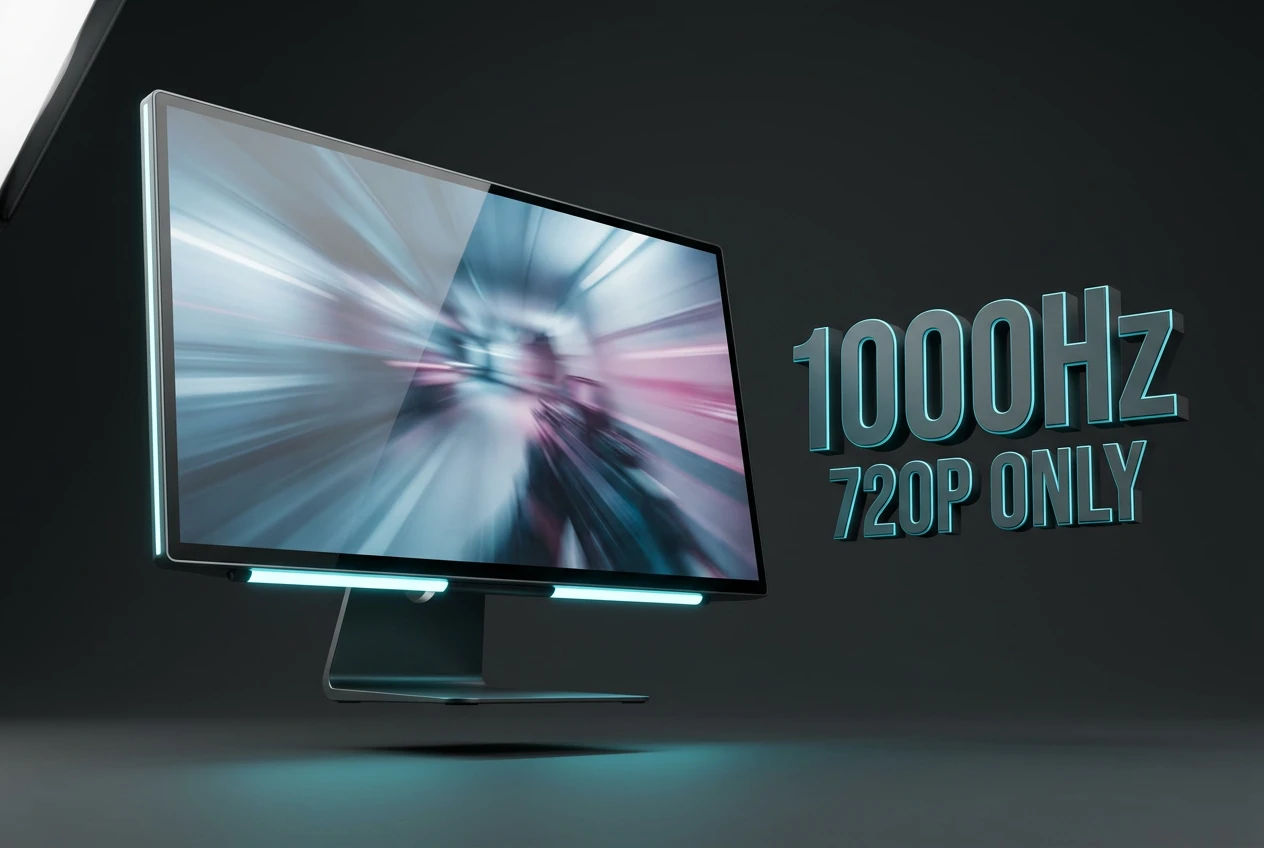
Acer’s new Predator and Nitro gaming monitors, unveiled at Computex 2026, headline with a 1000Hz refresh rate on a panel that costs $699.99 (about RM2,800), the cheapest four-figure-Hertz display any maker has announced. The footnote matters: that peak only arrives at 1280×720, a resolution most players left behind a decade ago. At its native 2560×1440, the same Nitro XV273U F5 runs 540Hz.
That trade repeats across the range. Three of the five monitors use a resolution-for-speed toggle Acer calls Dynamic Frequency and Resolution, and the lineup also revives glasses-free 3D through eye tracking and adds two 5K mini LED panels, all aimed at a launch in the final quarter of the year.
The 1000Hz Number Hides a 720p Catch
Start with the panel that got the screenshots. The Nitro XV273U F5 is a 27-inch Fast IPS monitor Acer is pitching as the first four-figure-Hertz display under $700, and on paper it tops out at 1000Hz. Reach that figure and you are running at 1280×720, the resolution a budget laptop shipped with years ago. Drop back to the panel’s native 2560×1440 (QHD) and it settles into a still-elite mode built for sharpness over raw speed.
That switch is the whole trick. The monitor cannot push QHD detail and a four-figure frame rate at the same time, so Acer lets you pick one: full sharpness, or maximum speed at a fraction of the pixels. For a competitive player in a title like CS2 or Valorant, where frames matter more than crispness, the low-resolution mode has a logic to it. For anyone buying a QHD monitor to look at QHD, the four-figure number on the box is one you will rarely touch.
It is fair to ask what a person even gets from rates this high. A peer-reviewed study on visual flicker found people can still perceive flicker artifacts above 500Hz under high-contrast conditions, so the ceiling is not pure marketing. The gains just shrink quickly the higher you go.
How Dynamic Frequency and Resolution Works
Acer’s name for that resolution-for-speed switch is Dynamic Frequency and Resolution (DFR, a mode that swaps pixel count for frame rate on demand). It appears on three of the five new monitors, and the pattern repeats: a high native resolution at a sensible refresh rate, plus a stripped-down mode that trades sharpness for motion.
The three DFR models each carry two personalities:
- Nitro XV273U F5: native QHD for sharpness, a 720p mode for its peak refresh.
- Nitro XV345CKR P: full 5K in normal use, a windowed Full HD mode for far higher frames.
- Nitro XV320QX: 5K for detail, QHD when you want maximum speed.
Day to day, the native line is the one you live on. That is the resolution and refresh rate the monitor runs in normal use, because few games and fewer graphics cards can feed the turbo mode at full tilt. The peak figures are real; they describe a corner case rather than a desktop you would set up and leave.
Five Monitors on One Spec Sheet
The full range runs from a $699.99 esports panel to a $1,299.99 3D showpiece, with two 5K screens in between. Side by side, the trade-offs sharpen up.
| Monitor | Panel & size | Native res / refresh | DFR peak | US price |
|---|---|---|---|---|
| Predator XB273K 3D | 27″ IPS, eye-tracked 3D | 4K UHD / 180Hz | None | $1,299.99 |
| Predator X34 F1 | 34″ QD-OLED ultrawide | WQHD / 360Hz | None | $1,099.99 |
| Nitro XV345CKR P | 34″ VA, mini LED (1,344 zones) | 5K WUHD / 180Hz | 360Hz (WFHD) | $899.99 |
| Nitro XV320QX | 31.5″ IPS | 5K / 165Hz | 330Hz (QHD) | $1,099.99 |
| Nitro XV273U F5 | 27″ Fast IPS | QHD / 540Hz | 1000Hz (720p) | $699.99 |
Two panels stand out for reasons beyond speed. The 34-inch QD-OLED (quantum dot OLED, a self-lit panel known for deep blacks and saturated color) Predator X34 F1 hits a 0.03 ms gray-to-gray response and a peak 1,300 nits in HDR, carrying VESA’s DisplayHDR True Black 500 badge. The Nitro XV345CKR P pairs a 5K resolution with a mini LED backlight split into 1,344 local dimming zones and a DisplayHDR 1000 rating, the two tiers laid out on VESA’s DisplayHDR certification page.
QD-OLED at high speed is the year’s busiest monitor category. Acer’s X34 F1 lands in the same window as the rival Alienware AW3426DW QD-OLED ultrawide shown at Computex 2026, which runs Samsung Display’s five-stack panel at 280Hz. Buyers shopping the high end have more genuinely good choices than usual.
Glasses-Free 3D Returns Through Eye Tracking
The Predator XB273K 3D is the lineup’s oddest swing. It is a 27-inch 4K monitor that renders depth without glasses, using cameras to track where your eyes are and adjusting the image so each eye sees a slightly different view. Acer pairs that with an onboard AI model that converts ordinary 2D games into 3D-like depth in real time, plus a new SpatialLabs 3D Hub app to manage supported titles and settings.
Glasses-free 3D has a graveyard behind it. The 3D TV boom of the early 2010s asked everyone to wear battery-powered shutter glasses and collapsed within a few years once the novelty wore off. Acer’s SpatialLabs brand, which has run on its creator laptops for several years, takes a different route: no glasses, eye tracking instead, and a software layer doing the heavy lifting.
Whether a gaming audience wants it is the open question. The XB273K 3D runs 180Hz, fast enough for most games but well short of the esports panels in the same range, and the 2D-to-3D conversion leans on your graphics card to do the work. At $1,299.99 it is the priciest monitor of the five. It is also the only one doing something no rival on the show floor was, which is its own kind of pitch.
Is the Refresh Rate Race Outrunning Your Graphics Card?
A high-refresh monitor only earns its price if a graphics card can feed it. In older or lightweight competitive titles at low settings, a strong GPU pushes the hundreds of frames these panels want. In a modern AAA game at native resolution, no consumer card comes close, which is the quiet limit on every fast panel in this range.
The engineering reason to chase these rates is not raw perception; it is motion blur. On a sample-and-hold display each frame is held on screen until the next one arrives, smearing motion, and a higher refresh rate shortens that hold time when pixel response keeps up. A study on display refresh rate in first-person shooter games found measurable gains in player performance at higher rates, though the curve flattens as the numbers climb.
The lineup’s non-refresh numbers are easier to put a value on:
- 1,344 local dimming zones on the 5K mini LED Nitro XV345CKR P.
- 0.03 ms gray-to-gray response on the QD-OLED Predator X34 F1.
- 99% DCI-P3 (a digital cinema color space) coverage on that same QD-OLED panel.
The timing is pointed. The same show floor saw Nvidia’s partners lean on software and cooling rather than new silicon, with the GeForce lineup built around DLSS 4.5 instead of a new chip. Frame generation can manufacture the frames a fast panel craves, but those are interpolated frames, not the lower-latency real ones a competitive player is paying for.
Pricing Runs From $699 to $1,299
All five monitors are headed for a launch in the final quarter of the year in North America, with European prices in the same brackets and earlier China availability for two models. Acer set the US figures in its Computex monitor announcement: $699.99 for the Nitro XV273U F5 at the bottom, $1,299.99 for the Predator XB273K 3D at the top, with the two 5K Nitros and the QD-OLED Predator filling the middle.
The competitive context is crowded too. Samsung opened its own season with discounts, bundling store credit and free gear with its 2026 Odyssey monitors for direct buyers. Acer is countering with specs rather than freebies, which is the more Acer move.
The harder number to pin down is the Malaysian one. Acer has not confirmed which models reach Malaysia or at what ringgit price, and regional lineups often drop the most niche entries first. For now the only firm dates are the North American ones; Malaysian pricing waits on Acer Malaysia, which has not announced a local lineup.
Frequently Asked Questions
Is the Acer Nitro XV273U F5 worth it for esports?
Its peak refresh rate only runs at 1280×720; at the native 2560×1440 resolution it runs 540Hz, which is already among the fastest QHD figures available. For low-resolution competitive play it makes sense, but you are paying mainly for that native QHD speed.
What does Acer’s DFR mode do?
Dynamic Frequency and Resolution lets a monitor trade resolution for refresh rate. You toggle between the full native resolution at a normal refresh rate, or a lower resolution that unlocks a much higher frame rate. It appears on the XV273U F5, XV345CKR P and XV320QX.
Do you need a powerful graphics card for these monitors?
Yes, to get near their peak frame rates. A high refresh panel only helps if a GPU can render that many frames; modern AAA games at native resolution will not reach these numbers on any consumer card, so the fastest modes suit older or lightweight competitive titles.
Will these Acer monitors come to Malaysia?
Acer has not confirmed a Malaysian lineup or ringgit pricing. The North American launch is set for the final quarter of the year, with European and China availability in similar windows. Local buyers should watch for an Acer Malaysia announcement.


Sony’s 10 Percent Disc Drop Leaves the 2028 Cutoff Intact

Chip Allocation Sidelines the Base iPhone 18 This Fall

Miami-Dade Fights the Vice City Brand It Already Wears

IFA 2026 Awards Put Tecno Ahead of Flagship Phones

USB-C Gadgets Made the Junk Drawer Rechargeable

Pixel 11 Pro Asks $1,099 for a Light Google Locked

The iPhone Ultra Sells Two Retired Minis as One Foldable

Google Opens Gmail to Voice and Gates Docs Live

Lenovo Prices the IdeaPad Vibe Against Apple’s $699 Neo

Xbox Caps Game Pass Cloud Gaming at 15 Hours

Oracle Cuts 21,000 Jobs in a Year, Cites AI in 10-K Filing

Fable 5 and Mythos 5 Return as US Lifts Anthropic Export Controls

SpaceX’s Google Deal Turns a Rocket Company Into a Cloud Landlord

CD Projekt Red Co-CEO: Redemption Arc Isn’t Done, Witcher 4 in 2027

XPL Rallies 30% Ahead of Plasma One Card Tier Launch

Google Search Profiles Build a Follow Graph Inside Discover

DGO App Brings Rs 549 Mobile Pass for FIFA World Cup 2026 in Nepal

Moonshot AI Targets $30 Billion in China’s Fastest AI Funding Sprint

Oppo’s ColorOS 17 Eligibility List Leaves A-Series Buyers Behind

Microsoft Xbox Layoffs Start in July as Sharma Slams 3% Margin
-
 AI3 months ago
Oracle Cuts 21,000 Jobs in a Year, Cites AI in 10-K Filing
-
 AI2 months ago
Fable 5 and Mythos 5 Return as US Lifts Anthropic Export Controls
-
 AI3 months ago
SpaceX’s Google Deal Turns a Rocket Company Into a Cloud Landlord
-
 GAMING3 months ago
CD Projekt Red Co-CEO: Redemption Arc Isn’t Done, Witcher 4 in 2027
-
 CRYPTO3 months ago
XPL Rallies 30% Ahead of Plasma One Card Tier Launch
-
 NEWS3 months ago
Google Search Profiles Build a Follow Graph Inside Discover
-
 APPS3 months ago
DGO App Brings Rs 549 Mobile Pass for FIFA World Cup 2026 in Nepal
-
 AI3 months ago
Moonshot AI Targets $30 Billion in China’s Fastest AI Funding Sprint