
GADGETS
Google’s $99.99 Fitbit Air Drops the Screen, Adds a Coach
Google’s $99.99 Fitbit Air skips the screen for Gemini-powered coaching, 7-day battery, and a sub-optional model. India launch nears after BIS nod.

Google launched the Fitbit Air on May 7, 2026, a $99.99 fitness tracker that does the one thing the rest of its category no longer does: nothing on the wrist. The screenless, 5.2-gram pod pairs with the Google Health app and runs Google’s Gemini Health Coach, a personalised AI assistant trained on the user’s biometric data. The Air is positioned as a daily-wear wellness device rather than a smartwatch alternative, and it ships into a category that has, until now, been owned by subscription-only players like Whoop.
Three months of Google Health Premium come bundled with every pre-order, but the core heart-rate and sleep tracking work without a paid plan. That combination, a $99.99 entry price, a screenless form factor, and a no-subscription floor, is the sharpest break from Whoop’s $30/month membership model since the category was invented.
A Pebble Where a Screen Used to Be
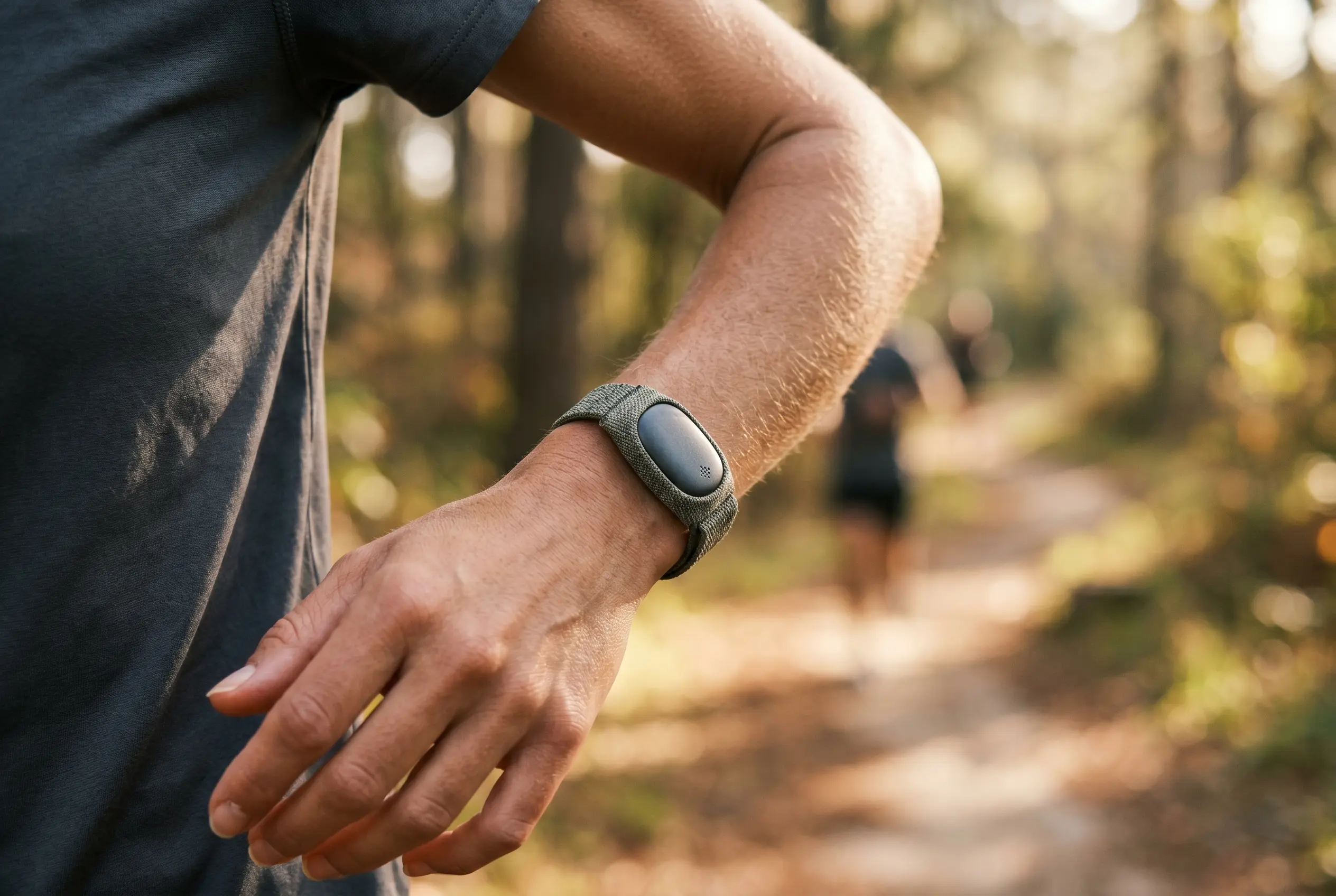
The Fitbit Air drops the display, the haptic button, and most of what makes a fitness band look like a fitness band. Google’s own product blog calls the tracker a “screenless pebble” that clips into a range of swappable bands, and at 5.2 grams for the pod (12 grams with the included Performance Loop band), it is the lightest Fitbit the company has ever shipped. WIRED’s launch coverage pegged the Air as 20 percent lighter than the discontinued Fitbit Luxe.
The intent is for the device to disappear. There is no AMOLED to glance at mid-run, no notification stack, and no live workout dashboard. Haptic feedback through vibration handles the one loop Google does preserve: a Smart Wake alarm that uses sleep data to pick a gentler moment in the sleep cycle. Everything else lives in the Google Health app, where the pod’s data streams in over Bluetooth, and the same pod pops out of its band the way a Whoop module does. The May 7 product launch announcement carries the full band and color options.
The Health Coach That Runs on Gemini
The Air ships into a redesigned Google Health app, the company confirmed in a separate May 7 blog post. The headline addition is the Google Health Coach, a Gemini-powered assistant that takes over the app’s Today tab and offers tailored workout, sleep, and recovery guidance. The coach begins rolling out May 19 and reaches 100 percent availability on May 26, the same day the Air hits US store shelves.
Google’s Health Coach post describes the system as “the most personalised, holistic, adaptive coaching possible, right on your phone, 24/7.” The coach pulls together fitness, sleep, nutrition, menstrual cycle, environmental, and (in the US) personal medical record data to deliver what Google calls “proactive, timely insights.” Three long-requested features have been rebuilt for the new release: cycle tracking, nutrition logging, and mental wellbeing monitoring. The Health Coach global rollout details list the supported data sources.
The coach itself is not free. Google Health Premium, the renamed Fitbit Premium, costs $9.99 per month or $99 per year. Google AI Pro and Ultra subscribers get the premium tier bundled at no extra cost. Three months of the service come with every Air pre-order, after which the subscription auto-renews at $9.99 a month and can be cancelled anytime.
What the Pod Tracks Around the Clock
The sensor stack is the smallest Fitbit has ever shipped, but it carries the same flagship tracking the company built into the Charge 6. WIRED’s launch-day spec sheet lists an optical heart rate monitor, a 3-axis accelerometer, gyroscope, red and infrared SpO2 sensors, and a device temperature sensor, all packed into a recycled polycarbonate and PBT plastic housing. Water resistance is 5 ATM, equivalent to a 50-metre dive rating.
- 5.2g pod weight, 12g with the band
- 5 ATM water resistance (50m)
- 7 days battery life, 5-min fast charge for 1 day
- 90 minutes for a full charge from empty
- 3 months of Google Health Premium included
Google claims a 15 percent accuracy improvement in sleep tracking, with the new algorithm powered by Gemini, over the previous Fitbit generation. AFib alerts and irregular heart rhythm notifications carry over, with the standard caveat: not for users under 22 with known arrhythmias, and not a medical device. The pod itself is a small oval that pops out of its band, and the same sensor can move between any of the three first-party bands Google sells.
The Health Coach is the reason to subscribe. The pod captures the data; the app turns it into a weekly plan, with the coach setting targets and adjusting for weather, recovery, and progress. The whole experience is conversation-led: the Today tab surfaces the day’s focus, and the “Ask Coach” button is open 24/7.
One Week of Battery and Three First-Party Bands
Battery life is the clearest payoff of going screenless. Google rates the Air at up to 7 days on a single charge, with a 5-minute fast charge topping up a full day’s power, and a 90-minute run from empty to full. The Pixel Watch 4 sits at around 36 hours per charge by comparison, and even Google’s own description flags the Air as a sleep-tracking alternative for Pixel Watch owners who want to keep their watch on the charger overnight.
| Band | Material | Best for | Color options |
|---|---|---|---|
| Performance Loop (in box) | Recycled textile, at least 35% recycled by weight | Daily wear | Obsidian, Fog, Lavender, Berry |
| Active Band | Sweat- and waterproof silicone | High-intensity training | Obsidian, Fog, Lavender, Berry |
| Elevated Modern Band | Premium materials | Lifestyle and formal | Porcelain, Moonstone, Obsidian |
Accessory bands start at $34.99 from the Google Store. The Air pairs with both Android 11.0 or higher and Apple iOS 16.4 or higher, a cross-platform reach the Android-only Pixel Watch cannot match. Google explicitly markets the Air as a swap-in for the Pixel Watch, particularly for sleep, noting that users can move between the two “without missing a beat” in their health data sync. A co-designed Stephen Curry Special Edition Performance Loop, in rye brown with a pop of game-day orange, ships alongside the standard bands for $129.99.
India’s BIS Filing Without a Launch Date
India is the conspicuous absence on the launch map. Google released the Air in the US, UK, parts of Europe, and Australia in May, and Indian customers have been pushing for a date. A BIS certification filing for model number GW968, spotted by 91Mobiles and reported by Republic World, suggests an India launch is being prepared. The same model number has been linked back to Google’s own Fitbit support pages, the strongest signal yet that the device is on its way to one of the world’s fastest-growing wearable markets.
Google has not given a launch date. The official Google Health account told Indian users on X that the company does not have “an official launch date for India just yet” and pointed them to the online store for updates. The full Google I/O 2026 push, including Gemini’s deeper move into hardware, was previewed at the Shoreline keynote build-up.
India pricing remains unofficial. Retail chatter captured by Tech Advisor, summarised in the India pricing expectations report, puts the expected range at ₹12,000 to ₹14,000, which would land the Air near the Inspire 3’s local positioning and well below premium wrist wearables. The same report, drawing on Google’s replies to Indian customers, treats the launch as a question of when, not if, with stock constraints the most likely cause of the delay.
Where Fitbit Air Stops Short of Whoop
You can use the band without a subscription and still get the core health-tracking experience.
CNET’s first-impressions review flagged the no-subscription angle as one Google is “less eager to advertise,” and it is the sharpest point of departure from Whoop. Whoop’s hardware effectively requires a $30/month membership to do anything beyond basic activity logging; Google’s $99.99 pod enables the full sensor suite on day one, with the $9.99/month Google Health Premium layering the AI coach on top. The same review also confirmed what Google left out of its launch blog: anyone can use the band and the Google Health app for free, with the Coach reserved for paying subscribers.
The trade-offs are real. The Air uses an older sensor stack than the Pixel Watch 4, per CNET, with a single-path optical heart rate sensor rather than the multipath version in Google’s flagship watch. Whoop’s band still lasts closer to two weeks per charge, double the Air’s stated life. Early users have reported connectivity drops, and the one-size-fits-all band has drawn complaints from slimmer wrists. Google has not announced alternate mounting options like Whoop’s bra-strap or bicep band, a gap that the broader split toward niche hardware, captured across this season’s Android launches, may yet force. The Curry Special Edition aside, the $99 price is also the entry point: bands, the premium tier, and the right fit all cost more, even if the core band is sub-free for the first three months.
Frequently Asked Questions
When did the Google Fitbit Air launch?
Pre-orders for the Google Fitbit Air opened on May 7, 2026, at $99.99 from the Google Store. In-store retail in the US followed on May 26, 2026, the same day the Google Health Coach reached 100 percent availability.
Does the Google Fitbit Air require a subscription?
No. Heart rate, sleep, and activity tracking work without a paid plan. The Google Health Premium subscription, at $9.99 per month or $99 per year, unlocks the Gemini-powered Health Coach and adaptive plans. Three months of Premium come bundled with every Air pre-order.
What sensors does the Google Fitbit Air have?
An optical heart rate monitor, 3-axis accelerometer, gyroscope, red and infrared SpO2 sensors, and a device temperature sensor, in a 5 ATM water-resistant recycled housing that weighs 5.2g on its own.
How much does the Google Fitbit Air cost?
$99.99 for the standard model and $129.99 for the Stephen Curry Special Edition. Accessory bands start at $34.99, and the device is compatible with Android 11 or higher and iOS 16.4 or higher.
When will the Google Fitbit Air launch in India?
Google has not announced a date. A BIS certification for model number GW968 surfaced in June 2026, and retail chatter captured by Tech Advisor puts the expected India price between ₹12,000 and ₹14,000.


Sony’s 10 Percent Disc Drop Leaves the 2028 Cutoff Intact

Chip Allocation Sidelines the Base iPhone 18 This Fall

Miami-Dade Fights the Vice City Brand It Already Wears

IFA 2026 Awards Put Tecno Ahead of Flagship Phones

USB-C Gadgets Made the Junk Drawer Rechargeable

Pixel 11 Pro Asks $1,099 for a Light Google Locked

The iPhone Ultra Sells Two Retired Minis as One Foldable

Google Opens Gmail to Voice and Gates Docs Live

Lenovo Prices the IdeaPad Vibe Against Apple’s $699 Neo

Xbox Caps Game Pass Cloud Gaming at 15 Hours

Oracle Cuts 21,000 Jobs in a Year, Cites AI in 10-K Filing

Fable 5 and Mythos 5 Return as US Lifts Anthropic Export Controls

SpaceX’s Google Deal Turns a Rocket Company Into a Cloud Landlord

CD Projekt Red Co-CEO: Redemption Arc Isn’t Done, Witcher 4 in 2027

XPL Rallies 30% Ahead of Plasma One Card Tier Launch

Google Search Profiles Build a Follow Graph Inside Discover

DGO App Brings Rs 549 Mobile Pass for FIFA World Cup 2026 in Nepal

Moonshot AI Targets $30 Billion in China’s Fastest AI Funding Sprint

Oppo’s ColorOS 17 Eligibility List Leaves A-Series Buyers Behind

Microsoft Xbox Layoffs Start in July as Sharma Slams 3% Margin
-
 AI3 months ago
Oracle Cuts 21,000 Jobs in a Year, Cites AI in 10-K Filing
-
 AI2 months ago
Fable 5 and Mythos 5 Return as US Lifts Anthropic Export Controls
-
 AI3 months ago
SpaceX’s Google Deal Turns a Rocket Company Into a Cloud Landlord
-
 GAMING3 months ago
CD Projekt Red Co-CEO: Redemption Arc Isn’t Done, Witcher 4 in 2027
-
 CRYPTO3 months ago
XPL Rallies 30% Ahead of Plasma One Card Tier Launch
-
 NEWS3 months ago
Google Search Profiles Build a Follow Graph Inside Discover
-
 APPS3 months ago
DGO App Brings Rs 549 Mobile Pass for FIFA World Cup 2026 in Nepal
-
 AI3 months ago
Moonshot AI Targets $30 Billion in China’s Fastest AI Funding Sprint