
AI
Meta’s Brain2Qwerty v2 Reads Brain Signals Into Text Without Surgery
Meta’s Brain2Qwerty v2 decodes brain signals into text at 61% word accuracy using MEG, no surgery needed. Here’s how it works and what’s still missing.

Meta has unveiled Brain2Qwerty v2 and its accuracy figures, the highest-performing end-to-end pipeline that decodes brain activity into typed sentences without a surgical implant. The system reads magnetoencephalography (MEG) signals at 61% word accuracy on average across nine participants, rising to 78% for the best participant in the study. Meta is publishing the full training code for both v1 and v2, and its research partner, the Basque Center on Cognition, Brain and Language (BCBL), is releasing the v1 dataset alongside it.
The release lands as the field’s invasive alternatives, including Elon Musk’s Neuralink and Synchron, push toward restoring speech in locked-in patients at much higher accuracy. Brain2Qwerty v2 approaches those levels without opening the skull, a result Meta frames as a step toward helping “the millions of people who suffer from brain lesions that prevent them from communicating.”
What Meta Announced
Meta’s FAIR research division published Brain2Qwerty v2 on June 25, 2026. The model is the second iteration of an architecture first introduced in 2025 and recently accepted at the journal Nature Neuroscience. The new release targets the same clinical end-point as implanted brain-computer interfaces, restoring communication for people who have lost the ability to speak, while removing the surgical step from the path.
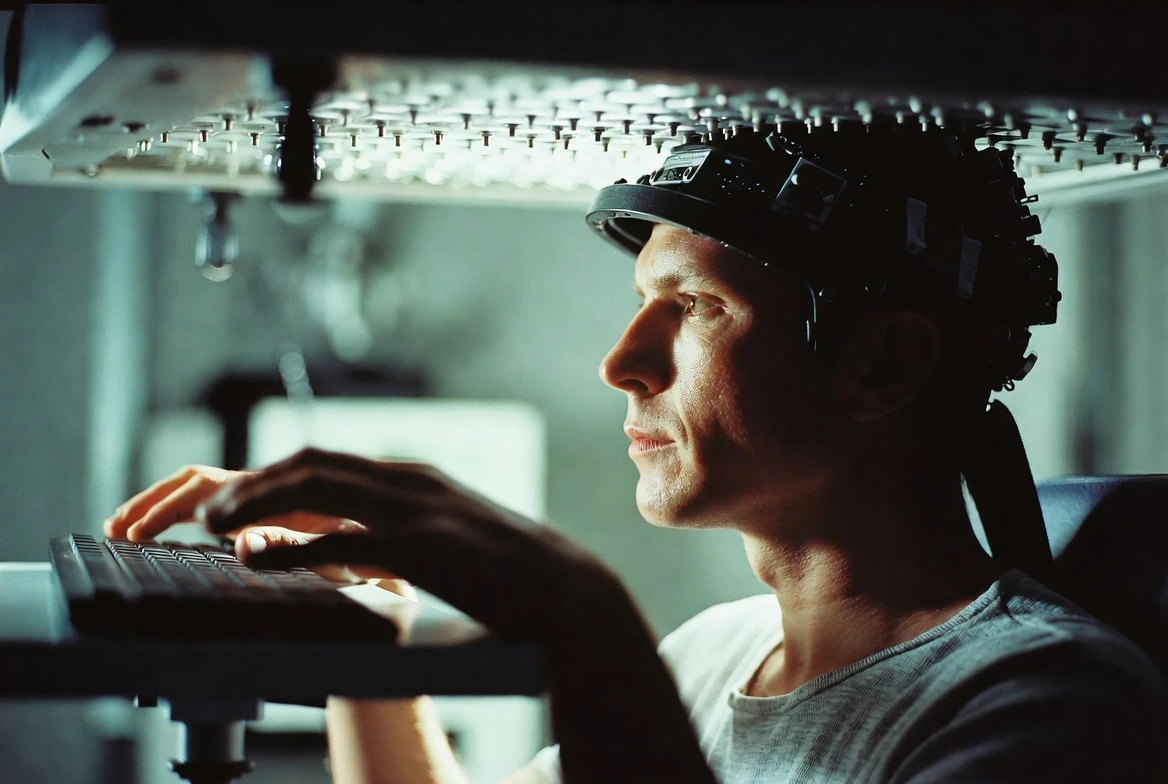
Meta trained Brain2Qwerty v2 on approximately 22,000 sentences from nine volunteer participants, each recorded for about 10 hours wearing an MEG device while actively typing on a keyboard. That is roughly ten times more data per participant than the v1 model, which trained on around 2,200 sentences per subject. The new architecture abandons the old approach of detecting individual keystrokes and generates sentences directly from a continuous recording of brain activity. Letters, words, and sentences are decoded jointly through three hierarchical modules inside that continuous stream.
The Numbers Behind the Accuracy Jump
Brain2Qwerty v2 reaches a word accuracy rate of 61% across the nine participants, a level Meta describes as significantly above the roughly 8% word accuracy posted by other non-invasive methods. For its best participant, the system hit 78% word accuracy, with more than half of all decoded sentences containing one word error or less. The worst participant’s performance still trailed the best by enough margin to highlight how variable the technique is across individuals.
The jump from v1 to v2 is the clearest payoff yet for the field’s bet on data scaling. v1 hit 40% word accuracy on average and 48% for its best participant. v2 reaches 61% mean word accuracy and 78% for its best participant, on training data that grew from about 2,200 to about 22,000 sentences per subject. Meta said decoding accuracy improves log-linearly with data volume, and the curve shows no detectable plateau as the dataset grows.
| Metric | Brain2Qwerty v1 | Brain2Qwerty v2 |
|---|---|---|
| Training sentences per participant | ~2,200 | ~22,000 |
| Mean word accuracy | 40% | 61% |
| Best-participant word accuracy | 48% | 78% |
| Real-time sentence decoding | No | Yes |
| Surgical implant required | No | No |
v2 used the same MEG hardware and the same encoder architecture as v1, scaled up with ten times more training sentences per participant. The Brain2Qwerty project page compares v1 and v2 in side-by-side tables and lists the v2 dataset as “embargoed until journal publication.” The authors add that the curve shows no detectable plateau as the dataset grows, a pattern they describe as suggesting the gap to surgical systems can be narrowed further with more data.
How the System Reads Brain Signals
The pipeline starts with a 306-channel Megin magnetoencephalography scanner, a helmet-shaped device that picks up the magnetic fields produced by neural activity. Raw MEG signals feed into a CTC-trained encoder that decodes characters asynchronously, without needing to know when each key was pressed. That change from v1, which required precise keystroke timing, is what enables real-time sentence generation. The encoder uses a BrainModule, a convolutional feature extractor combined with subject-specific spatial merging, followed by a 4-layer Conformer trained with a Connectionist Temporal Classification objective.
A word aligner sits between the encoder and the language model, learning to bridge MEG embeddings with the word-level embedding space of a Qwen3-4B large language model through a SigLIP contrastive loss. The LLM is fine-tuned per subject with Low-Rank Adaptation, then merged across all nine subjects through a technique the team calls Model Soup. The result is a single adapter that, the authors report, outperforms per-subject and jointly trained adapters as LLM size scales from 0.6B to 4B parameters. AutoResearch agents (Cursor, powered by Claude Opus 4.6) ran optimization rounds to find the best hyperparameters. Engineers selected the final configurations manually, with Meta reporting the agents explored learning rate, weight decay, LoRA rank, and batch size.
Fine-tuning LLMs on neural data lets the system use semantic context to bridge the gap between noisy brain recordings and coherent language. The LLM receives both CTC character predictions and the MEG-derived word embeddings, then autoregressively generates the decoded sentence. Removing the MEG tokens from this input degrades performance by 5.6 percentage points of word error rate, an ablation result that confirms the model is actively reading neural signal. Without the MEG stream, the LLM would only be cleaning up character-level noise.
The team’s central finding is a log-linear scaling law between data volume and accuracy, with the curve showing no detectable plateau as more training sentences are added. Pearson correlation between log10(hours) and character error rate sits at minus 0.99 across the experiments. In a controlled experiment, 128 unique sentences at 2 repetitions produced lower character error than 256 unique sentences at 1 repetition (0.45 vs 0.65, p under 0.001).
Closing In on Surgical Accuracy
Invasive BCIs read neural activity from electrodes placed directly on the motor cortex, picking up clean, high-resolution signals that have let paralyzed patients type at near-natural rates. Those gains come with neurosurgery, infection risk, and long-term implant maintenance that make scaling to millions of patients impractical. Meta’s pitch with Brain2Qwerty v2 is that the gap to those surgical results is no longer exclusive to surgery. The two invasive methods Meta singles out (stereotactic EEG and electrocorticography) both require surgical implants, while Brain2Qwerty v2 needs only an MEG helmet. That distinction is what gives the v2 announcement its clinical weight, even at 61% word accuracy.
Brain2Qwerty v2 recovers sentences coherently from noisy neural inputs, achieving a word accuracy rate of 61%, significantly improving upon the 8% word accuracy from other non-invasive methods. And for our best participant, we achieve a 78% word accuracy, where more than half of all sentences are decoded with one word error or less.
Meta said the technology is approaching levels of accuracy previously exclusive to techniques that require brain surgery. The team has not yet published a head-to-head benchmark against any specific implanted system. The gap to the best invasive numbers remains large. What v2 establishes is that scaling can keep closing it.
Meta reports that decoding accuracy improves log-linearly with data volume, with the curve showing no detectable plateau as more training sentences are added. That scaling pattern, common in deep learning but rarely so cleanly visible in a neuroscience system, is what underwrites the rest of the announcement. v1 reached 40% mean word accuracy; v2 reaches 61%, after Meta trained it on ten times more data per participant. The team’s position is that with larger datasets the performance gap with surgical approaches could be further narrowed through data scaling alone. Practical validation of that claim will require studies in the patient population the technique is meant to serve, none of whom have been enrolled yet.
- 61%: Brain2Qwerty v2 mean word accuracy
- 78%: best participant’s word accuracy
- ~8%: word accuracy of earlier non-invasive methods
- ~22,000: training sentences per participant
- 9: healthy volunteers in the study
What Still Stands in the Way
Meta is direct about the two problems that have to be solved before Brain2Qwerty v2 can move into clinics. First, decoding performance is not yet good enough for everyday use; the system still makes too many word-level and character-level errors to be practical. The errors it does produce are grammatical but lexically wrong, the difference between decoding “my homework is due tomorrow” when the participant typed “cars are not allowed on this road.” That makes the output readable but unreliable for anything that demands accuracy.
Second, the MEG device used in the study is a large scanner, “a setup inaccessible to most patients,” Meta’s own project page reads. The 306-channel Megin system requires a magnetically shielded room and cannot be worn outside a lab. Patients cannot take a clinical scanner home, which alone blocks the path from research to daily use. Optically pumped magnetometer (OPM) MEG helmets, which are wearable and run at room temperature, are the most plausible path to a portable version. Meta reports that a 153-sensor OPM-class helmet costs only about 5.7 additional percentage points of word error rate against the full 306-channel system.
The clinical target population is also an open problem. All nine participants in the study were healthy, right-handed, proficient typists, exactly the kind of subject who can produce the labeled training data the system needs, and adapting the pipeline to ALS patients, who cannot generate the same kind of keystroke data, is the critical open problem the team flags in its paper. Inter-subject variability adds a third: N-gram character error rate ranged from 17.1% for the best subject to 41.0% for the worst, a spread the team says subject-level consistency will have to address before the system can move out of the lab.
Open Release and the Brain-Decoding Race
Meta is releasing the full training code for both Brain2Qwerty v1 and v2 through GitHub, alongside the v1 dataset from BCBL. The v2 dataset remains embargoed until the journal publication lands, but the code (including the CTC encoder, the word aligner, and the LLM fine-tuning pipeline) is open for researchers to extend. The release sits inside Meta’s wider Digital Brain Project, backed by a $5 million fund to stimulate open neuroscience datasets. The company frames the move as part of its open-source research ethos, an argument the company has applied across its Llama and computer-vision work.
The competitive field is moving on parallel tracks. Neuralink and Synchron are developing implantable BCIs aimed at the same patient population. Merge Labs, backed by Sam Altman, is also developing technology to restore communication for patients with neurological diseases. Non-invasive players are advancing in parallel: Neurable’s EEG-based headphones measure focus and fatigue, while MIT spinoff AlterEgo reads neuromuscular signals from the face and neck. Meta’s announcement signals that the race to decode brain signals is expanding from surgical implants to AI-driven non-invasive pipelines, a shift the company says could change which patient populations the technology reaches first.
Frequently Asked Questions
What is Meta’s Brain2Qwerty v2?
Brain2Qwerty v2 is an AI system published by Meta FAIR on June 25, 2026, that decodes typed sentences from non-invasive magnetoencephalography (MEG) brain recordings. It is the second iteration of an architecture first introduced in 2025 and recently accepted at Nature Neuroscience.
How accurate is Brain2Qwerty v2?
Brain2Qwerty v2 reaches a 61% word accuracy rate across nine participants on average, rising to 78% for the best participant. Meta reports that more than half of all decoded sentences for the best participant contain one word error or less, while the average across all subjects is significantly above the roughly 8% word accuracy posted by other non-invasive methods.
Does Brain2Qwerty v2 require brain surgery?
No. Brain2Qwerty v2 reads brain activity from a magnetoencephalography (MEG) helmet placed over the head. It does not require any surgical implant, unlike techniques such as stereotactic electroencephalography or electrocorticography, which need electrodes placed on or in the motor cortex.
When could patients use Brain2Qwerty v2?
Meta has not set a clinical timeline. The company has identified two remaining challenges: the system still makes too many word-level and character-level errors for everyday use, and the MEG scanner used in the study is too bulky for most patients. Wearable OPM-MEG helmets and larger datasets are the paths the team is pointing to next.
How does Brain2Qwerty v2 compare to Neuralink?
Neuralink and other invasive BCI companies have demonstrated higher word accuracy and faster typing speeds for paralyzed patients, but at the cost of brain surgery. Brain2Qwerty v2 is non-invasive and reached 61% word accuracy without an implant, with Meta reporting that the gap with surgical approaches narrows as more training data is added.
Disclaimer: This article reports on a research-stage AI system. The findings described are from a Meta-led study; the v1 architecture has been peer-reviewed at Nature Neuroscience and the v2 results are reported in a Meta preprint. Readers with neurological conditions should consult qualified medical professionals for any communication-aid decisions.


South Korea Retail Investors Face Reckoning After KOSPI AI Rally Collapses

Surrey AI Maps Three Heart Attack Paths and Their Molecular Roots

Germany Locks Neutral Apple ATT Prompts Across Most of Europe

Apple’s 5% EU Fee Quietly Rewrites Alternative App Store Math

Apple’s EU Fee Truce Cuts Complexity but Leaves Rivals Fuming

Pixel 11 Pro Fold Trades Thinness for Durability and Seven-Year Stay

Mayo AI Flags HCM Obstruction From Everyday Ultrasound Videos

Indian Brands Quietly Scale Landmark Screens and Home Tech

Navin Vatsa Turns Grief Into a Lifetime of Quiet Seeing

Google Bets Pixel 11 Agentic AI Will Redefine Phones

Oracle Cuts 21,000 Jobs in a Year, Cites AI in 10-K Filing

Fable 5 and Mythos 5 Return as US Lifts Anthropic Export Controls

SpaceX’s Google Deal Turns a Rocket Company Into a Cloud Landlord

CD Projekt Red Co-CEO: Redemption Arc Isn’t Done, Witcher 4 in 2027

XPL Rallies 30% Ahead of Plasma One Card Tier Launch

Google Search Profiles Build a Follow Graph Inside Discover

DGO App Brings Rs 549 Mobile Pass for FIFA World Cup 2026 in Nepal

Moonshot AI Targets $30 Billion in China’s Fastest AI Funding Sprint

Oppo’s ColorOS 17 Eligibility List Leaves A-Series Buyers Behind

Microsoft Xbox Layoffs Start in July as Sharma Slams 3% Margin
-
 AI2 months ago
Oracle Cuts 21,000 Jobs in a Year, Cites AI in 10-K Filing
-
 AI2 months ago
Fable 5 and Mythos 5 Return as US Lifts Anthropic Export Controls
-
 AI2 months ago
SpaceX’s Google Deal Turns a Rocket Company Into a Cloud Landlord
-
 GAMING2 months ago
CD Projekt Red Co-CEO: Redemption Arc Isn’t Done, Witcher 4 in 2027
-
 CRYPTO2 months ago
XPL Rallies 30% Ahead of Plasma One Card Tier Launch
-
 NEWS3 months ago
Google Search Profiles Build a Follow Graph Inside Discover
-
 APPS2 months ago
DGO App Brings Rs 549 Mobile Pass for FIFA World Cup 2026 in Nepal
-
 AI2 months ago
Moonshot AI Targets $30 Billion in China’s Fastest AI Funding Sprint