
NEWS
How to Unfreeze a Frozen Bank Account in India After a Cyber Complaint

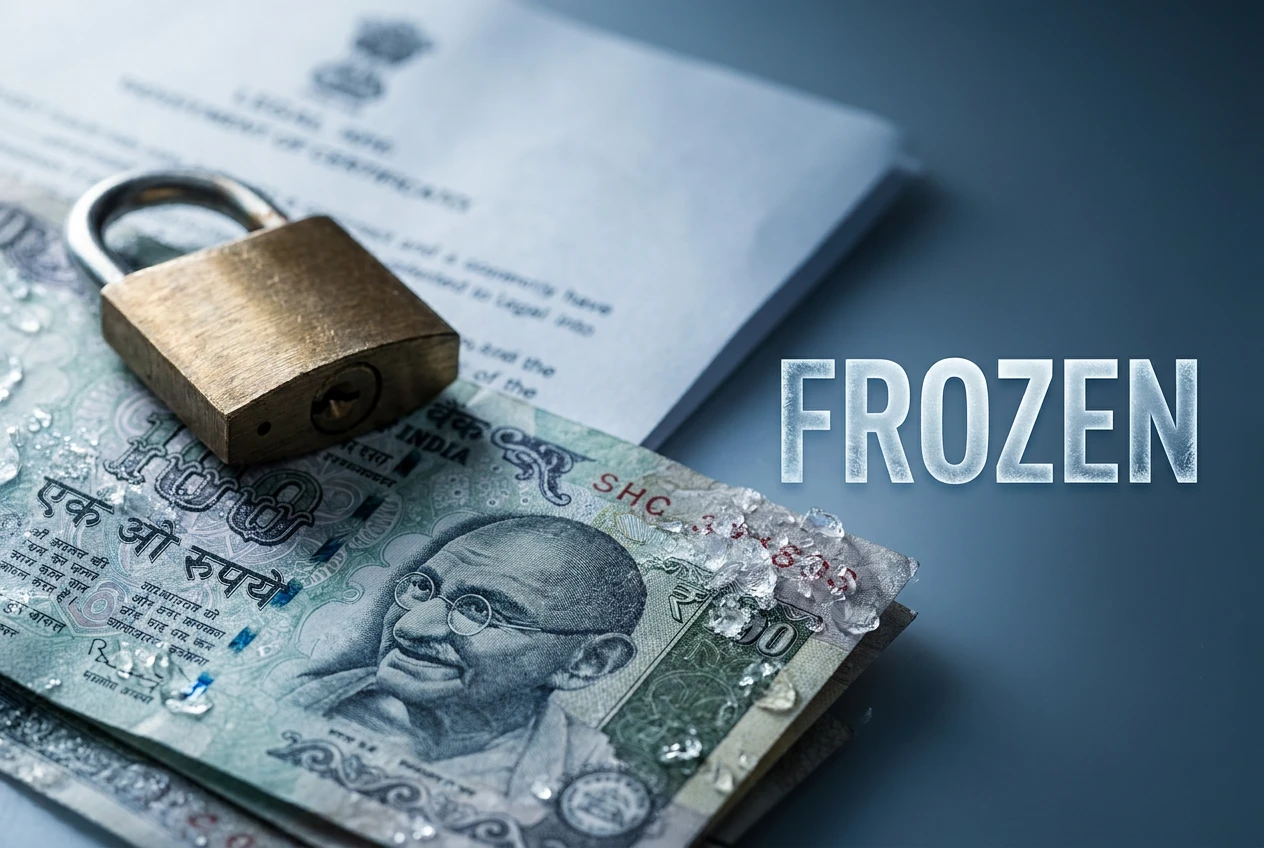
A credit of a few hundred rupees from a person you have never met can lock every rupee you own. That is how a growing number of Indians learn that their bank account has been “debit frozen” after a cyber crime complaint brushes against a payment that once passed through it. To unfreeze a frozen bank account in India, you can demand the written legal basis for the freeze, file a ten rupee Right to Information request to confirm no case actually names you, cite the recent court rulings that limit any freeze to the disputed amount, and take the matter to a magistrate or the High Court if the bank still refuses.
None of that is obvious from the counter at your branch, where the standard answer is some version of “cyber police told us to do it.” The law and a run of recent judgments say otherwise, and they say it clearly enough that ordinary account holders are starting to win.
Why a Small Credit Can Lock Your Entire Balance
When someone is defrauded online, the money rarely sits still. The scammer moves it from the victim to a first account, then to a second, then a third, passing it through a chain that investigators call layers. By the time it reaches “Layer 3” or “Layer 5,” the final recipient may have no idea the funds are tainted. A widely shared Reddit account from a user posting as HauntedAlgorithm described exactly this: a ₹175 credit landing in Layer 3 that triggered a freeze on an account holding ₹18.6 lakh (about US$22,000).
Most of these freezes start with a complaint to the 1930 helpline or the online portal run by the Indian Cybercrime Coordination Centre (I4C, the unit under the Ministry of Home Affairs that coordinates cyber fraud response). The system then flags every downstream account that touched the money and asks each bank to block it.
The people caught this way are usually not accused of anything. They are sellers, freelancers, and peer to peer (P2P, person to person) crypto traders who received a normal looking payment. The trade most associated with these freezes is P2P cryptocurrency, where a buyer’s “clean” payment can turn out to be a fraud victim’s stolen money.
- Layer 1 is the fraud victim’s own account, where the money first leaves.
- Layers 2 to 5 are the relay accounts the money is pushed through to break the trail.
- The final recipient can be frozen even with no direct link to the scam, simply for sitting at the end of the chain.
Lien Versus Debit Freeze, the Setting That Decides Your Access
The single most useful thing to understand is that there are two very different ways a bank can restrict your account, and the gap between them is the gap between an inconvenience and a crisis. A lien blocks only a named sum. A debit freeze locks the whole account, including money that has nothing to do with any complaint.
Investigators in several states say they ask banks to mark a lien on the disputed amount only. Banks, wary of getting it wrong, often freeze everything instead. That mismatch is the source of most of the misery, and it is exactly what the courts have started to attack.
| Feature | Lien (mark) | Debit freeze |
|---|---|---|
| Amount affected | Only the specific disputed sum | The entire account balance |
| Use of remaining money | Allowed | Blocked |
| Salary and EMI flows | Continue normally | Stop entirely |
| What courts now favour | The default in fraud trails | Only when circumstances justify it |
What Sections 106 and 107 of the BNSS Demand
The power to touch your account during an investigation used to live in Section 102 of the Code of Criminal Procedure (CrPC, the old criminal procedure code). Since July 2024 it sits in the Bharatiya Nagarik Suraksha Sanhita, 2023 (BNSS, India’s replacement for the CrPC), under Sections 106 and 107.
The distinction between those two sections is where many freezes fall apart. A police officer can seize property under Section 106, but Section 106(3) requires that officer to report the seizure to the jurisdictional magistrate at once. Actual attachment or freezing of a bank account is a higher bar, reserved for Section 107 and a magistrate’s order.
In plain terms: a cyber cell that emails your bank and walks away has not completed the process the law lays out. Courts have called that reporting duty a substantive condition, not paperwork, because it is the moment a judge first gets to check whether the freeze is fair. If the magistrate was never told, the freeze is legally exposed no matter where the original complaint was filed.
You can ask the bank, in writing, under which section it acted and whether a magistrate was informed within the required time. If you anchor your demand in P2P or small downstream credits, also confirm the freeze was meant as a lien on a named figure. The portal that generated the complaint, India’s National Cyber Crime Reporting Portal, leaves a paper trail your bank can be pushed to produce.
The High Court Rulings That Moved the Line
The reason this is winnable now, and was much harder two years ago, is a cluster of judgments that have hardened into a clear principle: a freeze must be proportionate to the suspected fraud.
Madras Set the Proportionality Test
In Mohammed Saifullah versus the Reserve Bank of India and others (W.P. No. 25631 of 2024), Justice G Jayachandran of the Madras High Court ruled on 17 September 2024 that police cannot freeze an entire account without quantifying the amount tied to the fraud. The petitioner’s account held ₹9,69,580, while only ₹2,48,835 was under suspicion in a Telangana cyber case.
The court ordered the bank to de-freeze the account and keep a lien on just ₹2,50,000, slightly above the disputed figure, until the probe ended. Freezing the rest, the judge held, violated the petitioner’s right to carry on trade and business. You can read the full text of the Madras High Court order for the exact wording.
Delhi and Bombay Narrowed Police Power
In January 2026, in Malabar Gold and Diamond Ltd versus Union of India (2026 SCC OnLine Del 297), Justice Purushaindra Kumar Kaurav of the Delhi High Court drew the Section 106 and 107 line sharply.
Attachment or freezing of bank accounts can be undertaken only under Section 107 of the BNSS and strictly upon orders of a competent Magistrate.
That observation came in the Delhi ruling, which also held that blanket freezing of an account belonging to someone who is neither an accused nor a suspect is arbitrary and breaches Articles 19(1)(g) and 21 of the Constitution. The Bombay High Court reached a similar conclusion, finding that an investigating agency has no power to debit freeze accounts under Section 106 at all.
Why the Location of the Complaint Does Not Save the Freeze
A common excuse is that the case sits in another state, so nothing can be done locally. The judgments cut against that. The magistrate who matters is usually the one with jurisdiction over where the account is held, and the reporting duty attaches regardless of which city the First Information Report (FIR, the police’s initial case record) was registered in.
That removes the most common stalling tactic, the demand that you travel hundreds of kilometres to a distant police station before anyone will help.
The Route to Getting Your Money Released
Knowing the law is one thing. Moving a reluctant branch manager is another. The sequence below follows what has actually worked, escalating only as far as you need to.
Start polite and on paper. Most of your leverage comes from forcing the bank to put its reasons in writing, because a freeze that cannot be justified in writing is one a bank does not want to defend in court.
- Get the basis in writing. Ask the bank for the email or notice from the cyber cell, the section relied on, and whether a magistrate was informed. A refusal to share is itself useful later.
- File a ten rupee RTI. Send a Right to Information request to the relevant police authority asking whether any case is registered against you in that district or state. Many holders get a clean “no,” which is powerful proof you are an innocent downstream party. The central government’s online RTI portal handles requests to central agencies.
- Demand proportionality. Cite the Madras ruling and ask the bank to convert any debit freeze into a lien on the disputed sum so your salary, EMIs and the rest of your balance move again.
- Escalate publicly if ignored. Tagging the district and state police on X has, for many, produced a callback within a day when emails went unanswered.
- Go to the magistrate or High Court. If the freeze flows from a police instruction, a representation to the jurisdictional magistrate may suffice. If it flows from a court order, a writ petition in the High Court is the route, and recent orders are squarely on your side.
A Crackdown That Froze 8.5 Lakh Accounts
The personal stories sit inside a national drive of enormous scale. As authorities chase mule accounts, the dragnet has pulled in legitimate holders by the hundreds of thousands, which is why these freezes feel less like bad luck and more like a system working exactly as designed.
The numbers explain the volume of complaints, and the volume of collateral damage. Reported losses are now large enough to register against the wider economy, and the freezing pace has accelerated as fraud networks shift between banks.
- 8.5 lakh mule accounts frozen in one coordinated drive, spread across roughly 700 branches, after an earlier round of about 4.5 lakh.
- 2.8 million cybercrime complaints logged in 2025, up sharply on the year before.
- ₹22,495 crore (around US$2.7 billion) in reported losses over that period, a figure officials peg near 0.7% of GDP.
How to Lower Your Exposure
You cannot fully insulate yourself, because you do not control who sends you money. You can shrink the blast radius so that one bad credit never traps your main savings. The cheapest insurance is keeping your daily inflows away from the account that holds anything you cannot afford to lose for months.
A few habits go a long way, and they matter even more for anyone trading crypto P2P or selling to strangers online. Be alert, too, to scams that target people who have already lost money to fraud, since a freeze can make you a fresh mark for fake “recovery” agents.
- Keep a separate, low balance account for daily transfers and never park serious savings in it.
- Send unexpected or unexplained credits back promptly, and keep a record when you do.
- Avoid receiving P2P crypto payments into your salary or savings account.
- Save copies of every freeze notice, RTI reply and bank communication as you go.
If banks adopt proportionate liens as the default the way the courts now expect, the worst version of this problem fades. If they keep blanket freezing first and asking questions later, the magistrate and the writ petition will stay the only reliable way ordinary holders get their own money back.
Frequently Asked Questions
Can the police freeze my entire bank account for one small suspicious credit?
No, not lawfully in most cases. The Madras High Court held that an investigating agency cannot freeze a whole account without quantifying the fraud amount, and the Delhi High Court has called blanket freezes of non suspects arbitrary. The freeze should be limited to the disputed sum through a lien.
What is the difference between a lien and a debit freeze?
A lien blocks only a specific named amount and lets you use the rest of your balance. A debit freeze locks the entire account, so salary, EMIs and every other rupee stop moving. Courts now favour a lien on the disputed amount as the default.
How do I find out why my account was frozen?
Ask the bank in writing for the notice or email from the cyber cell, the BNSS section relied on, and whether a magistrate was informed within the required time. If it refuses, that refusal becomes useful evidence when you escalate to a magistrate or the High Court.
Does filing an RTI to check for a case cost money?
Yes, but only a token fee of ten rupees for central public authorities. You ask whether any case is registered against you in the relevant district or state. A reply confirming no case strengthens your claim that you are an innocent downstream recipient.
How long does it take to unfreeze an account?
It varies widely. Some holders resolve a police led freeze in weeks once they push the bank with an RTI reply and the proportionality rulings. A court ordered freeze that needs a writ petition can take months, and some accounts have stayed locked far longer.
Can I claim compensation for losses while my account was frozen?
Usually not from the bank, which is obliged to comply with law enforcement instructions. Suits over lost investment returns are generally dismissed because investigators can cite reasonable cause, so the practical goal is faster release, not damages.
Which BNSS sections apply now that the CrPC is replaced?
Look to Section 106 and Section 107 of the BNSS, which took over from Sections 102 and 91 of the old CrPC. Section 106 covers seizure with a duty to report to a magistrate, while actual freezing requires a magistrate’s order under Section 107.
Disclaimer: This article is for informational purposes only and is not legal advice. Bank account freezing under the BNSS and related cyber crime procedures is fact specific, and outcomes depend on your circumstances. Consult a qualified advocate before acting. Figures, case citations and statistics are accurate as of publication.


A20 Pro’s 18% Gain Is Process Math, Not a Chip Promise

OnePlus Nord and N hikes push major-brand sub-20K 5G out of reach

Snowflake routes AI tasks to cut spend inside its data cloud

Joe Hisaishi’s Guinness haul shows Ghibli packing classical halls

Cyberleek’s GTA 6 drops attack digital sales while selling a token

Hybrid model pins X-ray landmarks under 1.5 mm for surgery plans

Free Android AI Apps Quietly Replace Laptop Study and Design Work

Apple and Google Betas Lock Hardware Gates Before September

Memory Crunch Splits Apple iPhone 18 Lineup Into Premium Fall and Thinned Spring

Samsung Galaxy Z Fold 8 wider shape finally suits everyday users

Fable 5 and Mythos 5 Return as US Lifts Anthropic Export Controls

Oracle Cuts 21,000 Jobs in a Year, Cites AI in 10-K Filing

SpaceX’s Google Deal Turns a Rocket Company Into a Cloud Landlord

CD Projekt Red Co-CEO: Redemption Arc Isn’t Done, Witcher 4 in 2027

XPL Rallies 30% Ahead of Plasma One Card Tier Launch

Google Search Profiles Build a Follow Graph Inside Discover

DGO App Brings Rs 549 Mobile Pass for FIFA World Cup 2026 in Nepal

Moonshot AI Targets $30 Billion in China’s Fastest AI Funding Sprint

Oppo’s ColorOS 17 Eligibility List Leaves A-Series Buyers Behind

Microsoft Xbox Layoffs Start in July as Sharma Slams 3% Margin
-
 AI2 months ago
Fable 5 and Mythos 5 Return as US Lifts Anthropic Export Controls
-
 AI2 months ago
Oracle Cuts 21,000 Jobs in a Year, Cites AI in 10-K Filing
-
 AI2 months ago
SpaceX’s Google Deal Turns a Rocket Company Into a Cloud Landlord
-
 GAMING2 months ago
CD Projekt Red Co-CEO: Redemption Arc Isn’t Done, Witcher 4 in 2027
-
 CRYPTO2 months ago
XPL Rallies 30% Ahead of Plasma One Card Tier Launch
-
 NEWS2 months ago
Google Search Profiles Build a Follow Graph Inside Discover
-
 APPS2 months ago
DGO App Brings Rs 549 Mobile Pass for FIFA World Cup 2026 in Nepal
-
 AI2 months ago
Moonshot AI Targets $30 Billion in China’s Fastest AI Funding Sprint