
NEWS
One UI 8.5 Lands on Galaxy A07 5G, A17 and Tab S10 Tablets

Samsung expanded the stable One UI 8.5 rollout to a fresh wave of Galaxy phones and tablets this week, three weeks after the update reached the Galaxy S25 series. The additions include the Galaxy A07 5G, Galaxy A17 4G, Galaxy A26, Galaxy M56, the rugged XCover 7 Pro, the Tab S10 and Tab S9 ranges, and the Tab A11 budget tablets.
The cadence is unusually fast for Samsung’s budget cycle. Hardware tier still decides which features make the cut once the firmware lands on a cheaper screen.
The Devices That Just Joined the Wave
The new entries reach deeper into Samsung’s catalog than any prior week-three Galaxy update in recent memory. Firmware deployments tracked across multiple regions over the past 72 hours confirm coverage that stretches from sub-$200 entry phones to enterprise-grade rugged tablets.
- Galaxy A26 (mid-range, 6.7-inch AMOLED)
- Galaxy XCover 7 Pro (ruggedised enterprise handset)
- Galaxy A35 and Galaxy A55 (upper mid-range)
- Galaxy Tab S10+, Tab S10 Ultra and Tab S10 Lite (current flagship tablets)
- Galaxy Tab S9, Tab S9+, Tab S9 Ultra and Tab S9 FE (Fan Edition, prior-generation flagship tablets)
- Galaxy Tab Active 5 and Tab Active 5 Pro (ruggedised tablets)
- Galaxy A17 4G (entry-level handset)
- Galaxy M56 (online-only mid-range)
- Galaxy Tab A11 and Tab A11+ (budget tablets)
- Galaxy A07 5G (Samsung’s cheapest current 5G phone)
Last weekend’s opening wave was almost entirely premium: the Galaxy S25 family, the Galaxy Z Fold 7, the Z Flip 7, and a handful of upper-tier A-series phones. This week’s roster moves the floor down to the cheapest 5G phone Samsung currently sells, while the top of the lineup stays the territory of devices like the Galaxy Z Fold 8 Wide and its premium feature stack.
That floor matters. The cheapest of the bunch launched globally in late 2025 as a sub-$200 entry-level handset for emerging markets, where it competes against entrants from Xiaomi’s Redmi A line and Realme’s C series. Phones in that bracket have historically been treated as one-and-done devices by their manufacturers, shipped with the OS version installed at launch, then largely abandoned at the firmware level. Pulling such a device into a current-version stable rollout three weeks behind the flagship is the part of this announcement worth pausing on.
Why This Cadence Is Unusual for Samsung
Samsung’s annual OS (operating system) cycle has historically taken months to reach budget A-series phones once the S-series received it. In the One UI 7 cycle, the gap between the Galaxy S24’s January 2025 update and the Galaxy A05’s eventual rollout stretched closer to four months, with several mid-tier models slotted between.
This cycle compresses that timeline aggressively.
- 3 weeks from the flagship stable rollout start to the entry-tier handset queue
- 11 product lines added in this week’s wave
- 4 tablet ranges updated in one push: Tab S10, Tab S9, Tab Active 5 and Tab A11
- 2 enterprise models included: XCover 7 Pro and Tab Active 5 Pro
The signal sits in the rugged and enterprise inclusions. XCover and Tab Active devices serve fleet buyers who weigh software-support windows when they sign three-year procurement contracts. Putting them in week three rather than month three is a sales-cycle move.
Samsung publicly committed to seven years of OS upgrades for its S24 and newer flagships, and four years for newer Galaxy A devices. The faster cadence keeps that promise visible on the firmware screen, not just in the marketing slide. For context on how the budget segment is being squeezed by competing 5G entrants this season, see our comparison of the Moto G37 Power, Oppo K14x and Galaxy M17 5G, where software-support length is one of the few clear differentiators against newer Chinese rivals.
The Awesome Intelligence Tier Cap
Owners of Samsung’s entry-tier devices should manage expectations. Samsung organises its on-device AI into two visible tiers: the full Galaxy AI suite, reserved for the S25 family and current foldables, and a smaller bundle the company labels Awesome Intelligence, which it allocates to Galaxy A, M and F series phones from the last three generations.
Features That Trickle Down
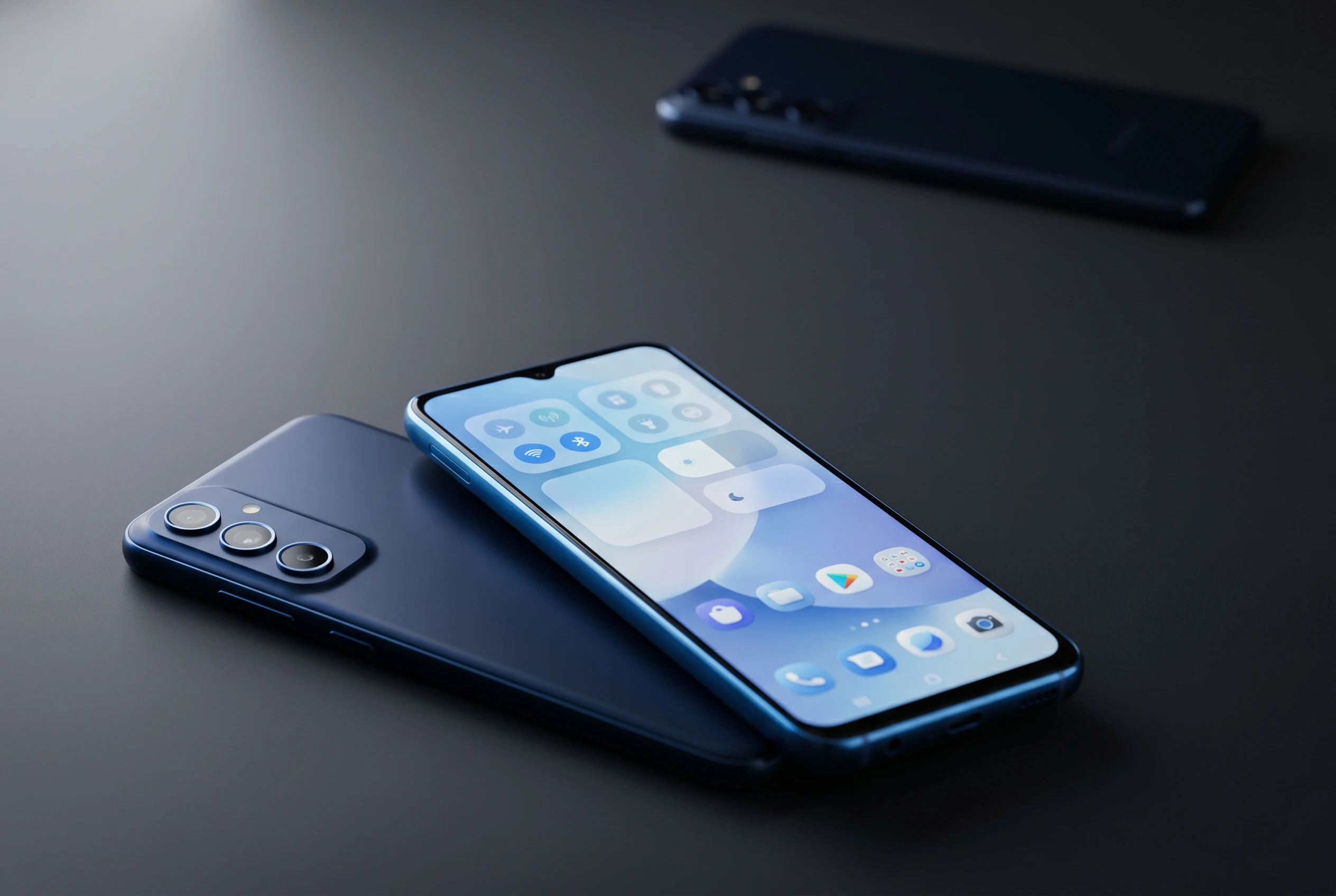
Budget owners get the headline visual changes Samsung calls the Liquid Glass overhaul: frosted-glass surfaces across the system shell, redesigned 3D app icons, a fully customisable Quick Settings panel that allows toggles to be moved, resized or removed, and reworked Clock and Voice Recorder apps. Quick Share interoperability with Apple’s AirDrop is also part of the base package, letting Galaxy users push files directly to an iPhone or Mac.
The mid-tier bundle that A-series owners can expect covers AI Call Screening, which transcribes unknown callers in real time, the Audio Eraser tool for stripping background noise from voice recordings and video, and a constrained version of Creative Studio for on-device wallpaper and sticker generation. Always-on Display now offers a wake-up animation that radiates from the point of touch, and lock-screen clock styles expand from one to four selectable layouts. None of those require the NPU (Neural Processing Unit, the specialised AI chip block) horsepower the flagships enjoy.
Features That Stay Premium
The agentic Bixby that can chain tasks across multiple apps using plain-language instructions stays on the flagship tier. So does the full Creative Studio with generative outfit-swap and object-removal, the Now Brief contextual summary card on the home screen, and the deeper personalised AI tasks tied to on-device processing budgets the cheaper system-on-chips cannot meet.
The boundary line tracks Samsung’s strategy of using AI as the premium differentiator now that screen size, refresh rate and 5G connectivity have commoditised at the mid-tier. The cheaper devices get the look. The pricier devices keep the brain.
| Feature | Galaxy S25 / Z Fold 7 | Galaxy A35 / A55 | Galaxy A17 / A07 5G |
|---|---|---|---|
| Liquid Glass UI shell | Yes | Yes | Yes |
| Reworked Quick Panel | Yes | Yes | Yes |
| Quick Share to AirDrop | Yes | Yes | Yes |
| Awesome Intelligence bundle | Folds into Galaxy AI | Yes | Subset only |
| Full Galaxy AI suite | Yes | No | No |
| Agentic Bixby across apps | Yes | No | No |
The Korea-First, Then Everywhere Else Pattern
The wider rollout is not uniform. Samsung’s pattern this cycle has been to push firmware to its home market first, watch for hot-fix issues, then expand outward. Last weekend, the cheapest of the new entries reached shelves in Malaysia, Taiwan, Thailand, the Philippines and Vietnam first; the Galaxy A26 followed a similar Southeast-Asia-led path before a wider expansion this week.
This week’s batch is a mix. Some models, like the Tab S10 series, kicked off in South Korea and are still propagating outward. Others, including the M56 and the Tab A11+, are landing globally as of this week. Imported handsets, common in markets like Kenya where unofficial retail channels move faster than Samsung’s local distributors, may receive the update at a different time than the same SKU bought through a Samsung Kenya store.
The practical implication: two friends holding the same A-series handset may see the update prompt arrive days or weeks apart depending on which region’s CSC (Consumer Software Customization, the firmware variant code Samsung uses to localise builds) is on the device. The CSC code is visible in Settings under About Phone, and changing it requires firmware-flashing tools Samsung does not officially endorse.
Tablets Got the Sweep, Not Just Phones
The tablet inclusion is the under-reported half of this week’s wave. Four ranges landed at once: the current flagship Tab S10, the prior Tab S9, the rugged Tab Active 5 and the budget Tab A11. That covers Samsung’s entire current tablet portfolio with the exception of the Tab S11 and Tab S10 FE, both already updated earlier in the cycle.
For tablet owners, the visual overhaul matters more than on phones because tablets sit in the orbit of laptops and creator workflows where window management, multi-app Quick Panel access and Apple-compatible Quick Share carry direct productivity weight. The Tab S9 FE getting the same shell as the premium flagship variant collapses a feature gap that until now was a meaningful upsell pitch.
The ruggedised business tablet inclusion is the bigger structural signal. Field-deployment fleets in logistics, utilities and field services run on these devices, and a software-feature-parity guarantee at week three reshapes how IT buyers evaluate Samsung versus the iPad and Microsoft Surface alternatives.
Beyond the consumer-product angle, the FE variant and entry-level tablet inclusion has classroom-procurement implications. Education-sector tablet contracts in markets like Kenya, India and Indonesia favor the cheaper FE and A-series tablets for one-to-one student deployment, and a current-version system makes those devices more defensible when school boards weigh them against alternatives.
Settings, Software Update, Download and Install
For owners of any device on the list, the manual check route runs through Settings, then Software Update, then Download and Install. The over-the-air package weighs several gigabytes for major version upgrades, so Samsung recommends a stable Wi-Fi connection and battery above 50 percent before tapping install.
Phones running an imported firmware variant will need to wait until Samsung pushes the build for the device’s CSC code. There is no supported way to side-load the firmware from a different region without unlocking the bootloader, which voids the warranty on most carriers.
If the update is not yet visible, the device is queued rather than excluded. Samsung’s published rollout calendar runs into June, with remaining lower-tier A-series devices expected to follow this batch within two to four weeks. The official rollout details are documented on Samsung’s global newsroom page for the One UI 8.5 launch, and the company’s overview of current One UI capabilities sits on its consumer site.
The closing test for this rollout is what happens when the remaining Galaxy A16 5G, Galaxy A15 5G and older A06 family come up. Those devices were promised four years of OS upgrades when launched, and this wave is one of those years being delivered on schedule.
If Samsung holds the May pace through June, the next generation of sub-$200 Android buyers will inherit a software-support expectation Korean OEMs (original equipment manufacturers) have never set publicly. If the pipeline stalls before the A16 hits, the entry-tier sweep becomes an outlier rather than the new baseline.


South Korea Retail Investors Face Reckoning After KOSPI AI Rally Collapses

Surrey AI Maps Three Heart Attack Paths and Their Molecular Roots

Germany Locks Neutral Apple ATT Prompts Across Most of Europe

Apple’s 5% EU Fee Quietly Rewrites Alternative App Store Math

Apple’s EU Fee Truce Cuts Complexity but Leaves Rivals Fuming

Pixel 11 Pro Fold Trades Thinness for Durability and Seven-Year Stay

Mayo AI Flags HCM Obstruction From Everyday Ultrasound Videos

Indian Brands Quietly Scale Landmark Screens and Home Tech

Navin Vatsa Turns Grief Into a Lifetime of Quiet Seeing

Google Bets Pixel 11 Agentic AI Will Redefine Phones

Oracle Cuts 21,000 Jobs in a Year, Cites AI in 10-K Filing

Fable 5 and Mythos 5 Return as US Lifts Anthropic Export Controls

SpaceX’s Google Deal Turns a Rocket Company Into a Cloud Landlord

CD Projekt Red Co-CEO: Redemption Arc Isn’t Done, Witcher 4 in 2027

XPL Rallies 30% Ahead of Plasma One Card Tier Launch

Google Search Profiles Build a Follow Graph Inside Discover

DGO App Brings Rs 549 Mobile Pass for FIFA World Cup 2026 in Nepal

Moonshot AI Targets $30 Billion in China’s Fastest AI Funding Sprint

Oppo’s ColorOS 17 Eligibility List Leaves A-Series Buyers Behind

Microsoft Xbox Layoffs Start in July as Sharma Slams 3% Margin
-
 AI2 months ago
Oracle Cuts 21,000 Jobs in a Year, Cites AI in 10-K Filing
-
 AI2 months ago
Fable 5 and Mythos 5 Return as US Lifts Anthropic Export Controls
-
 AI3 months ago
SpaceX’s Google Deal Turns a Rocket Company Into a Cloud Landlord
-
 GAMING2 months ago
CD Projekt Red Co-CEO: Redemption Arc Isn’t Done, Witcher 4 in 2027
-
 CRYPTO2 months ago
XPL Rallies 30% Ahead of Plasma One Card Tier Launch
-
 NEWS3 months ago
Google Search Profiles Build a Follow Graph Inside Discover
-
 APPS2 months ago
DGO App Brings Rs 549 Mobile Pass for FIFA World Cup 2026 in Nepal
-
 AI3 months ago
Moonshot AI Targets $30 Billion in China’s Fastest AI Funding Sprint