
NEWS
Vivo S60 Spec Sheet Leaks Ahead of May 29 China Launch

Vivo will unveil the S60 in China on Friday, May 29, and a full spec sheet hit Weibo four days ahead of the reveal. The mid-ranger packs a 7,200 mAh battery into a 7.92 mm body, three 50-megapixel cameras around a periscope telephoto, and a Snapdragon 8s Gen 3 chip that the company already shipped in the S50 last December.
That last fact carries more weight than the camera count. Six months after CNY 2,999 bought Vivo’s adjacent-to-flagship silicon, the company is recycling the same processor inside a body with a fatter battery, IP69 rating, and an ultrasonic fingerprint reader. The mid-range floor moved; the chip ladder held.
The Spec Sheet That Leaked Four Days Early
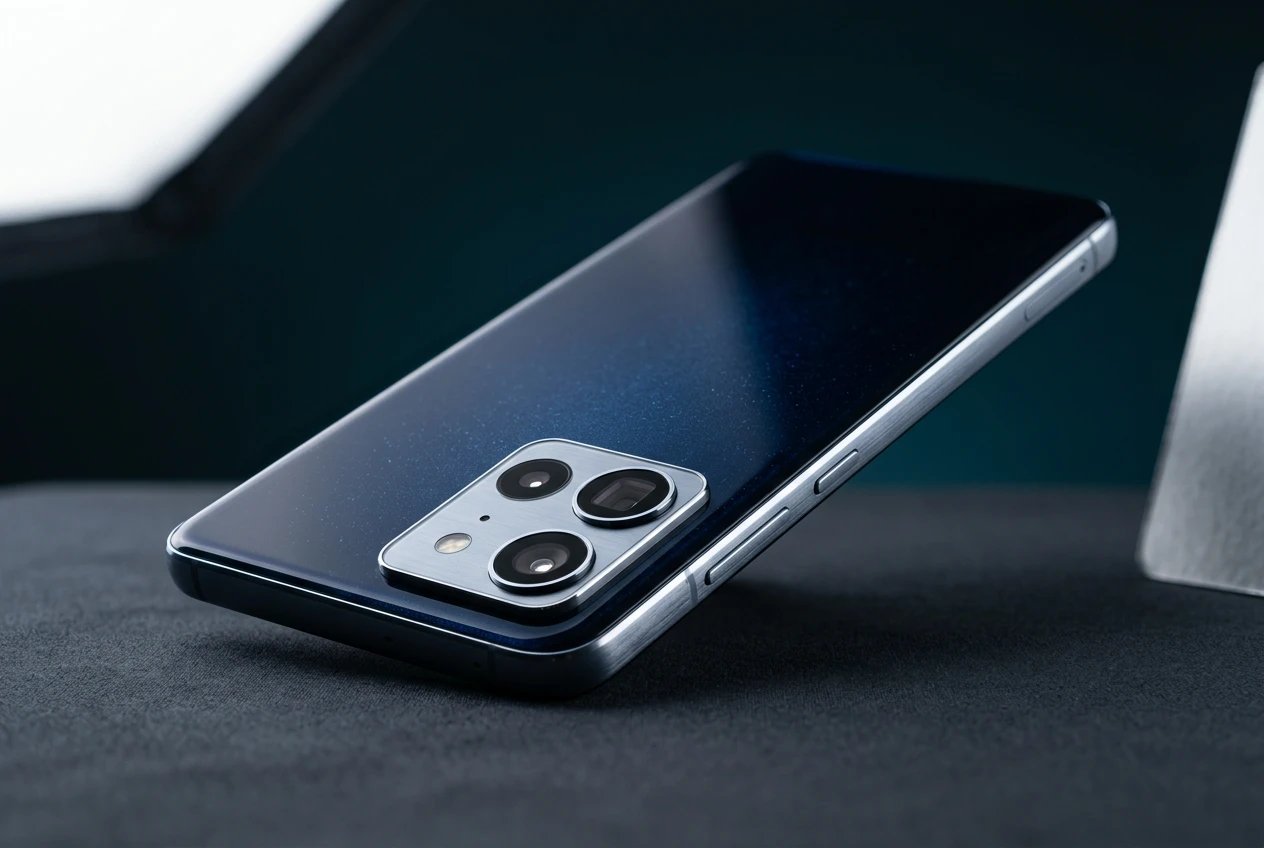
The leak originated on Weibo and was corroborated by a China Telecom certification listing, both surfacing on May 25. Vivo’s own teaser page confirms the May 29 unveiling and shows the device in three colorways: a midnight black, a forest green, and a textured Starry Sea blue with a shimmering finish that catches light unevenly.
Display is a 6.59-inch flat AMOLED at 1.5K resolution (1260 by 2750), matching the panel that shipped in the S50. The phone measures 157.52 by 74.33 by 7.92 millimetres and weighs 207 grams, putting it in the heavier half of 6.6-inch phones, with the slimness coming from the battery chemistry rather than a smaller cell.
The headline sensor stack is what social posts have latched onto: a 50 MP main camera, an 8 MP ultra-wide, and a 50 MP periscope telephoto using Sony’s IMX882 with 3x optical zoom, plus a 50 MP selfie camera on the front. Three of the four shooters share the same megapixel count. The supporting hardware list pulls features that used to mark the tier above:
- Ultrasonic in-display fingerprint sensor, faster and more reliable than the optical variant most mid-rangers still ship
- Stereo speakers tuned for landscape gaming and video
- X-axis linear vibration motor, the haptics layout Apple popularised on the iPhone
- IR blaster for legacy remote-control duties common in Chinese homes
- IP68 and IP69 dust and water resistance, the latter rated for hot, high-pressure jets
Where the Vitality Edition Cuts the Bill
Vivo will launch a cheaper sibling alongside the standard model. The S60 Vitality Edition drops two line items from the bill of materials, shaving cost and weight without touching the silhouette buyers see in store displays.
The first cut is the processor. Vitality runs MediaTek’s Dimensity 7500, a 4 nm part carrying the codename MT6881 that benchmarks below the Snapdragon 8s Gen 3 by roughly a third on sustained GPU workloads. The second cut is the periscope telephoto; Vitality keeps the 50 MP main, the 8 MP ultra-wide, and the 50 MP selfie, but drops to a two-camera rear setup. Weight comes down to 199 grams, same battery, same charging speed, same display, same IP rating.
How the two variants compare:
| Spec | Vivo S60 | S60 Vitality Edition |
|---|---|---|
| Processor | Snapdragon 8s Gen 3 | MediaTek Dimensity 7500 |
| Rear cameras | 50 MP main, 8 MP ultra-wide, 50 MP periscope | 50 MP main, 8 MP ultra-wide |
| Front camera | 50 MP | 50 MP |
| Battery | 7,200 mAh | 7,200 mAh |
| Wired charging | 90 W | 90 W |
| Display | 6.59-inch 1.5K AMOLED | 6.59-inch 1.5K AMOLED |
| IP rating | IP68 and IP69 | IP68 and IP69 |
| Weight | 207 g | 199 g |
| Starting storage | Not yet listed | 8 GB, 128 GB |
The split lets Vivo cover two price tiers off one industrial design. Buyers who want camera versatility pay for the silicon and the periscope; buyers who want the battery and the build pay for nothing else.
How a 7,200 mAh Cell Fits in a 7.92 mm Body
Six years ago a 4,500 mAh cell needed an 8.5 mm body. The S60’s cell sits in less depth than that, and weighs no more than a 5,000 mAh phone from the same era. Silicon-anode chemistry is the reason.
Chinese cell makers, led by suppliers including ATL and Amperex, have shipped commercial silicon-carbon anode batteries to smartphone OEMs since 2023. The chemistry packs more energy per millilitre than the graphite anodes it replaces, which is how the same 7.92 mm depth now houses a noticeably larger cell than it did two product cycles ago.
The trade-off is calendar life. Silicon swells more than graphite during charge cycles, which historically meant faster capacity decay. Suppliers claim the newest formulations match graphite on long-term retention, but independent long-cycle data on shipping phones is still limited. That uncertainty matters mainly for buyers planning to keep a device three years or more.
Three numbers frame the density story:
- 7,200 mAh capacity, 11 percent above the S50’s 6,500 mAh cell at the same physical depth
- 7.92 mm body thickness, identical to the S50 despite the bigger battery
- 90 W wired charging, the same speed Vivo shipped on the prior generation
The charging speed standing still is itself a signal. At that capacity, 90 W gets the phone from empty to full in about 40 minutes, which is plenty for routine use. The bottleneck has shifted to what the cell chemistry tolerates without shedding cycle life, not what the brick can deliver.
The S50 Set This Template Last December
The Vivo S50 launched in China on December 15, 2025, with a starting price of CNY 2,999 for the 12 GB RAM and 256 GB storage configuration. It paired Snapdragon 8s Gen 3 silicon with a 6,500 mAh cell, fast wired charging, a 6.59-inch AMOLED, and the same Sony IMX882 periscope sensor the new model inherits. The blueprint is largely intact.
What changed cycle to cycle: the battery added 700 mAh, the cosmetics picked up the textured Starry Sea finish, and the front camera moved to a higher-resolution module matching the rear. Most of the platform held over.
That continuity reads as iterative, but it lines up with a broader 2026 mid-range pattern. Honor, Xiaomi’s Redmi K line, and OnePlus’s Ace series have converged on a similar bundle since CES: a 6.6-ish-inch 1.5K AMOLED, a comparable Snapdragon or Dimensity chip, a 7,000-plus mAh silicon-anode cell, and at least IP68 ingress protection. The S60 is the third launch this quarter inside that bracket, not the first, and probably not the last before the summer’s flagship cycle starts.
For buyers, the convergence pushes the differentiation into camera tuning, software polish, and brand loyalty. For Vivo, it means the S series has to lean on details like the ultrasonic fingerprint reader, the IR blaster, and the Starry Sea finish to stand apart in a category where the core spec sheet is almost interchangeable across four brands.
The V80 Pipeline From China to India
Vivo’s S series typically gets a global rebrand. The S50 from last winter shipped to India as the V60. Earlier S phones became V70, V40, and so on, with the conversion landing four to eight weeks after the Chinese debut. The new model is widely expected to launch globally as the Vivo V80, with leaker accounts on the Indian side targeting a July window.
Vivo has not used the V80 name on any of its teaser sites, and the company’s Indian arm has not opened pre-registration.
The rebrand math matters because India and Southeast Asia sit at a different price tier and a different competitive frame. In India, the V series competes against OnePlus’s Nord line, Oppo’s Reno, and the Samsung Galaxy A56, none of which currently offers a 7,000-plus mAh battery in this thickness class. If the V80 lands by July at sub-INR 40,000, the company gets a clear hardware lead for the back-to-school window.
Distribution momentum is on Vivo’s side this quarter. The X300 Ultra and X300 FE went on sale in India in May, the first time the company’s top-tier Ultra model reached the country at launch rather than months later. A V80 conversion following the S50-to-V60 cadence would slot into the broadest distribution push the brand has attempted in years.
What Vivo Has Not Confirmed Yet
Pricing is the largest open question. The prior generation started at CNY 2,999; market expectation for the new model hovers in the same band, with the Vitality Edition likely to undercut by CNY 400 to CNY 600. No official tiers have appeared on the teaser pages. Friday’s event is when the wallet math actually clears.
Software is the second unknown. The S50 launched on OriginOS 5 over Android 15; the new device should ship with OriginOS 6 on Android 16, but no build number has been published and the AI features bundled with this generation remain unspecified. The company has emphasised on-device generative imaging in recent X-series marketing; whether those features reach this price point at launch is unclear.
Regional rollout beyond China is the third. If the V80 brand surfaces by mid-July, the bigger story for non-Chinese buyers starts then. If the rebrand slips to August or later, the V60 stays the company’s pitch for the summer, and the S60’s 7,200 mAh headline number gets to age inside a Chinese-only SKU for an extra cycle.


South Korea Retail Investors Face Reckoning After KOSPI AI Rally Collapses

Surrey AI Maps Three Heart Attack Paths and Their Molecular Roots

Germany Locks Neutral Apple ATT Prompts Across Most of Europe

Apple’s 5% EU Fee Quietly Rewrites Alternative App Store Math

Apple’s EU Fee Truce Cuts Complexity but Leaves Rivals Fuming

Pixel 11 Pro Fold Trades Thinness for Durability and Seven-Year Stay

Mayo AI Flags HCM Obstruction From Everyday Ultrasound Videos

Indian Brands Quietly Scale Landmark Screens and Home Tech

Navin Vatsa Turns Grief Into a Lifetime of Quiet Seeing

Google Bets Pixel 11 Agentic AI Will Redefine Phones

Oracle Cuts 21,000 Jobs in a Year, Cites AI in 10-K Filing

Fable 5 and Mythos 5 Return as US Lifts Anthropic Export Controls

SpaceX’s Google Deal Turns a Rocket Company Into a Cloud Landlord

CD Projekt Red Co-CEO: Redemption Arc Isn’t Done, Witcher 4 in 2027

XPL Rallies 30% Ahead of Plasma One Card Tier Launch

Google Search Profiles Build a Follow Graph Inside Discover

DGO App Brings Rs 549 Mobile Pass for FIFA World Cup 2026 in Nepal

Moonshot AI Targets $30 Billion in China’s Fastest AI Funding Sprint

Oppo’s ColorOS 17 Eligibility List Leaves A-Series Buyers Behind

Microsoft Xbox Layoffs Start in July as Sharma Slams 3% Margin
-
 AI2 months ago
Oracle Cuts 21,000 Jobs in a Year, Cites AI in 10-K Filing
-
 AI2 months ago
Fable 5 and Mythos 5 Return as US Lifts Anthropic Export Controls
-
 AI3 months ago
SpaceX’s Google Deal Turns a Rocket Company Into a Cloud Landlord
-
 GAMING2 months ago
CD Projekt Red Co-CEO: Redemption Arc Isn’t Done, Witcher 4 in 2027
-
 CRYPTO3 months ago
XPL Rallies 30% Ahead of Plasma One Card Tier Launch
-
 NEWS3 months ago
Google Search Profiles Build a Follow Graph Inside Discover
-
 APPS3 months ago
DGO App Brings Rs 549 Mobile Pass for FIFA World Cup 2026 in Nepal
-
 AI3 months ago
Moonshot AI Targets $30 Billion in China’s Fastest AI Funding Sprint