
AI
Jodie Foster Calls F1 ‘Made by AI’ at Aspen Festival of Ideas
Jodie Foster told Aspen Ideas Festival that F1 ‘was made by AI,’ citing its textbook structure. F1 earned $634M worldwide and won Best Sound at the Oscars.

Jodie Foster called Brad Pitt’s $634 million race film F1 a movie “made by AI,” then on the same Aspen panel turned to the workers those algorithms are already replacing. The two-time Oscar winner framed both remarks with the same set of facts: an Apple-backed drama that won Best Sound at the 2026 Oscars and became a global hit by following a structural playbook any sufficiently trained model could reproduce. She delivered the line at a festival session where studio executives and union leaders were the audience, and the term “made by AI” was meant as a provocation more than a technical claim.
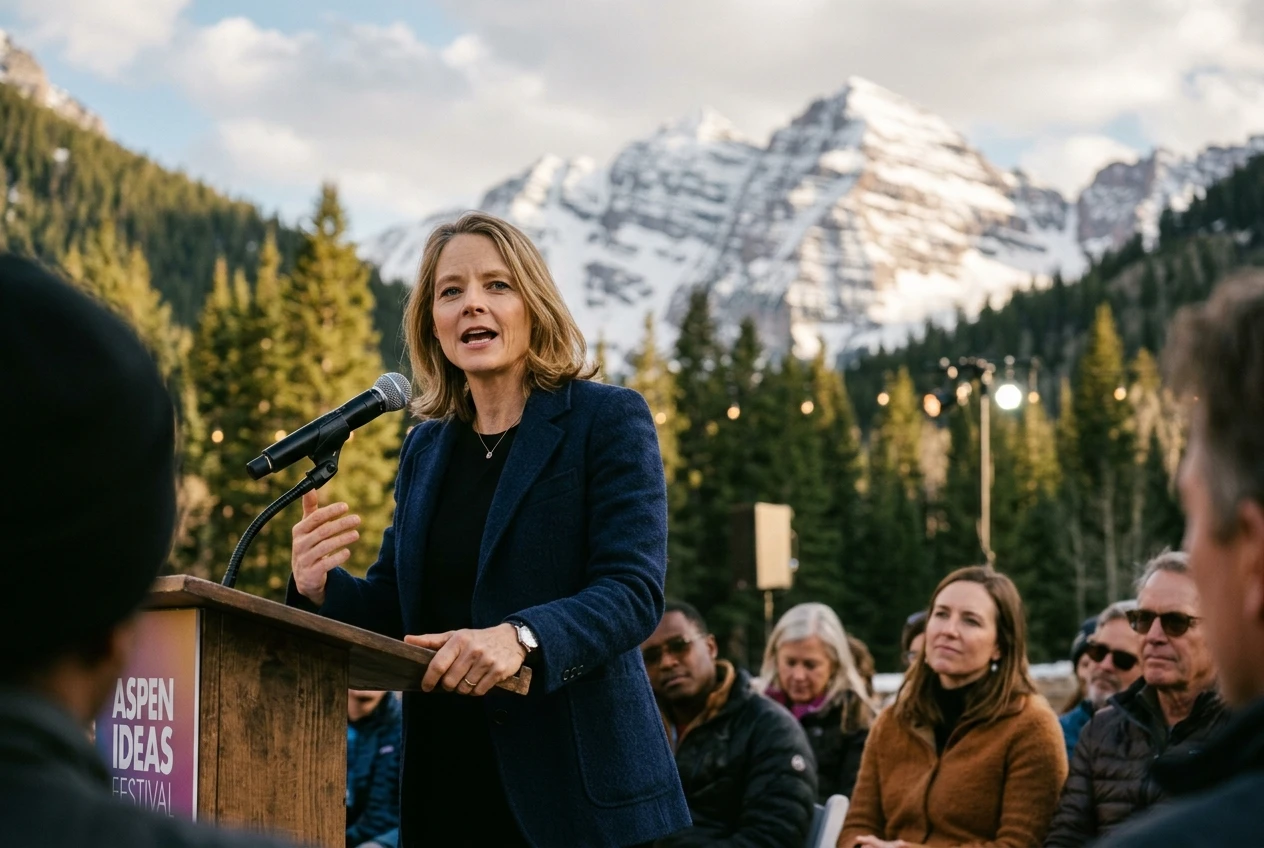
Foster made the remarks Tuesday at the 2026 Aspen Ideas Festival in Colorado. She joined former Sony Pictures chairman Michael Lynton, now chairman of Snap Inc., for a Tuesday session the festival’s program listed for Foster and Lynton on Hollywood’s future.
The Remark That Opened the Panel
Foster prefaced her F1 critique with a smile at the Aspen Ideas Festival, telling the audience “I don’t say this disparagingly.” She continued: “How could I? This movie went on to make millions of dollars.”
She pointed at the racing drama as her exhibit: “I look at a movie like F1 and I’m like, F1 was made by AI. Wasn’t it?” Her evidence was the script and its delivery. “The structure was exactly the structure that you would learn in school,” Foster said. “The actors say the lines exactly the way it would be written if a computer was writing exactly what would be the right thing for that time.”
“And they were able to dominate the technology to make something big and beautiful and, potentially, where a lot of the information comes from other places,” Foster said. The coverage split on how literal to take the remark: The Hollywood Reporter noted that “Foster seemed to be using F1 as an example rather than claiming it was actually created by AI.” Deadline framed her as “explaining why she believes” F1 was generated by AI; Variety caught the room laughing and recorded the closing line as a smiling provocation: “Wasn’t it?”
The Aspen stage was a venue worth noting. An audience of executives and cultural figures watched an Oscar winner set F1 as a marker for the era. Foster’s remarks paired Apple’s biggest theatrical bet to date with the language a coder might use about output.
An Oscar Winner Worth $634 Million
F1 was directed by Joseph Kosinski, the filmmaker behind Top Gun: Maverick, and written by Kosinski and Ehren Kruger, the latter an Oscar nominee on his own. The producer roster was Apple’s launch ramp for theatrical film: Brad Pitt, Jerry Bruckheimer, Dede Gardner, Jeremy Kleiner, seven-time world champion Lewis Hamilton (who also cameoed), Chad Oman, and Kosinski. Pitt took the lead role as Sonny Hayes, a comeback driver who returns to mentor rookie Joshua Pearce (Damson Idris). The film had embedded with the actual F1 racing season, shooting on and around Grand Prix weekends.
The film earned four Academy Award nominations in March 2026, including Best Picture, Best Film Editing, and Best Visual Effects. F1 took Best Sound at the March 16, 2026 Oscars. Best Picture at the same ceremony went to One Battle After Another, per Variety.
F1 was the test of Apple’s theatrical ambition. The film’s $200 million budget was a sum only a handful of studios had put behind motorsport. Pitt’s involvement, Bruckheimer’s producer credit, and Hamilton’s producer and cameo role were meant to brand the movie as a credible racing drama, the kind of pitch Apple needed to claim a seat in the theatrical tent. Per the Hollywood Reporter’s account of the production, the team “relied as much as possible on practical effects” while leaning on digital magic for racing sequences. VFX supervisor Ryan Tudhope told THR that the practical shoots used two or three APXGP cars on the track, with F3 cars standing in for risky stunts.
F1 by the numbers
- Worldwide gross: $634,142,436 (per IMDb)
- U.S. and Canada gross: $189,642,436 (per IMDb)
- Estimated production budget: $200,000,000 (per IMDb)
- Academy Awards: 4 nominations, 1 win (Best Sound)
What Foster Means By “AI-Made”
Foster’s case turns on pattern. She pointed at the structure familiar to anyone who has sat through a screenwriting class.
Foster told the panel: “The actors say the lines exactly the way it would be written if a computer was writing exactly what would be the right thing for that time.” The observation collapses two things at once. The structure of F1 reads as a mentor-mentee arc, a redemption beat, and a championship finish. The dialogue sounds rehearsed by audience expectation as much as by the actors who deliver it.
The irony is sitting on the balance sheet. Foster flagged F1 as the kind of movie a machine could write, and F1 outperformed every prior Brad Pitt title by gross, becoming his highest-grossing film of all time. The same success that gave Foster her example is the proof she did not have to argue for.
Critics of F1 have spent the year calling the racing scenes formulaic and the dialogue thin. Defenders counter that Kosinski’s craft made the racing feel real. Foster’s framing adds a third option: a formula this recognizable can be mass-produced by any sufficiently trained set of weights. The marketplace already rewards that pattern.
Foster’s choice of F1 as her exhibit wasn’t accidental. The film had everything the screenwriting class could want: a mentor-mentee arc, a redemption beat, a championship finish, and dialogue engineered to land on the audience’s preferred emotional register. It earned the box office record and the four Oscar nominations. F1 also leaned visibly on digital tools in post-production, per THR.
The Job Question That Followed
Lynton moved the conversation onto labor. “The big question is, is it going to replace actors and writers?” he asked.
Foster answered quickly. “We do replace people,” she said, citing the standard practice of replicating background performers for crowd scenes. She pushed the comparison to consumer tech. “Face-swapping and all the things you guys can do on your iPhone, we can do them even better with real fancy people,” Foster said. The remark placed the technology inside the production pipeline; the loss is concentrated where the standard practice already runs.
Foster’s policy answer pointed to the union contract. “Hopefully, things like unions will be able to come in and say, you can use my actor twenty times, but you’re going to pay him twenty times,” Foster said. “And I think that’s fair.” The proposal treats AI replication of an actor’s face as a separate licensed use, distinct from the original performance. Her framing moved the contract question from residuals to licensing.
The exchange ran from craft to contract in a single panel. They opened with a quip about formula and closed with a union proposal. The Aspen panel bridged the screenwriting class and the SAG-AFTRA bargaining table inside one session. Most industry discussion of AI has stayed at the policy layer; Foster kept the framing inside the producer’s room.
Where Foster Says AI Has Earned Its Place
The critique came with a carve-out. She named a narrow lane where the technology, in her telling, has done useful work: “small helpful things” like pre-visualization, the pre-production technique for mapping shots and sequences before filming, and storyboarding. Her own 2025 French-language film, the Rebecca Zlotowski-directed A Private Life (also called “My Private Life” in some accounts), used AI-generated imagery for a dream sequence. The actress praised the effect, not the source, conceding that the images “made no sense” while landing them as surrealist backdrops. Foster’s analogy was that dream logic worked precisely because the imagery didn’t. The film hit the festival circuit that same year, where generative imagery had become a regular production tool.
What we all would love is that filmmakers would be able to dominate AI, and never lose sight of that.
Foster positions AI as the latest in a long line of studio tools. “AI is one more giant step forward into changing the industry,” she said after walking through the CGI and digital revolutions of the prior decades. Her test for any new tool is whether the filmmaker stays in command. Pre-visualization and storyboarding pass; a fully written feature does not, in her framing, unless a credited writer’s name is on the script.
The Larger Moment She’s Speaking Into
The Aspen stage sat between two policy rails already in motion. Per Deadline’s report on the talk, SAG-AFTRA has endorsed the Trump administration’s AI policy framework. The framework calls for Congress to enact legislation covering a list of priorities:
- Parental controls
- Intellectual property rights protection
- First Amendment protections
- Expanded AI workforce development
- Permission for data centers to generate their own power
- Removal of legal barriers that limit AI innovation
The same Deadline report notes that the president signed an executive order in June 2026 for a voluntary framework. Under it, AI companies would provide the government with access to new models for a 30-day review period before their release. Foster’s Tuesday talk sat at the meeting point of a union endorsement and a White House framework. Both moved under her feet as she spoke.
The actor’s terms landed on creative control. Foster kept returning to a single framing: AI should sit under the filmmaker. The script writers decide what gets made.
Her proposal to be paid twenty times for an actor whose face gets reused twenty times reads as the same logic at the contract level. Foster’s frame, like Variety’s transcript, kept the dispute in terms of authorship and consent. The contract, the panel, and the executive order were all touching the same set of names and faces at the same moment. The Aspen talk was the studio-system argument landing inside the AI debate just as the AI debate was setting terms inside the studio system. The audience heard both at once. That mix of audience and policy makes the panel useful as a marker for where Hollywood’s AI conversation sits in 2026.


Sony’s 10 Percent Disc Drop Leaves the 2028 Cutoff Intact

Chip Allocation Sidelines the Base iPhone 18 This Fall

Miami-Dade Fights the Vice City Brand It Already Wears

IFA 2026 Awards Put Tecno Ahead of Flagship Phones

USB-C Gadgets Made the Junk Drawer Rechargeable

Pixel 11 Pro Asks $1,099 for a Light Google Locked

The iPhone Ultra Sells Two Retired Minis as One Foldable

Google Opens Gmail to Voice and Gates Docs Live

Lenovo Prices the IdeaPad Vibe Against Apple’s $699 Neo

Xbox Caps Game Pass Cloud Gaming at 15 Hours

Oracle Cuts 21,000 Jobs in a Year, Cites AI in 10-K Filing

Fable 5 and Mythos 5 Return as US Lifts Anthropic Export Controls

SpaceX’s Google Deal Turns a Rocket Company Into a Cloud Landlord

CD Projekt Red Co-CEO: Redemption Arc Isn’t Done, Witcher 4 in 2027

XPL Rallies 30% Ahead of Plasma One Card Tier Launch

Google Search Profiles Build a Follow Graph Inside Discover

DGO App Brings Rs 549 Mobile Pass for FIFA World Cup 2026 in Nepal

Moonshot AI Targets $30 Billion in China’s Fastest AI Funding Sprint

Oppo’s ColorOS 17 Eligibility List Leaves A-Series Buyers Behind

Microsoft Xbox Layoffs Start in July as Sharma Slams 3% Margin
-
 AI2 months ago
Oracle Cuts 21,000 Jobs in a Year, Cites AI in 10-K Filing
-
 AI2 months ago
Fable 5 and Mythos 5 Return as US Lifts Anthropic Export Controls
-
 AI3 months ago
SpaceX’s Google Deal Turns a Rocket Company Into a Cloud Landlord
-
 GAMING3 months ago
CD Projekt Red Co-CEO: Redemption Arc Isn’t Done, Witcher 4 in 2027
-
 CRYPTO3 months ago
XPL Rallies 30% Ahead of Plasma One Card Tier Launch
-
 NEWS3 months ago
Google Search Profiles Build a Follow Graph Inside Discover
-
 APPS3 months ago
DGO App Brings Rs 549 Mobile Pass for FIFA World Cup 2026 in Nepal
-
 AI3 months ago
Moonshot AI Targets $30 Billion in China’s Fastest AI Funding Sprint