
APPS
Android Auto 17.2 Is Live: How to Skip the Play Store Wait
Android Auto 17.2 is rolling out with no changelog, but users are racing to install it ahead of Google’s major Android Auto overhaul coming in H2 2026.

Android Auto 17.2 started rolling out to production builds on July 2, 2026, ending a stretch of weeks without a new version on Google Play. The update brings no new features and no published changelog, and yet users are racing to install it. The reason sits behind the build itself: a major Android Auto overhaul that Google committed to delivering in the second half of the year.
Until 17.2 is on a phone, the staged rollout of the redesigned Android Auto has no foundation to land on. Drivers who want to be first in line when the new experience arrives are updating today, even when the update itself ships with nothing visible to them. APKMirror already lists the build, dated July 2, 2026 PDT, as version 17.2.6626, and that is the version to look for on third-party mirrors.
What Android Auto 17.2 Changes
The new Android Auto 17.2 build, version 17.2.6626, ships as a maintenance release. Google has not published a changelog, and based on the gap between versions, the work is focused on internal refinements rather than user-facing features. That makes 17.2 an unusual update to install on launch day.
There is nothing wrong with installing it. The point is that drivers are not chasing a new feature or a fix they can name. They are chasing the version bump itself, because it is the precondition for the next phase of the Android Auto rollout Google committed to at I/O. 17.2.6626 is the file to look for, and the install is automatic on top of the existing app. The version on your phone after the install matches the version Google is staging for the next rollout wave.
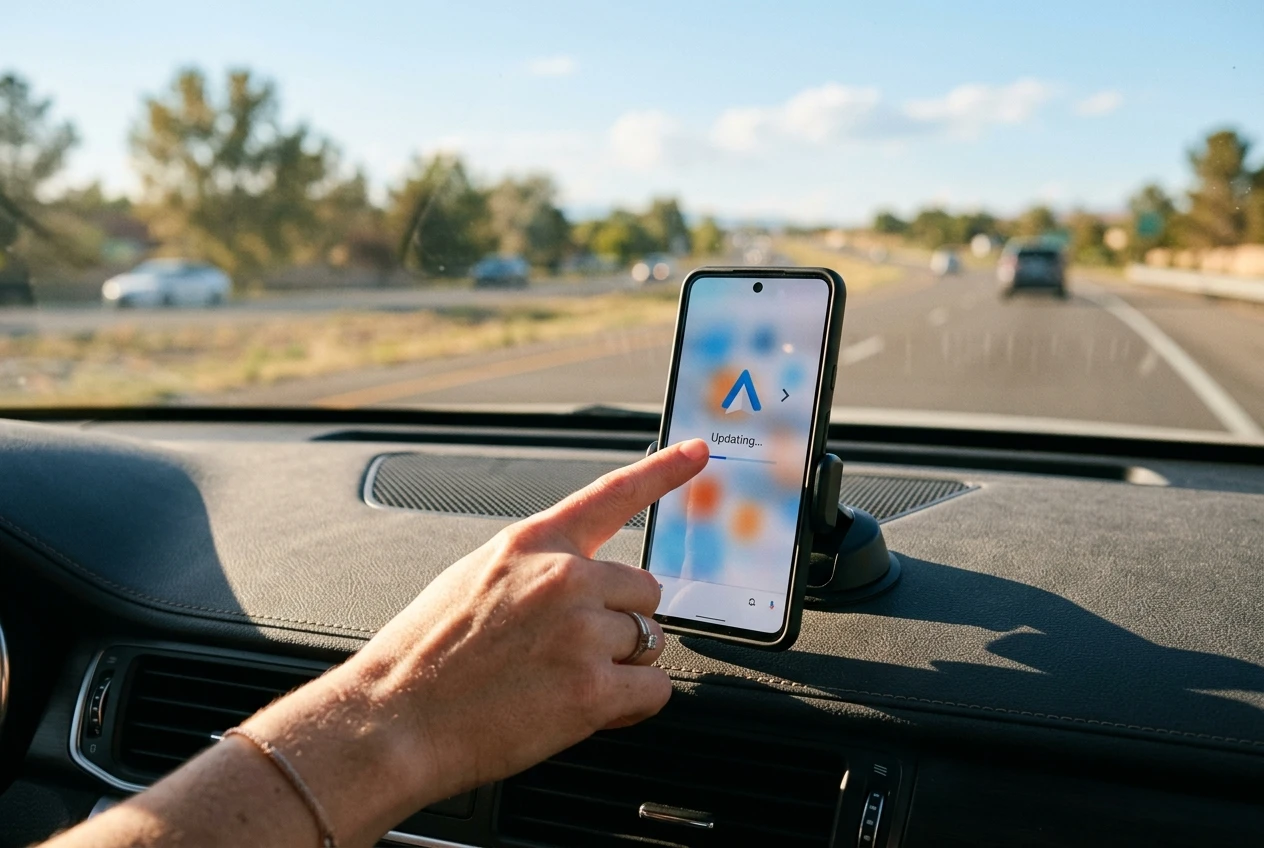
The Play Store Rollout Is Slow and You Can Skip It
Every Android Auto update moves through Google Play in stages, and 17.2 is no exception. Some devices will see the update land within hours of the July 2 release; others will wait up to several weeks before the same build number shows up on their phone. Google staggers the rollout to catch regressions before they hit the wider installed base. The staged rollout is the standard delivery model for any Android Auto update.
The fastest way around the wait is a manual APK install. Once you download the Android Auto 17.2 APK installer from a trusted source, you can either run the dedicated installer or extract the APK and tap the file to start the update. You do not need to remove the existing Android Auto version first, because the installer replaces the existing files automatically.
Running the bundled installer is the simplest path; tapping the APK directly works just as well if you prefer to skip the helper. The sideload install leaves a couple of things unchanged: you are still tied to Google for what the app actually does, and you are not getting anything new by skipping the wait. All you are doing is closing the gap between the version on your phone and the version Google will start pushing to the wider pool over the coming weeks. Build 17.2.6626, dated July 2, 2026 PDT on APKMirror’s Android Auto 17.2.6626 release listing, is the version to look for.
Google’s Major Android Auto Overhaul Still Has No Firm Date
The major Android Auto overhaul Google committed to for the second half of 2026 is the actual reason to update today. Autoevolution flags that the new experience is expected to begin rolling out in the second half of the year, and that 17.2 does not enable it.
The scale of the rollout explains why Google is being careful with the new experience. Google’s next-generation Android Auto announcement, dated May 12, 2026, lays out the installed base across two categories. Google built-in, the deeper-integrated variant, runs alongside standard Android Auto as the second category. The staged rollout exists because any regression in 17.2 has the potential to touch every one of those vehicles, with the numbers below showing why.
- More than 250 million Android Auto-compatible cars on the road today
- More than 100 car models running Google built-in
- 16 brands shipping Google built-in
- 11 brands first in line for YouTube support
- 60fps full HD video for parked YouTube playback
A three-month-old wireless disconnect bug on Pixel phones is a reminder that even small Android Auto updates can have outsized consequences. Google’s June Play Services fix has not fully resolved the drops for affected owners. The maintenance work in 17.2 happens against that backdrop of unresolved quirks.
The new rollout window is still vague. Google’s blog post talks about features arriving later this year without committing to a specific month or quarter. Autoevolution reads the same window as the second half of 2026, which is also when Google’s rollout is broadly expected to start. For now, 17.2 is the version users need to have on their phones when the staged rollout does begin.
YouTube on the Dash, With One Caveat
YouTube on the dash only plays while the car is parked. Once the vehicle starts moving, the video transitions to audio-only, as long as the app supports background audio. Google’s blog describes the handoff as smooth, with the video becoming audio, and notes the playback runs in crisp 60fps full HD in supported cars. For YouTube specifically, the audio-only handoff works only with a YouTube Premium subscription. For other video apps, audio-only will require the developer to integrate the same background-audio mode, otherwise the video simply ends when the wheels start turning.
The audio-only transition is up to each developer beyond YouTube. Google’s blog describes the transition as safe and continuous, with the video becoming audio when the car shifts from park to drive. 9to5Google reports that Google has already launched this audio-only mode on YouTube in at least a limited capacity, ahead of the broader platform rollout. The end result is the same regardless of app: video when parked, audio when driving, silence when the app does not bother to support either.
The first wave of supported vehicles is a defined list of brands. The starting lineup for YouTube and the other video apps includes eleven carmakers. Google’s blog lists them in one sentence; this is the starting lineup, with more carmakers expected later.
- BMW
- Ford
- Genesis
- Hyundai
- Kia
- Mahindra
- Mercedes-Benz
- Renault
- Škoda
- Tata
- Volvo
Beyond YouTube, What Else Google’s Android Auto Overhaul Brings
Around the YouTube moment, Google is reshaping how the rest of the dashboard looks. The new interface will be tailored to fit any car screen shape, from ultrawide rectangles to circles and the odd standalone display, instead of forcing every car into the same template. Google’s blog notes that the redesign covers any screen, ultrawide rectangle, circle, or unique shape. A Waze bug on the cancel-route button has gone unfixed for three months, separate from but still happening alongside the broader overhaul.
The visual refresh is broader than a recolor. Google is laying the new design on top of the in-car interface as one wave. Three confirmed areas of the visual overhaul sit below, drawn from Google’s blog announcement. Each of the three areas below ships together as part of the same visual redesign. Autoevolution’s coverage highlights the widget behavior as the one area where Android Auto’s approach differs from CarPlay’s.
- Material 3 Expressive design language with new fonts, animations, and wallpapers
- Widgets alongside the existing UI, instead of a dedicated widget screen like CarPlay
- Visual refreshes for YouTube Music and Spotify within the new design language
At the center of the new look is Immersive Navigation in Google Maps, which Google’s blog calls the biggest update to Google Maps in over a decade. The map goes edge-to-edge across the display, with vivid 3D views of buildings, overpasses, and terrain, and it highlights critical details like lanes, traffic lights, and stop signs to help with tricky turns and merges. Google’s blog frames the ambition of the whole refresh this way:
Designed to feel uniquely yours, Android Auto is getting a full refresh that brings personal design touches, widgets you can see at a glance and edge-to-edge Google Maps to your dash.
Audio is also getting a serious upgrade. Android Auto will support Dolby Atmos immersive, spatial sound in supported apps and cars, starting with BMW, Genesis, Mahindra, Mercedes-Benz, Renault, Škoda, Tata, and Volvo. Gemini Intelligence, Google’s smarter assistant, is set to arrive on Android Auto later this year, with the ability to order food via DoorDash or surface answers to questions about a vehicle’s hardware. None of the new features ship in 17.2, and none has a firm date yet.
Frequently Asked Questions
What does Android Auto 17.2 include?
Android Auto 17.2 (build 17.2.6626, dated July 2, 2026 on APKMirror) is a maintenance release with no published changelog. Autoevolution’s coverage frames it as focused on under-the-hood refinements after a break of several weeks between versions, with no user-facing features added in this build.
How do I install Android Auto 17.2 manually?
Download the Android Auto 17.2 APK installer from a trusted source, then either run the bundled installer or extract the APK and tap the file. The installer replaces the existing app’s files automatically, so you don’t have to uninstall the current Android Auto first; running the install on top of the existing copy is enough.
When does the new Android Auto overhaul arrive?
Google’s announcement places the rollout of the new interface, widgets, and YouTube support in the second half of 2026. The YouTube feature lands first in cars from BMW, Ford, Genesis, Hyundai, Kia, Mahindra, Mercedes-Benz, Renault, Škoda, Tata, and Volvo, with no firm date for any individual market.
Will YouTube work while the car is moving?
No. YouTube video playback is restricted to when the car is parked. Google’s blog describes a transition to audio-only mode when the car shifts into drive, which on YouTube works only with a YouTube Premium subscription. Other video apps need to integrate their own background-audio support, or the video simply ends when the car starts moving.
Which cars support YouTube in Android Auto first?
Google’s announcement lists BMW, Ford, Genesis, Hyundai, Kia, Mahindra, Mercedes-Benz, Renault, Škoda, Tata, and Volvo as the initial brand roster. Google’s blog frames this as a starting list, with the feature shipping later this year in supported cars that have high-definition screens.


South Korea Retail Investors Face Reckoning After KOSPI AI Rally Collapses

Surrey AI Maps Three Heart Attack Paths and Their Molecular Roots

Germany Locks Neutral Apple ATT Prompts Across Most of Europe

Apple’s 5% EU Fee Quietly Rewrites Alternative App Store Math

Apple’s EU Fee Truce Cuts Complexity but Leaves Rivals Fuming

Pixel 11 Pro Fold Trades Thinness for Durability and Seven-Year Stay

Mayo AI Flags HCM Obstruction From Everyday Ultrasound Videos

Indian Brands Quietly Scale Landmark Screens and Home Tech

Navin Vatsa Turns Grief Into a Lifetime of Quiet Seeing

Google Bets Pixel 11 Agentic AI Will Redefine Phones

Oracle Cuts 21,000 Jobs in a Year, Cites AI in 10-K Filing

Fable 5 and Mythos 5 Return as US Lifts Anthropic Export Controls

SpaceX’s Google Deal Turns a Rocket Company Into a Cloud Landlord

CD Projekt Red Co-CEO: Redemption Arc Isn’t Done, Witcher 4 in 2027

XPL Rallies 30% Ahead of Plasma One Card Tier Launch

Google Search Profiles Build a Follow Graph Inside Discover

DGO App Brings Rs 549 Mobile Pass for FIFA World Cup 2026 in Nepal

Moonshot AI Targets $30 Billion in China’s Fastest AI Funding Sprint

Oppo’s ColorOS 17 Eligibility List Leaves A-Series Buyers Behind

Microsoft Xbox Layoffs Start in July as Sharma Slams 3% Margin
-
 AI2 months ago
Oracle Cuts 21,000 Jobs in a Year, Cites AI in 10-K Filing
-
 AI2 months ago
Fable 5 and Mythos 5 Return as US Lifts Anthropic Export Controls
-
 AI2 months ago
SpaceX’s Google Deal Turns a Rocket Company Into a Cloud Landlord
-
 GAMING2 months ago
CD Projekt Red Co-CEO: Redemption Arc Isn’t Done, Witcher 4 in 2027
-
 CRYPTO2 months ago
XPL Rallies 30% Ahead of Plasma One Card Tier Launch
-
 NEWS2 months ago
Google Search Profiles Build a Follow Graph Inside Discover
-
 APPS2 months ago
DGO App Brings Rs 549 Mobile Pass for FIFA World Cup 2026 in Nepal
-
 AI2 months ago
Moonshot AI Targets $30 Billion in China’s Fastest AI Funding Sprint