
COMPUTERS
Tardigrade Genome Sequencing Is the Small Step Toward Mapping All Life
Morek pulls moss off a Cambridge wall to feed the Sanger Tree of Life programme, now sequencing 48 genomes every week in its bid to map every eukaryotic species on Earth.

On the Cambridgeshire campus of the Wellcome Sanger Institute, postdoctoral researcher Witek Morek inspected an old brick-and-flint wall, broke off a fistful of moss, and slid it into an envelope. The whole exercise looked modest. The plan behind it is not. Morek’s tardigrades, and the moss clinging to their microscopic bodies, are some of the newest raw material for the Sanger’s Tree of Life programme, a wildly ambitious bid to sequence the genomes of all eukaryotic life on Earth. The point is scale as much as the creature: a pipeline built to pull a genome from a single 350-micrometre animal is the same one that will, eventually, read every species in Britain and Ireland, and far beyond.
We are going to use a very advanced tool designed by bioengineers and evolved over millions of years, the human hand, and grab some moss, and put it in an envelope.
The Tardigrade hunting trip that yielded that wiggly, translucent specimen was run by Morek alongside Prof Mark Blaxter, who leads the Sanger’s Tree of Life programme. They had walked over to a walnut tree on the institute’s grounds to collect lichen too. Samples in hand, they returned to a lab whose operations now produce tens of thousands of base-pair reads in hours, where the same work a generation ago took years. Tardigrades are not the headline act of the Tree of Life project, but they are an instructive one: small, abundant, hard to find, and impossible to read with the older methods the field used to rely on.
From 18 Genomes in 25 Years to 48 Every Week
A genome is the set of instructions for building an animal, written in the four-letter chemical code of DNA. Genomics widens the lens: not just the protein-coding genes, but everything written around them. Reference genomes let researchers trace a species’ biology, its evolution, and the chemical tricks it has evolved, including the ones that might become new medicines or compounds.
For most of the field’s history, producing one was slow. Blaxter, now the head of Tree of Life, sequenced 18 genomes across 25 years of his own early-career work. Today the Sanger’s programme is producing 48 a week, and has logged about 2,600 genomes from British and Irish species, from whales down to fungi, with tardigrades as one of the next groups in line. The turn-around has compressed to a degree that would have looked fanciful at the turn of the century.
The wider context is set by two milestones. In 1998, a millimetre-long nematode worm became the first animal to have its whole genome sequenced. The human genome followed five years later, though it was not fully completed until 2021. Both efforts took years. Tardigrade work used to belong in that same slow lane, until the same machinery that released those earlier projects became small enough to read one of the world’s smallest animals instead.
| Era | Output rate | Programme or person |
|---|---|---|
| Blaxter’s early career | 18 genomes over 25 years | Mark Blaxter, in his own early career |
| Sanger Tree of Life today | 48 genomes a week, 2,600 so far | Wellcome Sanger Tree of Life programme |
Waking Up Moss Piglets One Slide at a Time
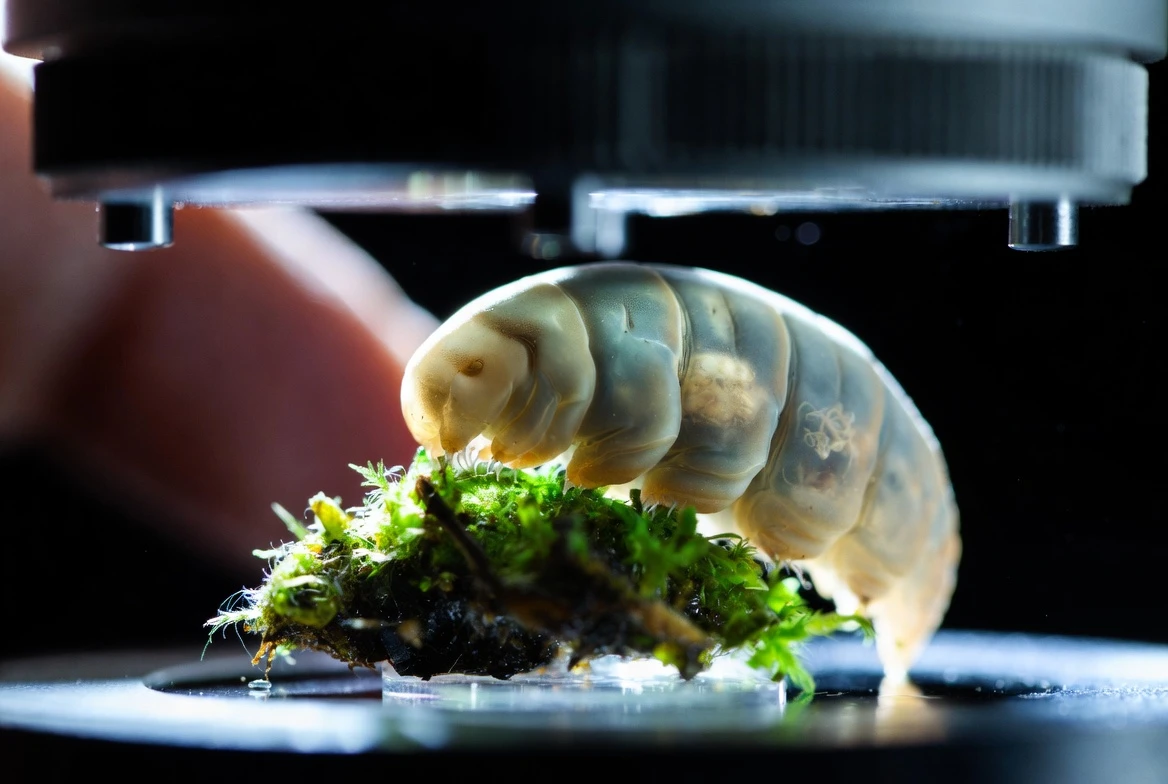
Back at the bench, Morek dropped his moss and lichen into a beaker of water. Within half an hour, tardigrades were wiggling free. He lifted a small piece of moss under the microscope and quickly located one: a translucent animal of about 350 micrometres in length, plump legs waving, and faintly visible gut contents showing what it had last eaten (a reminder, if needed, that a human hair is around 50 micrometres across). The nickname “moss piglet” lands more accurately on a creature this small and absurd than on most others.
Tardigrades are famously hard to kill. The roughly 1,500 species identified worldwide survive searing heat, deep cold, and a stint in outer space. The trick is desiccation. When dried out, they enter a kind of suspended animation and stay there until water returns. That same indestructibility has practical limits for the people studying them. Pooling 1,000 animals for a single old-school extraction was hard on common species and impossible on rare ones. Working with one at a time was a fantasy when the chemistry needed micrograms of starting material.
Morek has so far collected about 20 of the 50 tardigrade species on the British list, a count he describes as a “huge underestimate” of the actual number waiting to be described in Britain alone. To pin a specimen to a species, he needs its eggs, since the adult bodies look alike across many groups.
- Smooth eggs, no surface texture
- Mushroom-shaped processes on the egg surface
- Conical projections around the egg
- Needle-like ornamentation across the shell
The animals themselves are not all cuddly. They can be, in Morek’s words, “voracious carnivores, chasing down nematodes and eating them like spaghetti.” But some of them also show parental care: a mother may shed her cuticle with the eggs still inside the shed skin, and keep that skin attached to her legs until the young hatch. Once identified, a specimen is placed on a temporary slide under a coverslip (permanent slides would crush the animal as the water dried), then pipetted into a barcoded plastic tube and stored.
The Picogram Problem and How Sanger Solves It
The hardest constraint is not the hunting, the slide, or the freezer. It is the quantity of DNA. A tardigrade holds roughly 200 to 500 picograms of DNA, where one picogram is one trillionth of a gram. For most of the field’s history, that was not enough to sequence. Some teams pooled thousands of animals. Others kept captive females to mass-produce genetic clones. Both workarounds were impractical for rare or single-specimen cases.
The Sanger’s answer is the picogram input multimodal sequencing protocol, a method built around accepting tiny inputs and amplifying them through to usable sequencing libraries. Morek first disrupts the animal, either by hand with a fine blade on a 200-micrometre specimen or by mashing it inside a block of ice when frozen. The protocol then splits the extract into two streams, one for genomic DNA and one for RNA, and uses polymerase chain reaction (PCR) to copy each fragment enough times to feed the sequencing machines.
The pipeline fits inside the institute’s broader infrastructure. Samples are barcoded and stored in special double-doored freezers set at -71C. Read quality is checked on the institute’s computer cluster, and the sequence itself comes out as millions-long strings of the four DNA bases, adenine, cytosine, guanine and thymine (ACTG).how massively parallel sequencing closes cold cases for downstream illustration of the same family of tools in a very different setting.
What a Genome 30 Times Smaller Could Unlock
Tardigrades are a gift to the lab in another sense: their genomes are small, about 30 times smaller than the human genome. Less data is needed to assemble a clean reference, which speeds the work and lowers its cost. The first wave of payoff is taxonomy. Tardigrade lineages are separated by as much as 550m years of evolution, and a clean genome from each species lets scientists draw the tree more confidently than morphology alone can.
The second wave is the practical one. Researchers want the genes behind the tardigrade’s most useful tricks.
- Cryobiosis, the resistance to freezing
- Anoxybiosis, the resistance to very low oxygen
- Anhydrobiosis, the repeatedly dried-out-and-revived trick
Pin down the right proteins and the imagination runs to applications. The Guardian piece reports researchers asking whether a protein central to anhydrobiosis could be used to produce dry vaccines, or added to crops to make them more drought-resistant. Those remain open questions, not promises. Even Morek frames the field as a slow unlock rather than a sprint.
And, because most of life on this planet is small, like the tardigrades, this new approach to genome sequencing promises to open the gates to sequencing all of life. These genomes will in turn open up new ideas and opportunities in biomedicine and biotechnology.
That wider bid is run by the Earth BioGenome Project, of which the Sanger programme is a part. The current phase, published in 2025, lays out a plan to sequence close to 10 percent of all known eukaryotic species and the vast majority of their families by the time the second phase ends, and to act as a proof of concept for sequencing every species on Earth afterwards. Tardigrades are a useful stress test for that ambition: small, common, hard to identify, and built to dry out for years.
Where Tardigrades Sit in the Larger Bid to Map Every Species
About 1,500 tardigrade species have been formally described worldwide. Four high-quality tardigrade genomes sit in public databases today. Morek is closely working on 14 more, with roughly 50 species in the freezer awaiting sequencing. Those numbers are deliberately small compared to the scale of the wider programme, and they sit at the harder edge of it, where individual specimens must do the work of colonies.
Here is the wider frame for that work, drawn from the same announcement and the Sanger’s programme:
- About 1,500 tardigrade species identified worldwide
- 4 high-quality tardigrade genomes in public databases today
- 14 more tardigrade genomes being closely worked on by Morek
- Around 50 tardigrade species in the freezer awaiting sequencing
- At least 1.3 million invertebrate species on Earth; vertebrates are about 5% of animal life
For Morek, the work is not slowing down. “There are a lot of research questions,” he says. “The more we know, the more questions we are asking. It’s a never-ending story.” The species that win next steps are the ones that test the limits of the protocol, and tardigrades are exactly that. The wider the Earth BioGenome Project plan to sequence every eukaryotic species also reads well as a stress test for one practical reason: the project’s institutions expect sequencing every eukaryote on Earth to fall out of methods built around the hardest, smallest samples first. The Sanger’s work on tardigrades, and the picogram-scale protocol behind it, sit squarely in that direction. For a wider primer on what those traits actually are, the Sanger’s own the science behind tardigrade survival traits walks through the biology Morek’s team builds on.
Frequently Asked Questions
Why are tardigrades being sequenced?
Tardigrades are being sequenced to add missing branches to the tree of eukaryotic life, and to find the genes behind the animal’s ability to survive being frozen, starved of oxygen, and dried out. Both uses feed the Sanger Tree of Life programme’s larger plan to produce reference genomes for every eukaryotic species in Britain and Ireland, and to support the wider Earth BioGenome Project bid to sequence every eukaryotic species on Earth.
How much DNA does a single tardigrade contain?
A single tardigrade contains between 200 and 500 picograms of DNA, where one picogram is one trillionth of a gram. Older protocols needed hundreds or thousands of pooled animals to reach usable amounts, which made rare species effectively unsequencable.
How does the Sanger sequence from such a small amount of DNA?
The Sanger uses the picogram input multimodal sequencing protocol, which extracts both DNA and RNA from one animal, amplifies them with polymerase chain reaction, and feeds the products into the institute’s sequencing machines.
Why are tardigrade genomes easier to assemble than larger animal genomes?
Tardigrade genomes are about 30 times smaller than the human genome, so a clean assembly needs less sequence data. The protocol is complex, but the smaller target keeps the project within reach of a single research team.
How many tardigrade genomes already exist, and how many are coming?
Four high-quality tardigrade genomes sit in public databases today, Morek is closely working on 14 more, and around 50 species are in the Sanger’s freezers awaiting sequencing.


South Korea Retail Investors Face Reckoning After KOSPI AI Rally Collapses

Surrey AI Maps Three Heart Attack Paths and Their Molecular Roots

Germany Locks Neutral Apple ATT Prompts Across Most of Europe

Apple’s 5% EU Fee Quietly Rewrites Alternative App Store Math

Apple’s EU Fee Truce Cuts Complexity but Leaves Rivals Fuming

Pixel 11 Pro Fold Trades Thinness for Durability and Seven-Year Stay

Mayo AI Flags HCM Obstruction From Everyday Ultrasound Videos

Indian Brands Quietly Scale Landmark Screens and Home Tech

Navin Vatsa Turns Grief Into a Lifetime of Quiet Seeing

Google Bets Pixel 11 Agentic AI Will Redefine Phones

Oracle Cuts 21,000 Jobs in a Year, Cites AI in 10-K Filing

Fable 5 and Mythos 5 Return as US Lifts Anthropic Export Controls

SpaceX’s Google Deal Turns a Rocket Company Into a Cloud Landlord

CD Projekt Red Co-CEO: Redemption Arc Isn’t Done, Witcher 4 in 2027

XPL Rallies 30% Ahead of Plasma One Card Tier Launch

Google Search Profiles Build a Follow Graph Inside Discover

DGO App Brings Rs 549 Mobile Pass for FIFA World Cup 2026 in Nepal

Moonshot AI Targets $30 Billion in China’s Fastest AI Funding Sprint

Oppo’s ColorOS 17 Eligibility List Leaves A-Series Buyers Behind

Microsoft Xbox Layoffs Start in July as Sharma Slams 3% Margin
-
 AI2 months ago
Oracle Cuts 21,000 Jobs in a Year, Cites AI in 10-K Filing
-
 AI2 months ago
Fable 5 and Mythos 5 Return as US Lifts Anthropic Export Controls
-
 AI2 months ago
SpaceX’s Google Deal Turns a Rocket Company Into a Cloud Landlord
-
 GAMING2 months ago
CD Projekt Red Co-CEO: Redemption Arc Isn’t Done, Witcher 4 in 2027
-
 CRYPTO2 months ago
XPL Rallies 30% Ahead of Plasma One Card Tier Launch
-
 NEWS2 months ago
Google Search Profiles Build a Follow Graph Inside Discover
-
 APPS2 months ago
DGO App Brings Rs 549 Mobile Pass for FIFA World Cup 2026 in Nepal
-
 AI2 months ago
Moonshot AI Targets $30 Billion in China’s Fastest AI Funding Sprint