
NEWS
How Massively Parallel Sequencing Is Rewriting Forensic DNA
Massively parallel sequencing is upending forensic DNA work, from the 2018 Golden State Killer arrest to a 2026 NSW cold case. Here is how it works.

Police in New South Wales used massively parallel sequencing to charge 77-year-old Robert Kwan on February 11, 2026 with sexual assaults committed in 1991, 1996, and 2002. It was the first arrest in the state built on forensic investigative genetic genealogy, the same playbook that caught the Golden State Killer in California in 2018.
The same technology is now closing cold cases from the United States to Brazil to Australia. The bioinformatics load, though, is keeping most forensic labs dependent on outside specialists.
What Massively Parallel Sequencing Actually Does
Massively parallel sequencing is a DNA-reading technique that lets forensic scientists examine many thousands of genetic markers in a single workflow, rather than the 21 genetic markers that define a standard forensic profile. The standard, short tandem repeat (STR) profiling, has been the gold standard in forensic DNA work for three decades. It extracts DNA from a sample, amplifies a fixed panel of 21 short tandem repeat markers using PCR, and reads their lengths on a capillary electrophoresis machine to produce a unique genetic fingerprint.
Massively parallel sequencing is a game changer.
Each STR profile is checked against offender databases such as the FBI’s CODIS in the United States or the National Criminal Investigation DNA Database in Australia. Massively parallel sequencing reads more of the genome per run, scrutinizing many thousands of single-nucleotide polymorphisms, or SNPs, in a single workflow, and, in some setups, the whole genome. The same SNPs feed forensic investigative genetic genealogy, the database lookups that cracked the Golden State Killer case in 2018 and the NSW case in 2026. Geneticist Celso Teixeira Mendes Junior, of the Forensic and Genomics Research Laboratory at the University of São Paulo, gave a vivid example of the difference: ‘In my opinion, only massively parallel sequencing is a good approach, because you will find something like 40 or 50 variation sites differing between the two siblings,’ and he was talking about identical twins, the hardest case in forensic DNA.
STR profiling cannot separate identical twins, but massively parallel sequencing can, by reading the rare mutations that have accumulated between them. The technology had been used in research labs for years before its 2018 breakout, when a crime-scene DNA profile uploaded to the public ancestry website GEDmatch matched several distant relatives of Joseph DeAngelo, the equivalent of third cousins. Genealogy records, age, and the geography of the crimes did the rest, and Sacramento police arrested 72-year-old DeAngelo on April 24, 2018, in a case examined in an academic review of the Golden State Killer case at the National Library of Medicine.
Kirsty Wright, a forensic biologist currently working to overhaul a government-run forensic laboratory in Queensland, said the technology is impressive in both its sensitivity and the volume of data it can return, and the wider discipline has spent the last five years building capacity in-house or buying it from specialist providers. The work is not slowing down.
The Cold Case That Closed in 2026
On February 11, 2026, New South Wales Police detectives arrested Robert Kwan, 77, at a property in South Kempsey, charging him with multiple sexual assault and kidnapping offences. The allegations stretched back to 1991, when an 11-year-old girl was lured into a car in Glendinning, in western Sydney, and sexually assaulted. The same DNA profile was later matched to a 1996 attack on a 16-year-old in Kanahooka, near Wollongong, and a 2002 assault on a 26-year-old woman in Dubbo.
A 2022 review, led by New South Wales Police Force forensic scientist Alison Sears, assessed whether the cold cases could be reopened with emerging DNA technology. The three crime-scene samples were reworked with massively parallel sequencing.
The high-density profiles were uploaded to two public genealogy databases, GEDmatch and FamilyTreeDNA, where a close relative of the alleged offender was identified. It was the first time New South Wales Police had used forensic investigative genetic genealogy to make an arrest, and Sex Crimes Squad Commander, Detective Superintendent Jayne Doherty, called the technique a ‘breakthrough technology.’ Traditional profiling only gives police a handful of DNA markers to work with, she said, while FIGG can create hundreds of thousands, and ‘that allows us to connect family relationships as far away as third of fourth cousins.’ From there, traditional genealogy is used to build and prune a family tree, and Kwan was refused bail at an online hearing and ordered to face court in Kempsey in April 2026.
- 1991: Sexual assault of an 11-year-old in Glendinning, western Sydney
- 1996: Sexual assault of a 16-year-old in Kanahooka, near Wollongong
- 2002: Sexual assault of a 26-year-old in Dubbo
- 2022: NSW Police review of historic sex crimes using emerging DNA technology
- February 2026: Robert Kwan, 77, arrested in South Kempsey
- April 2026: First court appearance scheduled in Kempsey Local Court
When the Sample Is Too Small, or Already Mixed
The same sensitivity that lets massively parallel sequencing crack cold cases also exposes a problem STR profiling tends to sidestep. A 2019 experiment made the point sharply: a 10-second handshake can transfer enough DNA between two people for the uninitiated person’s profile to be picked up on whatever the second person touches next, including, in a worst case, a weapon at a crime scene. Traditional STR profiling often cannot read such a faint signal, but massively parallel sequencing can, and that is the source of a new question for courts.
Forensic scientists are now asked, as Wright put it, to answer a harder version of the same question: ‘No longer is the question in courts, typically, “Whose DNA is this?” A lot of the time, the question is, “What’s the source of this DNA profile? Is it blood? Is it semen? Is it saliva? And how did it get there?”‘ Wright called those questions ‘really challenging things for forensic scientists to answer.’ Mixed profiles can be disentangled because the bioinformatics pipeline can estimate the relative quantity of DNA from each contributor, and that is where the technology starts to feel like its own discipline.
Mendes Junior put the same point more directly. ‘I always emphasize that DNA is only a piece of a very large puzzle,’ he said, and selecting the samples most likely to be relevant to the crime is, in his words, ‘of utmost importance.’ On sensitivity, he noted that some sequencing platforms are ‘already dealing with 25 to 50 picograms of DNA‘ per sample, while Wright summed it up as needing ‘only a handful of cells’ to generate a profile. That is the scale at which a forensic case can now turn on a fingerprint left by a passing touch.
A Lab That Fits in a Briefcase
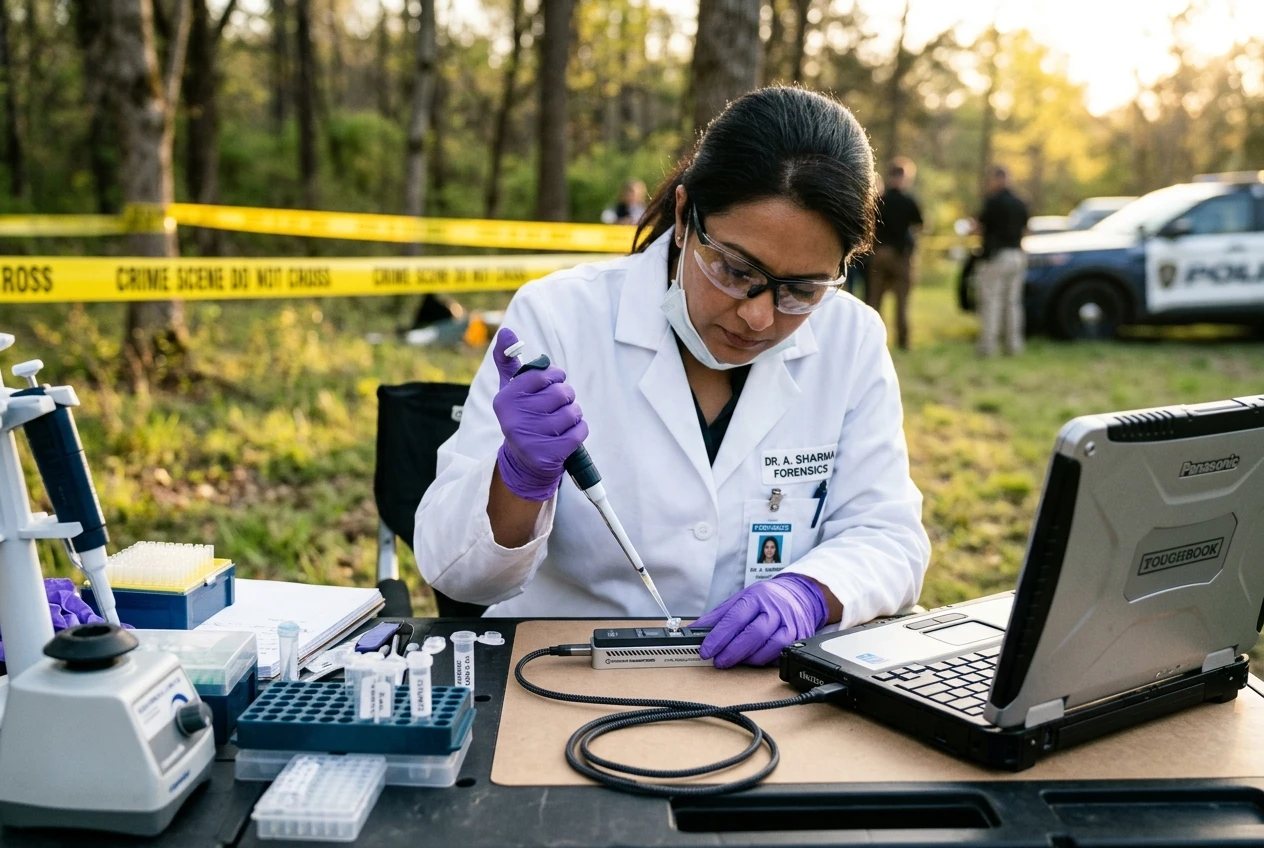
For all the bioinformatics load, the sequencing hardware itself is shrinking. Oxford Nanopore Technologies sells a device called the MinION, a palm-sized sequencer that weighs 130 grams, plugs into a laptop over USB-C, and runs at ambient temperatures from 10 to 35 degrees Celsius. The MinION Mk1D device starts at $3,150, with packs that include flow cells, wash kits, and 12 months of standard support available for $5,150, and read lengths span 20 base pairs to more than 4 megabases.
A single run can produce tens of gigabases of data, enough for bacterial genomes, viral amplicons, or small eukaryotic genomes, the categories Oxford Nanopore lists on its MinION device specifications and pricing page. Wright described the device as ‘a portable massively parallel sequencing lab-on-a-stick,’ and said the difference it makes is measured in weeks, not hours. In rural and remote Queensland, she said, getting a sample to a forensic laboratory ‘could take up to a month.’ A sequencer that goes to the sample instead of the other way around removes that wait, and Wright framed the impact in plain terms: ‘This kind of in-field testing kind of balances the playing field for all victims, no matter what the geographic area is.’
For countries with vast rural populations and thin lab coverage, the hardware implication is bigger than the software one. Forensic labs that once needed a dedicated capillary electrophoresis sequencer, PCR thermal cyclers, and a separate analysis workstation can now start a sequencing run from a single laptop on a folding table at a remote crime scene.
Massively parallel sequencing will not make traditional methods like STR profiling redundant, Mendes Junior said, and the two technologies are likely to coexist in working labs. The same crime scene can produce a sample that benefits from each workflow, with STR for routine hits and MPS for the cases that would otherwise go cold, and the table below captures how the two workflows stand side by side today.
| Dimension | Traditional forensic lab (STR + capillary electrophoresis) | Oxford Nanopore MinION |
|---|---|---|
| Physical footprint | Bench-top capillary electrophoresis sequencer, PCR thermal cyclers, separate analysis workstations | Palm-sized device (55 x 13 x 125 mm), 130 g, plugs into a laptop via USB-C |
| Markers read per sample | 21 short tandem repeat (STR) loci | Thousands of SNPs; read lengths from 20 bp to over 4 Mb |
| Time to result | Days to weeks, depending on sample transit and lab queue | Real-time data; results in hours when used in the field |
| Sensitivity | Struggles with degraded or low-template samples | Some platforms handle 25 to 50 picograms of DNA; a handful of cells can yield a profile |
| Operating conditions | Controlled laboratory environment | Active temperature control for 10 to 35 degrees Celsius ambient |
Sources: Oxford Nanopore MinION product specifications; The Scientist interview with Kirsty Wright and Celso Teixeira Mendes Junior.
Predicting What Someone Looks Like
Massively parallel sequencing also makes a step possible that STR profiling never managed: producing a physical description of an unknown suspect directly from their DNA. The technique is called forensic DNA phenotyping, and it works by reading single-nucleotide polymorphisms associated with externally visible characteristics, including hair color, skin pigmentation, eye color, and height. It is one of the more nascent applications of the technology, and the discipline is split on how far to trust it.
Teresa Vreeland, vice president of forensic genealogy services at Bode Technology, a US forensic DNA analysis provider, said her team has looked at phenotyping and decided against using it. ‘Some places have been doing it for a while,’ she said, but ‘we haven’t found it to be reliable enough to validate it, and we don’t use any of the identity SNPs [at Bode] to predict any physical characteristics.’ Other providers and academic groups do run the panels, particularly where there is no suspect and no database hit, and the disagreement sits inside the discipline: enough SNPs are validated to publish a profile, but not yet enough to put a face to it in a courtroom.
The Bioinformatics Bottleneck
The shift from capillary electrophoresis to massively parallel sequencing is, in Mendes Junior’s words, a transition the wider discipline is still negotiating, and the bioinformatics step is the part that is slowing it down: ‘This is the most difficult part, particularly for the forensic experts who are already working in the field with PCR and capillary electrophoresis: they are not prepared to deal with large amounts of data,’ he said. The work of running a sequencer and the work of turning its output into a courtroom-ready profile are two different jobs, and the second one is new.
Teresa Vreeland walked through the gap from the inside. Bode is a private forensic DNA analysis provider, not a public crime lab, and the team had to teach itself the new pipeline, and ‘even down to the amount of computational resources, the size of the computers, the CPUs, data storage sizes, it was the most challenging, and I would say the most out of our wheelhouse for the team to have to navigate,’ she said. Most forensic laboratories do not yet have the infrastructure or the bioinformatics staff to run massively parallel sequencing in-house, so the work is outsourced to private providers or a handful of academic centers when it is needed at all, and the discipline that produced STR profiling in the 1990s is, in effect, learning a second trade.
Mendes Junior is convinced the change is coming anyway. ‘It will depend on the country, on the lab, on the people dealing with that, on the financial support for this transition,’ he said, and ‘it will take a long time, but I think we are going in this direction, and in my opinion, there is no other direction to follow.’ Wright, for her part, is trying to bring the rest of the field with her, and her job in Queensland is to overhaul a government-run forensic laboratory for an era in which a single crime scene can produce a profile that the courts have never had to weigh before. The sequencers are getting cheaper, and the data is the harder problem.
Frequently Asked Questions
What is massively parallel sequencing in forensics?
Massively parallel sequencing, sometimes called next-generation sequencing, is a DNA-reading technology that lets forensic scientists examine many thousands of genetic markers in a single workflow, rather than the 21 short tandem repeat loci that define a standard STR profile. It can be used to identify contributors to a mixed sample, predict ancestry, and feed forensic investigative genetic genealogy searches.
How does MPS differ from STR profiling?
STR profiling reads the lengths of 21 repeated DNA regions using PCR and capillary electrophoresis, and produces a genetic fingerprint that can be checked against offender databases. Massively parallel sequencing reads many thousands of single-nucleotide polymorphisms and, in some setups, entire genomes, and the larger data set lets forensic scientists separate identical twins, identify contributors in mixed or degraded samples, and generate profiles from as little as 25 to 50 picograms of DNA.
What is forensic investigative genetic genealogy (FIGG)?
Forensic investigative genetic genealogy is the practice of uploading a DNA profile generated from crime-scene evidence to public genealogy databases such as GEDmatch and FamilyTreeDNA, then building a family tree from the distant relatives who match. It is the technique that identified Joseph DeAngelo as the Golden State Killer in 2018 and Robert Kwan as the suspect in a 35-year New South Wales sexual assault case in 2026.
How was the Golden State Killer caught using DNA?
In April 2018, California investigators uploaded a crime-scene DNA profile from one of the Golden State Killer cases to GEDmatch, a public ancestry database. The profile matched several distant relatives, the equivalent of third cousins, and detectives used traditional genealogy work, age, and the geography of the crimes to narrow the field. Sacramento police arrested 72-year-old Joseph DeAngelo, a former police officer, on April 24, 2018, in a case examined in an academic review of the Golden State Killer case at the National Library of Medicine.
What can a MinION device do at a crime scene?
The MinION, made by Oxford Nanopore Technologies, is a palm-sized DNA sequencer that weighs 130 grams, plugs into a laptop over USB-C, and operates in ambient temperatures from 10 to 35 degrees Celsius. It can generate read lengths from 20 base pairs to more than 4 megabases and produce tens of gigabases of data per run, enough to deliver a forensic DNA profile from a crime scene in hours rather than the days or weeks a traditional lab might take.
What is forensic DNA phenotyping?
Forensic DNA phenotyping is the practice of using single-nucleotide polymorphisms to predict externally visible characteristics, including hair color, skin pigmentation, eye color, and height, from a crime-scene sample. Some providers, including Bode Technology, say they do not yet consider the predictions reliable enough to validate for casework, while other groups run the panels in jurisdictions that permit them.
Why is bioinformatics the biggest hurdle for MPS adoption?
Massively parallel sequencing produces orders of magnitude more data than STR profiling, and the analysis requires expertise in bioinformatics, including large data storage, high-performance computing, and population databases. Most forensic laboratories were built for capillary electrophoresis workflows and do not have the staff or infrastructure to handle the data, so the work is often outsourced to private providers or academic centers.


South Korea Retail Investors Face Reckoning After KOSPI AI Rally Collapses

Surrey AI Maps Three Heart Attack Paths and Their Molecular Roots

Germany Locks Neutral Apple ATT Prompts Across Most of Europe

Apple’s 5% EU Fee Quietly Rewrites Alternative App Store Math

Apple’s EU Fee Truce Cuts Complexity but Leaves Rivals Fuming

Pixel 11 Pro Fold Trades Thinness for Durability and Seven-Year Stay

Mayo AI Flags HCM Obstruction From Everyday Ultrasound Videos

Indian Brands Quietly Scale Landmark Screens and Home Tech

Navin Vatsa Turns Grief Into a Lifetime of Quiet Seeing

Google Bets Pixel 11 Agentic AI Will Redefine Phones

Oracle Cuts 21,000 Jobs in a Year, Cites AI in 10-K Filing

Fable 5 and Mythos 5 Return as US Lifts Anthropic Export Controls

SpaceX’s Google Deal Turns a Rocket Company Into a Cloud Landlord

CD Projekt Red Co-CEO: Redemption Arc Isn’t Done, Witcher 4 in 2027

XPL Rallies 30% Ahead of Plasma One Card Tier Launch

Google Search Profiles Build a Follow Graph Inside Discover

DGO App Brings Rs 549 Mobile Pass for FIFA World Cup 2026 in Nepal

Moonshot AI Targets $30 Billion in China’s Fastest AI Funding Sprint

Oppo’s ColorOS 17 Eligibility List Leaves A-Series Buyers Behind

Microsoft Xbox Layoffs Start in July as Sharma Slams 3% Margin
-
 AI2 months ago
Oracle Cuts 21,000 Jobs in a Year, Cites AI in 10-K Filing
-
 AI2 months ago
Fable 5 and Mythos 5 Return as US Lifts Anthropic Export Controls
-
 AI3 months ago
SpaceX’s Google Deal Turns a Rocket Company Into a Cloud Landlord
-
 GAMING2 months ago
CD Projekt Red Co-CEO: Redemption Arc Isn’t Done, Witcher 4 in 2027
-
 CRYPTO3 months ago
XPL Rallies 30% Ahead of Plasma One Card Tier Launch
-
 NEWS3 months ago
Google Search Profiles Build a Follow Graph Inside Discover
-
 APPS3 months ago
DGO App Brings Rs 549 Mobile Pass for FIFA World Cup 2026 in Nepal
-
 AI3 months ago
Moonshot AI Targets $30 Billion in China’s Fastest AI Funding Sprint