
AI
XPeng’s June Delivery Beat Funds a Bold Physical AI Bet
XPeng delivered 40,126 vehicles in June 2026 (up 15.9% YoY), pushing Q2 to 103,295. X-Mind closed its Physical AI roadmap; IRON mass production moves to Q4.

XPeng delivered 40,126 vehicles in June 2026, a 15.93% increase from a year earlier and a 24.78% jump from May, the company said in the June and Q2 2026 delivery release. The monthly figure pushed total second-quarter deliveries to 103,295 units and ended five straight months of year-on-year declines. The release, filed as a Form 6-K with the SEC on July 2, 2026 and signed by chairman and CEO He Xiaopeng, also marked the production milestone for the GX flagship SUV and locked in the debut date for the next MONA model.
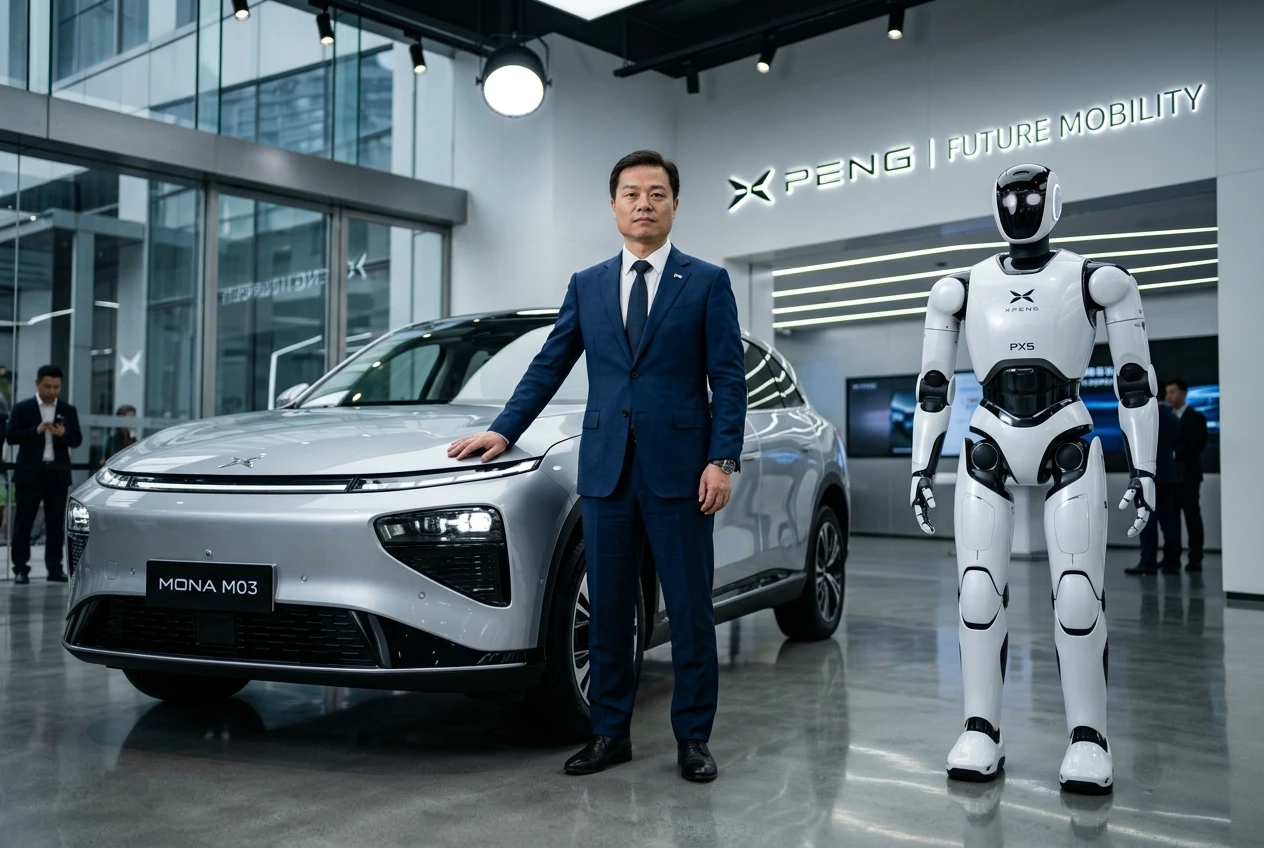
The same stretch that closed the EV quarter also closed XPeng’s Physical AI story. The company unveiled X-Mind at CVPR 2026 in June, completing its predictive world-model roadmap, and confirmed its IRON humanoid robot is targeting mass production in the fourth quarter. The robot push lands on a balance sheet that returned to a net loss of 1.78 billion yuan in the first quarter.
June’s 40,126 Brought the Quarter Home
June’s 40,126 deliveries were the highest monthly figure XPeng has posted in 2026. The 15.93% year-on-year gain broke a five-month slide in which deliveries had trailed the prior year every month. Month-on-month, the increase was 24.78% off May’s 32,158 units. The release framed the print as a return to growth after a sluggish first half.
The quarter itself landed inside management’s earlier guidance of 100,000 to 106,000 units. The rebound was concentrated in the GX SUV, which recorded 6,739 deliveries in June, its first full month on sale, and saw its 10,000th unit roll off the production line on the same day as the announcement. The X9 MPV, the company’s most expensive model, surpassed 60,000 cumulative global deliveries, with mid-June launches in Germany, Finland, and Norway taking it into seven European countries. XPeng delivered 165,977 vehicles in the first half of 2026, down 15.83% year-on-year, and has now moved 1,185,801 units since inception.
- June 2026 deliveries: 40,126 vehicles
- Q2 2026 deliveries: 103,295 units
- June YoY change: +15.93%
- June MoM change: +24.78%
- GX June deliveries: 6,739 units (first full month)
Q2 Barely Outran Last Year
The quarter was a recovery, not a re-acceleration. Q2 2026 deliveries came in at 103,295 units against 103,181 in the same period a year earlier, a 0.11% year-on-year lift. The big swing was the sequential one: Q1 2026 had come in at just 62,682 deliveries, so Q2 represented a 64.8% quarter-on-quarter rebound. XPeng’s Q1 figure had been down 33.32% year-on-year and 46.08% quarter-on-quarter against Q4 2025, so the first quarter was the trough the second quarter had to climb out of.
First-half cumulative deliveries of 165,977 vehicles still trail 2025 by 15.83%. The recovery narrative depends on June holding and the back half picking up the slack. The GX flagship, which went on sale in China on May 20, 2026 at a limited-time starting price of 269,800 yuan ($39,761), offers both battery-electric and super extended-range powertrain options. Production-line additions for core components are expected to shorten delivery wait times of more than 35 weeks by one to three weeks.
For comparison, NIO reported 40,597 June deliveries, up 62.9% year-on-year, with Q2 at 107,658 units, up 49.4%. Li Auto reported 30,895 June deliveries, down 15% year-on-year. XPeng’s volume still trails NIO’s in June and Q2 by a small margin, while Li Auto has slipped behind.
The MONA L03 Carries the Back Half
XPeng will debut the MONA L03 in China on July 2, 2026, with presale opening the same day, followed by a global market launch later in July. The company is positioning the L03 as “young people’s first smart and stylish SUV,” the lineup’s first SUV after the M03 sedan. Display vehicles are slated to arrive at stores on July 1.
The L03 is the company’s attempt to replicate the M03’s volume with a different body style. The M03 sedan delivered 175,689 units in 2025, accounting for 40.91% of XPeng’s full-year deliveries. But the formula has cooled in 2026: M03 cumulative deliveries in the first five months came to 48,291 units, down 33.15% year-on-year. XPeng is counting on the SUV body to revive that mass-market engine. The release also noted that vehicles delivered from January to June 2026 are expected to reduce life-cycle greenhouse gas emissions by more than 2.66 million tons compared to internal combustion engine vehicles, equivalent to the carbon absorption of 43.92 million young trees over 10 years.
X-Mind Closes the Physical AI Loop
XPENG unveiled X-Mind at the CVPR 2026 Workshop on Foundation Model Deployment for Embodied Intelligence, completing its Physical AI foundational model roadmap alongside X-World and X-Foresight. Xianming Liu, head of XPENG Group’s General Intelligence Center, presented the framework as the third leg of a stack aimed at next-generation autonomous driving. the X-Mind presentation at CVPR 2026 describes the model as a Predictive World Model that lets vehicles simulate future traffic scenarios before deciding, using a Visual Chain-of-Thought.
The framework rests on three core technologies. Thought Sketch creates an efficient cognitive representation combining Bird’s-Eye-View layouts and driving priors, preserving road structures, obstacles, traffic lights, and navigation intentions while reducing computational complexity. Recurrent Block Diffusion enables high-quality future scene generation within a single forward pass, balancing advanced reasoning with real-time deployment. Visual CoT exposes how the model predicts obstacle movements, lane connectivity, and future traffic conditions before generating a driving decision, giving the system a transparency layer.
X-Mind was trained on hundreds of millions of real-world driving data frames, with a target of improved trajectory prediction accuracy, enhanced performance in complex long-tail scenarios, and ultra-low inference latency for automotive-grade chips. XPENG says the model completes the Physical AI roadmap by letting vehicles understand not just how to act, but how the world evolves after each action.
The CVPR presentation also cited training-efficiency gains from XPENG’s cluster. In the 12 months ending March 2026, the cluster posted a 1,010% uplift in per-GPU training efficiency and a 4,360% gain in single-job training efficiency. The company has separately confirmed that its VLA 2.0 system, with UN and EU regulatory approval, is locked in for global markets in 2027.
| Component | What it does | Why it matters |
|---|---|---|
| Thought Sketch | Cognitive representation combining BEV layouts with driving priors | Preserves road structures, obstacles, traffic lights, navigation intentions while reducing computational complexity |
| Recurrent Block Diffusion | Generates high-quality future driving scenes in a single forward pass | Overcomes conventional diffusion latency, balancing advanced reasoning with real-time deployment |
| Visual CoT | Reveals predicted obstacle movements, lane connectivity, and future traffic before a decision | Improves transparency and system validation of autonomous decisions |
IRON Is the Big Spend
He Xiaopeng told employees in an internal letter on June 10, 2026 that he will personally serve as the “CEO” of XPeng’s robotics business, putting the title in quotation marks because the unit has not been spun off. the internal letter on the robotics transition framed the moment as the “eve of mass production and commercialization,” comparing the current stage to eight years ago when XPeng was preparing to launch its first vehicle, the G3 SUV. He named automobiles, robotics, and globalization as the three core growth curves for the next decade.
The IRON humanoid robot is equipped with an all-solid-state battery, three in-house Turing AI chips delivering 2,250 TOPS of computing power, and the second-generation VLA large model. The robotics team has grown to over 1,000 people, and XPeng began construction of a humanoid robot mass-production base covering about 110,000 square meters in Q1 2026. The first ET1 prototype, developed to automotive standards, was delivered in January 2026.
The build-out is running while the team undergoes turnover. Shi Xiaoxin, a core founding member of the IRON project and the product lead of XPeng’s robotics business, departed earlier in June 2026. He Xiaopeng has publicly said he is dedicating this year to achieving mass production of robotaxis and humanoid robots in parallel. The CEO’s direct takeover is the company’s response: consolidate the decision-maker at the top while the production line comes online.
- Q4 2026: Mass production and initial delivery of IRON humanoid robots.
- Q1 2027: IRON deployed in XPeng stores nationwide as shopping guides.
- Q2 2027: IRON pushed to broader overseas markets.
- 2028: IRON begins entering ordinary households.
The Math Has to Work Twice
XPeng returned to a net loss in Q1 2026. The unaudited results, released May 28, showed a net loss of 1.78 billion yuan ($260 million), ending a single-quarter profit streak. the first-quarter earnings breakdown confirmed revenue fell 17.6% year-on-year to 13.03 billion yuan. The loss was wider than a year earlier, when Q1 2025 had come in at a 660 million yuan net loss, but it erased the 380 million yuan net profit XPeng had posted in Q4 2025, the company’s first-ever quarterly profit.
Gross margin still climbed. The overall gross margin reached 20.6%, up from 15.6% in the same period a year earlier, and vehicle margin rose 1.6 percentage points year-on-year to 12.1%. The combination of rising margin and falling revenue pointed to a model-mix and pricing story: average selling prices rose even as unit volumes fell by a third. The traditional Chinese auto-industry slow season and the gap between model launches hit the top line.
Physical AI applications will be a global strategic opportunity in the next 10 years.
That is XPeng chairman and CEO He Xiaopeng, speaking on the company’s Q1 2026 earnings call, framing why the robotics build-out is happening now, while the auto business is still working its way back to a clean profit print. He has said this year he is dedicated to achieving mass production of robotaxis and humanoid robots in parallel, and the IRON timeline now has hard quarters attached to it.
The second half of 2026 has to deliver on three fronts at once. GX needs to scale into a real premium volume contributor. MONA L03 needs to revive the mass-market engine the M03 sedan is no longer running. IRON needs to clear mass production in Q4 without the robotics product lead who built the project. Q2’s delivery beat landed inside guidance; Q2 earnings, which come next, will show whether the Q1 margin story carried forward with GX volumes in the mix.
What the Street Is Watching
XPeng shares were up 1.41% at $13.43 in premarket trading on Wednesday after the release, according to Benzinga Pro data cited by Sahm Capital. The stock is rallying, but Benzinga Edge’s stock scorecard flagged a “Weak” momentum reading of 5.52, suggesting the tape has not fully re-rated the delivery print.
The near-term calendar is dense. The MONA L03 China debut and presale open on July 2. XPeng’s Q2 2026 earnings release, expected in August, will offer the first look at whether the gross-margin lift from Q1 holds with GX layering into the mix. GX wait times should start to shorten by one to three weeks as new component production lines come online. The IRON mass-production milestone is locked to Q4 2026, with the first commercial shopping-guide deployment at XPeng stores in Q1 2027. The Street’s price-target spread for XPEV remains wide across the major aggregators, and the next print that compresses the range is the Q2 earnings report.
Disclaimer: This article is for informational purposes only and does not constitute financial advice. Investing in equities such as XPeng (XPEV) carries risk, including the potential loss of principal. Past delivery performance and product roadmaps do not guarantee future results. Consult a qualified financial professional before making investment decisions. Figures are accurate as of publication on July 3, 2026.


South Korea Retail Investors Face Reckoning After KOSPI AI Rally Collapses

Surrey AI Maps Three Heart Attack Paths and Their Molecular Roots

Germany Locks Neutral Apple ATT Prompts Across Most of Europe

Apple’s 5% EU Fee Quietly Rewrites Alternative App Store Math

Apple’s EU Fee Truce Cuts Complexity but Leaves Rivals Fuming

Pixel 11 Pro Fold Trades Thinness for Durability and Seven-Year Stay

Mayo AI Flags HCM Obstruction From Everyday Ultrasound Videos

Indian Brands Quietly Scale Landmark Screens and Home Tech

Navin Vatsa Turns Grief Into a Lifetime of Quiet Seeing

Google Bets Pixel 11 Agentic AI Will Redefine Phones

Oracle Cuts 21,000 Jobs in a Year, Cites AI in 10-K Filing

Fable 5 and Mythos 5 Return as US Lifts Anthropic Export Controls

SpaceX’s Google Deal Turns a Rocket Company Into a Cloud Landlord

CD Projekt Red Co-CEO: Redemption Arc Isn’t Done, Witcher 4 in 2027

XPL Rallies 30% Ahead of Plasma One Card Tier Launch

Google Search Profiles Build a Follow Graph Inside Discover

DGO App Brings Rs 549 Mobile Pass for FIFA World Cup 2026 in Nepal

Moonshot AI Targets $30 Billion in China’s Fastest AI Funding Sprint

Oppo’s ColorOS 17 Eligibility List Leaves A-Series Buyers Behind

Microsoft Xbox Layoffs Start in July as Sharma Slams 3% Margin
-
 AI2 months ago
Oracle Cuts 21,000 Jobs in a Year, Cites AI in 10-K Filing
-
 AI2 months ago
Fable 5 and Mythos 5 Return as US Lifts Anthropic Export Controls
-
 AI2 months ago
SpaceX’s Google Deal Turns a Rocket Company Into a Cloud Landlord
-
 GAMING2 months ago
CD Projekt Red Co-CEO: Redemption Arc Isn’t Done, Witcher 4 in 2027
-
 CRYPTO2 months ago
XPL Rallies 30% Ahead of Plasma One Card Tier Launch
-
 NEWS2 months ago
Google Search Profiles Build a Follow Graph Inside Discover
-
 APPS2 months ago
DGO App Brings Rs 549 Mobile Pass for FIFA World Cup 2026 in Nepal
-
 AI2 months ago
Moonshot AI Targets $30 Billion in China’s Fastest AI Funding Sprint