
GADGETS
Kia Vision Meta Turismo turns the EV grand tourer into a console
Kia’s Vision Meta Turismo concept lands at BIMOS 2026 in Busan with three AR driving modes, a gaming-style steering wheel, and a wide HUD in its cabin.

Kia’s Vision Meta Turismo concept is back on Korean soil for the 2026 Busan International Mobility Show. The electric grand tourer, first shown in Korea in December 2025 and given a global reveal at Milan Design Week in April, now sits on the floor of BEXCO with three AR-driven driving modes wired into a gaming-inspired cabin. The show runs through July 5.
The concept brief for the Vision Meta Turismo puts it plainly: the concept turns “time on the move into moments of meaningful new experience.” Hardware backs the claim, with a gaming-controller-inspired steering wheel, a joystick virtual gear shifter, a wide AR head-up display, and a passenger seat that turns 180 degrees toward the rear when the car is parked. What that adds to driving, and what it takes from it, is the question the concept leaves the public to settle. Kia’s three named modes, Speedster, Dreamer, and Gamer, are the cabin’s spine.
A Concept Returns to Korean Soil
The Vision Meta Turismo is the centerpiece of Kia’s pavilion at the 2026 Busan International Mobility Show, the biennial show running at BEXCO Exhibition Center 1 & 2. The fair opened to the press on June 26, with public days running through July 5, and 150 companies and 2,200 booths in its listed scale. Hyundai Motor Group’s walkthrough places the concept beside the PV5 lineup, a separate Kia purpose-built vehicle family. The pairing sketches Kia’s full sweep in 2026, from the showroom-ready to the not-yet.
Kia first unveiled the Vision Meta Turismo inside Korea in December 2025, an 80th-anniversary debut the brand confirmed in this year’s Milan Design Week press release. April 22 brought the global reveal at Milan’s Salone dei Tessuti during Design Week, where the concept sat on display through April 26 alongside a line of Kia EV concepts. The Busan stop is the first major Asian showing since Milan, slotted into a show whose program describes the auto industry as “undergoing a transition… beyond the traditional concept of transportation.” Each stop gives Kia a different audience to test the concept against.
The exterior is half of the argument. The cabin, and the way it switches character, is where the design leadership has leaned hardest. At the Milan unveiling, the brand’s most senior designer argued that the concept belongs to a category Kia is still trying to name.
“Harmonising the spirit of 1960s long-distance touring with the limitless possibilities of an immersive digital experience, we have created a vehicle that moves beyond the bounds of tradition.”
The quote is from Karim Habib, executive vice president and head of Kia Global Design, speaking at the April 22 Milan debut. His second line on the same page makes the broader claim: “This concept embodies Kia’s vision of a future where mobility is not just about the destination, but about creating human-centered spaces that engage, stimulate, and inspire our customers in ways yet to be imagined.” Habib’s framing hints at where the modes fit. Kia’s three named modes, Speedster, Dreamer, and Gamer, are the spine.
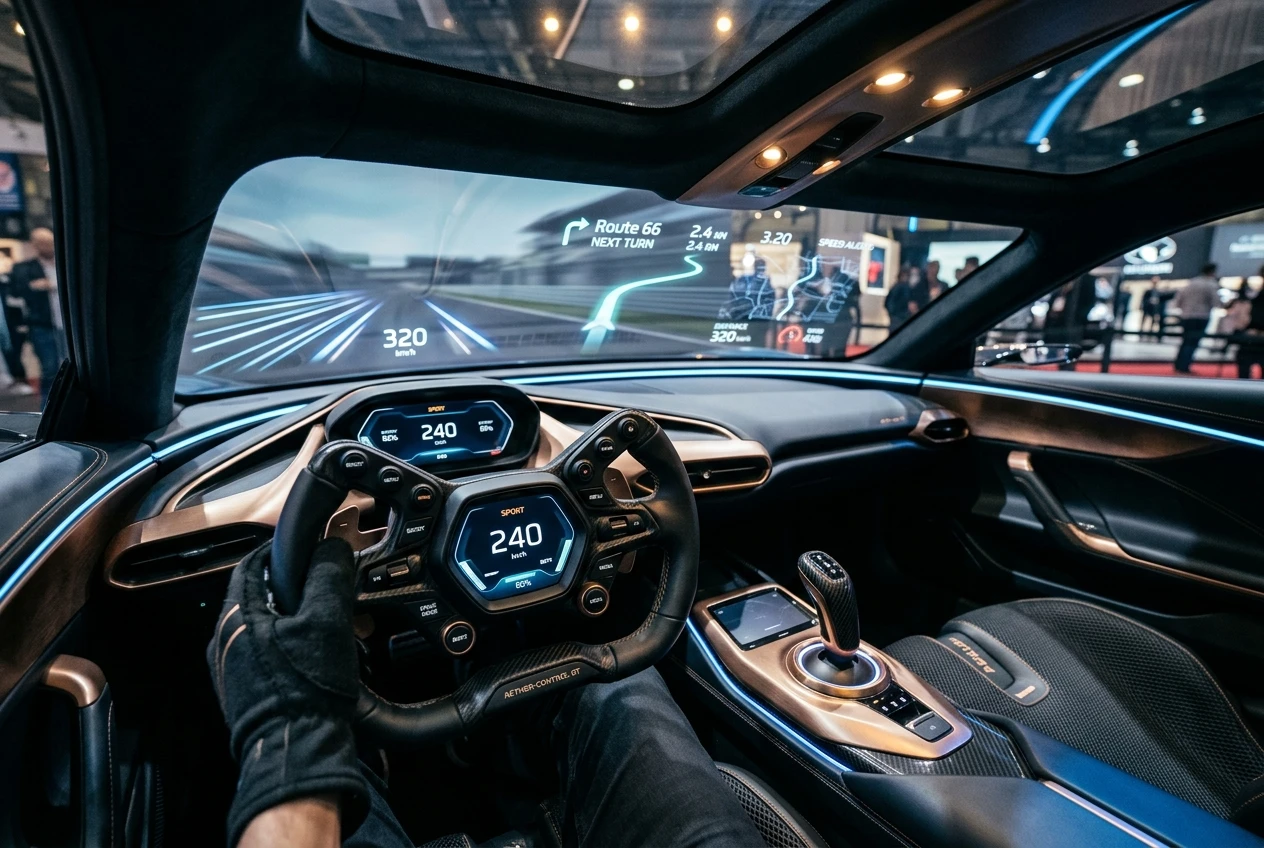
Three Modes, One Steering Wheel
Kia has named the three driving moods Speedster, Dreamer, and Gamer, all of them reached through a single steering wheel. The wide AR head-up display anchored to the windshield is what changes between them, with the cabin’s lighting, sound, and graphics re-tuned around each. Kia’s concept page describes the modes as expanding “the sensation of driving” across “different driving sensibilities and characters to suit the moment.” That line does a lot of work: the modes are real, the modes are not about finishing the drive faster. One wheel, three settings, three different reasons to be in the car.
| Mode | When it activates | What it changes |
|---|---|---|
| Speedster | Driving, especially on the open road | Wide AR HUD that distorts surrounding space as speed rises; sequential lighting; engine-style sound effects |
| Dreamer | Urban driving and low-speed cruise | AR HUD plus AR goggles that overlay information and color on the surrounding environment |
| Gamer | Parked | Virtual racing on the AR HUD via the steering wheel; an exterior projector turns the body into a group gaming hub |
The split is unusual enough to be worth dwelling on. Speedster treats the open road as a stage. Dreamer treats the city as a layer cake of virtual information. Gamer treats the parked car as a room. All three route through the same wide AR HUD and steer through the same gaming-pad-inspired wheel; that shared architecture is what makes the three a coherent design philosophy.
The cockpit has been rethought on the same axis. The gear shifter is a joystick, the boost is a button, the engine response is a dial, and the steering wheel itself borrows directly from a gaming pad. Walking from the hardware section back to the modes, the impression is that Kia is betting the cabin will matter at least as much as the road.
That bet is where the rest of the show-floor argument lives. It is also where the case for the concept gets harder to make.
A Cockpit Built Like a Controller
The cabin is where Kia spent the most design capital, and the parts the brand chose to highlight cluster around three analog-style controllers, each one meant to give the driver the haptic feedback a real gearbox or a real engine note would otherwise provide. The pieces sit inside what Kia calls a minimalist central structure that activates each controller only when the driver reaches for it.
- ‘Joystick’ virtual gear shifter: recreates the feeling of changing gears, paired with virtual engine sounds and vibrations.
- ‘Button’ launch control and GT Boost: awakens full power and delivers an instant surge of acceleration.
- ‘Dial’ virtual engine sound and driving motion control: adjusts virtual engine response, suspension sensitivity, and overall driving feel.
The hardware sits inside the cockpit with the steering wheel as its anchor. Kia has drawn the wheel directly from gaming controllers, with grips and a control layout the brand says ties the cabin hardware to the three modes. Add-Gear, a modular interface that combines game controllers, audio, and smart displays, lets passengers take part in the cabin’s shifting role. The impression is of a cockpit where every dial, lever, and trigger has been audited against what a sim rig would do.
The passenger seat uses the same form language and mesh materials as the driver’s seat but adopts a lounge-like posture. The seat rotates 180 degrees when the car is stationary so the front passenger can face the rear passengers. That single detail turns the cabin into a room with a front-row seat in every mode.
Where the Body Catches Up to the Cabin
The exterior reads as the cabin’s supporting act; the cabin does the headline work and the body provides the surface. Kia describes the architecture as cab-forward, with the low nose leaning aggressively forward, and a wide, low stance meant to “evoke dynamic speed even at a standstill.” The body language is built around what Kia calls a “soft geometric” surface language, with faceted panels and soft transitions the brand ties back to its “Opposites United” design philosophy. Two details stand out from the Milan unveil: the jet-inspired canard housing the upper front lamp and rear-view camera, and the horizontal LED blade wrapping the rear corners.
Underneath the body language is a reference to the era Kia is borrowing from. The concept pays homage to “the speed and elegance of 1960s long-distance touring,” with a glass canopy that meets the sky and an internal space frame visible through it. The result is a silhouette meant to look both retro-futurist and sleek at low, wide angles. The body’s cover is the part most visitors will see at BEXCO.
Engagement or Distraction?
The Vision Meta Turismo asks a question the more conventional BEXCO neighbors do not: if a grand tourer can become a sim rig when parked, a styled companion in traffic, and a theatric experience on the highway, what is left for the drive itself. Kia’s framing leans hard into the upside, with the concept page saying the modes are meant to “evoke the nostalgia of long touring-car journeys, reawakening the pure joy of driving.” The press material does not discuss whether distilling every moment of a drive into a designed experience starves the ordinary ones. That omission is the part of the concept the booth does not label.
The hardware is built with enough detail to make either reading defensible. The AR HUD, the three modes, the gaming-style steering wheel, and the Add-Gear interface are not a toy catalog; they form a coherent build designed around a specific kind of buyer. Read charitably, the modes add a level of attention and presence that an unembellished EV cabin does not currently offer. Read skeptically, they pull attention toward screens and away from the road. Kia’s release does not address the second read, but it is the question many readers will bring.
What BIMOS cannot settle is whether the drive itself absorbs the change or fades behind it. Kia has not announced a production date for the concept, and the brand’s release notes the design “may differ from the actual production model.” Whether the modes translate to a saleable car is a question that gets handed to whatever comes next. The next round of evidence will come from how Kia positions similar cabin features in any production model it ships.
A Show Built Around Concepts Like This
The Vision Meta Turismo is one of several Kia and Hyundai Motor Group concepts that the Busan International Mobility Show has grouped inside a single pavilion. The PV5 lineup takes the floor beside the grand tourer concept, both framed as future-mobility platforms. The pairing gives BEXCO a sense of Kia’s full sweep in 2026, from the showroom-ready to the not-yet. Other Korean brands run adjacent pavilions under similar mobility banners.
- Show window: June 26 – July 5, 2026
- Press day: June 26, 2026
- Venue: BEXCO Exhibition Center 1 & 2, Busan
- Listed scale: 150 companies, 2,200 booths
BIMOS itself is broader than the Kia booth. The fair ran press day on June 26 and runs public days through July 5, with 150 companies and 2,200 booths in its listed scale, per the official BIMOS 2026 schedule and venue details. BEXCO Exhibition Center 1 & 2 is the venue, with Hyundai Motor Group, Genesis, and other Korean brands running adjacent pavilions under similar mobility banners. The Vision Meta Turismo takes a corner of the Kia space; the show as a whole is built around Korea’s case for why the next decade of cars looks more like a software platform than a piece of hardware. Habib’s broader framing that the concept embodies a future “where mobility is not just about the destination” is the same logic the show’s organizers use to position the 2026 edition.
Frequently Asked Questions
What is the Kia Vision Meta Turismo concept?
The Vision Meta Turismo is an electric grand tourer concept car that Kia first unveiled in Korea in December 2025 to mark its 80th anniversary, with a subsequent global debut at Milan Design Week in April 2026. The concept pairs a low, wide cab-forward silhouette with three digital driving moods: Speedster, Dreamer, and Gamer. It is a concept model that the brand marks as design direction only, distinct from a production car.
When did the Vision Meta Turismo make its global debut?
Kia gave the Vision Meta Turismo its global public debut at Milan’s Salone dei Tessuti during Design Week on April 22, 2026. The Busan stop is the first major Asian showing since Milan, with the concept now on the show floor at BEXCO. The Korea-first, world-second sequence has been Kia’s preferred debut pattern for the concept.
What are the three driving modes?
Kia has named the three driving moods Speedster, Dreamer, and Gamer, with Speedster and Dreamer meant to be used while the car is moving and Gamer reserved for parked sessions. Each mode reshapes the cabin’s lighting, sound, and AR HUD content. The single wheel that switches between all three is the part of the concept Kia leans on hardest.
Is the Vision Meta Turismo an electric car?
Yes. Kia has described the Vision Meta Turismo as an electric grand tourer concept, and the brand’s press release frames it as a contemporary reinterpretation of performance driving, immersive digital interaction, and lounge-like space. No production date has been announced.
Where can the Vision Meta Turismo be seen in 2026?
The Vision Meta Turismo is on display at the 2026 Busan International Mobility Show at BEXCO Exhibition Center 1 & 2 in Busan, where it shares the Kia pavilion with the new PV5 lineup. It previously showed at Milan’s Salone dei Tessuti during Design Week 2026. The show schedule and venue information is on the official BIMOS website.


Tickeron AI Trading Agents Post Up to 232% Annualized Return

Germany’s HMI Systems Market Will Grow 4-6% Through 2035

UK School Phone Ban: Smartwatches Out, Uniform Caps from September

Revvity’s Signals MCP Connector Joins Claude, but RVTY Stays a Sleeper

Apple’s Foldable iPhone Arrives at $2,000, Years After Samsung

Free Fire MAX Redeem Codes for July 4, 2026: Claim Diamonds and Skins

Hotel Won’t Fix Wrong DoorDash Address, Guests’ Food Lands Elsewhere

Tardigrade Genome Sequencing Is the Small Step Toward Mapping All Life

Apple’s iPhone Air 2 Adds a Second Camera for Spring 2027

Anthropic’s Drug Push Begins With Claude Science in San Francisco

Google Search Profiles Build a Follow Graph Inside Discover

Microsoft Xbox Layoffs Start in July as Sharma Slams 3% Margin

Google DeepMind and A24 Sign $75 Million AI Partnership Deal

DGO App Brings Rs 549 Mobile Pass for FIFA World Cup 2026 in Nepal

Anthropic Tells Senators Alibaba Ran the Largest Claude Distillation Attack

Apple Strikes Preliminary Deal For Intel To Make iPhone And Mac Chips

Oracle Cuts 21,000 Jobs in a Year, Cites AI in 10-K Filing

Andreessen Horowitz Bets $2.2B on Crypto’s Quiet Cycle

VinRobotics’ VR-H3 Debuts at Vienna, VinFast Is Next

Oppo’s ColorOS 17 Eligibility List Leaves A-Series Buyers Behind
-
 NEWS4 weeks ago
Google Search Profiles Build a Follow Graph Inside Discover
-
 GAMING3 weeks ago
Microsoft Xbox Layoffs Start in July as Sharma Slams 3% Margin
-
 AI2 weeks ago
Google DeepMind and A24 Sign $75 Million AI Partnership Deal
-
 APPS3 weeks ago
DGO App Brings Rs 549 Mobile Pass for FIFA World Cup 2026 in Nepal
-
 AI1 week ago
Anthropic Tells Senators Alibaba Ran the Largest Claude Distillation Attack
-
 NEWS2 months ago
Apple Strikes Preliminary Deal For Intel To Make iPhone And Mac Chips
-
 AI1 week ago
Oracle Cuts 21,000 Jobs in a Year, Cites AI in 10-K Filing
-
 CRYPTO2 months ago
Andreessen Horowitz Bets $2.2B on Crypto’s Quiet Cycle