
AI
Schneider Electric to Acquire Cognite in $3.1 Billion AI Deal
Schneider Electric pays $3.1 billion for Cognite, whose Atlas AI runs at ADNOC and Aker BP. The deal folds Cognite into AVEVA, pending approval.

Schneider Electric will pay $3.1 billion in cash for Cognite, a cloud-native industrial data and AI software firm whose Atlas AI platform already runs at plants operated by ADNOC, Aker BP, and TotalEnergies, the companies said on June 30 in their joint announcement. The deal will fold Cognite into AVEVA, the British industrial software company Schneider acquired in 2023. Cognite’s results will sit inside Schneider Electric’s Industrial Automation business once the transaction closes in the coming quarters, subject to regulatory approval.
Cognite’s software pulls together the streams of sensor, maintenance, and engineering data that industrial plants generate and turns them into a single contextualized data model that AI agents can act on. Schneider Electric CEO Olivier Blum framed the purchase as the missing layer that turns the company’s existing energy management and automation hardware into software that “thinks, adapts, and acts.” The price, paid in cash and reported on June 30, values the industrial data platform at well above its 2025 revenue of more than $170 million.
The Deal Schneider Announced This Week
Schneider Electric and Cognite signed a definitive agreement on June 30, 2026, with the announcement coming from Schneider Electric’s Rueil-Malmaison headquarters. Under the terms, Schneider Electric will acquire 100% of Cognite Holding B.V. in an all-cash transaction valued at $3.1 billion. Schneider Electric held an analyst and investor call on July 1, 2026 to walk through the strategic rationale behind the purchase.
Cognite, founded in 2017 and headquartered in Tempe, Arizona, employs more than 800 people across the Americas, Europe, the Middle East, and Asia-Pacific. Its 2025 annual revenue exceeded $170 million, with 36% growth in annual recurring revenue bookings during the same year. Cognite CEO Girish Rishi is expected to remain in his role through the integration. Schneider Electric confirmed that Cognite’s results will be consolidated within its Industrial Automation business once the transaction closes.
What Cognite Brings to the Stack
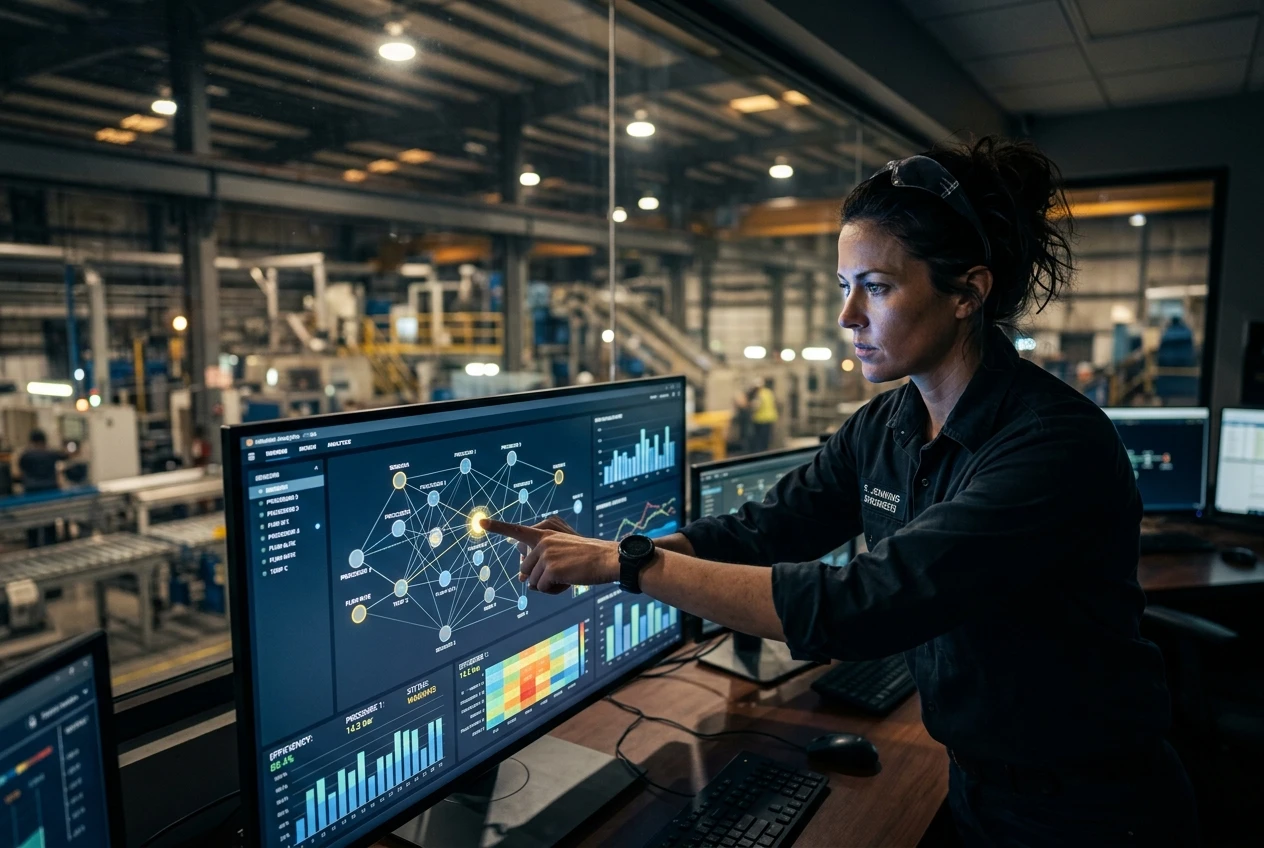
Cognite sells two products that together do the work its customers cannot easily do themselves. The first is Atlas AI, a low-code workbench for building AI agents that query industrial data. The second is Data Fusion, a cloud-native platform that holds the contextualized map those agents run on. Cognite describes the platform as an industrial grade data foundation that turns fragmented operational data into a competitive advantage.
The knowledge graph inside Data Fusion is the part that separates Cognite from generic industrial data lakes. Each piece of data inherits relationships to the equipment, processes, and operators it touches, so an AI asking “why did this pump fail” can pull together vibration readings, work orders, supplier history, and maintenance notes in one query rather than across a dozen siloed systems. Cognite Atlas AI extends the graph with agentic AI capabilities that automate industrial workflows, from anomaly detection to maintenance scheduling. Atlas AI lets users pick from Anthropic, OpenAI, Gemini, or Cognite’s own Dark Horse model, the last trained with NVIDIA on industrial time-series data where general-purpose large language models stumble.
Schneider Electric CEO Olivier Blum, in the companies’ June 30 release, framed the deal as the bridge between physical infrastructure and digital intelligence.
Cognite has built something rare, a truly industrial grade AI platform that turns the complexity of operational data into a competitive advantage. This acquisition strengthens AVEVA, Schneider Electric’s wholly owned industrial software company, in the highest-growth segments of the market and positions Schneider Electric at the centre of the next phase of industrial intelligence.
The release adds that the combined entity will treat the contextualized data layer as a strategic asset that runs across the design, build, operate, and optimize stages of an industrial asset’s life. Blum, in the same statement, said Schneider Electric “has always believed the energy transition demands intelligence, intelligence demands data, and unlocking its full value requires AI.” Together, Cognite and AVEVA will form what the release calls a unified platform built for the next phase of industrial AI.
What Industrial AI Actually Runs On
Industrial AI is shifting from describing what is happening inside a plant to deciding what to do about it, and Cognite’s pitch is that the bottleneck is no longer the model. It is the data underneath. The June 30 release puts the shift plainly: industrial AI is moving from supporting analytics to executing operations, “from describing what is happening in industrial infrastructure to deciding and acting on it.” Cognite’s Data Fusion is built to feed that shift by giving every AI agent a shared, contextualized map of the plant it is supposed to act on.
That map, in Cognite’s design, is a knowledge graph that links each sensor reading, work order, maintenance record, and engineering document to the equipment, process, and operator it belongs to. The graph ingests data from sources like time-series historians, ERP systems, and engineering document stores, then reconciles it into a single model the AI can query. Cognite CEO Girish Rishi, in a Forbes interview, used an analogy to explain the difference: “Girish will travel on July 8 from Salt Lake City to San Francisco on the Delta flight at 3:30 in the afternoon, in seat 1111 C, landing at 4:40” is one set of facts, while “Girish will travel to San Francisco the week of July 5” is another set that is factually true but far less useful. The implication for a refinery or chemical plant, Rishi argues, is that an AI asked to fix a corroding pump can pull together the supplier history, vibration trend, and last maintenance window in one go.
The same contextualization step is what makes industrial AI different from enterprise AI. A single chemical plant, Rishi has said, can produce data sets measured in trillions of records; one Cognite customer pulled in 2.5 trillion records from 47 source systems during deployment. Time-series data from vibration, pressure, and temperature sensors alone tends to dwarf the document and transactional data that enterprise AI platforms were built to handle. That is why Cognite built Dark Horse, its own foundation model trained with NVIDIA on industrial time-series data, rather than relying solely on third-party large language models.
The combined Schneider Electric stack gives Schneider Electric a full contextualization-to-action stack it did not previously own. Schneider Electric’s own framing of the deal, in the June 30 release, is that the stack “unites the world’s most comprehensive energy management and automation infrastructure with the software and AI capabilities to make it natively intelligent.” Cognite’s open architecture is what lets CONNECT ingest industrial data across the asset life cycle without forcing customers to replace existing systems.
| Layer | What it does | Where it sits |
|---|---|---|
| Cognite Data Fusion | Ingests sensor, maintenance, engineering, and enterprise data and reconciles it into a single knowledge graph | Foundation |
| Cognite Atlas AI | Low-code workbench for building AI agents that query the knowledge graph and act on its findings | Agent layer |
| AVEVA CONNECT | Industrial software platform for design, build, operation, and optimization of capital projects and assets | Asset layer |
The Numbers Behind the $3.1 Billion Tag
Forbes put the price at 18.2x Cognite’s 2025 revenue, a steep multiple set against a company still scaling fast. Cognite posted 36% growth in annual recurring revenue bookings in 2025, with much of that growth concentrated in Atlas AI, the agentic AI workbench at the centre of the deal. Forbes framed the premium around the data-layer scarcity story Schneider Electric is now selling: customers running multi-billion-dollar plants have a lot to gain from shaving even a few days of unplanned downtime. Rishi, in the same Forbes interview, argued that the contextualized data layer is what turns those uptime gains into operational reality. Schneider Electric, for its part, made the same point in its announcement: industrial AI is shifting from describing operations to acting on them, and the companies that own the data layer own that shift.
Schneider Electric does not break out Cognite’s contribution to its earnings, and the company has not given a closing date for the transaction. The release notes that Cognite will be reported inside Schneider Electric’s Industrial Automation business “upon completion,” and that the deal is “expected to be completed in the coming quarters.” Schneider Electric finished its previous industrial software acquisition, AVEVA, in 2023, a deal that valued the Cambridge-based engineering software firm at £9.5 billion. Cognite joins AVEVA inside Schneider Electric’s Industrial Automation business, with the two software assets now sitting under the same reporting line.
Key figures behind the deal
- $3.1 billion: all-cash price Schneider Electric will pay for Cognite (June 30 announcement)
- 18.2x: Forbes’s implied multiple on Cognite’s 2025 revenue
- 36%: Cognite’s 2025 growth in annual recurring revenue bookings
How AVEVA Absorbs Cognite
AVEVA is Schneider Electric’s wholly owned industrial software subsidiary, headquartered in Cambridge, UK, with more than 6,000 employees and a customer base that, per the company, includes more than 90% of leading industrial enterprises. The combined platform will sit inside Schneider Electric’s Industrial Automation business, with Cognite’s Data Fusion and Atlas AI acting as the data and AI layer beneath AVEVA’s CONNECT industrial intelligence platform. Schneider Electric’s wider reach across 160,000 employees and 1 million partners in over 100 countries is the go-to-market engine Cognite now plugs into.
AVEVA CONNECT is the design, build, operate, and optimize backbone that more than 20,000 industrial customers already use. Schneider Electric says Cognite’s open, cloud-native architecture is what lets CONNECT ingest industrial data across the asset life cycle without forcing customers to rip out existing systems. The two companies describe the combined offering as a unified platform for the next phase of industrial AI, with Data Fusion contextualizing engineering and operations data and Atlas AI turning that context into automated workflows. AVEVA’s role in the combined go-to-market will be the engineering, asset, and operations software that Cognite’s AI agents write back into. Cognite’s product roadmap, including Dark Horse and the Atlas AI workbench, continues to operate alongside CONNECT, per the deal release.
For Schneider Electric, the strategic frame is the same one it has been building toward since the AVEVA deal closed in early 2023: a single stack that connects electricity, automation, and software. Schneider Electric closed its prior industrial software deal, the 2023 acquisition that valued AVEVA at £9.5 billion and consolidated the British engineering software firm under its Industrial Automation umbrella. Three years later, Cognite plugs the contextual data layer that AVEVA’s own engineering software did not natively build. Customers already running on both AVEVA tools and Cognite, including Aker BP, TotalEnergies, and ADNOC, are positioned to see the two vendors’ software stitched together over time. Schneider Electric’s hardware side, from the TeSys Deca contactor where Weidmüller SNAP IN terminals were added to plant-wide automation gear, also feeds the same operational layer that Cognite now governs. ADNOC, Aker BP, and TotalEnergies move from being Cognite’s customers to being Schneider Electric customers once the deal closes.
What Industrial Customers Are Already Seeing
The customer evidence Schneider Electric is leaning on comes largely from chemical and energy companies with plants that cost more than $1 billion to build. Cognite’s CEO told Forbes that an extra day a plant stays open is worth roughly $11 million in incremental revenue, and that an extra four days of uptime is “very doable” with Cognite’s tools deployed. The numbers behind that claim come from production-scale deployments at plants run by ADNOC, Aker BP, and TotalEnergies, the three oil and gas customers Cognite has named publicly. Celanese, a global chemical manufacturer, has published its own results from running Cognite Data Fusion across its operations.
Celanese had 2.5 trillion records drawn from 47 data sources when it implemented the Cognite platform, per a presentation the company gave last year. The deployment turned Cognite Data Fusion into the single surface Celanese’s operators and engineers query for anomaly detection, work orders, and maintenance history. Celanese has reported a 15% improvement in effective preventative maintenance since the rollout, though the company also disclosed its generative AI user interface has been known to hallucinate.
For artificial intelligence to work and scale, the data has to be contextualized. The data has to be meaningful, concise, and comprehensive. Without that foundation, there is no AI.
Girish Rishi, CEO of Cognite, in a Forbes interview following the deal announcement.
That detail, the hallucination risk, is what Rishi says the contextualization layer is meant to prevent. In his Forbes interview, he framed the problem as a data one before a model one: if the contextualized data is tested and accurate, the AI outcomes do not hallucinate, with a human kept in the decision-making loop. Cognite’s Atlas AI workbench also includes Dark Horse, a foundation model trained with NVIDIA on industrial time-series data, as an option alongside Anthropic, OpenAI, and Gemini. The choice of model is downstream of the data layer, and Cognite’s pitch is that the same Atlas AI workbench can swap models without re-architecting the customer’s data. Root-cause analysis on the Cognite platform has dropped from weeks to hours for some customers, Rishi told Forbes.
For Schneider Electric, the deployment evidence is the argument it needs to justify the price. Industrial customers running on Cognite today include chemical plants, refineries, and upstream energy operators; the ADNOC deployment, for example, won the AI Innovation award at Cognite’s Impact 2025 user conference. Aker BP has published a customer story on how the Norwegian operator used Cognite Data Fusion across its Norwegian continental shelf assets, with Siemens Energy as the systems integrator. TotalEnergies has signed a separate deal with Cognite to deploy the AI platform across its upstream asset base. The combined platform gives Schneider Electric a foothold in the data layer AVEVA’s engineering software never built, with a single-vendor sales motion to take to those customers for engineering software and operational AI. ADNOC, Aker BP, and TotalEnergies move from being Cognite’s customers to being Schneider Electric customers once the deal closes.
What Has to Happen Before Close
The deal still needs customary closing conditions and regulatory approvals before Cognite becomes a Schneider Electric subsidiary. The June 30 release lists the timing in general terms: “expected to be completed in the coming quarters.” Schneider Electric did not name a target closing date in the announcement. The transaction is an all-cash acquisition of 100% of Cognite’s share capital, and there is no earn-out or stock consideration disclosed in the release.
Until close, Cognite continues to operate as an independent company out of Tempe, Arizona. Cognite CEO Girish Rishi is expected to remain in his role through the integration, though the release does not name his long-term position. Once close happens, Cognite’s books fold into Schneider Electric’s Industrial Automation segment, and the company’s results will no longer be reported separately.
Frequently Asked Questions
When did Schneider Electric announce the Cognite acquisition?
Schneider Electric and Cognite announced the $3.1 billion all-cash deal on June 30, 2026, with the announcement coming from Schneider Electric’s Rueil-Malmaison, France headquarters. Schneider Electric held an analyst and investor call on July 1, 2026 to walk through the strategic rationale.
How much revenue did Cognite generate in 2025?
Cognite’s annual revenue exceeded $170 million in 2025, with 36% growth in annual recurring revenue bookings during the same period. Cognite is headquartered in Tempe, Arizona, and employs more than 800 people across the Americas, Europe, the Middle East, and Asia-Pacific.
Who are Cognite’s main customers?
Cognite has publicly named ADNOC, Aker BP, and TotalEnergies as customers of its industrial AI platform. The company’s Atlas AI agentic workbench and Data Fusion platform run across chemical, energy, and asset-heavy industrial deployments.
What will happen to Cognite once the deal closes?
Once the deal closes, Cognite will be integrated into AVEVA, the Cambridge, UK-based industrial software firm Schneider Electric acquired in 2023. Cognite’s results will be reported inside Schneider Electric’s Industrial Automation business. The deal is subject to customary closing conditions and regulatory approvals and is expected to close in the coming quarters.
Why did Schneider Electric pay $3.1 billion for Cognite?
Schneider Electric says Cognite adds the contextualized industrial data layer that lets AI agents act on plant operations, complementing AVEVA’s engineering software. Forbes valued the price at 18.2 times Cognite’s 2025 revenue, a premium that the deal’s backers tied to the value of avoiding unplanned downtime at multi-billion-dollar plants.


Perplexity Numbat Makes Coding Agents Auditable Endpoints

Gemini Setup Assistant Turns Android Onboarding Into a Live Funnel

Huawei’s Active Cooling Plan Could Quietly Reset Mid-Range Phones

Pixel 11 Pro Fold Thins Out While Rivals Go Wider and Lighter

Hanwha Life Turns IOI Gold into Its AI Talent Pipeline

Zuckerberg Rails at AI Centralization While Meta Sells Closed Models

Nothing Phone 4a Price Hike Hits Buyers as Memory Costs Climb

Apple’s Record Quarter Meets the AI Chip Crunch Head-On

Tendata AI Cracks LLM Brand Bias in Trade Lead Hunt

Microsoft Copilot Super App Collapses Tools Into One Agent Home

Fable 5 and Mythos 5 Return as US Lifts Anthropic Export Controls

SpaceX’s Google Deal Turns a Rocket Company Into a Cloud Landlord

Oracle Cuts 21,000 Jobs in a Year, Cites AI in 10-K Filing

CD Projekt Red Co-CEO: Redemption Arc Isn’t Done, Witcher 4 in 2027

XPL Rallies 30% Ahead of Plasma One Card Tier Launch

DGO App Brings Rs 549 Mobile Pass for FIFA World Cup 2026 in Nepal

Google Search Profiles Build a Follow Graph Inside Discover

Moonshot AI Targets $30 Billion in China’s Fastest AI Funding Sprint

Microsoft Xbox Layoffs Start in July as Sharma Slams 3% Margin

Oppo’s ColorOS 17 Eligibility List Leaves A-Series Buyers Behind
-
 AI1 month ago
Fable 5 and Mythos 5 Return as US Lifts Anthropic Export Controls
-
 AI2 months ago
SpaceX’s Google Deal Turns a Rocket Company Into a Cloud Landlord
-
 AI1 month ago
Oracle Cuts 21,000 Jobs in a Year, Cites AI in 10-K Filing
-
 GAMING1 month ago
CD Projekt Red Co-CEO: Redemption Arc Isn’t Done, Witcher 4 in 2027
-
 CRYPTO2 months ago
XPL Rallies 30% Ahead of Plasma One Card Tier Launch
-
 APPS2 months ago
DGO App Brings Rs 549 Mobile Pass for FIFA World Cup 2026 in Nepal
-
 NEWS2 months ago
Google Search Profiles Build a Follow Graph Inside Discover
-
 AI2 months ago
Moonshot AI Targets $30 Billion in China’s Fastest AI Funding Sprint