
NEWS
Samsung Sets July 22 Galaxy Unpacked in London to Beat Apple to the Punch
Samsung confirms July 22 Galaxy Unpacked in London with a wider Z Fold 8, Galaxy Glasses, and two watches, hours after a record $58B profit quarter.

Samsung confirmed its next Galaxy Unpacked for July 22 in London on Tuesday, a Tuesday that also closed with a record $58 billion profit print for the company’s memory chip business. The invite, sent under the tagline “a new shape unfolds,” sets up the most crowded single-stage product launch Samsung has staged in years: a wider Galaxy Z Fold 8, a direct Fold 7 successor, a refreshed clamshell, two watches, and Samsung’s first pair of consumer smart glasses. Every piece of hardware is tuned to a single competitive fact: Apple’s foldable iPhone arriving at $2,000 is expected about seven weeks later.
The livestream starts at 9 a.m. EDT (2 p.m. BST) on Samsung.com, Samsung Newsroom, and the company’s YouTube channel, per the official Samsung’s July 22 Unpacked invite. The lineup is also a public answer to a $58.43 billion quarter that the stock market still sold off.
The Fold 8 Wide Is the Direct Shot at Apple
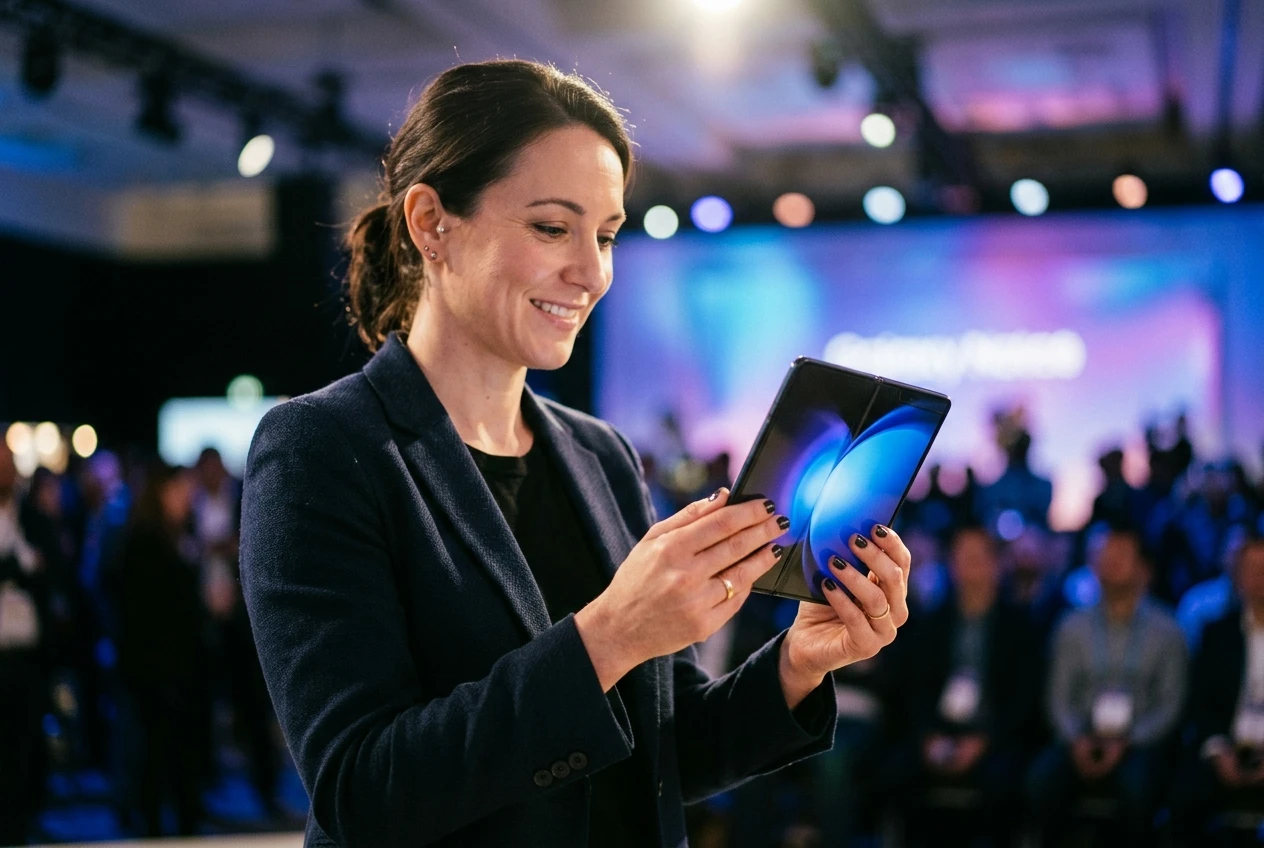
The passport-shaped model is the centerpiece of the day. Samsung’s teaser campaign, which Forbes’ David Phelan decoded across the company’s Instagram and YouTube channels, walked viewers through pizza slices, chocolate bars, and paint splodges forming an 8 before any official render appeared. The geometry being teased: a 7.6-inch inner display at a 4:3 aspect ratio, a 5.4-inch cover display, a dual-lens camera (no telephoto), a body that sits shorter and wider than any Fold since the line launched in 2019, and a weight of around 200 grams. Battery capacity sits at 4,800mAh. The whole pitch is that the Wide unfolds into something closer to a small landscape tablet than a tall phone.
Why now is simple. Apple’s first foldable, widely tipped to debut in September under the rumored iPhone Ultra name, is expected to share that wider aspect ratio. Samsung wants the form factor on shelves, in reviews, and in buyers’ hands first. Forbes framed the campaign in exactly those terms: it’s Samsung’s way of getting in first. The Samsung’s wider foldable teaser campaign doubles as the first official confirmation that the device exists, and the Samsung’s cryptic ASMR campaign for the Z Fold 8 tracks the same rollout week by week.
It’s the first official confirmation that a new wider model is coming to the Galaxy range. Just as importantly, since it’s thought the first Apple foldable, possibly called the iPhone Ultra, will have a similar aspect ratio, it’s Samsung’s way of getting in first.
David Phelan, writing in Forbes on July 1, 2026, laid out the decoded teasers. He tied the wider shape directly to Apple’s expected debut window. The message Samsung is sending with the lineup is structural, not cosmetic: the company that defined the book-style foldable is also the first to redefine its proportions before the biggest challenger in the category has shipped a single unit.
| Model | Inner display | Cover display | Aspect (unfolded) | Battery | Starting price |
|---|---|---|---|---|---|
| Galaxy Z Fold 8 Ultra | 8.0-inch | 6.5-inch | Tall, narrow | 5,000mAh | $1,999 |
| Galaxy Z Fold 8 Wide | 7.6-inch | 5.4-inch | 4:3 | 4,800mAh | $1,999 |
| Galaxy Z Flip 8 | 6.9-inch | 4.1-inch FlexWindow | Clamshell | 4,300mAh | $1,099 |
Fold 8 Ultra, Flip 8, and the Two Watches
The Fold 8 Ultra is the direct successor to the Fold 7 and the device most existing Samsung owners will recognize. Battery jumps to 5,000mAh from 4,400mAh. Wired charging finally clears the 25W ceiling Samsung had held for four years and lands at 45W. Qualcomm’s Snapdragon 8 Elite Gen 5 ships globally with no Exynos variant, the same chip inside the Galaxy S26 Ultra.
The camera system is the biggest jump on paper. The main sensor reaches 200MP. The ultrawide jumps from 12MP to 50MP. The phone ships with One UI 9 on Android 17, and Samsung has extended a seven-year software support commitment across its 2026 flagships. Pricing holds the base 256GB model at $1,999, matching the Fold 7’s 2025 launch price. The 512GB tier lands at roughly $2,199. The 1TB configuration runs about $2,499. The top two tiers carry the memory cost increase; the entry price is the political anchor.
Galaxy Z Flip 8 sticks to the clamshell refresh playbook. 6.9-inch main AMOLED at 120Hz, 4.1-inch FlexWindow cover, 4,300mAh battery, up to 512GB of storage. Samsung splits the silicon this year: Exynos 2600 for Europe and South Korea, Snapdragon 8 Elite Gen 5 for the US. 256GB at $1,099, 512GB at $1,219.
Galaxy Watch 9 and Galaxy Watch Ultra 2 mark the first time in eight years Samsung watches run on Qualcomm rather than the in-house Exynos W-series silicon. The Snapdragon Wear Elite enables 5G RedCap (Reduced Capability) on the Ultra 2, narrowband 5G designed for wearables that handles calls and data without the battery penalty of full 5G. Samsung has not filed a Galaxy Watch 9 Classic in the FCC or China’s CMIIT regulatory databases so far, a gap that has not gone unnoticed by fans of the rotating bezel.
Galaxy Glasses Take the Same Stage
The device likely to draw the most public attention is not a phone. Samsung Galaxy Glasses, co-designed with Korean eyewear label Gentle Monster and running Google’s Android XR platform with Gemini built in, get their full commercial debut at the July 22 event. The hardware profile tracks Meta’s Ray-Ban approach closely: speakers for audio output, microphones for voice capture, a single first-person camera, and no heads-up display. Samsung previewed the glasses at Android-related events in May 2026 and now ships them into the same retail window as the foldables.
The pairing is deliberate. Phones, watches, and glasses on one stage positions Samsung as the only Android maker with a full XR plus foldable plus wearable stack on display before Apple opens its September iPhone window. The glasses integrate across Samsung’s device ecosystem and can tether to Galaxy phones, home appliances, and future vehicle work, a halo product meant to make the rest of the lineup feel like a connected system rather than five separate boxes.
A Record Quarter the Market Sold Off Anyway
Samsung posted its biggest operating profit in company history on Tuesday. The figure, 89.4 trillion won ($58.43 billion), ran more than 19-fold ahead of the 4.68 trillion won recorded a year earlier. It marked the third consecutive record quarter. The Samsung’s record Q2 operating profit print beat Bloomberg’s 84.2 trillion won estimate and was anchored by high-bandwidth memory (HBM) demand from AI data center buildouts. Samsung is a major NVIDIA supplier in this market.
Revenue doubled to 171 trillion won from 74.57 trillion won a year earlier. The memory business carried the print. Foundry is expected to swing to a loss after Samsung negotiated a major bonus payout to chip-division workers in May. The smartphone and consumer electronics business faces a different pressure: rising memory costs that have already dented consumer demand, costs the company now passes into the very devices it is launching on July 22.
The stock told the other half of the story. Shares slid as much as 8% in Seoul after the print on a mix of profit-taking and a single open question: how long does the AI memory cycle stay this hot? The KOSPI dropped more than 6%. Samsung rival SK Hynix tumbled 7% in sympathy. The quarterly beat did not change the durability question now baked into Samsung’s valuation.
- 89.4 trillion won – Samsung’s Q2 2026 operating profit, a company record.
- $58.43 billion – the USD equivalent at Samsung’s stated rate.
- Up more than 19-fold from 4.68 trillion won a year earlier.
- 171 trillion won in revenue, up from 74.57 trillion won a year earlier.
- Shares slid up to 8% on profit-taking after the print.
- Third consecutive record quarter for Samsung’s chip business.
The Memory Tax Quietly Reshaping What You’ll Pay
The single most consequential force on the July 22 lineup is invisible on any spec sheet. The mechanism is specific: high-bandwidth memory, the stacked DRAM architecture that powers AI accelerators from NVIDIA and others, uses roughly three times the wafer capacity per gigabyte compared to the conventional DRAM inside smartphones. Samsung, SK Hynix, and Micron have redirected production lines toward high-margin HBM to serve AI infrastructure. The wafer capacity left for the LPDDR5X inside every premium Android phone has shrunk. Less consumer DRAM supply combined with flat smartphone demand produces exactly what the second quarter just printed.
- LPDDR5X 12GB rose from $77.10 to $145.90 per unit in Q2 2026, an 89% quarter-over-quarter jump.
- UFS 3.1 and uMCP storage rose more than 100% over the same period.
- Samsung’s procurement scale and its dual role as memory producer and device maker is the reason the entry Fold 8 Ultra can hold at $1,999 while smaller Android rivals cannot absorb equivalent cost pressure.
That scale shows up at the top of the storage tiers. The 512GB and 1TB Fold 8 Ultra configurations carry roughly $80 to $200 more than the equivalent Fold 7 tiers did at launch in 2025. The Fold 8 Wide, the Galaxy Watch Ultra 2 with 5G RedCap, and the Galaxy Glasses all sit inside the same supply chain. None are insulated from the AI tax.
No analyst consensus expects consumer DRAM prices to normalize before late 2027. Buyers stepping up to the Wide or higher storage configurations on July 22 are paying for AI infrastructure buildout directly, a cost that did not exist when the Fold 7 launched a year ago.
Pixel on August 12, Apple’s Foldable in September
Samsung is the first mover on a calendar that will not stop. Google confirmed its Made by Google event for August 12 in New York, with a 6 p.m. ET kickoff that runs an hour later in the day than Google’s usual Pixel hardware slot. The Google’s August 12 Pixel 11 invite features a gold metal frame and a horizontal camera visor, and points to the Pixel 11, Pixel 11 Pro, Pixel 11 Pro XL, and Pixel 11 Pro Fold.
The leak front around Pixel 11 points to a base storage jump from 128GB to 256GB, which is widely read as a price-increase tell. Memory component costs feed straight into Google’s lineup the same way they feed into Samsung’s. Pixel Watch 5 is expected at the same event.
- July 22 – Galaxy Unpacked, London.
- August 12 – Made by Google, New York.
- September 1, 2026 – John Ternus becomes Apple CEO, with Tim Cook shifting to executive chairman.
- September (expected) – Apple foldable iPhone debut as the first major launch under Ternus.
Ternus runs Apple’s hardware engineering group, and the foldable has been his project inside the company for years. Apple’s rumored September foldable lineup under Ternus includes the iPhone 18 Pro, iPhone 18 Pro Max, iPhone Ultra (the foldable), iPhone Air 2, Apple Watch Ultra 4, Apple Watch Series 12, and updated AirPods Pro. Pricing rumors for the foldable cluster around $1,999 and above, a figure IDC’s foldable value forecast for the iPhone Fold projects will command roughly a third of category value in year one.
Where Samsung sits on this calendar is the core question. The company gets roughly seven weeks of uncontested foldable mindshare before Apple’s September event. The Fold 8 Wide defines the wider aspect ratio in buyers’ minds before Apple’s take ships. The memory tax is real, but Samsung’s ability to absorb part of it on the entry tier is the same moat smaller Android rivals do not have. The window between July 22 and Apple’s September stage is the one Samsung is trying to fill.
Frequently Asked Questions
When is Samsung’s next Galaxy Unpacked?
July 22, 2026, in London. Samsung’s official invite confirms the livestream starts at 9 a.m. EDT (2 p.m. BST) on Samsung.com, Samsung Newsroom, and the company’s YouTube channel.
How much will the Galaxy Z Fold 8 cost?
The base 256GB Fold 8 Ultra holds at $1,999, the same price the Fold 7 launched at in 2025. The 512GB configuration lands at roughly $2,199 and the 1TB at roughly $2,499. The Galaxy Z Fold 8 Wide also starts at $1,999. Galaxy Z Flip 8 starts at $1,099 for 256GB and $1,219 for 512GB.
What is the Galaxy Z Fold 8 Wide?
A second book-style foldable with a 4:3 aspect ratio, a 7.6-inch inner display, a 5.4-inch cover display, a dual-lens camera without a telephoto, and a weight of around 200 grams. It is the first Samsung foldable designed from the ground up around a wider, passport-shaped geometry.
When does Apple’s first foldable launch?
Apple’s first foldable iPhone is widely expected to debut in September 2026, days after John Ternus becomes CEO on September 1. The device is rumored to carry the iPhone Ultra name and is expected to share the wider aspect ratio Samsung introduced with the Fold 8 Wide.
Is now a bad time to buy a foldable?
Memory prices are still climbing, with no analyst consensus on relief before late 2027. Samsung’s decision to hold the entry Fold 8 Ultra at $1,999 suggests Unpacked-day pricing is close to a floor for the year, not a ceiling. Higher storage tiers and the new form factor will cost more as the supply chain absorbs the AI tax.


D&D Bets Big on WoW and Star Wars to Grow Its Tables

Game Pass Drops Celeste and Crusader Kings on First Net-Loss Day

Gemini Breaks Basic Calls on Foldable Phones in Android Auto

Citadel Clears AI Fund Overhang While Crypto Stays Flat

Morgan Stanley Staking ETPs Crack Open Crypto Yield for Wealth Clients

Snapdragon Price Hike Forces Premium Buyers Toward Last Year’s Phones

Croc 2 Remaster Unlocks Argonaut’s Full Revival Path

Scale AI Names Google Cloud Veteran deSouza CEO for Enterprise Push

Epic Store Hits Brazilian iPhones Amid Apple’s Familiar Friction Play

LORDNINE Helena Server Races Players Toward Real USDT Rewards

Fable 5 and Mythos 5 Return as US Lifts Anthropic Export Controls

SpaceX’s Google Deal Turns a Rocket Company Into a Cloud Landlord

Oracle Cuts 21,000 Jobs in a Year, Cites AI in 10-K Filing

CD Projekt Red Co-CEO: Redemption Arc Isn’t Done, Witcher 4 in 2027

XPL Rallies 30% Ahead of Plasma One Card Tier Launch

DGO App Brings Rs 549 Mobile Pass for FIFA World Cup 2026 in Nepal

Google Search Profiles Build a Follow Graph Inside Discover

Moonshot AI Targets $30 Billion in China’s Fastest AI Funding Sprint

Microsoft Xbox Layoffs Start in July as Sharma Slams 3% Margin

Oppo’s ColorOS 17 Eligibility List Leaves A-Series Buyers Behind
-
 AI1 month ago
Fable 5 and Mythos 5 Return as US Lifts Anthropic Export Controls
-
 AI2 months ago
SpaceX’s Google Deal Turns a Rocket Company Into a Cloud Landlord
-
 AI1 month ago
Oracle Cuts 21,000 Jobs in a Year, Cites AI in 10-K Filing
-
 GAMING1 month ago
CD Projekt Red Co-CEO: Redemption Arc Isn’t Done, Witcher 4 in 2027
-
 CRYPTO2 months ago
XPL Rallies 30% Ahead of Plasma One Card Tier Launch
-
 APPS2 months ago
DGO App Brings Rs 549 Mobile Pass for FIFA World Cup 2026 in Nepal
-
 NEWS2 months ago
Google Search Profiles Build a Follow Graph Inside Discover
-
 AI2 months ago
Moonshot AI Targets $30 Billion in China’s Fastest AI Funding Sprint