
AI
Canada Saudi Arabia AI Deal Hands Cohere 50 Megawatts of Compute
Canada and Saudi Arabia signed a Cohere-Humain AI deal on Carney’s Jeddah visit, dedicating at least 50 MW of compute to Cohere’s next-gen models by late 2027.

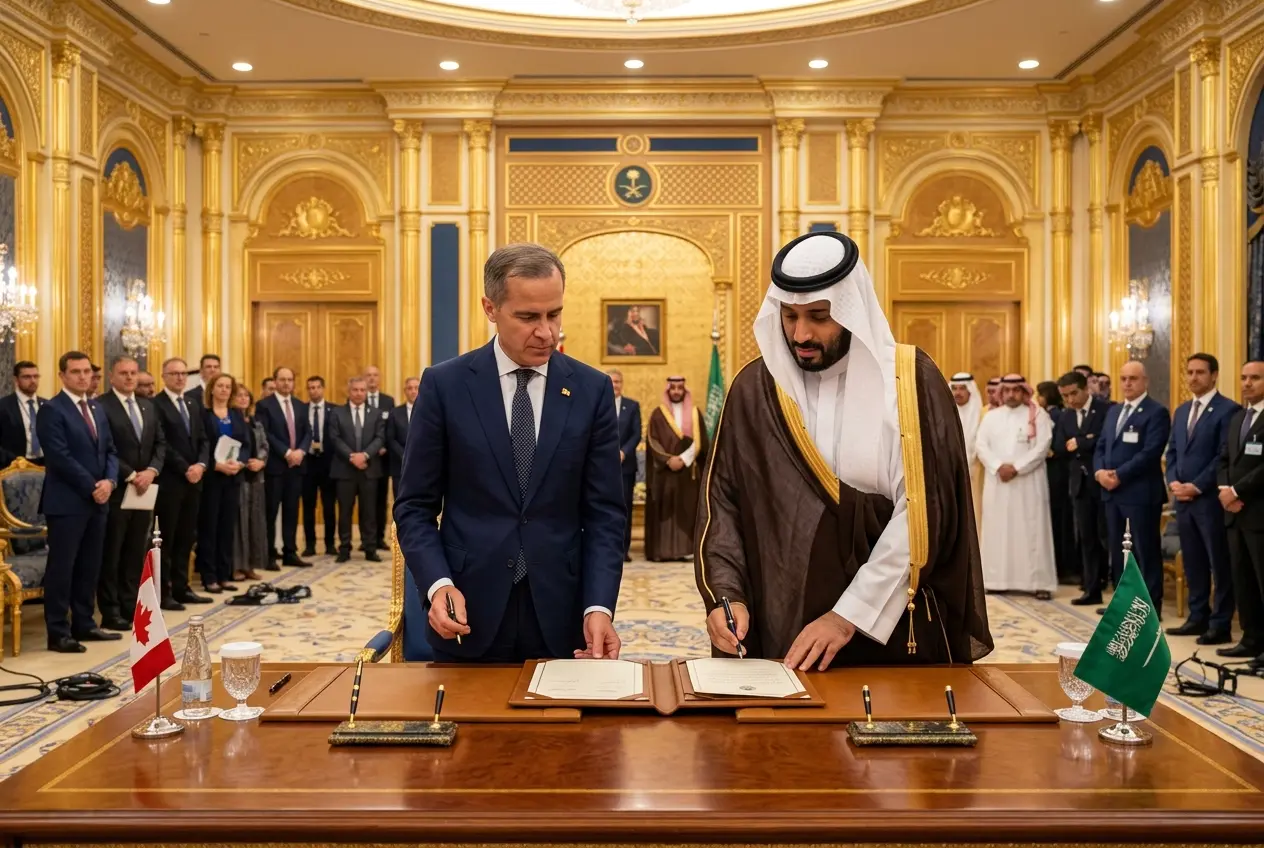
Canada and Saudi Arabia signed a Cohere-Humain AI deal on July 9, 2026, dedicating at least 50 megawatts of compute capacity to Cohere’s next-generation foundation models inside the kingdom, with the deployment set to go live by late 2027 and scale over the following five years. Prime Minister Mark Carney announced the partnership in Jeddah on the second day of a three-day trip that marked the first visit to Saudi Arabia by a Canadian prime minister in 26 years, according to multiple reports.
The compute pact is the most concrete deliverable of a wider Gulf diversification push that began with a $50 billion investment framework from the United Arab Emirates in November 2025 and a strategic partnership with Qatar in January. It lands the same week Meta announced its first Canadian data centre, a 1-gigawatt facility in Sturgeon County, Alberta, worth more than CA$13 billion. The two announcements together mark how compute, not just trade, is becoming the currency of Canada’s repositioning.
The Compute Pact Carney Brought Home
The Cohere-Humain deal gives the Toronto-based AI company reserved capacity inside Saudi Arabia’s national compute stack, one of the largest sovereign AI buildouts outside the United States and China. Under the agreement, Humain will designate at least 50 megawatts of dedicated AI computing capacity to support Cohere’s next-generation foundational models, the two companies said in a joint statement on July 9, 2026. The deployment is expected to be live by the fourth quarter of 2027, with the ability to scale the allocation over the next five years.
| Country | AI vehicle | Stated capacity or commitment |
|---|---|---|
| Saudi Arabia | Humain (PIF-backed, launched May 2025) | At least 50 MW reserved for Cohere; up to 250 MW pipeline under earlier $1.2 billion financing framework |
| United Arab Emirates | G42 (Abu Dhabi government-backed) | Cloud and AI delivery across energy, finance and health sectors |
| Qatar | Qai (subsidiary of Qatar Investment Authority) | $20 billion AI infrastructure joint venture with Brookfield |
Humain chief executive Tariq Amin framed the Cohere agreement as a milestone for Saudi Arabia’s compute ambitions, calling it the first significant international AI compute deployment outside North America. “The fact that Cohere has selected Humain for the first significant international AI compute deployment outside North America underscores the strength of the AI infrastructure we are building and our ability to support the next generation of model research and development,” Amin said in the joint statement. Cohere and Humain will also collaborate on enterprise AI solutions and sovereign models, including Arabic-language and domain-adapted foundation models, according to the joint statement from Humain and Cohere. The shape of the deal goes beyond raw compute: the two companies will share model development work, not just server racks.
Why Carney Is in Jeddah at All
The trip is Carney’s third trip to the Gulf this year and the centerpiece of a broader effort to boost trade and investment ties with the region and other partners amid trade tensions with the US and threats from President Donald Trump, according to The National. Carney arrived in Jeddah on July 8, 2026, after attending the NATO summit in Türkiye, and stayed through July 10. He is the first Canadian prime minister to set foot in the kingdom in more than two decades, per multiple reports citing Bloomberg and The Washington Post.
Saudi Arabia is one of three Gulf capitals Canada is courting at once. In November 2025, the United Arab Emirates committed to invest up to $50 billion in Canada across energy, AI logistics and mining under a framework agreement announced in Abu Dhabi. Canadian International Trade Minister Maninder Sidhu told Reuters in January that Ottawa wants to attract investment in liquefied natural gas, and that XRG, Adnoc’s international investment arm, is looking at Canadian natural gas projects. The Gulf capital is moving not just into Saudi AI infrastructure but into Canadian energy supply chains.
Canada signed a strategic partnership with Qatar in January to accelerate two-way investment across AI, quantum computing, defence and other sectors, and Carney plans to host the first-ever Investment Summit in Toronto in September 2026 to bring Saudi investors into the Canadian market, according to the joint statement released in Jeddah by Carney and Crown Prince Mohammed bin Salman. The Gulf push has gone from a one-off to a coordinated diplomatic track across Riyadh, Abu Dhabi and Doha. The joint statement from Ottawa and Riyadh set out the bilateral deliverables, including a new Coordination Council led by foreign ministers on both sides.
The Gulf’s Bigger AI Buildout
The Cohere-Humain deal is a single node in a much larger pattern of Gulf sovereign wealth being redirected into compute infrastructure. Saudi Arabia has stated a target of attracting $20 billion in foreign and local investment in data and AI over the next 10 years. Humain, launched in May 2025 under Riyadh’s Public Investment Fund, sits at the centre of that plan as part of Saudi Arabia’s Vision 2030 programme.
- Saudi Arabia target: $20 billion in data and AI investment over 10 years.
- UAE-Canada framework: up to $50 billion across energy, AI logistics and mining.
- Qai-Brookfield joint venture: $20 billion committed to AI infrastructure.
Humain secured a financing framework of up to $1.2 billion with Saudi Arabia’s National Infrastructure Fund in January 2026 to fund up to 250 MW of hyperscale AI data centre capacity, according to international finance reporting. The company’s profile on the Public Investment Fund’s website lists it as a full-stack AI operator covering data centres, cloud infrastructure and model research. The model is oil-state capital converting to compute assets, fast.
The UAE’s G42 has been focused on delivering AI and cloud computing across energy, finance and health, while Qatar’s Qai operates as a subsidiary of the $524 billion Qatar Investment Authority and announced a $20 billion AI infrastructure joint venture with Brookfield in December 2025. Saudi Arabia, the UAE and Qatar are now running parallel national AI strategies, each anchored in sovereign capital and each courting foreign model partners to occupy their compute. The Cohere-Humain deal is the clearest example so far of what those strategies buy.
The Other Side of Canada’s AI Buildout
One day before Carney’s Jeddah signing, Meta announced its first Canadian data centre: a 1-gigawatt facility in Sturgeon County, Alberta, built with the ability to scale up to 1.8 gigawatts, at a cost of more than CA$13 billion, equivalent to roughly $9 billion in US dollars. Meta’s announcement of its first Canadian data centre said the project will support more than 300 operational jobs once complete and roughly 3,000 construction workers at peak build, with construction expected to take two to three years. The facility will be Meta’s 33rd data centre globally and its largest outside the United States.
Meta plans to spend between $125 billion and $145 billion on AI infrastructure and related spending in its current fiscal quarter, and the four major US hyperscalers together plan to spend $700 billion on AI this year. The Saudi pact does not change those numbers, but it changes who gets the marginal compute dollar going forward: a Canadian startup is now building its next-generation models on Saudi rails, while a US hyperscaler is building its largest non-US data centre on Canadian soil. Capital and compute are crossing borders in both directions.
At home, Canada has been making its own push in the global AI buildout, including through a new national strategy to support AI literacy and build the foundations for a sovereign Canadian AI. The Canadian Sovereign AI Compute Strategy, published this year by the federal government, aims to close the gap in affordable domestic computing resources for Canadian AI researchers. The country’s AI strategy now has three pillars: data centres, a digital sovereignty framework and an AI literacy programme, per reporting on the policy.
What Carney’s Trip Actually Unlocked
Beyond the Cohere-Humain deal, Carney’s visit produced a package of new bilateral instruments. The two governments signed a Memorandum of Understanding on Artificial Intelligence Investment and Skills Development, covering joint investment opportunities, business-to-business linkages, technical collaboration and advanced AI training. They also agreed to establish a Canada-Saudi Arabia Coordination Council led by the two countries’ foreign ministers to oversee cooperation across political, security, defence, economic, trade, investment, cultural, educational, scientific and consular priorities.
The two sides noted that bilateral trade has reached over $20 billion USD since 2020 and agreed to launch negotiations for a Double Taxation Agreement, with the ongoing Foreign Investment Promotion and Protection Agreement targeted for conclusion by early 2027, per the joint statement. Carney’s office said Canada aims to sign a broader investment pact with Saudi Arabia in the coming months, according to Bloomberg. The Toronto Investment Summit in September 2026 is being framed as the next concrete milestone, with Saudi investors expected to attend.
Frequently Asked Questions
What did the Cohere-Humain AI deal actually include?
The agreement reserves at least 50 megawatts of dedicated AI computing capacity inside Saudi Arabia for Cohere’s next-generation foundation models, plus joint development work on enterprise AI and sovereign Arabic-language models. The companies expect the deployment to be live by the fourth quarter of 2027 and to scale over the following five years.
Why is Mark Carney visiting Saudi Arabia?
Carney’s July 8 to 10, 2026 trip to Jeddah is his third Gulf visit this year and the first by a Canadian prime minister in 26 years. The visit is part of a broader effort to deepen trade and investment ties with Gulf states as Canada diversifies away from US trade dependence.
What other Gulf countries are investing in AI alongside Saudi Arabia?
The UAE committed up to $50 billion to Canada under a November 2025 framework spanning energy, AI logistics and mining, and Qatar’s sovereign AI vehicle Qai announced a $20 billion joint venture with Brookfield in December 2025 for AI infrastructure. Saudi Arabia’s own target is $20 billion in data and AI investment over the next 10 years.
How does the Meta Alberta data centre connect to the Saudi pact?
Meta’s Sturgeon County announcement on July 8, 2026, a $9 billion, 1-gigawatt facility, lands the day before the Cohere-Humain deal. Together they show Canadian soil hosting US hyperscaler compute and a Canadian startup placing its next-gen models on Saudi rails at the same time.
When does the Cohere-Humain compute go live?
The joint statement says the deployment is expected to be live by late 2027, with the ability to scale the allocation over the next five years. The 50-megawatt figure is a floor, not a ceiling.


Lunit Turns Routine H&E Slides Into a Lung Pre-Screen

Meta’s Muse Agent Wants Your Inbox and Your Card

Police Chase Mules as AI Chatbots Run Romance Scams

Ticketmaster’s Personalized App Is Built to Move Empty Seats

Software Deals Now Hinge on Filing Accuracy, Not Beats

Iowa Counties Warn Workers That ChatGPT Keeps Their Files

Shaalan Beg’s Oncology AI Hits an Enrollment Wall

Exowatt Warns Gas-Fired AI Campuses May Not Last a Decade

Philips Splits Innovation and Hands AI to Partovi

Chrome 153 Puts the Whole Web on a Two-Week Clock

Oracle Cuts 21,000 Jobs in a Year, Cites AI in 10-K Filing

Fable 5 and Mythos 5 Return as US Lifts Anthropic Export Controls

SpaceX’s Google Deal Turns a Rocket Company Into a Cloud Landlord

XPL Rallies 30% Ahead of Plasma One Card Tier Launch

DGO App Brings Rs 549 Mobile Pass for FIFA World Cup 2026 in Nepal

Moonshot AI Targets $30 Billion in China’s Fastest AI Funding Sprint

Oppo’s ColorOS 17 Eligibility List Leaves A-Series Buyers Behind

Microsoft Xbox Layoffs Start in July as Sharma Slams 3% Margin

Budget RTX 4050 Laptops Under Rs 70,000 in India: The 2026 Reality

Steam Machine vs Xbox Series X: The 2026 Living Room Gaming Showdown
-
 AI3 months ago
Oracle Cuts 21,000 Jobs in a Year, Cites AI in 10-K Filing
-
 AI2 months ago
Fable 5 and Mythos 5 Return as US Lifts Anthropic Export Controls
-
 AI3 months ago
SpaceX’s Google Deal Turns a Rocket Company Into a Cloud Landlord
-
 CRYPTO3 months ago
XPL Rallies 30% Ahead of Plasma One Card Tier Launch
-
 APPS3 months ago
DGO App Brings Rs 549 Mobile Pass for FIFA World Cup 2026 in Nepal
-
 AI3 months ago
Moonshot AI Targets $30 Billion in China’s Fastest AI Funding Sprint
-
 NEWS3 months ago
Oppo’s ColorOS 17 Eligibility List Leaves A-Series Buyers Behind
-
 GAMING3 months ago
Microsoft Xbox Layoffs Start in July as Sharma Slams 3% Margin