
NEWS
Best Budget Phones of 2026 Are the Last Ones Priced Before RAMageddon
RAMageddon is forecast to raise phone prices and shrink RAM through 2027, making 2026’s best budget phones a closing window worth acting on now.

Five phones anchor the field of 2026’s best budget smartphones at $499 to $699, and every one of them was priced before memory chips got dramatically more expensive. Apple, Google, Samsung, Nothing and OnePlus each shipped a genuine deal this year. Those prices do not reflect what memory now costs the people building the phones.
Industry researchers call what happened next “RAMageddon”, a shorthand for the AI-driven memory chip shortage that has sent DRAM and NAND flash contract prices up by double and triple digits since late 2025. Counterpoint Research now expects global smartphone shipments to fall 13.9% this year and average prices to climb 6.9%, with the cheapest phones absorbing the steepest hit. That makes this list less a snapshot of the market and more a photograph of it right before the shock fully lands.
Five Phones, One Price Set Before the Squeeze
The lineup is genuinely good. Apple’s iPhone 17e runs $599 and uses the A19 chip, giving up camera and display polish compared to pricier iPhones in exchange for current Apple Intelligence support. Google’s Pixel 10a costs $499 and keeps most of the camera quality Pixel is known for, in a flatter body that finally sits flush on a desk.
Samsung’s Galaxy A57 5G runs $549 and trades slow face unlock and patchy WiFi for a good display and battery life. Nothing’s Phone 4(a) Pro undercuts everyone at $499 with a 6.8-inch, 144Hz AMOLED display and a 5,000mAh battery, capped by a midrange Snapdragon chipset and 256GB of storage. OnePlus’s $699 15R, which launched in the middle of December 2025, packs a Snapdragon 8 Gen 5 and a display that hits 165Hz, at the cost of weaker cameras and no mmWave 5G.
| Phone | Price | Standout Strength | Biggest Compromise |
|---|---|---|---|
| Apple iPhone 17e | $599 | A19 chip runs current Apple Intelligence features | Camera and display quality versus pricier iPhones |
| Google Pixel 10a | $499 | Flat back, brighter display, faster charging | Not the newest Tensor chip or full AI suite |
| Samsung Galaxy A57 5G | $549 | Good display, solid battery life | Patchy WiFi, slow face unlock, thin Galaxy AI |
| Nothing Phone 4(a) Pro | $499 | 144Hz AMOLED display, 5,000mAh battery | Midrange chipset, storage capped at 256GB |
| OnePlus 15R | $699 | Snapdragon 8 Gen 5, up to 165Hz display | Weaker cameras, no mmWave 5G support |
OnePlus locked its price in mid-December, just before the sharpest quarter of chip inflation on record. The other four launched around the same window. None of them carry a price built for what memory costs today.
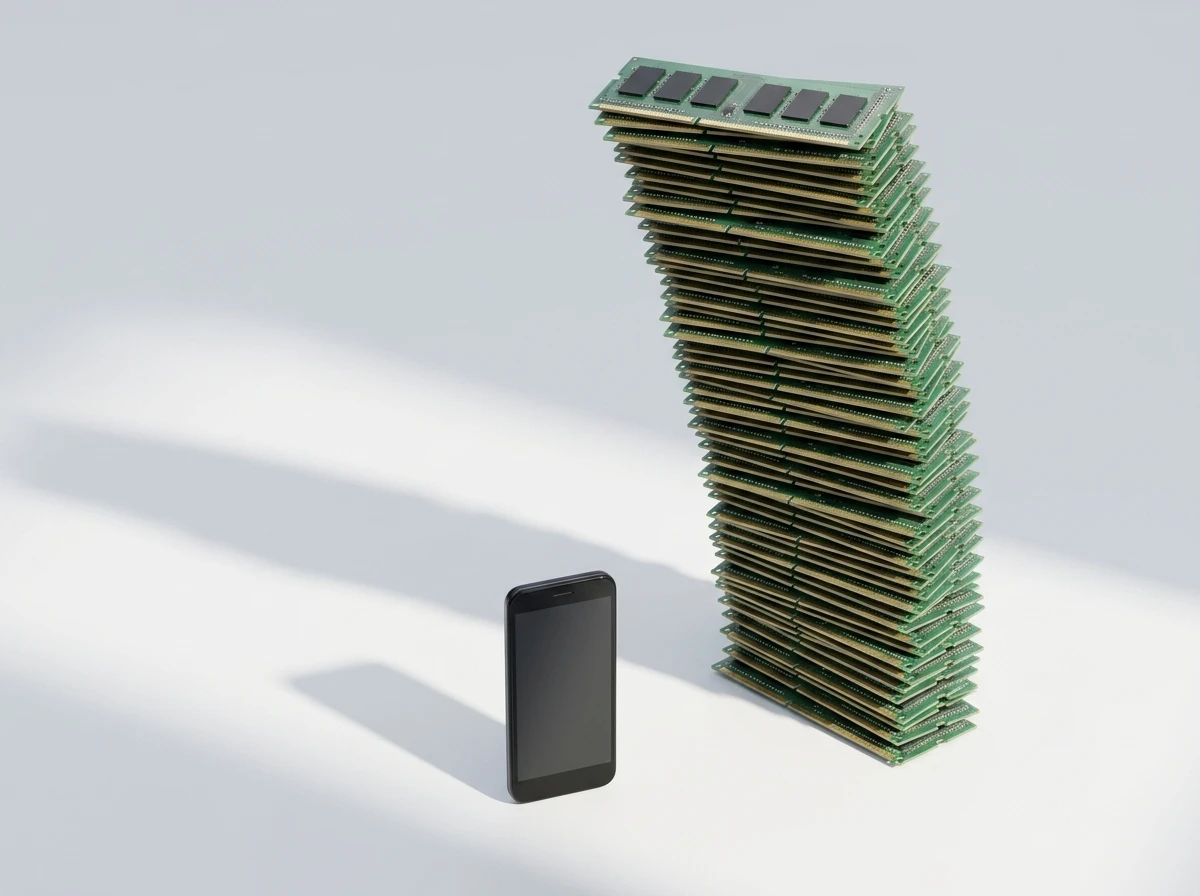
The Memory Chips Inside Them Just Got Brutally Expensive
The mechanism is straightforward. Cloud companies building AI data centers need enormous amounts of high-bandwidth memory for their servers. Samsung, SK Hynix and Micron, the three companies that make almost all the world’s DRAM, have been shifting factory lines toward that higher-margin product and away from the ordinary DRAM and NAND flash that goes into phones and laptops.
TrendForce originally forecast conventional DRAM contract prices would rise 55% to 60% quarter over quarter in the first three months of 2026. Actual prices blew past that, landing between 90% and 98%, with NAND flash climbing as much as 100% in the same stretch. Prices kept climbing in the second quarter, up another 58% to 63% for DRAM and as much as 70% to 75% for client SSD storage. Tighter DRAM supply now firmly in sight for 2026 is how the research firm frames the year ahead, tied directly to data center operators expanding capacity for AI workloads.
Some suppliers have simply left the consumer market. Micron closed its Crucial brand entirely to focus on enterprise and GPU-grade memory. Analysts at Avnet estimate AI data centers could absorb 70% of high-end DRAM supply this year. HP’s finance chief has said memory and storage jumped from 15% to 18% of a laptop’s build cost to roughly 35%. Phones run the same math, just with thinner margins to begin with.
Counterpoint Keeps Cutting Its Own Forecast
What makes this feel less like a blip and more like a trend is how often the numbers have gotten worse, not better, each time analysts revisit them.
- December 2025: Counterpoint cut its 2026 shipment forecast to a 2.1% decline, down from an earlier call for flat or slightly positive growth, and raised its average selling price forecast from 3.9% to 6.9%.
- Roughly February 2026: The shipment forecast worsened again, to a 12.4% decline for the year.
- June 5, 2026: Counterpoint cut it further, to 1.08 billion units for the year, a 13.9% drop, and said prices for LPDDR4 and LPDDR5, the low-power memory used in phones, could roughly triple quarter over quarter.
- Actual first quarter: Global shipments already contracted 3.1%, snapping a nine-quarter streak of growth.
Each revision moved the same direction. That is not how a temporary supply hiccup usually behaves.
Budget Phones Absorb the Deepest Cut
Premium phones can shrug off a pricier memory chip because that chip is a small slice of a $1,000-plus bill of materials. A $499 phone does not have that cushion.
In the lower price bands, steep price increases on smartphones are not sustainable.
Yang Wang, a senior analyst at Counterpoint Research, said that in a December note explaining the firm’s revised outlook. Wang added that where manufacturers cannot pass the cost along to buyers, they are simply cutting products from their lineups, and that the firm is already seeing sharply reduced volumes of low-end models. By June, Counterpoint described the sub-$150 phone tier specifically as facing a near collapse, with volume-focused brands like Transsion and Xiaomi taking the worst of it.
Shenghao Bai, another senior analyst at the firm, said manufacturers are already cutting corners to cope. “In some models, we are seeing downgrades of components like camera modules and periscope solutions, displays, audio components and, of course, memory configurations,” Bai said. TrendForce’s own outlook gets specific about where that lands next:
- Entry-level phones are expected to hold at roughly 4GB of RAM going forward, rather than moving up.
- Mid-range models are expected to stay between 6GB and 8GB instead of climbing toward 12GB.
- Even flagship Pro-tier phones are likely to stay at 12GB rather than moving to 16GB, according to a separate IDC estimate.
Samsung sits on both ends of this squeeze. Its chip division is one of the three companies pushing DRAM prices higher in the first place, and its mobile division has to pay those same higher prices to build the Galaxy A57 5G and everything else it sells.
What Replaces the Pixel 10a and the OnePlus 15R?
The next generation of these exact phones is where the cost is expected to show up, according to Counterpoint and TrendForce, through higher launch prices, thinner memory or both. Xiaomi and Redmi have already told customers to brace for price increases of 20% to 30% in 2026. TrendForce has said rising memory costs will push Samsung to raise launch prices on its 2026 lineup, and the firm expects even Apple to hold firmer on pricing, including skipping the usual discounts on older iPhones once its next lineup arrives this September.
Google has not said anything official about a Pixel 10a successor’s memory configuration. But leaks already point to a Tensor G6 chip landing in Google’s next budget phone, widely assumed to be the Pixel 11a, with nothing yet confirming whether it holds the line on RAM.
How Long the Memory Squeeze Lasts
There is a small silver lining. TrendForce’s newest quarterly outlook has the pace of increases slowing, with Q3 2026 contract prices for DRAM rising 13% to 18% quarter over quarter and NAND flash 10% to 15%, a sharp cooldown from the roughly 60% jumps recorded the previous quarter. That slowdown is coming from consumers hitting the ceiling of what they will pay, not from any real improvement in supply.
Counterpoint’s June forecast has the crunch persisting through the second half of 2027, with no meaningful market recovery expected until 2028. Prices climbing more slowly is not the same as prices coming back down.
The Window Closes Before the Next Upgrade Cycle
Buying one of these five phones today still makes sense. Nothing about their prices or specs has changed yet, and nothing in the forecasts suggests today’s listed prices for the iPhone 17e, Pixel 10a, Galaxy A57 5G, Nothing Phone 4(a) Pro or OnePlus 15R are about to move. The pressure lands on whatever replaces them.
Frequently Asked Questions
What Is RAMageddon?
RAMageddon is shorthand coined by industry press and analysts for the 2026 memory chip shortage, in which AI data center demand for high-bandwidth memory pulled factory capacity away from the ordinary DRAM and NAND flash used in phones, laptops and consoles. It is not an official industry term, and it differs from the 2021 chip shortage in one key way: that one came from pandemic factory shutdowns, while this one comes from AI infrastructure spending redirecting supply that never stopped being produced.
Will The Five Phones In This Roundup Get More Expensive?
There is no indication yet that the iPhone 17e, Pixel 10a, Galaxy A57 5G, Nothing Phone 4(a) Pro or OnePlus 15R will see price changes on their current models. Manufacturers rarely reprice a phone mid-cycle. The cost pressure documented by Counterpoint and TrendForce is expected to land on the next generation of devices that replace these five, not on the units already on shelves.
Should I Buy A Budget Phone Now Or Wait?
Buying now locks in pricing and memory configurations set before the worst of the shortage. Counterpoint’s forecasts have costs staying elevated through the second half of 2027, with no real relief expected until 2028, so waiting for a discount on a comparable device is a weak bet based on current data.
Which Phone Brands Are Best Positioned To Avoid The Squeeze?
Apple and Samsung are considered better positioned, according to Counterpoint, because premium product lines absorb a pricier memory chip more easily and both companies carry more leverage in supply negotiations. Samsung’s own semiconductor arm is also one of the three global DRAM makers. Chinese volume brands built around low-end pricing, including Xiaomi and Transsion, face the sharpest margin pressure.
When Will Memory Prices Return To Normal?
Counterpoint’s outlook does not expect a meaningful market recovery until 2028, when the commercialization of 6G networks and a new wave of AI-native devices are expected to spark a fresh replacement cycle that eases pressure on memory suppliers. Until then, elevated pricing is expected to persist, even as the pace of quarterly increases slows.


Sony’s 10 Percent Disc Drop Leaves the 2028 Cutoff Intact

Chip Allocation Sidelines the Base iPhone 18 This Fall

Miami-Dade Fights the Vice City Brand It Already Wears

IFA 2026 Awards Put Tecno Ahead of Flagship Phones

USB-C Gadgets Made the Junk Drawer Rechargeable

Pixel 11 Pro Asks $1,099 for a Light Google Locked

The iPhone Ultra Sells Two Retired Minis as One Foldable

Google Opens Gmail to Voice and Gates Docs Live

Lenovo Prices the IdeaPad Vibe Against Apple’s $699 Neo

Xbox Caps Game Pass Cloud Gaming at 15 Hours

Oracle Cuts 21,000 Jobs in a Year, Cites AI in 10-K Filing

Fable 5 and Mythos 5 Return as US Lifts Anthropic Export Controls

SpaceX’s Google Deal Turns a Rocket Company Into a Cloud Landlord

CD Projekt Red Co-CEO: Redemption Arc Isn’t Done, Witcher 4 in 2027

XPL Rallies 30% Ahead of Plasma One Card Tier Launch

Google Search Profiles Build a Follow Graph Inside Discover

DGO App Brings Rs 549 Mobile Pass for FIFA World Cup 2026 in Nepal

Moonshot AI Targets $30 Billion in China’s Fastest AI Funding Sprint

Oppo’s ColorOS 17 Eligibility List Leaves A-Series Buyers Behind

Microsoft Xbox Layoffs Start in July as Sharma Slams 3% Margin
-
 AI2 months ago
Oracle Cuts 21,000 Jobs in a Year, Cites AI in 10-K Filing
-
 AI2 months ago
Fable 5 and Mythos 5 Return as US Lifts Anthropic Export Controls
-
 AI3 months ago
SpaceX’s Google Deal Turns a Rocket Company Into a Cloud Landlord
-
 GAMING3 months ago
CD Projekt Red Co-CEO: Redemption Arc Isn’t Done, Witcher 4 in 2027
-
 CRYPTO3 months ago
XPL Rallies 30% Ahead of Plasma One Card Tier Launch
-
 NEWS3 months ago
Google Search Profiles Build a Follow Graph Inside Discover
-
 APPS3 months ago
DGO App Brings Rs 549 Mobile Pass for FIFA World Cup 2026 in Nepal
-
 AI3 months ago
Moonshot AI Targets $30 Billion in China’s Fastest AI Funding Sprint