
AI
HCLTech Bets Big on AI Data Centers as Infosys Passes
While Infosys’s board rejected AI infrastructure investment, HCLTech committed roughly $400 million to data centres, splitting India’s top IT exporters on AI’s next wager.

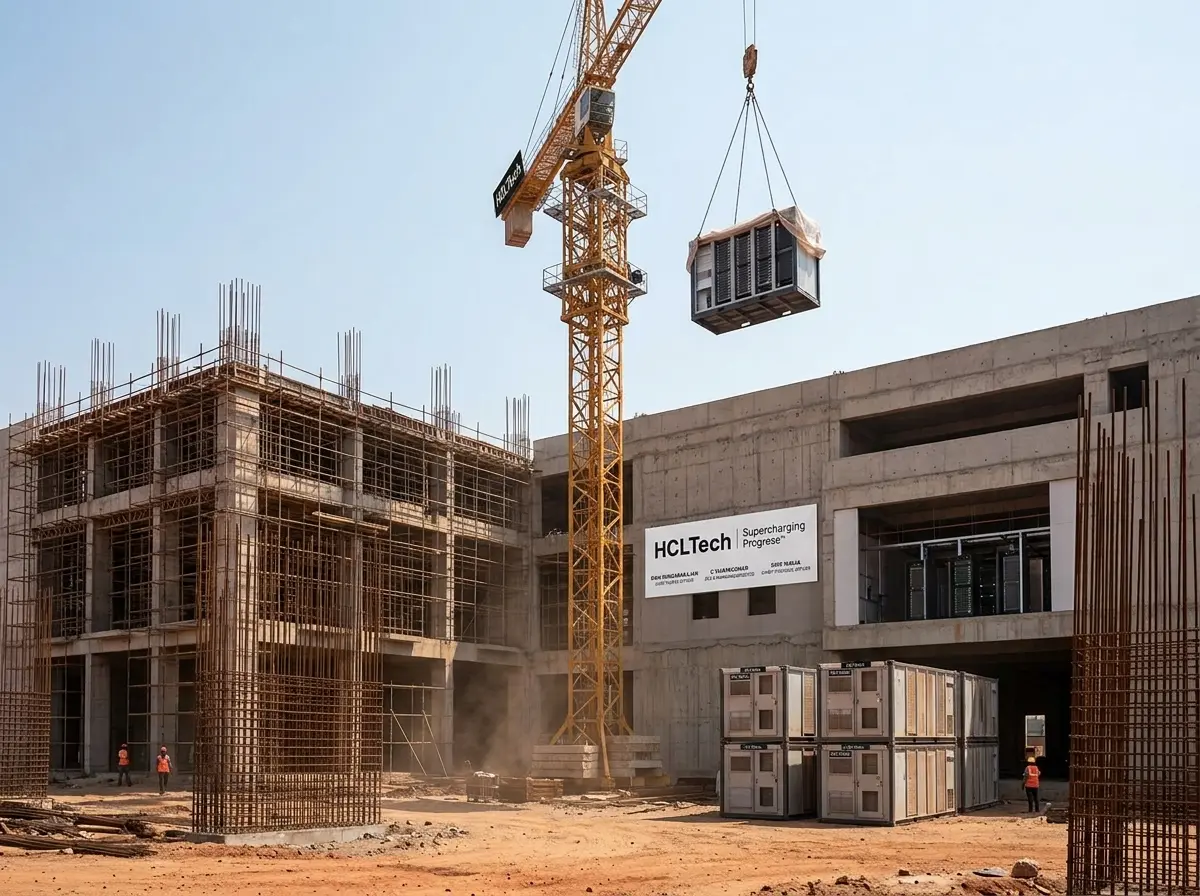
HCLTech’s board has approved an investment of up to ₹3,500 crore, roughly $400 million, to build AI data centre capacity in India. Infosys reviewed the identical opportunity with its management and board and decided against it.
That split, disclosed within days of each other as India’s four largest IT exporters reported June quarter results, is the sharpest strategic fork to open up in the industry in years. Deal wins held up almost everywhere. What diverged was whether owning the physical machinery behind artificial intelligence is worth the capital risk.
HCLTech Puts Real Money Behind Its AI Pitch
HCLTech’s Q1 FY27 numbers looked strong on the surface. Net profit climbed 20.3% year-on-year to ₹4,626 crore, and the company logged its highest-ever Q1 bookings of $2.41 billion, a figure Chief Executive Officer C Vijayakumar called the company’s strongest-ever quarter from a bookings perspective.
Underneath that, HCLTech committed to something none of its three closest rivals have matched: owning AI infrastructure outright. The company disclosed three separate moves within weeks of each other.
- ₹3,500 crore board-approved investment for up to 50 megawatts of AI data centre capacity, disclosed around the June quarter results
- $180 million AI Factory expansion, where a global technology client expanded its scope for AI data centre buildout
- ₹730 crore Bhubaneswar facility, a proposed AI-optimised data centre and global development centre in Odisha that would be HCLTech’s first owned data centre in India, pending a memorandum of understanding with the state government
Vijayakumar was explicit about what kind of business this is meant to be. “This is not a colo business. This is going to be a full stack play,” he told analysts on the earnings call, describing plans to combine infrastructure with software, DevOps and cloud operations rather than simply renting out server capacity.
Why Did Infosys Say No to AI Data Centres?
Infosys looked at the same opportunity and passed, at least for now. Chief Executive Officer Salil Parekh said the company reviewed entering the AI infrastructure and data centre business internally, with both management and the board, and decided against investing in the segment at this stage.
Infosys is not short of AI momentum otherwise. Large deal total contract value hit $3.6 billion in the June quarter, up 12.5% from $3.2 billion in March, and management pointed to healthy conversion of its pipeline into signed contracts even as customer decision-making has slowed. Constant currency revenue grew 1% quarter-on-quarter, recovering from a 1.3% decline previously, though around 1.1 percentage points of that came from acquisitions rather than the core business.
Even so, Infosys trimmed its constant currency revenue forecast for fiscal 2027 to between 1.5% and 3%, down from 1.5 to 3.5% previously. The company’s finance chief has also warned that the quarter’s softness would have a “cascading effect” on the rest of the year. Caution, in other words, showed up in both the guidance and the infrastructure decision.
The AI Deflation Squeeze Behind Both Bets
Every one of the four companies is fighting the same underlying problem. AI lets fewer people finish the same work faster, which erodes the old model of billing by the hour or by headcount.
HCLTech put a number on it: management estimates AI-led deflation across its portfolio at around 2% to 3%, though the company says its FY27 guidance already accounts for the drag. Vijayakumar framed the response directly. “We intend to innovate faster than the market to stay ahead of the deflationary curve,” he told analysts, arguing that owning infrastructure is part of outrunning that curve rather than being flattened by it.
Wipro described the same pressure without HCLTech’s confidence. Management acknowledged that AI investments weighed on margins during the quarter, even as clients keep reallocating technology budgets toward AI initiatives. Wipro did not disclose an AI revenue figure at all.
The stakes extend well beyond India’s IT corridor. Global hyperscalers are pouring unprecedented sums into the same infrastructure layer HCLTech now wants a piece of, with Amazon alone planning $200 billion in 2026 capital spending. Research from Allianz estimates US big tech investment surpassing $600 billion this year, more than double pre-ChatGPT capital intensity. HCLTech’s few hundred million dollars is a rounding error against that backdrop, but it is still the first time an Indian IT major has chosen to sit on that side of the ledger.
Infosys and HCLTech Lead the Big Four on Bookings
| Company | Large Deal TCV, Q1 FY27 | Constant Currency Revenue, QoQ | AI Revenue Signal |
|---|---|---|---|
| Infosys | $3.6 billion, up 12.5% | +1.0% | 8.2% of revenue, about $417 million |
| TCS | Order book $9.5 billion, down from $12 billion | +0.4% | $2.6 billion annualised run rate, 8.5% |
| HCLTech | $2.41 billion, record Q1 | -0.5% | $171 million Advanced AI revenue, 4.6% |
| Wipro | $1.63 billion, up 13% | -1.4% | Not disclosed |
TCS’s order book decline looks like the outlier, but the company still landed a marquee AI-led transformation deal with industrial group SKF during the quarter. TCS’s own AI business has reached an annualised revenue run rate of $2.6 billion, according to the company, with Chief Executive Officer K Krithivasan pointing to strong deal conversion and expanding ecosystem partnerships as the basis for long-term AI-led growth.
Deal-making outside the big four tells a similar story of resilience. Tata Technologies, the Tata group’s engineering services arm, extended a five-year, $100 million partnership with auto parts maker Tenneco this month, evidence that large contracts in Indian tech services have not dried up even where headline growth has.
Hiring Moves in the Opposite Direction of Growth
Hiring split the four companies almost as sharply as infrastructure strategy did, and not along the lines revenue growth would predict.
TCS, the weakest performer on order book, hired the most aggressively. It added over 9,000 employees during the quarter, taking its workforce to 5,93,798, and onboarded around 14,000 campus graduates.
HCLTech, fresh off its strongest bookings quarter ever, cut headcount to 223,889 employees, down from roughly 2.27 lakh the prior quarter, the only one of the four to report a notable reduction. Infosys posted a marginal decline of 532 employees to around 3.28 lakh, with voluntary attrition ticking up to 13% from 12.6% the prior quarter, though still below 14.4% a year earlier. Despite that, Infosys reaffirmed plans to hire 20,000 fresh graduates in fiscal 2027 and has already recruited more than 4,000 of them. Wipro added just 888 employees, bringing its workforce to around 2.43 lakh.
Read together, the pattern suggests AI productivity gains are already changing how these companies staff projects, independent of whether a quarter’s growth or bookings looked good.
Analysts Split on HCLTech’s Capital Bet
HCLTech shares fell after the results despite the profit jump and record bookings, a reaction that shows the market has not fully embraced the data centre pivot.
- HCLTech’s Vijayakumar calls it a full stack play combining infrastructure with software, DevOps and cloud operations, not a rental business.
- Market analysts, per a BigGo Finance review of the results, flagged an unfavourable risk-reward balance given the stock’s rich valuation and what they termed an untested capital-intensive pivot.
- Infosys’s Salil Parekh reviewed the identical opportunity with his board and concluded the returns did not clear the bar to divert capital from the core services model, at least for now.
HCLTech’s own EBIT margin guidance of 17.5% to 18.5% for fiscal 2027 is unchanged, and the company argues stronger business growth will offset the AI deflation drag rather than the reverse. Whether that math holds is now a live question for the next several quarters, not a settled one.
A New Infosys Chief Will Inherit the AI Question
Infosys added a second piece of news to its results this week that bears directly on the infrastructure question. The company named Ashiss Kumar Dash, a three-decade Infosys veteran who currently leads a diversified portfolio spanning more than a dozen industry verticals, as CEO-designate.
Dash will succeed Parekh as Chief Executive Officer and Managing Director from April 1, 2027, when Parekh completes a nine-year tenure that took Infosys past $20 billion in annual revenue. Infosys Chairman Nandan Nilekani said the board was pleased with the internal promotion, noting that the industry is entering a period of considerable change.
Parekh’s call to stay out of AI infrastructure was made on his watch. Whoever runs Infosys after April 2027 inherits that decision, at the exact moment HCLTech’s data centre bet, and the rest of the industry’s capital race, will have had a year or more to prove itself out.


Sony’s 10 Percent Disc Drop Leaves the 2028 Cutoff Intact

Chip Allocation Sidelines the Base iPhone 18 This Fall

Miami-Dade Fights the Vice City Brand It Already Wears

IFA 2026 Awards Put Tecno Ahead of Flagship Phones

USB-C Gadgets Made the Junk Drawer Rechargeable

Pixel 11 Pro Asks $1,099 for a Light Google Locked

The iPhone Ultra Sells Two Retired Minis as One Foldable

Google Opens Gmail to Voice and Gates Docs Live

Lenovo Prices the IdeaPad Vibe Against Apple’s $699 Neo

Xbox Caps Game Pass Cloud Gaming at 15 Hours

Oracle Cuts 21,000 Jobs in a Year, Cites AI in 10-K Filing

Fable 5 and Mythos 5 Return as US Lifts Anthropic Export Controls

SpaceX’s Google Deal Turns a Rocket Company Into a Cloud Landlord

CD Projekt Red Co-CEO: Redemption Arc Isn’t Done, Witcher 4 in 2027

XPL Rallies 30% Ahead of Plasma One Card Tier Launch

Google Search Profiles Build a Follow Graph Inside Discover

DGO App Brings Rs 549 Mobile Pass for FIFA World Cup 2026 in Nepal

Moonshot AI Targets $30 Billion in China’s Fastest AI Funding Sprint

Oppo’s ColorOS 17 Eligibility List Leaves A-Series Buyers Behind

Microsoft Xbox Layoffs Start in July as Sharma Slams 3% Margin
-
 AI3 months ago
Oracle Cuts 21,000 Jobs in a Year, Cites AI in 10-K Filing
-
 AI2 months ago
Fable 5 and Mythos 5 Return as US Lifts Anthropic Export Controls
-
 AI3 months ago
SpaceX’s Google Deal Turns a Rocket Company Into a Cloud Landlord
-
 GAMING3 months ago
CD Projekt Red Co-CEO: Redemption Arc Isn’t Done, Witcher 4 in 2027
-
 CRYPTO3 months ago
XPL Rallies 30% Ahead of Plasma One Card Tier Launch
-
 NEWS3 months ago
Google Search Profiles Build a Follow Graph Inside Discover
-
 APPS3 months ago
DGO App Brings Rs 549 Mobile Pass for FIFA World Cup 2026 in Nepal
-
 AI3 months ago
Moonshot AI Targets $30 Billion in China’s Fastest AI Funding Sprint