
NEWS
Motorola’s Razr 70 Ultra Costs More and Holds Less
Motorola’s Razr 70 Ultra costs $300 more than its predecessor with half the storage, an early sign of the AI memory shortage reshaping 2026 phone prices.

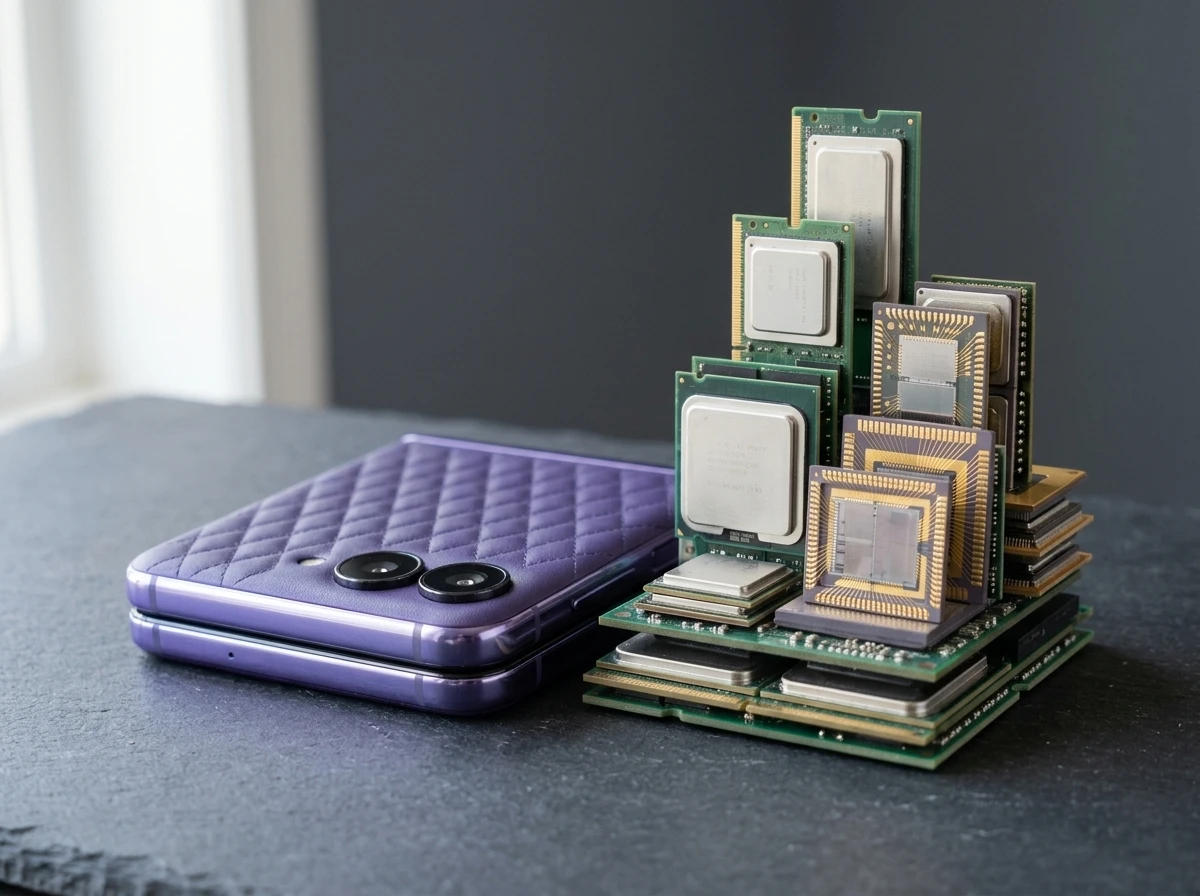
Motorola’s newest flip phone costs 300 dollars more than the one it replaced, and it ships with half the storage. The Razr 70 Ultra lists for AU$1999 (roughly US$1,300) in Australia, Motorola’s flagship foldable making its return after skipping the local market entirely in 2025. It is faster, better built and lasts longer on a charge than the phone before it. It also asks buyers to accept less storage and a downgraded camera for the privilege.
The reasons trace back to a global memory chip shortage that analyst firms Gartner, Counterpoint and IDC have all flagged this year. That shortage is already reshaping what a flagship phone gets buyers for their money, and the Razr 70 Ultra is a clean example of how.
Small Phone, Faster Chip
Motorola’s flip phone still folds into roughly half its open size, the same trick that revived the Razr name a few years back. The 70 Ultra keeps that shape: aluminum frame, titanium hinge, a textured plastic back that grips well and folds down to 15.69mm thick, versus 7.19mm unfolded. At 199 grams, it sits comfortably between too heavy and too light for its size.
Inside is a Qualcomm Snapdragon 8 Elite Gen 4, one generation behind the Gen 5 chip found in this year’s other flagships, paired with 12GB of RAM and 256GB of storage running Android 16. A 5000mAh silicon carbon battery sits underneath, the same chemistry Motorola used to give its book-style Razr Fold a 6,000mAh cell at launch. The phone carries an IP48 water resistance rating, enough for splashes but not a proper dunking.
Two screens do the work here. The outer 4-inch AMOLED panel runs at 1272×1080 and 165Hz behind Gorilla Glass, while the inner 6.96-inch AMOLED display matches that refresh rate at 1224×2992. Both are bright and sharp enough that it is hard to tell which one you are looking at.
What sets the cover screen apart is that it runs full Android apps, not just widgets. Samsung’s Z Flip line still limits its exterior display to shortcuts and micro apps. Motorola lets you open anything on the small screen exactly as you would on the big one. It remains one of the most genuinely useful ideas in any current foldable.
That extra generation of chip shows up in benchmark testing, even against phones released months later.
| Phone | Chipset | Multicore Score | GPU Score |
|---|---|---|---|
| Google Pixel 10 | Tensor G5 | 6193 | 3109 |
| Motorola Razr 70 Ultra | Snapdragon 8 Elite Gen 4 | 9408 | 19108 |
| Samsung Galaxy Z Fold 7 | Snapdragon 8 Elite | 9621 | 19744 |
| Oppo Find X9 Pro | Dimensity 9500 | 8941 | 23458 |
| Samsung Galaxy S26 Ultra | Snapdragon 8 Elite Gen 5 | 11200 | 24842 |
The Razr 70 Ultra will not beat this year’s flagship handsets outright, but it has enough headroom for daily use, gaming included, for years to come. A week of real-world testing produced minimal lag across the 12GB of RAM. Mobile speeds hit as high as 654Mbps on Telstra’s 5G network in Sydney before the telco’s bandwidth limiter kicked in.
The Camera Takes a Step Backward
Two years ago, Motorola made an unusual call on the Razr 50 Ultra: drop the ultra-wide lens and add a telephoto instead, on the logic that most people zoom in more than they zoom out. It was a smart trade that few other phone makers copied.
The Razr 70 Ultra undoes it. The telephoto is gone, replaced again by an ultra-wide, alongside a 50 megapixel main camera at F1.8 and a 50 megapixel selfie camera at F2.0 above the inner screen.
The photos themselves still look good. Daylight shots come out bright, sharp and detailed. Low light is the weak spot: images can turn soft and blotchy in dim rooms, and the jump in quality over the two-year-old Razr 50 Ultra’s camera setup is smaller than the price increase would suggest.
Where Motorola still innovates is in how you shoot. Opening the Razr flat turns it into a camcorder-style rig, with a touchpad on one half and the viewfinder on the other. Tilting the phone adds a layer of zoom control. Point it at kids and the cover screen cycles through bright, animated prompts designed to get them smiling, a small touch that actually works.
Why Does the New Razr Cost More for Less Storage?
Because component costs, not new features, explain most of the jump. The Razr 70 Ultra costs AU$1999, up $300 from the AU$1699 Razr 50 Ultra in 2024, while storage was cut from 512GB to 256GB. Motorola has not explained the change publicly, but the timing matches a global memory shortage now hitting every phone maker.
Motorola does offer a partial discount. Pre-orders are priced at AU$1799, about $200 off before the phone reverts to full price. That softens the blow, but even at the discounted rate, buyers get less storage than the model it replaces.
| Phone | Launch Price | Storage | Chipset |
|---|---|---|---|
| Motorola Razr 50 Ultra (2024) | AU$1699 | 512GB | Snapdragon 8s Gen 3 |
| Motorola Razr 70 Ultra (2026) | AU$1999 | 256GB | Snapdragon 8 Elite Gen 4 |
| Samsung Galaxy Z Flip8 (2026, US) | US$1,199.99 | 256GB | Snapdragon 8 Elite Gen 5 / Exynos 2600 |
The US version, sold as the Razr Ultra 2026, carried its own $200 increase over its predecessor when it launched earlier this year. Four things changed for the worse alongside the higher Australian price.
- Storage drops from 512GB to 256GB versus the 2024 model.
- The telephoto lens is gone, replaced by an ultra-wide.
- Qi2 charging holds a slight magnetic pull but does not snap to accessories.
- Software support runs three years of OS updates and five of security patches, already one Android version behind.
Only the battery life genuinely improved. Everything else on that list is a trade Motorola is asking buyers to make quietly, with little explanation beyond a new chip and a higher number on the box.
The Memory Shortage Behind the Price Tag
Motorola is not alone in this. The culprit is memory, specifically the chips inside every phone, laptop and AI data center on the planet.
Gartner said combined DRAM and SSD prices could surge 130% by the end of 2026, pushing smartphone prices up 13% and PC prices up 17% compared with 2025. The same report expects global smartphone shipments to fall 8.4% this year, the steepest drop in over a decade.
Higher prices will narrow the range of devices available, prompting buyers to hold on to devices for longer, fundamentally altering upgrade cycles.
Ranjit Atwal, a senior director analyst at Gartner, said that in the firm’s report on the shortage.
Gartner’s own numbers add a detail that matters here: “Premium smartphones will be less affected because of their higher margins,” the firm said, expecting basic smartphone buyers to leave the market five times faster than premium buyers this year. The Razr 70 Ultra is about as premium as phones get. It still lost storage and a camera lens to the same squeeze.
Counterpoint Research told CNBC in December that average smartphone prices could rise 6.9% in 2026, more than double its earlier 3.6% forecast, with global shipments falling 2.1%. DRAM chips serve both AI servers and phones, and AI has been winning that fight for supply.
Samsung’s own memory division posted an 86% jump in quarterly revenue in the first quarter of 2026, serving what the company called “high-value-added AI demand” under constrained supply, according to Omdia. Phones above $400 are still expected to grow 5.7% in 2026 even as the overall global smartphone market contracts 12%, because higher margins let premium brands absorb the extra cost. The Razr 70 Ultra shows what absorbing that cost looks like in practice: not just a higher price, but a smaller camera kit and half the storage.
Samsung Charges More for a Flip8 That Barely Moved
Samsung’s answer arrived this week. The Galaxy Z Flip8 launched on July 22, 2026, starting at $1,199.99 in the US for the 12GB and 256GB configuration, available for pre-order immediately ahead of an August 7 release. That is $100 more than the Flip7’s starting price, an increase Android Central attributed directly to the RAM crisis.
The rest of the phone barely moved. Battery capacity holds flat at 4,300mAh, matching the Flip7 exactly, and reviewers noted the phone gained little beyond a new processor and a thinner frame. Samsung is also adopting silicon carbon battery cells for the first time, the same chemistry Motorola introduced months earlier, though without a capacity increase to show for it.
The two phones now sit close enough to invite comparison. Coverage of the Flip8 pointed out that the Razr Ultra 2026 uses Gorilla Glass Ceramic on its cover screen, while the Flip8 sticks with Gorilla Glass Victus 2, giving Motorola an edge on paper and a higher price to match. Neither company brought back Qi2’s true magnetic snap this generation, despite both offering wireless charging.
Three Years of Updates and a Bundled FIFA Game
Software support is another area where the Razr 70 Ultra falls behind. Motorola promises three years of OS upgrades and five years of security patches. Google and Samsung now offer up to eight years on their own flagship phones. One of Motorola’s three OS updates is already spent, since Android 17 shipped this year, meaning the Razr 70 Ultra launches already one version behind.
Motorola’s update commitments have varied by region before. The Edge 70 Max’s update policy differs between the UK and India, and the Razr line’s three-year window sits on the shorter end of what any 2026 flagship offers.
Then there is the bloatware. The phone ships with small games for the cover screen, plus a new addition tied to Motorola’s FIFA World Cup sponsorship: a mobile football game bundled with in-app purchases. There is also a new Newsfeed panel inside the app drawer, powered by Taboola, Mobile Posse and Squid, three ad-supported content networks that surface a fixed handful of topics and sources rather than pulling from the open web the way Google’s Discover feed does.
Bloatware like this is common across Android phones, but it stacks on top of a device already charging more for less. The Razr 70 Ultra remains one of the most usable small phones sold today. It is just a harder sale at AU$1999 than the AU$1699 phone it replaced two years ago.
Frequently Asked Questions
Why did the Razr 70 Ultra’s price jump while storage shrank?
Global memory prices are the main driver. IDC forecasts the average smartphone will sell for a record US$523 in 2026, a 14% increase, as DRAM and NAND chips get redirected toward AI data centers instead of consumer phones. Motorola has not given a public reason beyond the new chip and battery.
Will phone prices keep rising after 2026?
Analysts expect the squeeze to last into 2027 at least. Gartner’s Ranjit Atwal told CNBC he does not expect meaningful relief until “the end of 2027,” with major memory makers prioritizing AI orders over consumer chips well into next year.
Is the Razr 70 Ultra sold outside Australia?
Yes, under a different name. Motorola sells the same phone globally as the Razr Ultra 2026, with the same 5,000mAh silicon carbon battery, 199 gram weight and IP48 rating confirmed in US coverage months before the Australian launch.
How does the Razr 70 Ultra compare with Samsung’s Galaxy Z Flip8 on price?
Samsung’s Z Flip8 starts at $1,199.99 in the US for its base 256GB model, $100 more than the Flip7, while the Razr 70 Ultra costs AU$1999 in Australia. Both phones raised prices this year with only modest hardware changes, reflecting the same memory cost pressure across the industry.


Sony’s 10 Percent Disc Drop Leaves the 2028 Cutoff Intact

Chip Allocation Sidelines the Base iPhone 18 This Fall

Miami-Dade Fights the Vice City Brand It Already Wears

IFA 2026 Awards Put Tecno Ahead of Flagship Phones

USB-C Gadgets Made the Junk Drawer Rechargeable

Pixel 11 Pro Asks $1,099 for a Light Google Locked

The iPhone Ultra Sells Two Retired Minis as One Foldable

Google Opens Gmail to Voice and Gates Docs Live

Lenovo Prices the IdeaPad Vibe Against Apple’s $699 Neo

Xbox Caps Game Pass Cloud Gaming at 15 Hours

Oracle Cuts 21,000 Jobs in a Year, Cites AI in 10-K Filing

Fable 5 and Mythos 5 Return as US Lifts Anthropic Export Controls

SpaceX’s Google Deal Turns a Rocket Company Into a Cloud Landlord

CD Projekt Red Co-CEO: Redemption Arc Isn’t Done, Witcher 4 in 2027

XPL Rallies 30% Ahead of Plasma One Card Tier Launch

Google Search Profiles Build a Follow Graph Inside Discover

DGO App Brings Rs 549 Mobile Pass for FIFA World Cup 2026 in Nepal

Moonshot AI Targets $30 Billion in China’s Fastest AI Funding Sprint

Oppo’s ColorOS 17 Eligibility List Leaves A-Series Buyers Behind

Microsoft Xbox Layoffs Start in July as Sharma Slams 3% Margin
-
 AI2 months ago
Oracle Cuts 21,000 Jobs in a Year, Cites AI in 10-K Filing
-
 AI2 months ago
Fable 5 and Mythos 5 Return as US Lifts Anthropic Export Controls
-
 AI3 months ago
SpaceX’s Google Deal Turns a Rocket Company Into a Cloud Landlord
-
 GAMING3 months ago
CD Projekt Red Co-CEO: Redemption Arc Isn’t Done, Witcher 4 in 2027
-
 CRYPTO3 months ago
XPL Rallies 30% Ahead of Plasma One Card Tier Launch
-
 NEWS3 months ago
Google Search Profiles Build a Follow Graph Inside Discover
-
 APPS3 months ago
DGO App Brings Rs 549 Mobile Pass for FIFA World Cup 2026 in Nepal
-
 AI3 months ago
Moonshot AI Targets $30 Billion in China’s Fastest AI Funding Sprint