
GADGETS
Samsung-Google Smart Glasses Bet on Gentle Monster and Warby Parker

Samsung Electronics and Google took the wraps off intelligent eyewear at Google I/O 2026, a category the two companies have been telegraphing for almost a year. The reveal showed two designs co-built with fashion eyewear houses: a black-frame Gentle Monster cut and a dark forest-green Warby Parker shape, both running Gemini (Google’s multimodal artificial intelligence model) through the Android XR platform, with the first collections launching in select markets this fall.
Yet the chips and the AI are not where the bet lives. Meta has sold more than two million Ray-Ban smart glasses since October 2023 and grew the category 139% year-over-year in the second half of 2025, taking 82% of global smart glasses shipments. That share was won inside Sunglass Hut, LensCrafters and Pearle Vision stores, not on spec sheets. The Samsung-Google answer is to copy that playbook with two of the most-recognized eyewear brands on either side of the Pacific.
Why the Eyewear Brands Matter More Than the Chips
Smart glasses spent most of a decade as the punchline of consumer tech. Google Glass became a meme. Snap Spectacles piled up unsold. Magic Leap pivoted to enterprise after burning billions on a consumer launch that never landed. The pattern broke once Meta paired with EssilorLuxottica, the Italian group that owns Ray-Ban, and put cameras inside frames people already wanted to wear.
That distribution edge shows up in the share numbers, per the H2 2025 smart glasses shipment data from Counterpoint Research:
- 82% share for Meta in the second half of 2025, up from 73% in the first half
- 139% year-over-year shipment growth across the global category in that window
- Two million-plus units of Ray-Ban Meta sold since the line launched in October 2023
Samsung and Google have spent the past 18 months trying to assemble the same edge without owning a retail footprint. The answer arrived at this year’s developer conference: license the design and the doors from Gentle Monster, the Seoul-based eyewear house with standalone flagships across Asia, London, New York and Dubai, and from Warby Parker, the New York brand with hundreds of US storefronts. Different demographics, same logic.
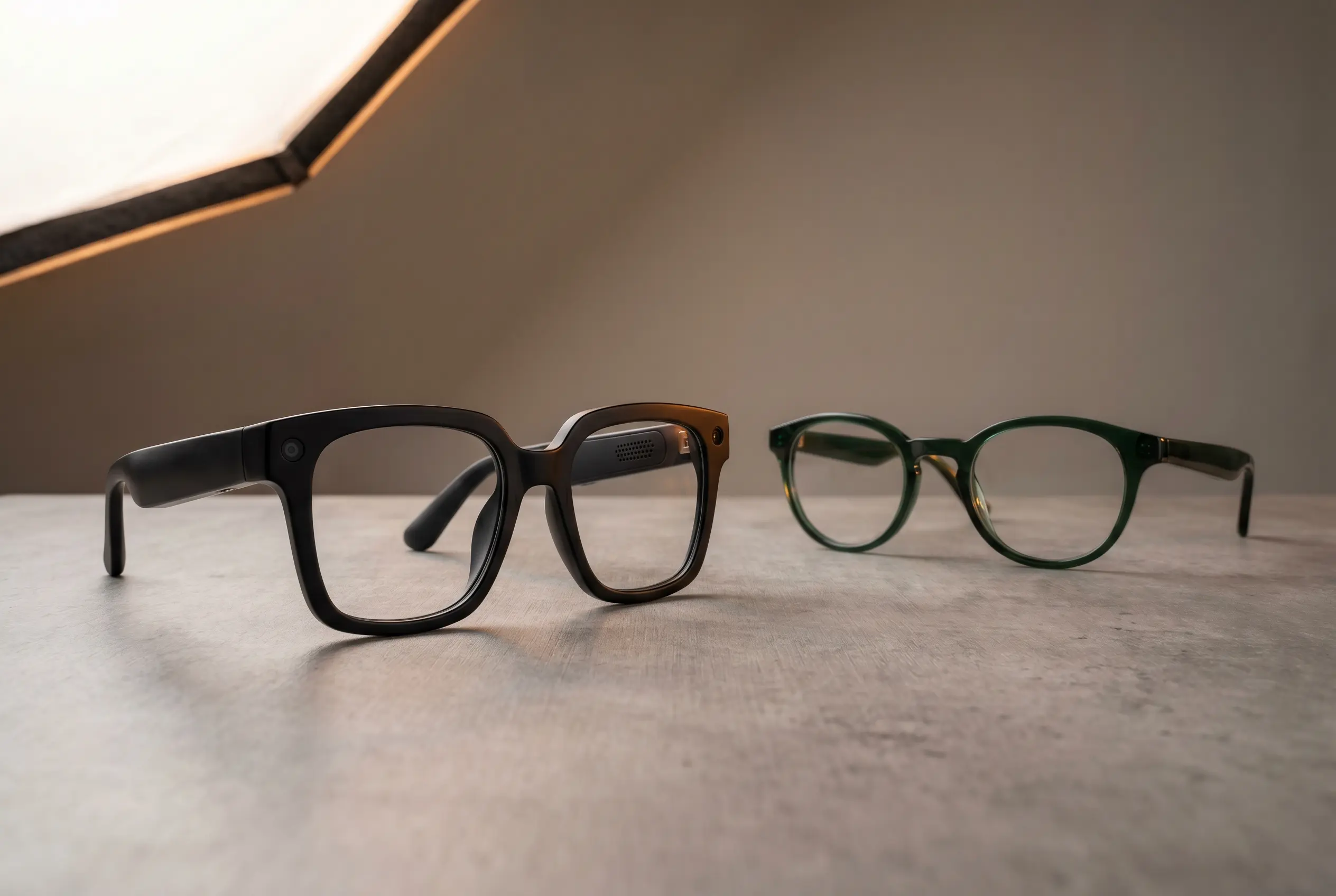
Samsung and Google’s Two-Frame Reveal
The reveal focused on what the devices feel like to use, not on processor names. Samsung confirmed audio-only glasses will ship first, with display glasses to follow. Both versions are positioned as companion devices to a mobile phone, designed for hands-free voice interaction.
What the audio models can do, per Google’s Android XR I/O 2026 product page, tracks close to Meta’s existing Ray-Ban Meta capability set, with a handful of Gemini-specific extras:
- Visual queries about the surroundings, answered by voice
- Turn-by-turn navigation, including mid-walk route modifications
- Real-time speech translation with audio that matches the original speaker’s voice, plus text translation on menus and signs
- Summarized notifications, calendar entries and hands-free messaging
- Multi-step tasks through third-party apps including Uber, Mondly and DoorDash
- Photo and video capture, with on-device editing through the Nano Banana tool
Crucially, Google confirmed the eyewear works with both Android and iPhone connections. That widens the addressable user base well beyond Samsung’s Galaxy installed base, an explicit acknowledgement that the Korean company is willing to subsidize iPhone users to grow the Android XR platform.
Gentle Monster brings the black-frame design, described in the joint announcement as ‘disruptive yet refined.’ Warby Parker brings dark-green frames built around what its co-CEO Dave Gilboa called ‘precision optics and exceptional comfort.’ Both shapes will sit inside each brand’s wider seasonal collections launching later this year.
Inside Google’s $150 Million Warby Parker Bet
The Warby Parker piece of this story is not a co-marketing deal. It is a structured investment, and the Warby Parker partnership filing spelled out the terms in May 2025: Google committed up to $150 million across two tranches, $75 million in product development and commercialization funding plus another $75 million in equity contingent on hitting collaboration milestones.
Warby Parker’s New York-listed stock popped 16% the day of the announcement, May 20, 2025. The size of the check told the market that Google was not buying a frame-supplier; it was buying a co-developer. The second tranche, gated on milestones, is the carrot that keeps both sides aligned through the messy first eighteen months of any new device category.
What Google gets goes beyond the optics expertise. Warby Parker built its business on home try-on kits, prescription verification, and a US-wide network of physical stores. Each of those touchpoints solves a problem that pure-tech founders have failed to crack: getting a customer through a fitting process, taking their prescription, and getting them out the door wearing the device that day, not three weeks later.
What Gentle Monster Already Learned From Huawei
Gentle Monster is not new to this category. The Seoul label co-released its first smart eyewear with Huawei in 2019, followed by Eyewear II the year after. That partnership ended in late 2020, with Huawei shifting subsequent AI eyewear manufacturing to Goertek. The frames sold well in Asia and never reached US mainstream attention.
What the Huawei chapter taught the brand was leverage. Gentle Monster controls the wearer relationship; the tech partner controls the platform. When the device moves from accessory to phone-adjacent computer, the value-split needs to be renegotiated. The 2019 deal shipped into a moment when smart eyewear was a curiosity. The Samsung version ships into a market where Meta is targeting 20 million units of annual Ray-Ban capacity by the end of this year, per supply-chain reporting.
Hankook Kim, founder and CEO of Gentle Monster, framed the new deal in design-first terms in the joint announcement:
Intelligent eyewear should feel as emotionally expressive as it is technologically advanced. Our vision was to merge fashion and technology in a way that feels bold, beautiful and human, bringing Gentle Monster’s disruptive design identity into a new era of intelligent eyewear with Samsung and Google.
Translation: the frames will not look like Galaxy hardware. They will look like Gentle Monster frames that happen to run Gemini.
Meta’s 82% Lead and the Retail Distribution Problem
Meta did not get to its dominant share because Ray-Ban Meta had the best silicon. It got there because EssilorLuxottica’s global Sunglass Hut, LensCrafters and Pearle Vision footprint meant a customer walking in for prescription frames could walk out with smart glasses by accident. Samsung and Google have to manufacture that same accident without the same retail real estate.
Gentle Monster and Warby Parker are the closest available substitutes. Both run their own stores. Both ship prescription lenses. Both already command the wallet-share of fashion-eyewear buyers in their respective markets. Side by side, the two partnerships look like complementary geography, not competitive overlap:
| Attribute | Gentle Monster | Warby Parker |
|---|---|---|
| Founded | 2011, Seoul | 2010, New York |
| Primary retail footprint | Standalone flagships across Asia, plus London, New York, Dubai | Hundreds of US storefronts, plus Canada expansion |
| Frame style in I/O reveal | Black frames, ‘disruptive yet refined’ | Dark-green frames, ‘refined and timeless’ |
| Prior tech-partner experience | Huawei Eyewear (2019), Eyewear II (2020) | None at this scale |
| Google financial commitment | Not disclosed | Up to $150 million |
The two-partner split also hedges geopolitical risk. A US regulatory shock affecting a Korean partner would still leave the New York brand shipping in the largest single smart-glasses market. A retail disruption on the US side would still leave the Asian brand shipping out of its flagship network. Neither outcome is likely. The hedge exists anyway, because the bet is large enough that hedges are cheap relative to the prize.
Apple’s Shadow and the Fall Launch Window
The window matters. Samsung and Google have not given a specific date beyond ‘this fall’ and ‘select markets,’ with Malaysia explicitly excluded at launch per the joint press release. The competitive backdrop dictates the urgency. Apple’s smart-glasses program is in active development, with industry reporting pointing to a late 2026 or early 2027 ship date for an audio-first eyewear product, and analyst Ming-Chi Kuo calling for a 2027 release.
The Samsung-Google calendar is also constrained from inside the Galaxy hardware family. Samsung shipped its Galaxy XR mixed-reality headset on October 21, 2025 at $1,800, the first commercial device on Android XR, positioned as a Vision Pro competitor at a lower price point. The intelligent eyewear is the next chapter of the same platform play. Pricing for the eyewear has not been disclosed; Ray-Ban Meta starts at $299 and rises to $379 for the Wayfarer with premium polarized lenses, which is the price ceiling Samsung and Google will be tested against. IDC’s latest XR forecast projects global smart-glasses installed base to exceed 80 million devices by 2030, with the steepest growth curve in the next 24 months.
If the fall launch lands with retail availability inside Warby Parker stores and Gentle Monster flagships, and the price sits within $50 of Meta’s range, the two-partner gambit has a credible shot at compressing Meta’s share back toward a normal duopoly. If the launch slips to 2027, or if pricing comes in above $500, Apple shows up to a market the incumbent has already locked, and the most expensive frame on the shelf this fall ends up being the Galaxy XR sitting unsold next to it.


D&D Bets Big on WoW and Star Wars to Grow Its Tables

Game Pass Drops Celeste and Crusader Kings on First Net-Loss Day

Gemini Breaks Basic Calls on Foldable Phones in Android Auto

Citadel Clears AI Fund Overhang While Crypto Stays Flat

Morgan Stanley Staking ETPs Crack Open Crypto Yield for Wealth Clients

Snapdragon Price Hike Forces Premium Buyers Toward Last Year’s Phones

Croc 2 Remaster Unlocks Argonaut’s Full Revival Path

Scale AI Names Google Cloud Veteran deSouza CEO for Enterprise Push

Epic Store Hits Brazilian iPhones Amid Apple’s Familiar Friction Play

LORDNINE Helena Server Races Players Toward Real USDT Rewards

Fable 5 and Mythos 5 Return as US Lifts Anthropic Export Controls

SpaceX’s Google Deal Turns a Rocket Company Into a Cloud Landlord

Oracle Cuts 21,000 Jobs in a Year, Cites AI in 10-K Filing

CD Projekt Red Co-CEO: Redemption Arc Isn’t Done, Witcher 4 in 2027

XPL Rallies 30% Ahead of Plasma One Card Tier Launch

DGO App Brings Rs 549 Mobile Pass for FIFA World Cup 2026 in Nepal

Google Search Profiles Build a Follow Graph Inside Discover

Moonshot AI Targets $30 Billion in China’s Fastest AI Funding Sprint

Microsoft Xbox Layoffs Start in July as Sharma Slams 3% Margin

Oppo’s ColorOS 17 Eligibility List Leaves A-Series Buyers Behind
-
 AI1 month ago
Fable 5 and Mythos 5 Return as US Lifts Anthropic Export Controls
-
 AI2 months ago
SpaceX’s Google Deal Turns a Rocket Company Into a Cloud Landlord
-
 AI1 month ago
Oracle Cuts 21,000 Jobs in a Year, Cites AI in 10-K Filing
-
 GAMING1 month ago
CD Projekt Red Co-CEO: Redemption Arc Isn’t Done, Witcher 4 in 2027
-
 CRYPTO2 months ago
XPL Rallies 30% Ahead of Plasma One Card Tier Launch
-
 APPS2 months ago
DGO App Brings Rs 549 Mobile Pass for FIFA World Cup 2026 in Nepal
-
 NEWS2 months ago
Google Search Profiles Build a Follow Graph Inside Discover
-
 AI2 months ago
Moonshot AI Targets $30 Billion in China’s Fastest AI Funding Sprint