
AI
Gulf’s $4.3 Billion AI Plan Runs on Scarce Power
Gulf Development’s 2,000 MW data-center plan is a power play, now tested by a 20,000 MW request spike and a pause on 166 other projects.

Gulf Development still aims to add as much as 2,000 megawatts of data center capacity over five years, a plan now stuck to a national fight over power. Chief Financial Officer Yupapin Wangviwat set that ceiling on June 4, 2026, and put a five-year group budget of as much as 140 billion baht (US$4.3 billion) behind data halls, plants and other kit for the AI boom.
Sarath Ratanavadi, the company’s chief executive and Thailand’s richest person, with a fortune of $18.3 billion, has already folded power and telecom into one group. The scarce piece is no longer a press-release cheque. It is a megawatt at the substation, and in early September the state started treating those megawatts as a public problem.
Gulf Set a 2,000-Megawatt Data Center Target
Yupapin told investors on a June 4 video call that Gulf, Thailand’s largest power producer, wants the extra 2,000 megawatts to serve AI and cloud loads. Gulf and its partners then ran about 200 megawatts. Shares jumped as much as 5.8% to a record that Thursday.
“We see AI and cloud computing as major growth opportunities for our company,” she said. “Our strong footprint and expertise in the power business give us a significant advantage as we expand into these areas.”
The 140 billion baht figure is a group ceiling for power, data centers and other infrastructure, not a dedicated AI cheque. Later company briefings put five-year capital spending at 130 billion to 140 billion baht, with about 10% going to digital work. At $6 million to $7 million per megawatt, the project cost Gulf itself has used for 2026 through 2030, a 2,000-megawatt build would run $12 billion to $14 billion, about three times the whole group capex cap, which is why partners, tenants and plant-level debt have to carry so much of the stack.
THE JUNE 4 PLEDGE
- Capacity add: Up to 2,000 megawatts of data center load over five years, from about 200 megawatts with partners.
- Group budget: As much as 140 billion baht, or $4.3 billion, for plants, halls and related infrastructure.
- Cash mix: Operating cash flow, bonds and bank loans, with lenders then being sounded out for $400 million to $600 million.
- First slice: A data-center park of about 1,000 megawatts, which chief strategy officer Smith Banomyong described on September 4 as the opening phase, with customers still calling.
Smith told the Bangkok Business Summit that Gulf has no plan to slow the build, and that most of its halls sit in the provinces, away from dense housing. He also gave a land rule of thumb of about 1 megawatt per 0.7 rai, so a 100-megawatt site would need about 70 rai. Several hundred rai have already been bought in stages, he said, without naming every plot.
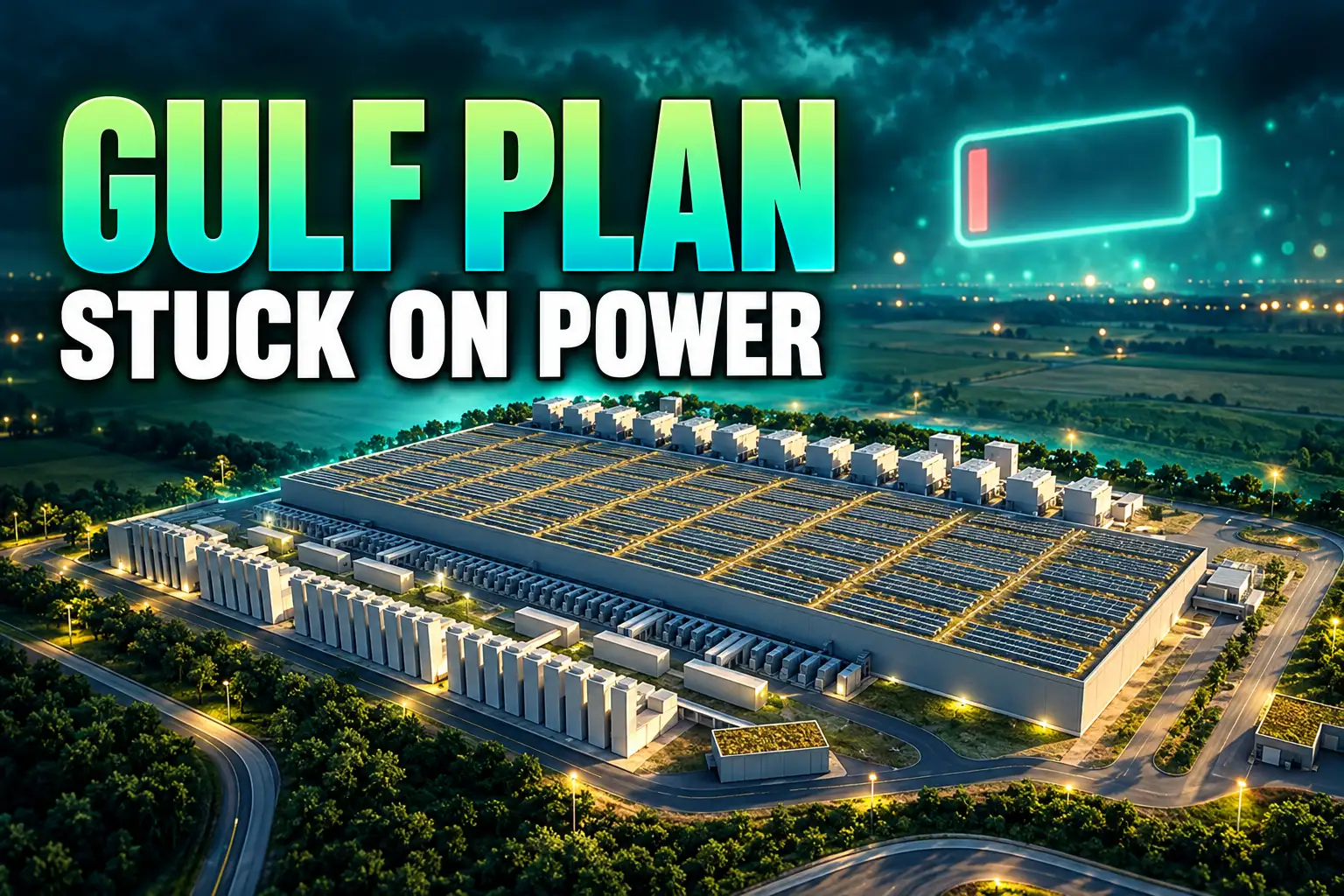
Idle Gas Plants and a 20,000-Megawatt Queue
Thailand’s draft Power Development Plan for 2026 flags data centers and AI as a new load. In a high-growth case, that demand could reach 8,800 megawatts. The grid is not starting from empty turbines. It is starting from a pile of paper requests that dwarfs anything Gulf can plug in this decade.
Prime Minister Anutin Charnvirakul, chairing the first 2026 meeting of the Data Centre Business Policy Committee on September 4, cited preliminary applications to the Provincial Electricity Authority of nearly 20,000 megawatts. He said firms were grabbing capacity they might not use, then sitting on it or trying to trade it. Hot-season peak demand has already reached 36,758 megawatts, against 46,191 megawatts of installed capacity excluding renewables, leaving a reserve margin under 30%, down from 38% a year earlier.
Joseph Majkut and Raj Sawhney, writing in a Center for Strategic and International Studies brief dated August 27, 2026, describe the other half of that picture. Across 2024 and 2025, most of Thailand’s gas independent power plants ran far less than half the time, leaving about 11.3 GW of idle gas generation, or about 99 terawatt-hours a year, already built and contracted. Availability payments for those idle units were about 0.63 baht per kilowatt-hour in early 2026, nearly 17% of the base tariff. New halls that can pay for firm power would soak up that slack, they argue, if contracting rules change.
MEGAWATTS ON THE TABLE
| Load | Megawatts | What it measures |
|---|---|---|
| Gulf and partners, in operation | About 200 | Company figure, June 4, 2026 |
| Gulf five-year add | Up to 2,000 | Yupapin’s ceiling on the investor call |
| Gulf first-phase park | About 1,000 | Smith Banomyong, September 4, 2026 |
| Thailand live data centers | 216 | BMI, second quarter of 2026 |
| Thailand pipeline | 944 | BMI, under construction and planned |
| PEA power applications | Nearly 20,000 | Speculative requests, not built load |
| Gulf plants in operation | 16,520 | Installed generation at December 31, 2025 |
Gulf’s own AGM minutes put equity generation at 9,610 megawatts at the end of 2025, heading for 24,727 megawatts installed by 2034 if projects now in development come online. Two Gulf-Mitsui gas plants at Si Racha and Pluak Daeng already total 5,300 megawatts in the Eastern Economic Corridor, the same belt where the new halls are clustering. BMI, a research house, put national live data-center capacity at 216 megawatts in the second quarter of 2026, with 944 megawatts in the pipeline, 902 of that around Bangkok.
Why Microsoft Booked Halls in Thailand
Hyperscalers are not buying Thai floor space for the view. They are buying a path to electrons, cooling and a local cloud region that keeps data in-country. On October 28, 2025, Gulf and affiliate Advanced Info Service announced a tie-up that puts that bargain in writing.
GSA Data Center 02, a Gulf subsidiary, signed up to provide data center services for Microsoft’s cloud region in Thailand. Gulf’s newsroom notice leaned on its power and renewable fleet as the reason the deal works, and G-AIS, a 50/50 digital unit with AIS, widened software work into customer-service and security tools. Microsoft ASEAN president Mayank Wadhwa and Microsoft Thailand managing director Dhanawat Suthumpun stood for the tenant side.
Our strong footprint and expertise in the power business give us a significant advantage as we expand into these areas.
Yupapin Wangviwat, Chief Financial Officer, Gulf Development, June 4, 2026 investor call
Gulf Edge, the group’s digital arm, signed a wider Google Cloud pact in January 2026, after Google opened its first Bangkok cloud region on the back of a $1 billion pledge. That deal is meant to push Gulf’s own companies, including AIS, onto Google’s stack and to sell sovereign cloud and so-called agentic tools to Thai firms. Sarath called it a step toward keeping Thai data inside Thai borders.
The offtake pattern is the same in both cases. A global cloud name wants a hall that already sits next to generation, fiber and a licensed Thai operator. Gulf can point to all three, which is why a power company is winning data-center mandates that a pure developer would have to assemble from scratch.
GSA01, Rayong and the Next 100 Megawatts
The 2,000-megawatt slide is a ceiling. The concrete is a handful of named halls in Samut Prakan, Chon Buri and Rayong, plus land Smith says is already in the books. GSA is the joint venture with Singtel and AIS. Gulf Edge Data Center 02 is the vehicle for the larger Rayong block.
GULF’S NEAR-TERM HALLS
- GSA01, Samut Prakan: 25 megawatts, in operation, the first Thai hall to use liquid cooling for AI chips, and 2026 is its first full year in the accounts.
- GSA02, Chon Buri: 38 megawatts, aimed at commercial operation in mid-2027, designed to Microsoft’s global standard for the local cloud region.
- GEDC, Rayong: 100 megawatts, under construction, with opening pegged for late 2027, after Gulf set up Gulf Edge Data Center 02 to hold the project.
Those three sites add to 163 megawatts of named capacity, which still leaves the 1,000-megawatt first-phase park and the 2,000-megawatt five-year add as targets, not a build sheet. In June, Smith said feasibility work had started on one or two more projects, with decisions due before year-end, and that 2026 spending included new halls totalling 100 megawatts. The Electricity Generating Authority of Thailand has been reinforcing the same corridor. Deputy Governor Teerawut Wetatham said upgrades around Phanthong in Chon Buri are meant to serve 1,150 MW of data-center demand in the EEC, with new PEA delivery points of 150 megawatts at Rayong 2, 250 megawatts at Phanthong and 250 megawatts at a temporary Phanthong 2, plus 350 megawatts of transformers at Pluak Daeng and 150 megawatts at Sattahip.
Rayong 2 is already in service. Phanthong’s main point was due in February 2026, the temporary point in December 2026, and Pluak Daeng in the first quarter of 2027. That is a grid story wearing a data-center badge: the state is moving substations because the load showed up on the eastern seaboard, not because a software model needed a press event in Bangkok.
Gulf Wants to Sell Power to Itself
On August 28, 2026, the energy minister lifted a 2,000-megawatt cap that had limited direct clean-power trades to data centers, and opened that market to all industry. Large users can buy renewable output straight from a plant and pay EGAT and the distributors a third-party access charge for the wires. For a group that already owns turbines, that rule is the product.
Smith said Gulf still draws most hall power from the grid, and that under the draft PDP 2026 the company is studying a direct power-purchase deal in which it would generate electricity and sell it into its own data centers. “We are already in the power business, so we are both buyer and seller,” he said after the Bangkok Business Summit, describing a study, not a signed contract. He also said Gulf would look at small modular reactors if the state opens that door and the public will wear it, which is a long-dated option, not a 2027 kilowatt-hour.
The same week, the policy board tried to freeze a much messier queue. NESDC secretary-general Danucha Pichayanan told the September 4 meeting that 16 agencies could count 35 operating data-center projects, about 49 under construction and more than 117 waiting on permits, or 166 in the last two buckets, and that the files were too thin to police. The board held the pending approvals and asked builders of the 49 live sites to pause while four panels draft standards in one month on economic return, infrastructure, location and the environment. Danucha said the government does not have the legal power to halt those 49 jobs by decree, so the construction stop is a request.
WHAT WE KNOW
- Approvals: More than 117 pending data-center permits were put on hold on September 4, 2026, until common national standards exist.
- Sites already building: About 49 projects were asked to pause; NESDC says that ask is not a legal shutdown.
- Gulf’s stance: Smith said customers are still calling and the company is not slowing its own park.
WHAT IS UNCONFIRMED
- Direct PPA: Gulf is studying a self-supply deal, with no size, plant or signing date disclosed.
- October rules: The four panels have a one-month clock from September 4; the text of those standards is not public.
- Who sits inside the 166: Officials have not published a project list, so Gulf’s named halls cannot be matched line by line to the freeze.
Anutin put the political line in one sentence at Government House: “We are not saying that we will never build data centers again. We need to put them in order.” He also told the committee to write a legal definition of a data center, push green supply, and stop urban jobs that had used the wrong building class to dodge rules. Finance Minister Ekniti Nitithanprapas was told to keep new load on solar and wind. On September 10, the NBTC office floated a seven-working-day licence track for complete files, which only works if the applicant already holds a power-purchase agreement that matches the IT load.
A developer whose only asset is a PEA application is now in a slower lane. A developer that already runs 16,520 megawatts of plants, holds AIS fiber, and has Microsoft on a 38-megawatt hall is in a different lane. That split is the second-order result of the June pledge. Gulf does not need the boom to stay unregulated. It needs the boom to be regulated around people who can actually deliver power.
October Bonds and a Cable Toward Singapore
Yupapin told the June call the group would fund the expansion with cash flow, bonds and loans, and that a sale of about 20 billion baht was slated for September. That sale moved. On August 28, Gulf said it would offer four tranches of retail debentures in October, including a 7-year digital note on Krung Thai’s Paotang app, with subscription due from October 19 to 21, 2026. TRIS Rating assigned AA- with a stable outlook on August 24. Proceeds go to repay maturing notes and to fund more solar, wind, data centers, cloud and AI. Coupon rates were still unstated on the notice.
The group has already shown it can clear a book. On March 20, 2026, it issued 35 billion baht of unsecured notes in four tenors at an average 2.36% for 6.4 years, with 49.507 billion baht of orders, about 1.4 times the offer. Second-quarter 2026 core profit was a record 12.33 billion baht, up 74% from a year earlier, on revenue of 50.29 billion baht, up 24%, Gulf said in the same August note, with AIS still throwing off dividends inside that mix.
FROM THE JUNE CALL TO THE CABLE DEAL
- June 4, 2026: Yupapin sets a 2,000-megawatt data-center add and a 140 billion baht group capex ceiling, and flags September bonds plus $400 million to $600 million of bank talks.
- June 23, 2026: Singtel sells a 2.8% Gulf stake for about S$1 billion, keeps 4.95%, and says the GSA data-center venture and AIS remain the Thai core.
- August 28, 2026: The 2,000-megawatt direct-clean-power cap is lifted for all industry, and Gulf files an October retail bond sale.
- September 4, 2026: Anutin flags nearly 20,000 megawatts of PEA requests; the policy board holds 117 pending permits and asks 49 live builds to wait.
- September 10, 2026: Gulf and Singtel agree to invest in the Vietnam-Thailand-Singapore submarine cable system, with service aimed at 2030, on top of the GSA halls.
Sarath said the cable gives Thailand another digital and AI pipe toward Singapore. Singtel group chief executive Yuen Kuan Moon called Thailand and Singapore two of Southeast Asia’s main digital economies and pointed at cloud, AI and data-center traffic as the load. Capital is now chasing the wet fiber as well as the dry hall, because a 2,000-megawatt campus with no path to Singapore is just a warm warehouse.
The June pledge is still the working plan: add as much as 2,000 megawatts, fund it from cash, notes and banks, and use the power business as the door in. What changed between that call and mid-September is the queue at the substation. Nearly 20,000 megawatts of paper demand met a state that cannot even list its 166 projects cleanly, and a producer that already owns the plants is the party that can wait out a one-month rule-writing sprint.
Disclaimer: This article is news reporting and analysis of Gulf Development’s disclosed plans, Thai power-market rules and related company notices. It is informational only and does not constitute investment, legal, or financial advice, a solicitation to buy or sell Gulf shares or debentures, or a forecast of project completion, tariffs, or earnings. Readers should consult a licensed financial adviser, securities broker, or Thai legal counsel before acting on any bond offer, share purchase, or project commitment. Figures, ratings, permit counts and construction status reflect the company, regulator and research sources cited and can change as the October bond sale, the one-month standards process, and individual site approvals move.

Instagram Plus Tests a Read-Only Mode That Cuts Stories

Altman Asks the Public to Accept Some AI Harm

Google Freezes OSS VRP Product Reports After AI Flood

AI Agents Make Payment Rails the Scarce Prize

Turkey’s Crypto Boom Now Runs Through Three Banks

Fable 5 Came Back Under a Commerce On-Off Switch

Google’s SpaceX GPU Lease Has a Sept. 30 Deadline

Plasma One’s XPL Locks Face a 1.81 Billion Cliff

DGO’s Rs 549 World Cup Pass Cost Fans Sleep and Data

Moonshot AI’s $30 Billion Ask Became a $35 Billion Close
-
 AI4 months ago
Fable 5 Came Back Under a Commerce On-Off Switch
-
 AI4 months ago
Google’s SpaceX GPU Lease Has a Sept. 30 Deadline
-
 CRYPTO4 months ago
Plasma One’s XPL Locks Face a 1.81 Billion Cliff
-
 APPS4 months ago
DGO’s Rs 549 World Cup Pass Cost Fans Sleep and Data
-
 AI4 months ago
Moonshot AI’s $30 Billion Ask Became a $35 Billion Close
-

 NEWS4 months ago
ColorOS 17 Device List Spans Oppo, OnePlus and Realme
-

 GAMING4 months ago
Xbox Cuts 3,200 Jobs After Five Years of Thin Returns
-

 GAMING4 months ago
The RTX 4050 Under Rs 70,000 Hides a Wattage Gap