
NEWS
How Nokia’s Hardware Empire Missed the Smartphone Era
Nokia missed the smartphone shift while holding 40% of the global mobile market. Six years later, Microsoft paid EUR 5.44 billion for what remained. Here is why.

Nokia missed the smartphone shift while controlling roughly 40% of the global mobile market in 2007, posting EUR 51 billion in revenues, and shipping more handsets that year than Samsung, Motorola, and Sony Ericsson combined. Six years later, Microsoft paid EUR 5.44 billion for what remained of its handset business.
Nokia’s organizational identity was built around manufacturing volume, supply chain efficiency, and device reliability. Those capabilities had made the company the world’s dominant handset maker through the feature phone era. Software ecosystems were a different discipline, and by the time Nokia’s leadership understood that, Apple and Google had already locked up the developers.
The 40-Percent Empire
Nokia arrived at mobile dominance through decades of manufacturing discipline. By 2005, the company had sold its billionth phone. Two years later it posted full-year sales of EUR 51.06 billion, a 24% rise over the prior year, with operating profit jumping 46%.
That peak came from a global strategy competitors could not easily replicate. Nokia served every price tier, from roughly EUR 15 budget devices aimed at first-time mobile buyers in South Asia and sub-Saharan Africa, to the N-series multimedia flagships sold through European carrier stores. Its Nokia 1100, a plastic-keyed budget handset with a built-in flashlight and a week of battery life, sold 250 million units and became the best-selling consumer electronics product in history at the time.
Nokia’s mobile operating system, Symbian OS, developed through a consortium Nokia joined with Ericsson, Motorola, and Psion in 1998, held 67% of the global smartphone market in 2006. There was no iOS. There was no Android. Nokia’s engineers had legitimate reasons to feel the position was secure.
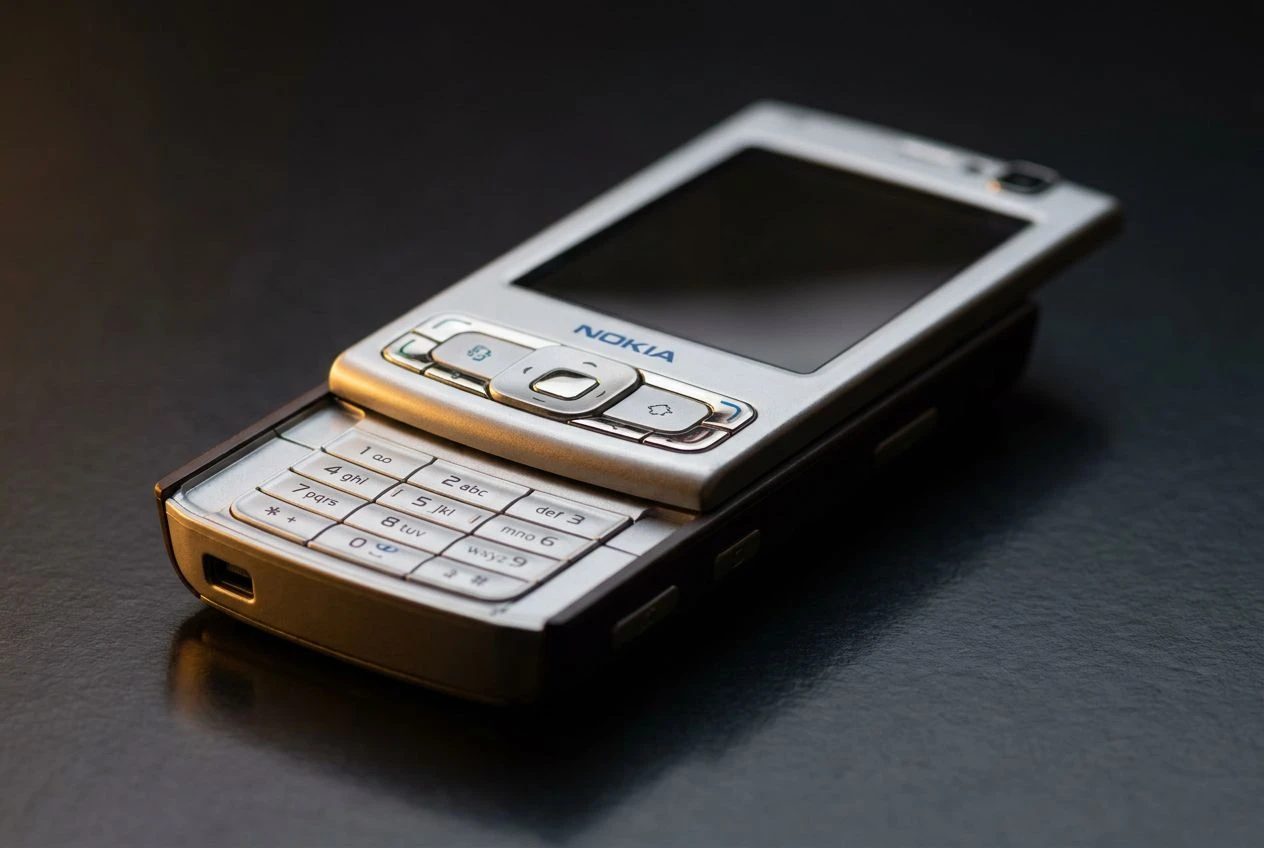
The company’s flagship in that period, the Nokia N95, shipped with a 5-megapixel camera, GPS navigation, Wi-Fi, and 3G data connectivity. According to a 2019 business history analysis of Nokia’s loss of market dominance in mobile phones, Nokia’s peak global market share reached 39% in early 2008 and the company remained the global handset leader until the second quarter of that year. On raw hardware metrics, the dominance looked durable.
When the Terrain Shifted
Apple’s iPhone launched in June 2007 with a 3.5-inch capacitive touchscreen and no physical keyboard. Nokia’s smartphone market share that year was around 50%. Apple’s was 5%. From the outside, it looked like a premium niche product from a computer company with no carrier relationships and no prior phone hardware experience at volume.
The iPhone’s hardware specifications were not its competitive advantage. Its camera was inferior to the Nokia N95. Its battery life was shorter. But iOS was designed from scratch for touch input, and in 2008 Apple launched the App Store, giving developers a single distribution channel with a clear revenue model and giving consumers a place to find and install software in a few taps. Nokia’s equivalent, Ovi Store, did not arrive until 2009.
Inside Nokia, CEO Olli-Pekka Kallasvuo, who led the company from 2006 to 2010, built an environment of increasing internal pressure as competitors gained ground. Multiple retrospective accounts describe a culture that stifled the experimental thinking the situation demanded. The hardware teams kept shipping. The software gap kept widening.
Our competitors aren’t taking our market share with devices; they are taking our market share with an entire ecosystem.
Stephen Elop, Nokia’s chief executive, wrote those words in an internal memo to staff in early February 2011. By then, Nokia was four years removed from the iPhone’s launch and had not shipped a product that matched its user experience.
The Symbian Trap
Built for an Earlier Era
Symbian was a technically sophisticated piece of engineering for its time. Its EKA2 microkernel could run both critical phone functions and user applications on the same processor core, a necessary property when ARM chips were expensive and multi-core mobile hardware was years away. The OS managed power consumption tightly enough to extend battery life on devices with limited capacity.
The architecture was frozen around the constraints of the late 1990s. Nokia had co-developed Symbian targeting hardware with just 1MB of RAM, and the resulting codebase required programmers to write Nokia’s proprietary variant of C++, with custom memory management, its own string class, and error-handling conventions that did not resemble standard C++ practice. Carbide.c++, Nokia’s Eclipse-based integrated development environment (IDE), was widely described by external developers as hostile to outsiders and requiring extensive configuration before a basic application would compile.
When Apple’s touchscreen phone launched in the summer of 2007, Nokia’s active Symbian platform, Series 60 3rd Edition, had no touchscreen support at all. The rushed attempt to add touch capabilities produced unstable, laggy software on subsequent devices. Nokia’s N8, released in 2010 and marketed directly against the iPhone, ran an improved Symbian 3 platform and still drew criticism for its unintuitive interface and slow performance relative to iOS and Android devices of the same period.
The Developer Exodus
Nokia had held an alternative path and chose not to take it. Its N770 Internet Tablet, released in 2005, and the N800 that followed it both ran a Linux-based operating system with touchscreens and modern interfaces. Internal resistance from the Symbian organization blocked those devices from including SIM cards, preventing them from functioning as phones. Without carrier distribution, they were media curiosities. Meanwhile, Google’s Android team was reportedly using Nokia’s N800 as development hardware while building the platform that would ultimately displace Symbian worldwide.
Nokia acquired full ownership of Symbian Ltd in June 2008, attempting to shore up the platform by open-sourcing it. The investment was substantial. The market share data moved in the opposite direction.
| Dimension | Symbian | iOS | Android |
|---|---|---|---|
| Primary language | Nokia-specific C++ dialect | Objective-C / Swift | Java / Kotlin |
| App distribution | Ovi Store (launched 2009) | App Store (launched 2008) | Android Market (launched 2008) |
| Touchscreen support | Added 2008, unstable | Native from launch | Native from launch |
| OS update model | Device-dependent, carrier-gated | Direct OTA from Apple | OEM-controlled |
Symbian’s global smartphone OS share slid from 39% in Q3 2010 to 31% in Q4 2010, the quarter Android overtook it worldwide. The platform had been the most widely used smartphone OS on the planet just months earlier.
The Burning Platform Memo
Stephen Elop became Nokia’s chief executive in September 2010, arriving from Microsoft where he had led the Office division. He was Nokia’s first non-Finnish CEO, and his appointment came when Nokia’s overall mobile market share had already fallen to 28.2% in Q3 2010, its lowest point since 1999.
His internal memo to staff was leaked by Engadget on February 8, 2011. It described Nokia’s position through the image of an oil worker forced to choose between burning alive on a platform or jumping 30 meters into the freezing North Sea. The memo did not spare the company’s self-image: it acknowledged that Android had overtaken Symbian in smartphone volumes and that Nokia still had nothing close to the iPhone’s user experience, four years after launch.
Three days after the leak, Nokia announced it would adopt Microsoft’s Windows Phone OS as its exclusive smartphone platform, abandoning Symbian and MeeGo, a Linux-based system Nokia had been co-developing with Intel.
The partnership failed. During Elop’s tenure, Nokia’s smartphone market share fell from 33% to 3% and its stock dropped 62%, with a cumulative EUR 4.9 billion in losses. The terms of the September 2013 transaction, filed with the SEC by Microsoft, set the total at EUR 5.44 billion.
- EUR 5.44 billion: total paid in September 2013 (EUR 3.79 billion for the Devices and Services business, EUR 1.65 billion for a 10-year patent license)
- $7.6 billion: Microsoft’s write-down on the Nokia acquisition in 2015, accompanied by 7,800 job cuts
- $350 million: price received for the remaining feature phone business, sold to HMD Global and FIH Mobile in 2016
How Apple and Google Built the Lock-In
Nokia’s engineers understood the App Store model by 2009 and tried building an equivalent through Ovi Store. It launched more than a year after the App Store, never achieved comparable developer volume, and the gap between the platforms widened through 2011.
Apple’s advantage compounded through a specific loop. The App Store in 2008 gave developers a single distribution channel with a clear revenue model. That attracted developers. Developer volume attracted consumers. Consumer lock-in on iOS justified further developer investment each year, deepening the platform with each cycle.
Google won through a structurally different mechanism. By releasing Android as free and open-source software, Google gave every phone manufacturer a smartphone platform with no licensing cost. Samsung, LG, HTC, Huawei, and dozens of others joined. Hardware competition between Android OEMs (original equipment manufacturers) drove prices down and distribution up. By late 2010, Android had overtaken Symbian in global smartphone volumes despite launching commercially only in late 2008.
Three structural gaps Nokia could not close:
- Single app marketplace: iOS and Android each offered one distribution destination for developers; Symbian’s ecosystem fragmented across device types and screen resolutions, with apps often incompatible between device families
- Free developer tooling: Apple’s Xcode and Android’s development kit lowered the cost of building apps to near zero; Symbian’s toolchain added weeks of proprietary-language learning and setup for any developer arriving from outside the Nokia ecosystem
- OEM coalition: Android’s open model let dozens of manufacturers share software development costs; Nokia’s exclusive commitment to Windows Phone left it as the near-sole hardware maker for a platform that neither consumers nor developers prioritized
Nokia After Phones
The company that completed the sale of its handset business to Microsoft in April 2014 is now a telecommunications infrastructure provider. Following the transaction, Nokia retained its network equipment arm and a patent licensing operation. The HERE Maps business was sold to a consortium of German automakers shortly after. Nokia built its future around carrier connectivity and network infrastructure.
Under CEO Pekka Lundmark, who stepped down in early 2025, Nokia re-established competitive standing in 5G radio access networks and grew in private wireless. At Nokia’s Capital Markets Day in November 2025, the company announced a reorganization into two primary operating segments effective January 2026, with its Network Infrastructure business positioned to capture data center and AI compute demand. Justin Hotard, Nokia’s current chief executive, created a dedicated Technology and AI Organization in October 2025.
In February 2025, Nokia closed its acquisition of Infinera Corporation, a San Jose-based optical networking company, expanding its capacity in the data infrastructure markets that AI deployment is driving. The mobile phone operation that once made Nokia Europe’s most valuable company is absent from that picture entirely.
Frequently Asked Questions
Why Did Nokia Fail to Adopt Android?
Nokia was offered Android in the platform’s early days but declined, concerned that joining Android would make it one of many interchangeable hardware makers competing primarily on cost against Samsung. When Stephen Elop took over in 2010, he chose Windows Phone instead, citing the opportunity for differentiation. The Lumia line that followed held over 83% of Windows Phone sales at its peak but never converted that position into a viable share of the broader smartphone market.
What Was Symbian OS?
Symbian OS was a mobile operating system first released in 1999, developed through a consortium that included Nokia, Ericsson, Motorola, and Psion. Nokia acquired full ownership in 2008. It was the world’s most-used smartphone OS through the end of 2010, built around an efficient but developer-hostile codebase that required Nokia’s proprietary C++ dialect. By 2013, Nokia had ended Symbian development entirely and focused on Windows Phone.
What Was Nokia’s Burning Platform Memo?
The burning platform memo was an internal communication written by Nokia CEO Stephen Elop in early February 2011 and leaked publicly on February 8 of that year. It compared Nokia’s competitive position to a worker on a burning oil platform forced to jump into the freezing North Sea to survive. The memo acknowledged that Android had overtaken Symbian in smartphone volumes and that Nokia had not shipped a product close to the iPhone’s experience four years after launch. Three days later, Nokia announced its exclusive partnership with Microsoft’s Windows Phone platform.
How Much Did Microsoft Pay for Nokia’s Phone Business?
Microsoft agreed to pay EUR 5.44 billion in total: EUR 3.79 billion for Nokia’s Devices and Services business and EUR 1.65 billion to license Nokia’s patent portfolio for 10 years. The transaction closed in April 2014. In 2015, Microsoft wrote down $7.6 billion related to the acquisition and cut 7,800 jobs. The following year it sold the remaining feature phone business to HMD Global and FIH Mobile for $350 million.
What Is Nokia Doing Today?
Nokia is now a telecommunications network infrastructure company, supplying 5G radio access networks, core network software, and optical networking equipment to carriers, enterprises, and data center operators globally. Nokia Bell Labs, the company’s research arm, works on 6G technology and advanced networking. Nokia’s strategy, as articulated at its Capital Markets Day in November 2025, targets the AI-driven transformation of global networks and next-generation data infrastructure.
Could Nokia Have Survived the Smartphone Shift with a Different Strategy?
Industry analysts and former Nokia executives debate this. Adopting Android early would have provided a competitive smartphone platform, but Nokia would have competed directly with Samsung and HTC on hardware cost and scale. The internal alternative most seriously considered was MeeGo, a Linux-based OS built with Intel. The one MeeGo device shipped, the Nokia N9, received strong critical reviews in 2011 but was discontinued almost immediately after the Microsoft partnership was announced, leaving the counterfactual unresolved.
When Did Nokia’s Smartphone Market Share Collapse?
Nokia’s smartphone market share peaked at roughly 50% during its years of mobile dominance, then declined progressively as iOS and Android gained ground through 2008 and 2009. By late 2010, Android had overtaken Symbian in global volumes. At the start of Stephen Elop’s tenure in September 2010, Nokia held roughly 33% of the global smartphone market. By the time Microsoft acquired the Devices and Services unit in 2013, that share had fallen below 5%.


AMD’s Data Center Revenue Jumps 57% as Its Stock Bets on Execution

Microsoft Loses an Xbox Lawsuit Just as Sony Kills Physical Discs

Bethesda Union Says HR Tore Down Its Memorial for Laid-Off Staff

Google Pixel 11 Pro Fold Price Leaks Point Toward a $2,000 Foldable

Smart Scales Promise Lab-Grade Body Fat Numbers, and the Science Pushes Back

Amap’s Ride-Hailing Hits 1,000 Cities Amid Security Warnings

Ulys’s Automatic Toll Billing Draws Scammers to 7 Million Drivers

Google’s Veo AI Video Tools Threaten VFX Jobs Far Beyond Hollywood

Music Industry Unveils AI Labels, but Streaming Giants Haven’t Signed On

Apple Sues OpenAI and Two Ex-Employees Over Stolen Trade Secrets

Microsoft Xbox Layoffs Start in July as Sharma Slams 3% Margin

Google Search Profiles Build a Follow Graph Inside Discover

Google DeepMind and A24 Sign $75 Million AI Partnership Deal

Oracle Cuts 21,000 Jobs in a Year, Cites AI in 10-K Filing

OCC Issues AML Consent Order Against Wise and Crypto.com Sponsor Bank

DGO App Brings Rs 549 Mobile Pass for FIFA World Cup 2026 in Nepal

Oppo’s ColorOS 17 Eligibility List Leaves A-Series Buyers Behind

Anthropic Tells Senators Alibaba Ran the Largest Claude Distillation Attack

Apple Strikes Preliminary Deal For Intel To Make iPhone And Mac Chips

Google Home Spring Update Adds Gemini 3.1 And Old Nest Cam AI
-
 GAMING1 month ago
Microsoft Xbox Layoffs Start in July as Sharma Slams 3% Margin
-
 NEWS1 month ago
Google Search Profiles Build a Follow Graph Inside Discover
-
 AI3 weeks ago
Google DeepMind and A24 Sign $75 Million AI Partnership Deal
-
 AI2 weeks ago
Oracle Cuts 21,000 Jobs in a Year, Cites AI in 10-K Filing
-
 CRYPTO2 months ago
OCC Issues AML Consent Order Against Wise and Crypto.com Sponsor Bank
-
 APPS1 month ago
DGO App Brings Rs 549 Mobile Pass for FIFA World Cup 2026 in Nepal
-
 NEWS1 month ago
Oppo’s ColorOS 17 Eligibility List Leaves A-Series Buyers Behind
-
 AI2 weeks ago
Anthropic Tells Senators Alibaba Ran the Largest Claude Distillation Attack