
AI
AI Found 800 Never-Seen Cosmic Anomalies in Hubble’s 35-Year Archive
AI tools trained on laptops are pulling 800 never-seen cosmic anomalies from Hubble’s 36-year archive, while a 500-petabyte data flood heads for astronomy.

AI in astronomy has quietly been finding new galaxies in 35-year-old data on modest hardware. An ESA neural network called AnomalyMatch pulled about 1,300 cosmic anomalies out of nearly 100 million Hubble image cutouts in just 2.5 days, and more than 800 of them had never appeared in scientific literature. At Oxford, an AI tool called the Virtual Research Assistant cut the astronomer workload for hunting supernovae by 85 per cent, trained on 15,000 examples on a single laptop. The bigger story sits behind those numbers.
AI is already delivering discoveries today from data the field already had, before Vera C. Rubin Observatory and other giants reach first light. Rubin’s 10-year Legacy Survey of Space and Time is expected to generate around 500 petabytes of images, while the next telescopes will produce more alerts in a single night than ATLAS does in a year. Astronomers at Birmingham, Oxford and the European Space Agency say the next breakthroughs will not need the biggest model: a lean tool, domain expertise, and an old archive are doing most of the work right now.
Finding 800 New Cosmic Anomalies in a 36-Year Archive
The Hubble Space Telescope’s archive now stretches back 35 years, and astronomers keep finding new things inside it. In early 2026, the AI tool that surfaced 800 new cosmic anomalies in Hubble data, called AnomalyMatch and trained by ESA researchers David O’Ryan and Pablo Gómez, ran systematically across the Hubble Legacy Archive for the first time. In 2.5 days the algorithm inspected approximately 100 million image cutouts and returned a ranked list of likely anomalies. O’Ryan and Gómez personally checked the highest-scoring candidates, and more than 1,300 of those were confirmed as true anomalies. More than 800 had never been documented in scientific literature.
What turns up in 35 years of Hubble? Mostly galaxies in the middle of merging or interacting, often trailing elongated tails of stars and gas. The list also includes gravitational lenses, where a foreground galaxy bends and magnifies the light of a more distant one. The team identified jellyfish galaxies with long gaseous tentacles, edge-on planet-forming disks whose silhouette looks like a hamburger, and 2 collisional ring galaxies. Several dozen of the finds, ESA said, simply defy existing classification schemes.
AnomalyMatch is not the typical pattern-recognition tool. It is a semi-supervised learning system designed for extreme class imbalance, where the rare objects of interest are vastly outnumbered by the mundane ones. According to the paper in Astronomy & Astrophysics, the model needs only a small number of labelled examples to start making high-confidence predictions, with active learning built into the loop so expert astronomers can flag and feed back immediately. The team expects the same approach to scale to Euclid and other surveys not yet searched systematically. ESA calls the Hubble run the first comprehensive systematic anomaly search of any space telescope archive.
AnomalyMatch in numbers:
- 1,300+ anomalies confirmed by O’Ryan and Gómez
- 800+ objects never documented in scientific literature
- ~100 million Hubble image cutouts inspected
- 2.5 days for the full archive sweep
- 35 years of Hubble imagery mined
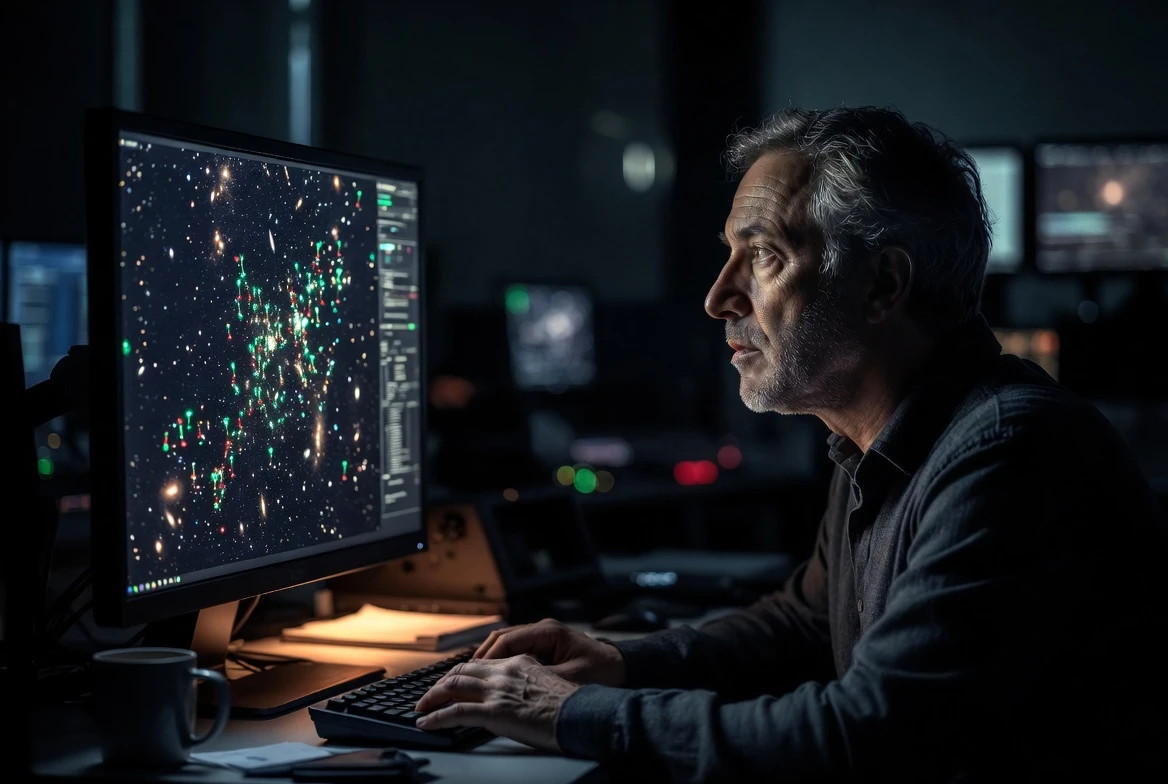
How a Neural Network Read 100 Million Cutouts in 2.5 Days
At the scale of an archive this large, even the most eagle-eyed human search falls behind. Astronomers traditionally find rare objects two ways: by inspecting small slices of data by hand, or by spotting them by chance in another study. Both routes are subjective, both are slow, and neither scales to the Hubble Legacy Archive. AnomalyMatch inverts that pipeline.
The bottleneck is not the model, it is the human review at the end. AI tools like AnomalyMatch can sort roughly 100 million sources down to a few thousand, and then trained scientists go back over the highest-ranked candidates. Galaxy Zoo and other citizen-science platforms have given the field a way to multiply human eyeballs across millions of images, but the Hubble archive is still too vast. Even Galaxy Zoo: Weird and Wonderful, a project designed to formalize the line between ‘interesting’ and ‘non-interesting,’ can suffer from subjectivity when judging what counts as truly anomalous. Theirs is the first systematic effort to apply a machine learning model to the whole archive at once.
Speed is the other large payoff. The paper in Astronomy & Astrophysics reports that searching the entire Hubble archive using AnomalyMatch takes 2 to 3 days, running on a single GPU. A thorough manual sweep would be measured in years. Tools like this will be essential, ESA said, for the volume of incoming data from Euclid, the Roman Space Telescope, and Rubin.
| Method | Scale per session | Time to cover the Hubble archive | Reliability on rare objects |
|---|---|---|---|
| Manual inspection by trained astronomers | A few thousand images | Years of dedicated effort | High accuracy, but subjective and inconsistent |
| Citizen-science projects (Galaxy Zoo) | Millions of images | Years of distributed effort | Variable; prone to subjective definitions of ‘interesting’ |
| AnomalyMatch neural network | ~100 million cutouts | About 2.5 days | Experts manually confirm top-ranked candidates |
85% Less Work, Trained on a Laptop
At the University of Oxford, astrophysicist Héloïse Stevance and colleagues are looking for the opposite problem: too few real signals lost in a flood of noise. The Asteroid Terrestrial Impact Last Alert System, ATLAS, is a NASA-funded network of five telescopes that scan the visible sky every 24 to 48 hours. The survey produces millions of potential alerts each night, mostly noise from instrumental artefacts or previously catalogued objects. Even after automated image analysis, between 200 and 400 candidate transients per day still needed to be inspected by hand. ‘Manual verification would take several hours each day,’ Stevance said.
The Virtual Research Assistant, or VRA, replaced most of that human sifting. Stevance’s team trained it not on a supercomputer but on a researcher’s laptop, using 15,000 hand-picked examples. That combination, a Virtual Research Assistant that cut supernova searching by 85%, does not use a data-hungry deep neural network. It runs on smaller decision-tree algorithms designed to look at specific features in the data and rank alerts by how likely they are to be real extragalactic explosions, while letting astronomers inject their own expertise into the model.
The first year was the test. The VRA filtered more than 30,000 alerts while missing fewer than 0.08 per cent of real supernovae and retaining more than 99.9 per cent of the genuine candidates. That cut the workload that fell to human eyeballers by about 85 per cent. Since December 2024 the VRA has been linked to the South African Lesedi Telescope, which means it can now trigger follow-up observations on the most promising candidates before a human ever reviews them.
The surprising thing is how little data it took. With just 15,000 examples and the computing power of my laptop, I could train smart algorithms to do the heavy lifting and automate what used to take a human being hours to do each day.
Héloïse Stevance, lead researcher on the Virtual Research Assistant at the University of Oxford, said this in marking the publication of her team’s paper in The Astrophysical Journal in September 2025.
The 500-Petabyte Wave Headed for Astronomers
The next decade of astronomy is going to look very different from the last one. The Vera C. Rubin Observatory released its first 10 hours of cosmic imagery in June 2025 from its perch on Cerro Pachón in Chile. The 8.4-metre Simonyi Survey Telescope at Rubin’s heart holds the LSST Camera, the largest digital camera ever built, at 3,200 megapixels. Once the 10-year Legacy Survey of Space and Time reaches full operations, Rubin will take about a thousand images of the southern sky every night, covering the entire visible southern sky every three to four nights.
The volumes are different from anything the field has handled. Rubin will generate about 20 terabytes of data per night, adding up to roughly 500 petabytes over the survey’s lifetime, more than every previous optical observatory combined. ESA’s Euclid, working in parallel, is already surveying a third of the night sky across billions of galaxies, having begun its main mission in 2023. NASA’s Nancy Grace Roman Space Telescope is scheduled to launch no later than May 2027. Each new dataset is larger, deeper, and faster than the last.
For Stevance and her colleagues, the implications for supernova hunting are immediate. The LSST is expected to deliver more than 10 million alerts per night, ranging from asteroids and supernovae to matter falling onto black holes and possibly new classes of object that have no name yet. The current ATLAS pipeline filters millions of nightly alerts by hand after a series of automatic cuts, leaving 200 to 400 candidates a day. Without tools like the Virtual Research Assistant, the legacy survey would be impossible for human reviewers to keep up with. Stevance is now building VRAs for LSST data brokers Lasair and Fink at Oxford and elsewhere, with the stated longer-term ambition of bots that pre-emptively hunt for supernovae by predicting where and when they will explode.
That is also why the U.S. National Science Foundation and the Simons Foundation announced two $20M AI research institutes to seed the field. The NSF-Simons AI Institute for the Sky, SkAI, will receive $20 million over five years, split evenly between the two funders, and is led by Northwestern University. A second institute, NSF-Simons CosmicAI, led by the University of Texas at Austin, will accelerate simulation work such as the chemistry inside stars. Both will train early-career researchers, build online courses, and run summer schools designed to spread AI literacy through astronomy.
The NSF director Sethuraman Panchanathan, announcing the institutes, said the data from Rubin and other surveys is ‘simply too vast and rich to be fully explored with existing methods.’ The SkAI Institute, he said, is meant to democratize access to that data by developing a powerful AI-based assistant that gives accurate scientific answers to queries. The Simons Foundation’s David Spergel, himself an astrophysicist, added that the rich open data sets of astronomy make it an ideal place to test what AI can do across other sciences. SkAI’s stated mission covers everything from neutron stars and black holes to galaxy formation and the role of dark matter and dark energy across the Universe.
- Vera C. Rubin Observatory (NSF-DOE, Chile). 8.4-metre Simonyi Survey Telescope, 3,200-megapixel LSST Camera, about 20 TB per night, roughly 500 PB total over 10 years. First imagery released 23 June 2025.
- Euclid (ESA, with NASA contribution). Wide survey of one-third of the night sky across billions of galaxies; main mission began in 2023.
- Nancy Grace Roman Space Telescope (NASA, with ESA as Mission of Opportunity). Scheduled to launch no later than May 2027.
Why Specialists, Not ChatGPT, Are Doing the Work
What none of those breakthroughs use, so far, is a chatbot. The AI tools behind the headline numbers of 2025 and 2026 are narrow, domain-specific models rather than general-purpose large language systems from companies like Anthropic and OpenAI. Stevance’s Virtual Research Assistant runs decision-tree algorithms trained on 15,000 hand-curated examples. AnomalyMatch uses semi-supervised learning plus active learning to flag anomalies with minimal labelled data. Both rely on a human expert sitting in the loop, not on a foundation model scraping the public web.
That is not a criticism of generative AI. It just sets the boundary of where the breakthroughs are landing. Per the Financial Times, Amaury Triaud, an exoplanet researcher at the University of Birmingham, sees generative tools helping astronomers with research-adjacent tasks: designing instrument interfaces, collaborating with international teams, and aligning telescope mirrors. Other Birmingham astronomers, per the same report, use AI emulators to handle stellar evolution models and exoplanet atmospheres. The emulators, once trained, can evaluate a model in less than a millisecond, where traditional code takes much longer. The scientific discovery itself, the part that earns the press release, is still the work of purpose-built, narrow models.
AI’s First Wins Came From Data Already in Hand
Pull those threads together and the shape of the current moment in astronomy looks different from the version most often pitched. The headline wins of late 2025 and early 2026 are not the next generation of telescopes. They are the existing archives, the modest training sets, the lean algorithms, and the laptop. AnomalyMatch found 800 newly documented objects in Hubble imagery that had been sitting in the Hubble Legacy Archive the whole time.
That is not a comment on whether Rubin will be valuable. The opposite is closer to true. When the 10-year sky movie starts flowing from Cerro Pachón, the AI that knows how to read it will be the difference between discovery and noise. The pattern in 2025 and early 2026 is that the leap in capability arrived first in the older data, not the newer. Gómez, per the Financial Times, said the team ran the whole Hubble search on a single GPU in a few days, not on 100,000 GPUs burning gigawatts, and the same line of argument applies to the Oxford decision trees.
For the next twelve months, the question is how the new institute money translates into working tools. The NSF-Simons AI Institute for the Sky at Northwestern and its sibling CosmicAI at UT Austin each get five years of funding, summer schools, and a remit to train an AI-literate generation of astronomers. The bottlenecks are well known: training data, reusable benchmarks, and tools that can be picked up by someone other than the team that built them. By the time Vera Rubin hits full survey operations, the field will have AI assistants designed for the data and for the daily life of the astronomer handling it.
Stevance’s next set of VRAs is the kind of build-out to watch. She is building AI bots for the UK’s Lasair and the European Fink LSST data broker streams, with the stated longer-term ambition of bots that pre-emptively hunt for supernovae by predicting when and where they will explode, before the explosion actually happens. The same pattern that surfaced 800 new objects in Hubble data is going to have to scale to a 10-year sky movie without losing what made the lean tools work. The alternative is the opposite, a river of alerts with no one at the gate. ‘In its first year alone, it will capture more data than every survey ever,’ Stevance said of the Legacy Survey of Space and Time.


South Korea Retail Investors Face Reckoning After KOSPI AI Rally Collapses

Surrey AI Maps Three Heart Attack Paths and Their Molecular Roots

Germany Locks Neutral Apple ATT Prompts Across Most of Europe

Apple’s 5% EU Fee Quietly Rewrites Alternative App Store Math

Apple’s EU Fee Truce Cuts Complexity but Leaves Rivals Fuming

Pixel 11 Pro Fold Trades Thinness for Durability and Seven-Year Stay

Mayo AI Flags HCM Obstruction From Everyday Ultrasound Videos

Indian Brands Quietly Scale Landmark Screens and Home Tech

Navin Vatsa Turns Grief Into a Lifetime of Quiet Seeing

Google Bets Pixel 11 Agentic AI Will Redefine Phones

Oracle Cuts 21,000 Jobs in a Year, Cites AI in 10-K Filing

Fable 5 and Mythos 5 Return as US Lifts Anthropic Export Controls

SpaceX’s Google Deal Turns a Rocket Company Into a Cloud Landlord

CD Projekt Red Co-CEO: Redemption Arc Isn’t Done, Witcher 4 in 2027

XPL Rallies 30% Ahead of Plasma One Card Tier Launch

Google Search Profiles Build a Follow Graph Inside Discover

DGO App Brings Rs 549 Mobile Pass for FIFA World Cup 2026 in Nepal

Moonshot AI Targets $30 Billion in China’s Fastest AI Funding Sprint

Oppo’s ColorOS 17 Eligibility List Leaves A-Series Buyers Behind

Microsoft Xbox Layoffs Start in July as Sharma Slams 3% Margin
-
 AI2 months ago
Oracle Cuts 21,000 Jobs in a Year, Cites AI in 10-K Filing
-
 AI2 months ago
Fable 5 and Mythos 5 Return as US Lifts Anthropic Export Controls
-
 AI3 months ago
SpaceX’s Google Deal Turns a Rocket Company Into a Cloud Landlord
-
 GAMING2 months ago
CD Projekt Red Co-CEO: Redemption Arc Isn’t Done, Witcher 4 in 2027
-
 CRYPTO2 months ago
XPL Rallies 30% Ahead of Plasma One Card Tier Launch
-
 NEWS3 months ago
Google Search Profiles Build a Follow Graph Inside Discover
-
 APPS2 months ago
DGO App Brings Rs 549 Mobile Pass for FIFA World Cup 2026 in Nepal
-
 AI3 months ago
Moonshot AI Targets $30 Billion in China’s Fastest AI Funding Sprint