
AI
Amazon’s Proteus Robot Turns Floor Work Into Prompts
Amazon’s next Proteus takes plain-language orders in Europe, folding a speech-driven control layer into a million-robot fleet and a 25,000-job pledge.

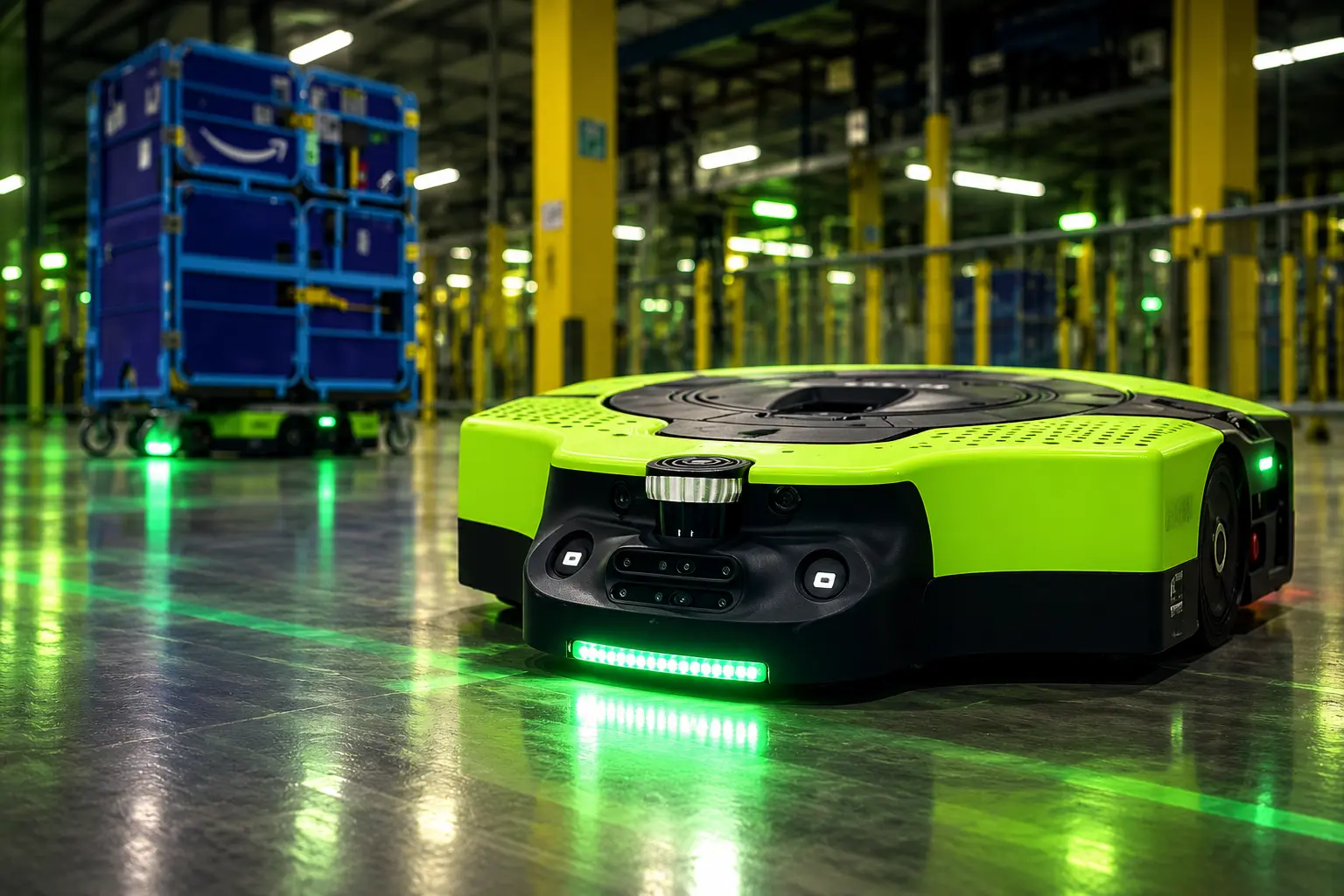
Amazon unveiled a next-generation Proteus robot on June 4, 2026 that takes a plain-language order and then sets its own route. The cart-mover was the centrepiece of the company’s Delivering the Future event in London, inside a plan to put more than €10 billion into European fulfillment centres and add 25,000 jobs.
The lasting product is the control layer. A worker types or says a task, and software assigns priority, path, and timing across a floor that already holds more than a million machines.
Workers Can Now Talk a Cart Across the Floor
First-generation Proteus already hauls carts of close to 400 kilograms through dock areas at 25 U.S. fulfillment centres. It is Amazon’s first fully autonomous mobile robot, meaning it does not need floor barcodes or a fenced lane. Scott Dresser, vice president of Amazon Robotics, has described its safety logic as a bubble around the vehicle that slows or stops when a person steps in.
The new unit leaves the dock. Amazon says it can run anywhere items need to move: inbound containers, workstation transfers, fulfillment floors, and delivery sites. The other change is the interface. Company pages describe next-generation Proteus with natural language commands, with no technical commands and no programming screen. On the Europe announcement page, those orders are conversational text-based prompts. Tye Brady, Amazon’s chief technologist, framed the same layer as speech, using an example of a worker saying, “Hey Proteus, could you take this to the corner of the building?”
You tell it what needs to be done. It figures out the priority, the route, the timing. It becomes your assistant for material movement.
Scott Dresser, vice president of Amazon Robotics, at Amazon’s Delivering the Future event in London
Brady said the upgrade rests on a new AI architecture that uses Amazon’s generative and agentic systems. That is the shift the three named robots are built around. Hardware still lifts. Software now decides what gets lifted next.
Amazon posted the Europe package the morning of the London show.
TODAY: Amazon just announced a multi-year plan to invest over €10 billion to expand and modernize its European fulfillment centers, including hiring 25,000 new employees. The investment will include the launch of a next-generation autonomous robot and the expansion of systems… https://t.co/wn3yw5tfVo
— Amazon (@amazon) June 4, 2026
Just over 4,000 first-generation Proteus units are already in those 25 U.S. sites. The next-generation machine is still in Amazon’s labs. European deployment is booked for the first half of 2027. Amazon’s own robotics round-up also says wider deployment is slated in the months ahead, a shorter window that appears to cover testing and U.S. sites rather than the Europe date.
A Million Robots Already Share One Brain
Proteus is one species in a fleet Amazon has built since it bought Kiva Systems in 2012. The company says it has now deployed more than 1 million robots across its network. The official lineup counts nine types, from Sequoia’s inventory sortation to Cardinal, a packing-dock arm that handles packages up to 50 pounds.
THE FLEET UNDER THE LANGUAGE LAYER
- DeepFleet: A generative AI foundation model Amazon compares to city traffic control, built on inventory-movement data and AWS SageMaker, and credited with a 10% cut in robot travel time.
- Project Eluna: An agentic AI model meant to help operators design safer, tighter workflows, the sibling of Proteus’s new task language.
- Hercules and Titan: Drive units that still read floor markers in restricted zones; Hercules lifts up to 1,250 pounds, and Titan lifts twice that load on bulkier goods.
- Shreveport template: The 2024 Louisiana robotics center that Amazon is copying into later large-format sites, including every U.S. large-format launch in 2026.
Brady, speaking in London, said the company is still early in that portfolio. The loop he described is blunt: deploy, learn, improve, then expand what the machines can do. A language prompt on Proteus is how a person joins that loop without a robotics console. The spoken and typed orders also turn floor staff into a live data source, the same pattern other shops chase when they put sensors on warehouse workers feeding data to physical AI.
Natural language is becoming the API for the physical fleet. Humanoid demo videos still get the airtime. Amazon already runs a million machines that pick, stow, sort, and haul, and it just taught one of them to take a sentence.
Barcelona’s Tote Lifter Is Going Continent-Wide
The London event did not only refresh Proteus. Two other systems are the European proof that the control layer will have more than one pair of hands. STARK is a collaborative tote handler, born from an operations employee’s idea in Spain, that lifts full totes off conveyors and sets them on carts. Armin Cossmann, vice president of operations for Europe, called it the first successful collaborative-robot deployment in Amazon’s fulfillment network, with people and machines in the same process in the same space. Vulcan, first built for Spokane, Washington, is the company’s first robot with a sense of touch. It now handles more complex picks at the Hamburg site in Germany, grabbing high and low pod rows so people stay in the mid-thigh to mid-chest power zone. Amazon says it can pick and stow about three-quarters of the item types stored in those buildings.
THREE MACHINES IN THE EUROPE PLAN
| Robot | Floor job | Where it started | Europe plan |
|---|---|---|---|
| Next-gen Proteus | Moves heavy carts on language orders, anywhere on site | Labs now; first-gen at 25 U.S. sites | First half of 2027, starting at LCY3 in Dartford |
| STARK | Lifts full totes from conveyors onto carts | Barcelona pilot, from a Spanish operations idea | 15 European sites by 2027 |
| Vulcan | Picks and stows with vision plus touch in packed pods | Spokane, then Hamburg | More European sites after Hamburg |
Cossmann said the transformation is meant as a step-change in how Amazon supports employees and serves customers, and that customer expectations are not slowing down. STARK’s 15-site map is the nearest dated commitment. Proteus is later and still lab-bound. Vulcan is already on a German floor.
Amazon Pledged 25,000 Jobs With the Machines
The robotics pages lead with people. Amazon says it will grow its European fulfillment-centre workforce by 25,000 over the coming years, and that robotics has already created reliability, maintenance, and engineering roles. Dresser put Europe at the centre of the next chapter of operations, naming the investment, the talent, and the technology being deployed there. In 2025 the company invested more than €60 billion across Europe, its largest annual total in the region, and says it now supports more than 1.5 million jobs on the continent: 230,000 Amazon employees, more than 400,000 contractors and seasonal staff, and more than 600,000 roles tied to 200,000-plus European small businesses that sell through the site.
Training is the other half of that pitch. Amazon is committing a $1 billion Career Choice training pledge by 2030, inside its $2.5 billion Future Ready 2030 program. More than 300,000 employees have already used Career Choice, including 30,000 in the UK, and the new money is meant to train another 500,000. Europe alone is down for more than €30 million in Career Choice spend in 2026. John Boumphrey, Amazon’s UK country manager, said the company could not find enough skilled people for the roles it needs, so it decided to develop them itself.
WHERE CAREER CHOICE IS BEING POINTED
- Cybersecurity: Fully funded courses aimed at security work Amazon says it cannot hire fast enough.
- Software development: Training for code roles as agentic tools spread from the warehouse into the rest of operations.
- Logistics: Pathways that keep hourly staff inside the network rather than only on the pick line.
- Renewable energy: Classes tied to the company’s climate-pledge operations, not the robot floor.
- Mechatronics: The closest match to the new fleet, mixing mechanical work with the electronics that keep Proteus, STARK, and Vulcan running.
Dresser has separately said Amazon has upskilled more than 700,000 employees since 2019 through a wider set of programs, a larger bucket than Career Choice alone. At the Shreveport robotics centre, he said advanced robotics required 30% more people in reliability, maintenance, and engineering. That is the headcount Amazon wants associated with the machines: fewer strained backs, more people who can recover a robot that throws a camera lens.
The Robotics Team Already Counted Skipped Hires
The Europe job pledge sits beside a colder U.S. spreadsheet. Internal Amazon robotics documents that circulated in 2025 put the near-term figure at more than 160,000 U.S. roles the company would otherwise need by 2027 if volume grew without more automation. The same cache described a longer target: hold U.S. headcount roughly flat while sales double by 2033, which would translate to more than 600,000 people Amazon did not hire. The robotics team’s stated aim was to automate 75% of operations. The documents put the saving at about 30 cents on each item picked, packed, and delivered, and at $12.6 billion from 2025 to 2027. They also discussed softer language, swapping “robot” for “cobot” and “automation” for “advanced technology.”
Amazon rejected that reading. A spokesman said leaked documents often paint an incomplete and misleading picture of its plans, and that this was such a case. The company has said the 600,000 figure came from one team that is not in charge of hiring, and that it was still hiring at operations sites.
WHERE EXPERTS DISAGREE
- Amazon’s public line: Robotics creates new technical jobs and the Europe plan adds 25,000 fulfillment roles, with Career Choice paying tuition even when people leave.
- The 2025 robotics papers: The U.S. network can skip more than 160,000 hires by 2027 and keep headcount flat toward 2033 even if volume doubles.
- Outside economists: Daron Acemoglu, the Nobel-winning economist, warned that if Amazon hits its automation goal, one of the biggest U.S. employers becomes a net job destroyer. Paul Miller, a vice president at Forrester, countered that robots create jobs in maintenance and in work that only exists once automation lowers the cost of a task, while adding that some people still get hurt in the shift.
Those two books can both be true in the same quarter. Europe can add 25,000 fulfillment jobs while the U.S. robotics model counts hires it no longer needs. The language layer makes that split easier to run. Once a task is a sentence, it can be handed to a person in Hamburg or to a cart in Dartford without rewriting the floor code.
Why a Talking Cart Still Needs a Human
The London site visits around the June event showed the limit. At LCY3, the 2-million-square-foot Dartford fulfillment centre on the Thames, Proteus units still fail in a mundane way: items fall off the pods they carry. An amnesty responder hits a button, the floor ballet pauses, the person walks in and picks up the stray object, and the robots start again only after that person leaves the arena. Collisions are rare, and they usually cost a camera lens that a mechanic swaps on the spot.
Travis Hearn, a QA engineer at BOS27, Amazon’s robot lab in Westborough, Massachusetts, put the design in one line: you put the robots where the people are, or the people where they are, and they get around you. That is the collaborative pitch. It is also why a language model does not retire the human in the loop. Someone still has to recover the fallen bottle. Someone still has to decide whether “the corner of the building” means dock 12 or the returns cage. Project Eluna is being sold as help for those operators. It does not remove them.
Brady rejects a people-versus-machines frame and says people with tools can do anything. The floor still votes with a pause button.
Dartford Gets Europe’s First Proteus in 2027
The next-generation cart has a calendar, not a press-release fog. Amazon has named the site and the half-year.
HOW THE FLEET GOT TO A SENTENCE
- 2012: Amazon buys Kiva Systems and starts the in-house robotics line that now exceeds 1 million machines.
- June 2022: Proteus debuts as the first fully autonomous mobile robot, built to slide under GoCarts and roam open dock floors.
- 2024: The Shreveport, Louisiana centre opens as the template for later robotics-heavy sites.
- 2025: Amazon marks its millionth robot, a Hercules unit sent to a Japan fulfillment centre, and publishes DeepFleet; Vulcan moves from Spokane to Hamburg.
- June 4, 2026: London’s Delivering the Future event pairs language-capable Proteus with STARK, Vulcan, more than €10 billion, and 25,000 jobs.
- First half of 2027: Next-generation Proteus is due at LCY3 in Dartford; STARK is due across 15 European sites.
Until that Dartford date, the speech-driven cart is a lab system with a European booking. The first-generation fleet keeps moving 400-kilogram loads in the United States. The argument Europe has to settle is not whether a robot can take a sentence. It is who still gets the next 25,000 jobs once the sentence is enough to run the floor.

Instagram Plus Tests a Read-Only Mode That Cuts Stories

Altman Asks the Public to Accept Some AI Harm

Google Freezes OSS VRP Product Reports After AI Flood

AI Agents Make Payment Rails the Scarce Prize

Turkey’s Crypto Boom Now Runs Through Three Banks

Fable 5 Came Back Under a Commerce On-Off Switch

Google’s SpaceX GPU Lease Has a Sept. 30 Deadline

Plasma One’s XPL Locks Face a 1.81 Billion Cliff

DGO’s Rs 549 World Cup Pass Cost Fans Sleep and Data

Moonshot AI’s $30 Billion Ask Became a $35 Billion Close
-
 AI4 months ago
Fable 5 Came Back Under a Commerce On-Off Switch
-
 AI5 months ago
Google’s SpaceX GPU Lease Has a Sept. 30 Deadline
-
 CRYPTO4 months ago
Plasma One’s XPL Locks Face a 1.81 Billion Cliff
-
 APPS4 months ago
DGO’s Rs 549 World Cup Pass Cost Fans Sleep and Data
-
 AI5 months ago
Moonshot AI’s $30 Billion Ask Became a $35 Billion Close
-

 NEWS5 months ago
ColorOS 17 Device List Spans Oppo, OnePlus and Realme
-

 GAMING4 months ago
Xbox Cuts 3,200 Jobs After Five Years of Thin Returns
-

 GAMING4 months ago
The RTX 4050 Under Rs 70,000 Hides a Wattage Gap