
AI
Anthropic Met With the White House. The Fable 5 Block Stays.
Anthropic and the Trump administration met in Washington Monday over the Fable 5 and Mythos 5 export controls. The restrictions were not lifted, and both sides say talks continue.

Anthropic and the Trump administration ended their first face-to-face meeting over the Fable 5 and Mythos 5 export controls on Monday in Washington without a deal, leaving the most powerful AI models from the ChatGPT rival shut off to every customer worldwide. An Anthropic spokesperson said the two sides were “working quickly to get this resolved,” the same language the company has used publicly since Friday. The restrictions, which a person close to the talks said neither side discussed lifting, are the second front in a fight between the AI lab and the White House that started at the Pentagon in February.
The Washington Meeting Ended Without a Deal
Trump administration officials met with Anthropic on Monday at the Commerce Department, with Commerce Secretary Howard Lutnick dialing in by conference call from the G7 summit in Evian, France. The meetings, which government researchers from the Center for AI Standards and Innovation attended, were led on the government side by the Office of the National Cyber Director, whose head, Sean Cairncross, did not participate in person, according to three people briefed on the discussions.
On Anthropic’s side, cofounder and chief compute officer Tom Brown and head of external affairs Sarah Heck led the talks. The company’s head of frontier red-teaming, Logan Graham, and senior security researcher Nicholas Carlini flew to Washington for the meetings, the post-meeting read-out naming Anthropic’s Washington team shows. The administration continues to believe that there are ways to disable the guardrails on Fable 5, the people said, and the Commerce Department expressed a willingness to find a path back to consumer use if Anthropic fully resolves those concerns.
Both parties are working quickly to get this resolved.
That was an Anthropic spokesperson, in a statement to WIRED on Monday. A White House spokesperson declined to comment. The Monday meeting was the first in-person contact since Lutnick’s Friday letter to Anthropic CEO Dario Amodei imposed the licensing requirement on Fable 5 and Mythos 5, and the company is now fighting to restore access to two models it has been selling to customers for under a week.
What the Commerce Directive Actually Requires
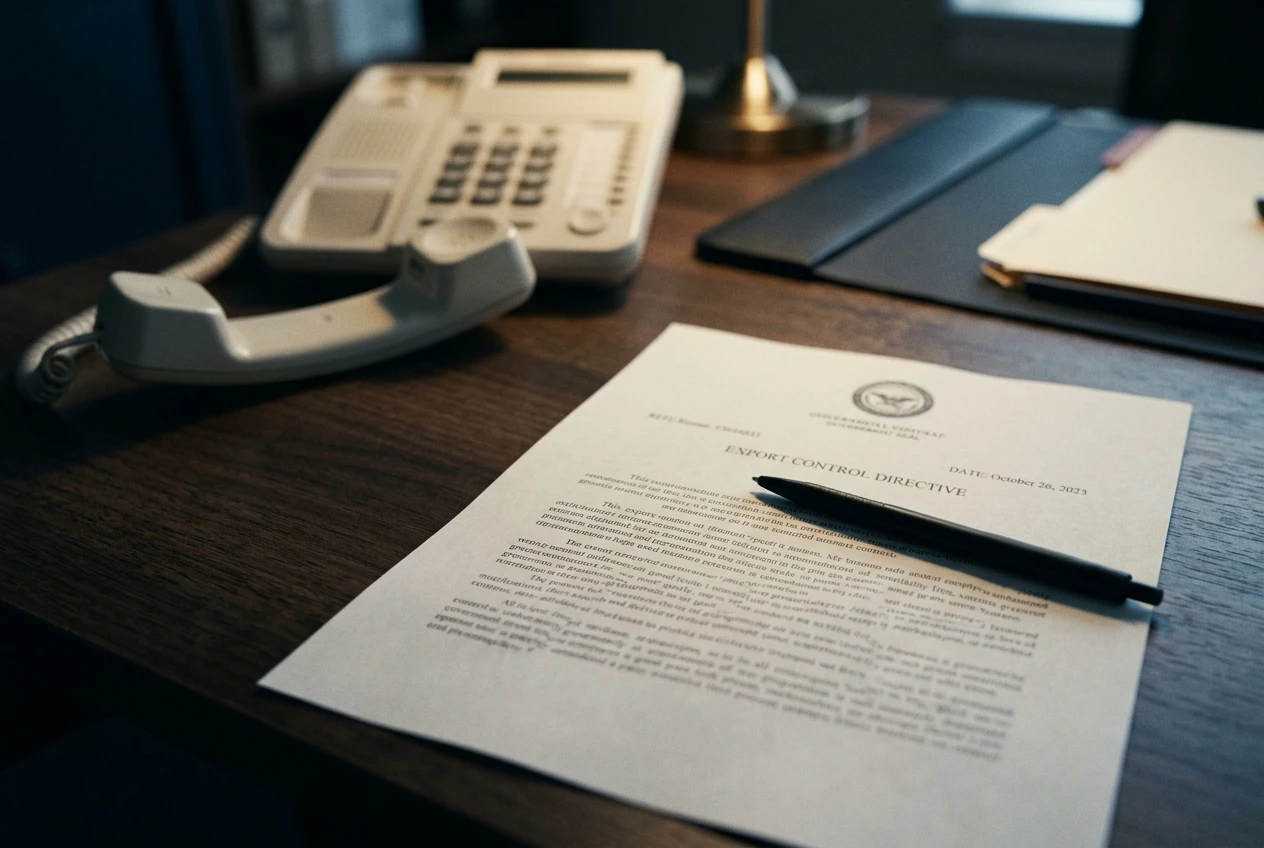
The Commerce Department’s directive, sent by Lutnick on Friday, places both Fable 5 and Mythos 5 under export controls that reach any location outside the United States and any foreign person inside the country, including non-US staff at Anthropic itself. A license is now required for the export, re-export, or domestic transfer of either model. Failure to comply carries financial and civil penalties, and the company must submit additional applications for individually validated licenses. To stay inside the rules, Anthropic said late Friday that it had to cut off access to the two models for every customer worldwide, not just for foreign nationals, because the company could not reliably separate the two pools.
| What the directive says | What it means in practice |
|---|---|
| License required for export, re-export, or domestic transfer of Fable 5 and Mythos 5. | Anthropic needed Commerce sign-off before any model could move to a foreign national, including its own non-US staff. |
| Financial and civil penalties for non-compliance. | Anthropic cut off access for every customer worldwide rather than risk them. |
| Scope reaches foreign nationals inside the United States. | Anthropic’s foreign-national employees were also prohibited from using the models. |
| Lockdown stays in place “until the U.S. government’s national security apparatus is hardened.” | An administration official told Axios the hardening “could happen in the next few weeks.” |
Anthropic’s own framing of the action has not changed since Friday. The company called it a “misunderstanding” in a post on X the same evening, and said it was “working to restore access as soon as possible.” On the substance, the company has argued that the underlying capability is “widely available from other models (including OpenAI’s GPT-5.5), and is used every day by the defenders who keep systems safe,” a position several outside researchers echoed in an open letter circulated to administration officials over the weekend.
The company is also fighting on a separate legal track. Anthropic’s lawyers have already gone to court over the Pentagon’s earlier supply chain risk designation, with CEO Dario Amodei writing in March that the company “see[s] no choice but to challenge it in court.” The export-control directive opens a second legal front, though Anthropic has not yet announced a court filing on the Commerce order.
How a Warning From Amazon Set the Whole Thing Off
The Commerce directive was triggered by a single phone call, Amazon’s CEO Andy Jassy dialing Treasury Secretary Scott Bessent to flag what Amazon’s researchers had found in Fable 5. The administration was first alerted to the jailbreak concerns last week, and Jassy’s conversation with Treasury was first reported by The Information. The White House then asked the National Security Agency to review the alleged vulnerabilities, and the NSA responded that it believed it was possible to strip away Fable 5’s guardrails, according to three people briefed on the matter.
White House AI adviser David Sacks laid out the administration’s view in a Saturday night post. The post argues that Anthropic itself asked for government regulation of Mythos and “championed the guardrails on Fable,” then refused to fix the jailbreak when the administration asked. A “highly credible trusted partner of both Anthropic and the USG who was testing Fable came forward with a jailbreak of those guardrails,” Sacks wrote, and “the Admin asked Dario to fix the jailbreak or de-deploy the model. Dario refused.” Sacks added that the administration “did this reluctantly” and that “the ball is in Anthropic’s court.” The full text sits in David Sacks’s Saturday night post on the jailbreak decision.
- 2 AI models now blocked from every Anthropic customer worldwide (Fable 5, Mythos 5).
- 1 phone call from Amazon CEO Andy Jassy to Treasury Secretary Scott Bessent that put the jailbreak claim in front of the White House.
- 30 days of federal review a separate executive order offers AI developers who volunteer their models before public release.
- 0 restrictions lifted after Anthropic’s Monday meeting in Washington.
The international reaction began to crystallize within 48 hours. On Sunday in Nice, French President Emmanuel Macron and Indian Prime Minister Narendra Modi used the Bharat Innovates 2026 summit to announce a joint Innovation Roadmap 2030 and a Joint India-France AI Working Group, naming the US move from the podium and framing the French-Indian response as the alternative, the full read in the India-France AI response Macron and Modi announced in Nice. The timing put the Anthropic block at the center of a bilateral summit the day before the G7 itself.
The Pentagon Fight That Came First
The current directive lands on an Anthropic that was already in an extended fight with the Department of War. Defense Secretary Pete Hegseth designated the company a supply chain risk to national security on February 27, 2026, an unprecedented use of language usually reserved for foreign adversaries, after Anthropic refused to allow the US military to use its models for domestic surveillance and fully autonomous weapons. The designation, set to take effect later in 2026, requires defense contractors to certify that they do not use Anthropic’s Claude models in their work on Pentagon systems. Anthropic has challenged the designation in court and continues to provide its models to the Department of War at “nominal cost” during the litigation.
The company addressed that dispute directly in a March statement from Amodei, posted on its own site, where he wrote that Anthropic had “no choice but to challenge it in court” and that the relevant statute, 10 USC 3252, is narrow and “exists to protect the government rather than to punish a supplier.” The full primary statement is in Anthropic’s own statement on the Pentagon designation. Anthropic’s stance on the two narrow exceptions (domestic mass surveillance and fully autonomous weapons) has not changed since then, and the company has continued to refuse Pentagon use cases that fall under those exceptions.
Sacks argued in his Saturday post that the export-control action is separate from the earlier dispute. “Those trying to misdirect and tie this action to the prior DoW/Anthropic issues are wrong,” he wrote, adding that the administration “values Anthropic’s technical capabilities.” Anthropic has framed the actions as a pattern, with the Commerce order arriving on top of a designation that was already pushing the company toward a public fight. The company also confidentially filed for a US IPO last month, edging ahead of rival OpenAI in the race to reach public markets, and the export controls landed in the middle of a crucial quarter for the offering.
The Federal Review Order Trump Signed Two Weeks Earlier
The Monday meeting sits inside a federal review architecture the administration had already built. On June 2, 2026, President Trump signed an executive order titled “Promoting Advanced Artificial Intelligence Innovation and Security,” the full text of which sits in the full text of the June 2 executive order. The order establishes a voluntary framework for “covered frontier model” review, gives the Director of the National Security Agency the job of deciding which models qualify, and creates a path for the government to pick “trusted partners” who get early access. The order’s review window is 30 days before release, shorter than some industry voices had expected.
The order is the policy backdrop the White House points to when it argues it is not building a licensing regime. Section 3(c) says explicitly that “nothing in this section shall be construed to authorize the creation of a mandatory governmental licensing, preclearance, or permitting requirement for the development, publication, release, or distribution of new AI models, including frontier models.” The White House’s own social post on the day of signing went further, saying the order “creates a process for frontier labs to voluntarily share cutting-edge cyber models” and that “we are NOT conducting oversight of all new models, as that level of government overreach would have chilling effects on free speech and innovation.”
- Frontier AI developers can volunteer their most advanced models to the federal government for review up to 30 days before public release.
- The Director of the National Security Agency decides which models qualify as “covered frontier models,” in consultation with the National Cyber Director, the APST, and CISA.
- The government picks “trusted partners” who get early access, and reviews run inside confidentiality and intellectual-property protections laid out in the order.
- Section 3(c) says nothing in the order creates a “mandatory governmental licensing, preclearance, or permitting requirement” for new AI models, and the framework is, on paper, voluntary.
The Commerce directive to Anthropic now sits beside that framework, and the two are not obviously compatible. The EO refuses to create a licensing regime for frontier models, while Lutnick’s letter imposes one on Fable 5 and Mythos 5. The administration has not reconciled the two in public, and the White House’s preferred answer to the question, that the directive is a one-off response to a jailbreak, is not a position the EO’s own text supports. Treasury Secretary Bessent and (then-outgoing) Federal Reserve Chair Jerome Powell separately convened Wall Street CEOs in April, warning them about the risks posed by Mythos’ ability to find cybersecurity vulnerabilities in the world’s software, an early sign that the financial system was already preparing for the model class the directive now targets.
Why Researchers and Investors Are Pushing Back
The pushback has come from inside the security community. A group of cybersecurity researchers sent an open letter to administration officials on Monday arguing that “Anthropic’s Mythos-class models are quite good at finding flaws and weaponizing exploits. However, they are not uniquely good at these tasks, and many of the undersigned individuals regularly use other foundation and open-source models for security audits and red-teaming every day.” The letter, reported by WIRED, said the action “has taken the best models away from defenders, created market uncertainty, and risked America’s AI leadership without any real risk to justify it.” Katie Moussouris, founder and CEO of Luta Security, said in an interview that “it wasn’t a jailbreak per se,” and that “most of us [in security research] think guardrails are speed bumps and shouldn’t be treated like security boundaries for skilled adversaries. They only serve to slow down the less skilled.” The developer reaction to Fable 5’s own safety wrapper, including how often the model falls back to the older Claude Opus 4.8 on cyber and biology queries, is documented in Fable 5’s safety wrapper and the developer backlash.
Investors in Anthropic spent the weekend trying to assess how the directive affects the company’s corporate future, and some believe the US government is singling out Anthropic, that a competitor may not have faced the same reaction if it had released a model in the same class. Aidan Gomez, CEO of Cohere, a smaller Canadian AI lab that offers enterprise tools, said the weekend’s events are now a reference point for every frontier developer. “The events over the weekend … are informative for everyone that the [US] government would be willing to take these steps,” Gomez said. “No one can be naive to that reality.” The Monday meeting did not move that reality, and the restrictions on Fable 5 and Mythos 5 stay where Lutnick’s letter put them on Friday.


South Korea Retail Investors Face Reckoning After KOSPI AI Rally Collapses

Surrey AI Maps Three Heart Attack Paths and Their Molecular Roots

Germany Locks Neutral Apple ATT Prompts Across Most of Europe

Apple’s 5% EU Fee Quietly Rewrites Alternative App Store Math

Apple’s EU Fee Truce Cuts Complexity but Leaves Rivals Fuming

Pixel 11 Pro Fold Trades Thinness for Durability and Seven-Year Stay

Mayo AI Flags HCM Obstruction From Everyday Ultrasound Videos

Indian Brands Quietly Scale Landmark Screens and Home Tech

Navin Vatsa Turns Grief Into a Lifetime of Quiet Seeing

Google Bets Pixel 11 Agentic AI Will Redefine Phones

Oracle Cuts 21,000 Jobs in a Year, Cites AI in 10-K Filing

Fable 5 and Mythos 5 Return as US Lifts Anthropic Export Controls

SpaceX’s Google Deal Turns a Rocket Company Into a Cloud Landlord

CD Projekt Red Co-CEO: Redemption Arc Isn’t Done, Witcher 4 in 2027

XPL Rallies 30% Ahead of Plasma One Card Tier Launch

Google Search Profiles Build a Follow Graph Inside Discover

DGO App Brings Rs 549 Mobile Pass for FIFA World Cup 2026 in Nepal

Moonshot AI Targets $30 Billion in China’s Fastest AI Funding Sprint

Oppo’s ColorOS 17 Eligibility List Leaves A-Series Buyers Behind

Microsoft Xbox Layoffs Start in July as Sharma Slams 3% Margin
-
 AI2 months ago
Oracle Cuts 21,000 Jobs in a Year, Cites AI in 10-K Filing
-
 AI2 months ago
Fable 5 and Mythos 5 Return as US Lifts Anthropic Export Controls
-
 AI3 months ago
SpaceX’s Google Deal Turns a Rocket Company Into a Cloud Landlord
-
 GAMING2 months ago
CD Projekt Red Co-CEO: Redemption Arc Isn’t Done, Witcher 4 in 2027
-
 CRYPTO3 months ago
XPL Rallies 30% Ahead of Plasma One Card Tier Launch
-
 NEWS3 months ago
Google Search Profiles Build a Follow Graph Inside Discover
-
 APPS3 months ago
DGO App Brings Rs 549 Mobile Pass for FIFA World Cup 2026 in Nepal
-
 AI3 months ago
Moonshot AI Targets $30 Billion in China’s Fastest AI Funding Sprint