
AI
Apple Will Let iPhone Users Pick Claude Or Gemini As Default AI

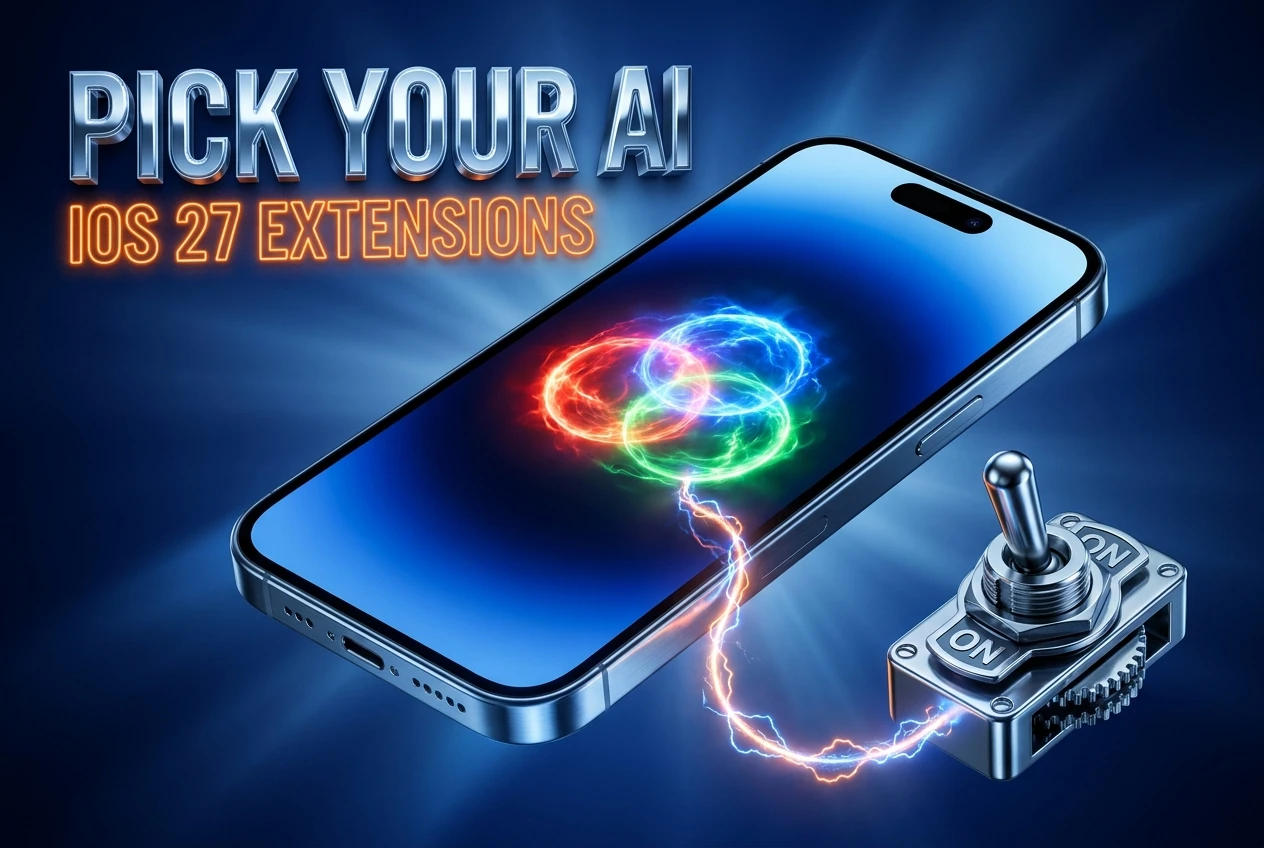
Apple is preparing to hand iPhone, iPad, and Mac users a setting that would have been unthinkable two years ago: a toggle that lets them swap Apple’s own AI for Google’s, Anthropic’s, or whoever ships the best model that quarter.
The feature, internally called Extensions, is expected to arrive with iOS 27, iPadOS 27, and macOS 27 this fall, with a developer preview at Apple’s WWDC 2026 keynote on June 8. Bloomberg’s Mark Gurman first reported the framework, which would route Apple Intelligence requests through whichever third-party model the user picks in Settings. Apple has been testing internal builds with Google and Anthropic so far. The timing is loud. The settlement check went out two days before the leak.
What the Extensions Toggle Actually Does
Extensions turns Siri, Writing Tools, and Image Playground into a model-agnostic shell. Install a compatible AI app from the App Store, flip on its Extension, set it as the default, and Apple’s system features start routing through it.
Each provider also gets its own Siri voice. Per Bloomberg, queries answered by Apple’s foundation models will speak in one voice; responses generated by a third-party model will speak in another. The split is deliberate. Apple wants users to know exactly which company answered the question, partly for transparency and partly to wall off liability for anything a third-party model says.
The fine print in the test build, surfaced by Gurman, reads: “Extensions allow agents from installed apps to work with Siri, the Siri app and other features on your devices.” That language matters. Agents, not chatbots. Apple is positioning Extensions for tool-using AI that can act inside apps, not just answer questions in a text box.
The App Store Gets An AI Marketplace
The most underplayed detail sits inside Gurman’s own post on X confirming the App Store carve-out: Extensions will get a dedicated section in the App Store. Gemini, Claude, Grok, Meta AI, and Alexa would all live there, each competing for the toggle.
It is, in effect, an AI app store inside the app store. Apple has not said whether there will be an approval process, a revenue share, or both. Given Cupertino’s history with the regular App Store, expect both.
Why This Reads As A Concession
For a decade, Apple’s AI pitch was that the silicon, the operating system, and the model all came from the same place. Extensions ends that pitch. Three sentences in a Settings menu now tell the user that the model is interchangeable.
Gurman put it plainly in his Power On newsletter: Apple has “effectively conceded the AI race.” The company that owns the device and the App Store is no longer trying to own the model on it.
Strip out the diplomacy and the math is simple. Apple ships roughly 230 million iPhones a year. OpenAI, Google, and Anthropic spend tens of billions training frontier models. Apple’s in-house cloud model tops out at 150 billion parameters. Google’s custom Siri model, the one Apple is paying for separately, runs at 1.2 trillion parameters. The distribution-versus-models swap was always going to happen. It is happening now.
Two Deals Running In Parallel
Extensions does not replace the Gemini-for-Siri arrangement. It runs alongside it. Apple is reportedly paying Google around $1 billion a year for a custom 1.2-trillion-parameter Gemini model that handles Siri’s planner and summarizer functions, white-labeled with no Google branding. Bloomberg’s November 2025 scoop on the 1.2T Gemini model laid out the architecture: Gemini handles planning and summarization, knowledge search stays local and encrypted on device.
So the user-facing layer has two doors. Door one is the new Siri, which already runs on Gemini whether the user picks anything or not. Door two is Extensions, where the user can route generative tasks to Claude or another provider. Both doors lead away from Apple’s own foundation models.
Gene Munster, managing partner at Deepwater Asset Management, pegged the Google deal’s total value at up to $5 billion across its multi-year term. Apple’s models team is meanwhile building a 1-trillion-parameter cloud model it hopes can replace Gemini. The stated plan is to bring everything back in-house. The shipped plan is the opposite.
The Settlement That Made The Pivot Necessary
Three days before the Extensions leak, Apple agreed to pay $250 million to settle a class action accusing it of overstating Apple Intelligence and Siri capabilities. The proposed settlement was filed for preliminary approval on May 5, 2026, in the Northern District of California, with a hearing set for June 17.
The class covers roughly 36 million devices sold in the United States between June 10, 2024 and March 29, 2025: the iPhone 15 Pro, 15 Pro Max, and the entire iPhone 16 lineup including the 16e. Eligible buyers can claim a base payment of $25 per device, scaling up to $95 if claim volume stays low. The payout is the legal residue of the Siri demos shown at WWDC 2024 that never shipped.
The Lawsuit’s Core Claim, In Plain English
The lawsuit, Landsheft v. Apple Inc., Case No. 5:25-cv-02668-NW, alleged that Apple sold iPhones on the promise of Apple Intelligence features that did not exist when the boxes were opened. The personalized, on-screen-aware Siri shown at WWDC 2024 was promoted in iPhone 16 launch ads through fall 2024 and pulled in March 2025 once the delays became public.
Since the launch of Apple Intelligence, we have introduced dozens of features across many languages that are integrated across Apple’s platforms, relevant to what users do every day, and built with privacy protections at every step. Apple has reached a settlement to resolve claims related to the availability of two additional features. We resolved this matter to stay focused on doing what we do best.
That statement, issued by Apple to plaintiffs’ counsel and reported alongside the filing, is the closest the company comes to acknowledging the gap between the demo and the device. It does not admit wrongdoing.
The settlement does not close out separate shareholder suits, including a securities action filed by South Korea’s National Pension Service alleging the AI claims hurt investors. Apple moved to dismiss that one in February 2026, calling the plaintiff’s argument “a massive and unsupported leap.”
If Extensions ships, the legal exposure shifts. A user who chooses Claude as their default model is choosing a third party, and Apple’s disclosure language in test builds already tells users it is not responsible for content generated by selected third-party models. The toggle is partly a product feature and partly a liability shield.
The Numbers Behind The Pivot
- $250 million: Apple’s proposed settlement payout, filed May 5, 2026 in the Northern District of California.
- 36 million devices: the size of the eligible class covering iPhone 15 Pro, 15 Pro Max, and the iPhone 16 lineup.
- $25 to $95: per-device claim amount depending on how many users file.
- $1 billion per year: estimated Apple payment to Google for the custom 1.2T Gemini model powering Siri’s planner and summarizer.
- 150 billion parameters: size of Apple’s existing cloud foundation model, eight times smaller than the Gemini variant Apple is licensing.
- 0.06 percent: the settlement’s share of Apple’s $416 billion fiscal 2025 revenue.
How Extensions Compares To The ChatGPT Integration
Apple already has one third-party AI bolted onto the operating system. ChatGPT has been available through Siri since iOS 18.2 as a single, hard-coded fallback. Extensions is a different shape entirely.
| Feature | ChatGPT Integration (iOS 18.2) | Extensions (iOS 27) |
|---|---|---|
| Number of supported providers | One (OpenAI) | Any qualifying provider |
| User choice | Single fallback toggle | Default model selectable in Settings |
| Distribution | Built into the OS | Distributed via App Store section |
| Voice differentiation | None | Distinct Siri voice per provider |
| Coverage | Siri queries only | Siri, Writing Tools, Image Playground |
The architectural shift is the App Store hook. ChatGPT was a partnership exception. Extensions is a platform.
What This Means For Developers
The Foundation Models framework Apple shipped at WWDC 2025 let app developers tap into the on-device Apple Intelligence model with as few as three lines of Swift. Extensions points the other direction: AI providers can plug their own models into Apple’s surfaces, not the other way around.
That creates a strange middle for app developers. Some will keep building on Apple’s on-device model because it runs offline and ships free with the OS. Others will route generative tasks to whichever Extension the user has selected, getting frontier-grade output without the on-device size constraint.
Frequently Asked Questions
When can I actually choose Claude or Gemini on my iPhone?
Not yet. Apple is expected to preview Extensions at the WWDC keynote on June 8, 2026, with developer betas to follow that week. Public release ships with iOS 27, iPadOS 27, and macOS 27 in fall 2026, typically mid-September for iPhones and late October for Macs. Until then, ChatGPT remains the only third-party AI integrated into Apple Intelligence on shipping devices.
Will switching to a third-party model send my data to Google or Anthropic?
Yes, when you actively use that model. Apple’s test-build language tells users it is not responsible for content generated by selected third-party providers, which strongly suggests queries routed to Gemini or Claude leave Apple’s privacy perimeter. The Gemini-powered Siri features run inside Apple’s Private Cloud Compute, but Extensions queries are a separate path. Read the consent screen carefully when you flip the toggle.
How do I claim my $25 to $95 from the Siri settlement?
Wait for the email. Notices to eligible claimants go out within 45 days of preliminary approval, which means roughly late June 2026 if the June 17 hearing approves the deal. You will need proof of purchase, the device serial number, your phone number, and Apple Account information. Clarkson Law Firm has said a dedicated settlement website will go live with filing instructions in the coming weeks.
Which iPhones qualify for the settlement payment?
The class covers iPhone 15 Pro, iPhone 15 Pro Max, iPhone 16, iPhone 16 Plus, iPhone 16 Pro, iPhone 16 Pro Max, and iPhone 16e purchased in the United States between June 10, 2024 and March 29, 2025. Older iPhones, iPhone 17 models, and devices bought outside that window are not eligible. Each qualifying device gets one claim.
Does Extensions mean Apple is giving up on its own AI?
No. Apple’s models team is still building a 1-trillion-parameter cloud model with the goal of eventually replacing Gemini for Siri. The on-device Foundation Models framework continues to ship with every Apple Intelligence device. Extensions is a parallel path, not a replacement. The strategic read is that Apple wants to win on distribution and silicon while renting frontier model performance until it catches up.
The pieces fit together once you stop looking at them separately. A settlement closes the gap between what was promised and what shipped. A custom Gemini model fills the next year of Siri features. Extensions hands the longer-tail use cases to whoever is winning the model race that quarter.
Apple is not betting on its own AI. It is betting that the iPhone is still the place every other AI wants to live, and that owning the toggle is enough.


South Korea Retail Investors Face Reckoning After KOSPI AI Rally Collapses

Surrey AI Maps Three Heart Attack Paths and Their Molecular Roots

Germany Locks Neutral Apple ATT Prompts Across Most of Europe

Apple’s 5% EU Fee Quietly Rewrites Alternative App Store Math

Apple’s EU Fee Truce Cuts Complexity but Leaves Rivals Fuming

Pixel 11 Pro Fold Trades Thinness for Durability and Seven-Year Stay

Mayo AI Flags HCM Obstruction From Everyday Ultrasound Videos

Indian Brands Quietly Scale Landmark Screens and Home Tech

Navin Vatsa Turns Grief Into a Lifetime of Quiet Seeing

Google Bets Pixel 11 Agentic AI Will Redefine Phones

Oracle Cuts 21,000 Jobs in a Year, Cites AI in 10-K Filing

Fable 5 and Mythos 5 Return as US Lifts Anthropic Export Controls

SpaceX’s Google Deal Turns a Rocket Company Into a Cloud Landlord

CD Projekt Red Co-CEO: Redemption Arc Isn’t Done, Witcher 4 in 2027

XPL Rallies 30% Ahead of Plasma One Card Tier Launch

Google Search Profiles Build a Follow Graph Inside Discover

DGO App Brings Rs 549 Mobile Pass for FIFA World Cup 2026 in Nepal

Moonshot AI Targets $30 Billion in China’s Fastest AI Funding Sprint

Oppo’s ColorOS 17 Eligibility List Leaves A-Series Buyers Behind

Microsoft Xbox Layoffs Start in July as Sharma Slams 3% Margin
-
 AI2 months ago
Oracle Cuts 21,000 Jobs in a Year, Cites AI in 10-K Filing
-
 AI2 months ago
Fable 5 and Mythos 5 Return as US Lifts Anthropic Export Controls
-
 AI2 months ago
SpaceX’s Google Deal Turns a Rocket Company Into a Cloud Landlord
-
 GAMING2 months ago
CD Projekt Red Co-CEO: Redemption Arc Isn’t Done, Witcher 4 in 2027
-
 CRYPTO2 months ago
XPL Rallies 30% Ahead of Plasma One Card Tier Launch
-
 NEWS2 months ago
Google Search Profiles Build a Follow Graph Inside Discover
-
 APPS2 months ago
DGO App Brings Rs 549 Mobile Pass for FIFA World Cup 2026 in Nepal
-
 AI2 months ago
Moonshot AI Targets $30 Billion in China’s Fastest AI Funding Sprint