
AI
Siri AI Ships on iOS 27 With Google in the Stack
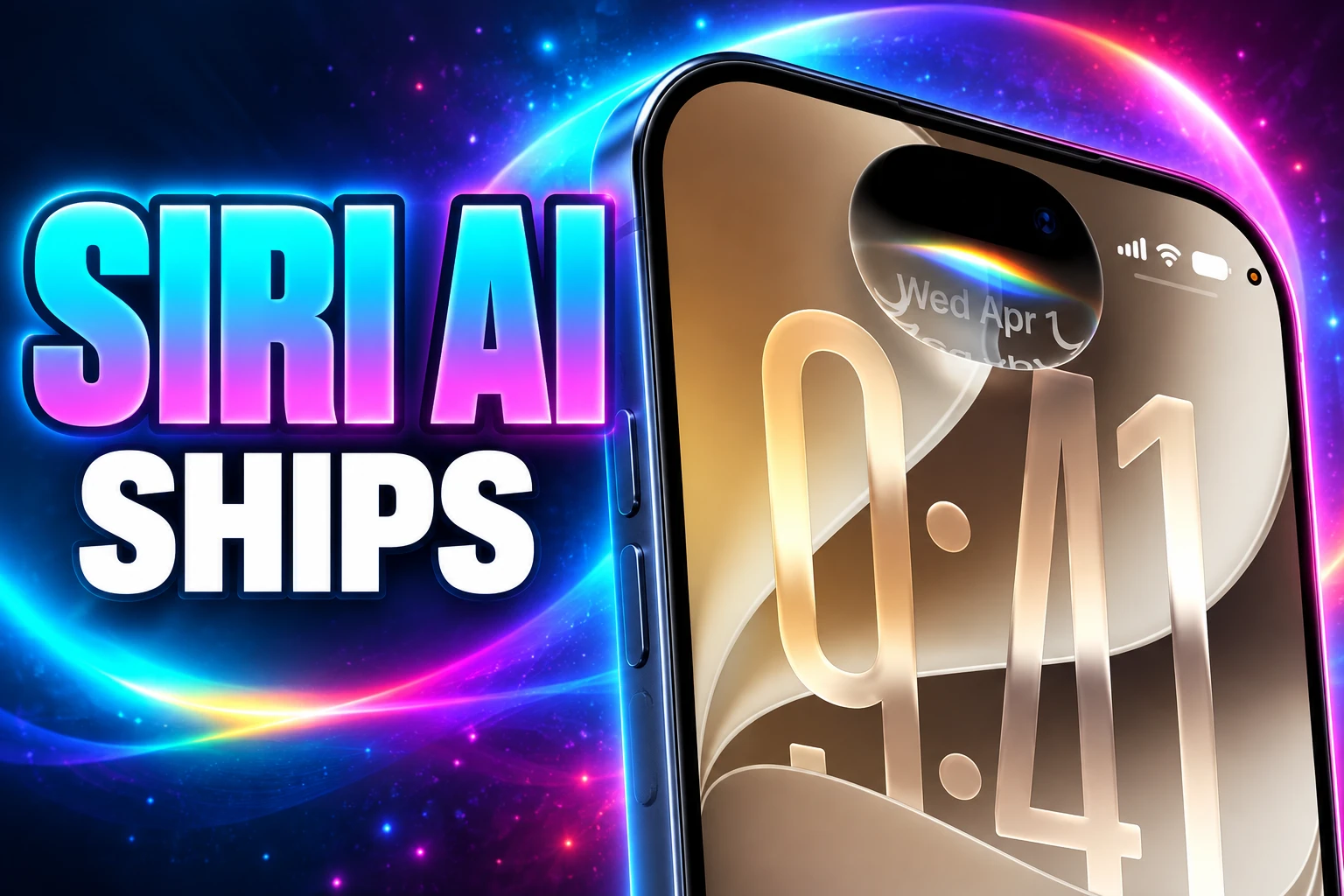
Siri AI lands on iOS 27 as an English beta whose models were refined with Gemini and whose hardest jobs run in Google Cloud.

Apple is rolling out Siri AI with iOS 27 on September 14, 2026, as an English-language beta with daily caps on server-heavy requests. The rebuilt assistant can read the screen, search mail and photos, and act in apps, while Apple still insists it is not chasing chatbots.
That pitch now has to survive contact with a product. The models under Siri were custom-built with Google, four of them refined with Gemini outputs, and the heaviest reasoning runs on NVIDIA GPUs in Google Cloud.
Siri AI Lands as an English Beta on iOS 27
Craig Federighi, Apple’s senior vice president of Software Engineering, used the June 8, 2026 WWDC keynote to scold the rest of the industry. “Some appear to be racing forward, seemingly pursuing AI for the sake of AI, without clear regard for the people, all of us, that it’s ultimately meant to serve,” he said. Helpful AI, he added, “must be centered around you and your needs.”
The thing shipping with iOS 27, iPadOS 27, macOS 27 Golden Gate, watchOS 27, and visionOS 27 is a ground-up Siri with a dedicated Siri app across devices. Conversations sync over iCloud. iPhone users can swipe down from the Dynamic Island, hold the side button, or say Hey Siri. On iPad and Mac, the assistant sits in Spotlight and in control-click menus. Apple Watch can pick up a chat from the wrist or surface it in the Smart Stack.
Apple’s own demos are still the best specimen of what it wants Siri to be. Ask it for a hotel confirmation buried in an old email. Ask what to bring to a potluck on the lock screen, then drop the recipe into Notes. Point the Camera in a new Siri mode at a dinner bill and split it with Apple Cash. On Mac, a keyboard shortcut grabs part of the display and sends it to Siri as a question.
Writing tools ride along. Siri can draft from a prompt, match the tone a user already uses with a given Mail or Messages contact, and proofread as they type, including in most third-party apps. Photos gets Spatial Reframing and stronger cleanup. Image Playground can turn out photorealistic stills. Safari can group tabs. Shortcuts can build a workflow from one sentence.
SIRI’S PATH FROM 2024 TO THE BETA
- June 10, 2024: Apple introduces its first Apple Intelligence foundation models for on-device and Private Cloud Compute use.
- January 12, 2026: Google posts a joint statement saying the next Apple Foundation Models will be based on Gemini models and cloud technology.
- June 8, 2026: WWDC26 unveils Siri AI and the third-generation AFM family for developer testing on iOS 27.
- September 9, 2026: At Apple’s iPhone event, Lilian Rincon, vice president of AI product marketing, confirms an English launch with iOS 27 and five more languages in October.
- September 14, 2026: iOS 27 reaches the public and Siri AI opens as an English beta on supported hardware.
Apple first promised a more personal Siri with Apple Intelligence in 2024, then postponed the harder pieces into 2026. The beta that arrives with this software update is that delayed assistant with a new name, a new app, and a new model stack.
The Google Line Federighi Drew on Stage
In January, Google’s own news account said Apple had picked Gemini as “the most capable foundation” for the next Apple Foundation Models, including a more personalized Siri, while still running the product on Apple devices and Private Cloud Compute. Elon Musk replied that the pairing looked like an unreasonable concentration of power for a company that already owns Android and Chrome.
Joint Statement: Apple and Google have entered into a multi-year collaboration under which the next generation of Apple Foundation Models will be based on Google's Gemini models and cloud technology. These models will help power future Apple Intelligence features, including a…
— News from Google (@NewsFromGoogle) January 12, 2026
By June, Federighi was drawing a much thinner line in a post-keynote briefing with Amar Subramanya, Apple’s vice president of AI. Apple, he said, does not ship the Gemini app, does not run Google’s client code on iOS, does not use the Gemini models Google deploys to its own customers, and does not use Google Search as the knowledge base.
Of course, we don’t have the Gemini app as our app. In fact, none of that client code is part of how we run on iOS. For these models, we use none of the models that Google deploys to their customers, nor do we use the infrastructure and means by which they deploy models to their customers. And then, when it comes to the knowledge base, we of course don’t use Google Search or anything like that as the foundation of our system. So I hope that’s clear. The amount of the Google Assistant we use is none.
Craig Federighi, senior vice president of Software Engineering, Apple, post-keynote briefing
Subramanya put the Google work back in the recipe in the next breath. The on-device and Apple-silicon cloud models, he said, are “custom built for Apple Silicon, trained using proprietary data with reinforcement learning and refined using outputs from Gemini frontier models.” AFM 3 Cloud Pro, the top server model, has “quality similar to Gemini frontier models.”
Both descriptions can sit in the same architecture. Apple owns the product, the orchestrator, the on-device index, and the privacy claims. Google supplied distillation targets, TPU training capacity, and, for the heaviest model, a place to run NVIDIA GPUs. The assistant Apple will not call a chatbot still learned from Google’s frontier stack, and the hard answers still leave the phone.
Five Models Split the Phone From Google Cloud
Apple’s machine learning group describes a family of five foundation models built with Google. Two run on the device. Two run on Private Cloud Compute on Apple silicon. One does not.
THE AFM 3 FAMILY
| Model | Job | Where it runs |
|---|---|---|
| AFM 3 Core | Everyday Apple Intelligence, 3 billion parameters | On device |
| AFM 3 Core Advanced | Multimodal 20 billion-parameter model; 1 to 4 billion active per request | On device, newest Apple silicon |
| AFM 3 Cloud | Faster server-side reasoning | Private Cloud Compute on Apple silicon |
| ADM 3 Cloud (Image) | Image generation, editing, Genmoji, Spatial Reframing | Private Cloud Compute on Apple silicon |
| AFM 3 Cloud Pro | Agentic tool use and complex reasoning | NVIDIA GPUs in Google Cloud, wrapped in Private Cloud Compute |
AFM 3 Core Advanced is the trick that lets a 20 billion-parameter model live on a phone. Apple stores the full weights in flash and loads a small expert set into memory per prompt, rather than holding every weight in DRAM. That is how the new expressive Siri voices and higher-accuracy dictation stay on device on the newest chips.
Apple’s own graders scored a clear step up over the 2025 models. AFM 3 Core was preferred on 45.6 percent of text prompts, against 23.3 percent for last year’s on-device model. AFM 3 Cloud was preferred on 64.7 percent of text prompts, against 8.7 percent for the 2025 server model. Cloud Pro then adds about 10 percent more satisfaction on text and 14 percent on image understanding over Cloud, per Apple’s write-up. Those are in-house side-by-sides, not public leaderboards.
Training data, Apple says, is a mix of public web text, licensed sets, open-source material, study data, and synthetic data. User interactions are not in the mix. Publishers can opt out. Queries that hit Private Cloud Compute are not stored and are not visible to Apple, and outside researchers can keep auditing that claim. For Cloud Pro, Apple, Google, and NVIDIA extended that same Private Cloud Compute wrapper onto NVIDIA GPUs in Google Cloud.
“We believe privacy in AI is non-negotiable,” Federighi said during the keynote. “Data is only used to execute your request, and outside experts can continue to verify this promise at any time.” The privacy argument is now the product as much as the assistant is. It has to cover a model that does its hardest work on a rival’s cloud.
Who Gets Siri AI in the First Wave?
iOS 27 itself will install on phones that cannot run the new assistant. Siri AI is an Apple Intelligence feature, and Apple’s hardware floor is much higher than the OS floor.
THE FIRST-WAVE GATES
- The date: Siri AI opens with iOS 27 on September 14, 2026, still labeled a beta.
- The language: English only at launch; French, Japanese, Korean, Portuguese, and Spanish follow in October.
- The phones: iPhone 15 Pro, iPhone 15 Pro Max, and iPhone 16 or later, including later 17 and 18-class models that support Apple Intelligence.
- The other hardware: iPad mini with A17 Pro, iPads with M1 or later, Macs with M1 or later, MacBook Neo with A18 Pro, Apple Vision Pro, and Watch Series 9, Ultra 2, or SE 3 paired with a supported iPhone.
- The maps: No Siri AI on iPhone, iPad, or Apple Watch in the EU at launch; Mac and Vision Pro in the EU can run it. China is held for regulatory clearance.
Apple Intelligence as a wider layer supports 16 languages with this software: English, Danish, Dutch, French, German, Italian, Norwegian, Portuguese, Spanish, Swedish, Turkish, Vietnamese, simplified and traditional Chinese, Japanese, and Korean. Siri AI is slower than that list. A phone set to Spanish on September 14 gets the rest of Apple Intelligence and waits until October for the new assistant.
AFM 3 Core Advanced is gated to the most capable Apple silicon, so dictation and the customizable Siri voices will feel better on newer chips than on a 2023 iPhone 15 Pro. Apple has not published a feature-by-feature split of what the older Intelligence phones lose.
Daily Caps Sit on the Heaviest Requests
The on-device models are the part of this story that matches the keynote. The moment a request needs AFM 3 Cloud or Cloud Pro, it becomes a metered cloud job. Apple says certain Apple Intelligence features that rely on server-side models are subject to daily usage limits, including Siri AI, intelligent photo editing, Image Playground, and AFM 3 Cloud models used in Shortcuts. The caps can move with the feature, the hardness of the request, live demand, and other policies Apple has not spelled out.
Most iCloud+ plans already raise those limits. A further paid expansion, Apple has said, will arrive later, with no price and no date attached. Free iCloud still gets Siri AI. It does not get an unlimited pipe into Cloud Pro.
That is the quiet cost of Federighi’s architecture. A 3 billion-parameter model on the phone can set a timer, draft a reply, and keep a short chat in RAM. Agentic tool use, the job Cloud Pro exists to do, is the work Apple is rationing. The company that declined to sell a coding assistant to consumers is still billing the hard reasoning against a daily budget.
The Same Swift API Now Hosts Claude and Gemini
While the keynote talked about ordinary people, the developer sessions handed out an agent platform. Apple opened the Foundation Models framework so any vendor that implements a LanguageModel protocol can sit behind the same Swift session as Apple’s on-device model. Google is routing Gemini models inside Apple’s Swift API through the Firebase Apple SDK, with a swap of the model instance. Anthropic shipped a package so apps can hand off hard jobs to Claude for multi-step reasoning, code, and web search, then stream the answer back into the same view.
Dynamic Profiles let an app change tools and instructions mid-session without throwing away the chat. That is how a native iPhone app becomes an agent without standing up its own chatbot. Small App Store developers with fewer than two million first-time downloads get free access to Apple’s cloud models on Private Cloud Compute, which removes the token bill that would otherwise kill an indie agent.
Apple can still tell consumers it is not asking them to live in a prompt box. Developers are being told the opposite: wire Claude, Gemini, or AFM behind one API and ship the agent inside the app. Other companies are not waiting for Apple’s consumer caution. Meta is already putting inbox and checkout agents already shipping in front of people who never open a terminal.
The bar for this beta, after years of Siri stalling on basic requests, is low and specific. If it can finish the hotel-email trick in a real inbox, keep a back-and-forth without dropping context, and take an action in another app without a second tap, it will feel new. If the useful answers trip a silent Cloud Pro cap, users will meet Google’s GPUs as a quota error, not as a philosophy.
European iPhones Sit Out the Launch
Mac and Apple Vision Pro users in the EU can turn Siri AI on when the device language is supported. iPhone, iPad, and Apple Watch users there cannot. Apple says it is still looking for a path that preserves privacy and security under the Digital Markets Act, and it has not published a date. China is a separate hold while Apple works through local rules.
That EU hole is the same privacy fight in another form. Apple has spent years arguing that its prompts and on-device controls are the point of the platform, including Apple’s privacy fight in Europe over tracking dialogs. Siri AI now asks those same regulators to accept a personal assistant that can see the screen, search mail, and send the hard queries to a PCC node that may sit on NVIDIA hardware in Google Cloud. Until that argument lands, the world’s most private assistant, in Apple’s phrasing, is a Mac feature in the EU and a missing icon on the phone.
Rincon’s October language list will not fix that map. French and Spanish Siri on an iPhone in Spain still needs the DMA path. The beta on September 14 is English, capped, hardware-limited, and geographically split. Federighi’s line about serving people is now a shipping product with a quota, a rival’s cloud, and a blank space where the European iPhone should be.

Instagram Plus Tests a Read-Only Mode That Cuts Stories

Altman Asks the Public to Accept Some AI Harm

Google Freezes OSS VRP Product Reports After AI Flood

AI Agents Make Payment Rails the Scarce Prize

Turkey’s Crypto Boom Now Runs Through Three Banks

Fable 5 Came Back Under a Commerce On-Off Switch

Google’s SpaceX GPU Lease Has a Sept. 30 Deadline

Plasma One’s XPL Locks Face a 1.81 Billion Cliff

DGO’s Rs 549 World Cup Pass Cost Fans Sleep and Data

Moonshot AI’s $30 Billion Ask Became a $35 Billion Close
-
 AI4 months ago
Fable 5 Came Back Under a Commerce On-Off Switch
-
 AI4 months ago
Google’s SpaceX GPU Lease Has a Sept. 30 Deadline
-
 CRYPTO4 months ago
Plasma One’s XPL Locks Face a 1.81 Billion Cliff
-
 APPS4 months ago
DGO’s Rs 549 World Cup Pass Cost Fans Sleep and Data
-
 AI4 months ago
Moonshot AI’s $30 Billion Ask Became a $35 Billion Close
-
 NEWS4 months ago
ColorOS 17 Device List Spans Oppo, OnePlus and Realme
-

 GAMING4 months ago
Xbox Cuts 3,200 Jobs After Five Years of Thin Returns
-

 GAMING4 months ago
The RTX 4050 Under Rs 70,000 Hides a Wattage Gap