
NEWS
AT&T Rebuilt Unlimited Plans to Pay for a Bigger Network
AT&T launched 2.0 unlimited plans three days after a $250 billion pledge, then hiked retired plans and opened a $15 Build-A-Plan door.

AT&T replaced its unlimited phone plans in March 2026 with a 2.0 stack, then raised prices on the retired tiers those plans replaced. Three days earlier the company had pledged more than $250 billion over five years to expand fiber, 5G, and satellite. The new rate card is how that bet shows up on a household bill.
Existing customers are not moved automatically. Switching can still trigger a line activation fee of up to $50. Advertised prices are AutoPay rates, usually about $10 less than the undiscounted charge, and taxes sit on top.
A $250 Billion Bet, Then a New Rate Card
On March 10, 2026, the 150th anniversary of Alexander Graham Bell’s first call, Chairman and CEO John Stankey tied the spend to federal tax and telecom policy and to a network that already serves more than 100 million U.S. customers. AT&T employs about 110,000 people in the United States and said it would hire thousands of technicians in 2026. Only 5% of its jobs require a four-year degree, the company said, and the pledge also covers FirstNet and a satellite tie-up with AST SpaceMobile.
Today, we’re committing more than $250 billion to increase U.S. connectivity competitiveness and expand access to AT&T’s leading fiber and wireless networks
John Stankey, Chairman and CEO of AT&T, March 10, 2026 announcement
On March 13, AT&T put Unlimited Your Way on a 2.0 chassis: Value, Extra, and Premium, with cleaner names and round-dollar AutoPay prices. Elite 2.0 arrived on April 16 as a traveler tier above Premium. Jenifer Robertson, then executive vice president and general manager of Mass Markets, said customers wanted simple plans and features they would actually use, and that the stack would mix-and-match unlimited plans across lines, unlike T-Mobile.
That mix is the product change hiding under the version number. A parent can keep unthrottled 5G on Premium 2.0 while a child sits on Value 2.0, and the account still looks like one family plan at checkout.
Legacy Lines Ate Two Hikes in 2026
AT&T did not wait for people to wander over. Retired unlimited bills moved in April, and a second group of lines got the same treatment in August. The company said the extra money helps it keep the network reliable. Affected plans also received extra hotspot data, which is a small sweetener on a higher recurring charge.
Two different hike rules ran at once, and login pages did not always show the same one. Retired unlimited accounts that were active before July 24, 2025, saw a $10 bump on a single line or $20 for the whole account if two or more lines sat on the plan, plus 20GB more hotspot. Separate Unlimited Your Way smartphone lines were increasing by $5 per line, with 10GB more hotspot. The August wave hit lines that skipped April and had been activated or moved between July 24 and November 1, 2025.
Those price hikes on retired AT&T plans are the conversion pressure. After the April math, a one-line Unlimited Premium PL bill sat at $96 AutoPay, while Premium 2.0 listed at $90. A four-line Premium PL household landed at $224 against $200 on Premium 2.0. The new card looks cheaper once the old card has already been marked up.
THE 2026 RATE-CARD CALENDAR
- March 10, 2026: AT&T commits more than $250 billion over five years on the 150th anniversary of the first phone call.
- March 13, 2026: Value 2.0, Extra 2.0, and Premium 2.0 replace Value Plus VL, Unlimited Extra EL, and Unlimited Premium PL, and Unlimited Starter SL disappears from the shelf.
- April 2026: Retired unlimited plans active before July 24, 2025, take the $10 or $20 account hike, and Unlimited Your Way phones take $5 per line.
- April 16, 2026: Elite 2.0 launches at $110 AutoPay for one line and $300 for four, with Turbo, 250GB of hotspot, and a free watch and tablet line.
- May 27, 2026: Build-A-Plan goes live online at $15 for new customers who bring an unlocked, eSIM-capable phone.
- July 7, 2026: Build-A-Plan adds AT&T Fiber 300 or Internet Air in the same flow, starting at $70 with unlimited SD mobile data.
- August 2026: The $5-per-line Unlimited Your Way increase hits remaining lines activated from July 24 through November 1, 2025.
You can stay. The support note says you do not have to change anything to keep the old benefits. The bill is just higher, and the new page is sitting next to it in the account app.
Each Person on the Account Can Carry a Different Plan
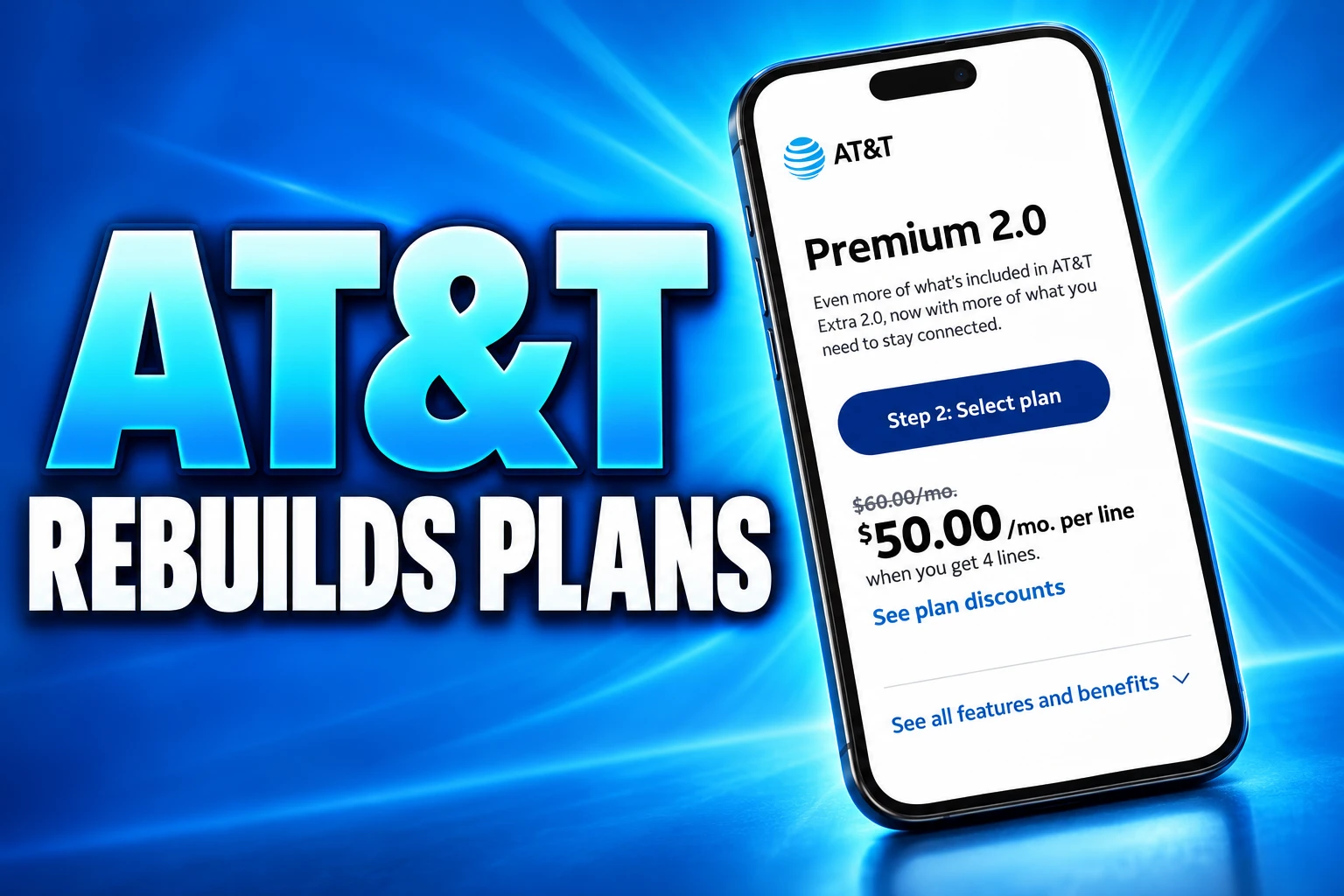
AutoPay prices are round numbers, which is easier to read than the old $50.99 Value Plus VL tag. Value 2.0 is $50 for one line and $120 for four, $0.99 under the old one-line VL rate. Extra 2.0 is $70 and $160, $6 under old Unlimited Extra EL on one line and $4 under it on four. Premium 2.0 is $90 and $200, after a cut from $220 on four lines, and it costs more than old Premium PL on one line until that PL hike is counted.
AT&T 2.0 AUTOPAY PRICES
| Plan | 1 line | 4 lines | High-speed data | Hotspot |
|---|---|---|---|---|
| Value 2.0 | $50 | $120 | 5GB, then congestion slowdowns | 3GB |
| Extra 2.0 | $70 | $160 | 100GB, then congestion slowdowns | 50GB |
| Premium 2.0 | $90 | $200 | Unlimited, no usage throttle | 100GB |
| Elite 2.0 | $110 | $300 | Unlimited, no usage throttle | 250GB |
After the hotspot cap, speeds drop to 128Kbps. Value and Extra stream in standard definition. Premium and Elite unlock 4K, though video still starts in standard definition until you turn the higher setting on. All four tiers include unlimited talk, text, and data in and between the United States, Mexico, and Canada, plus ActiveArmor. Unlimited text from the U.S. to 210-plus countries sits on the whole stack.
Value 2.0 is the budget slot that replaced both Value Plus VL and Starter SL. Five gigabytes of high-speed data is a thin cap for anyone who leaves Wi-Fi. Extra 2.0 is the middle: 100GB of high-speed data, up from 75GB on Extra EL, and 50GB of hotspot, up from 30GB. Premium 2.0 is the no-throttle tier, with 100GB of hotspot (40GB more than old Premium PL’s 60GB) and high-speed data in 20 Latin American countries.
Per-line mix is how AT&T keeps a family from walking over a kid’s data cap. It is also how the company avoids selling every line at the flagship rate. T-Mobile still does not let each line pick a different unlimited tier on the same account, according to AT&T’s own launch note, so the flexibility is a real contrast even if the bill is not always lower.
Build-A-Plan Starts at $15, If You Qualify
On May 21 AT&T unveiled Build-A-Plan, live online from May 27, as a month-to-month way to customize a wireless plan month to month on the same network as postpaid. The pitch was the lowest entry price versus T-Mobile and Verizon. The catch is eligibility: new customers, one line, bring your own unlocked eSIM phone, no contract. There is no international pack, no watch or tablet add-on, and no streaming perk.
AT&T is launching Build-A-Plan, a new wireless plan designed to give customers more choice, control, and value. Beginning May 27, Build-A-Plan customers can connect to America’s largest wireless network1 starting at $15.00 a month and adjust their plan month to month to better… pic.twitter.com/W1RijCGDCu
— AT&T News (@ATTNEWS) May 22, 2026
The $15 base is unlimited talk and text plus 1GB of high-speed data. From there the menu is à la carte. Testers who skip hotspot and 4K have been able to hold unlimited data near $35 a month, and 5G standalone can stay locked on a compatible phone. That is a postpaid floor, not a prepaid killer. Specialist brands still undercut it if you only want a data bucket.
BUILD-A-PLAN ADD-ONS
- Data steps: Add 5GB for $5 or 15GB for $10 on top of the $15 base.
- Unlimited video: Unlimited data with SD streaming is $20 more, or 4K streaming is $35 more.
- Hotspot packs: 5GB for $5, 25GB for $15, or 50GB for $20, with none included by default.
- Short top-up: An extra 5GB, good for five days, costs $8 when you run low.
- Home internet: From July 7, Fiber 300 or Internet Air can ride the same flow at $35 with eligible wireless and AutoPay, which makes $70 with the $15 base and $20 unlimited SD data.
Max out wireless data, 4K, and 50GB of hotspot and you are at $70, in Extra 2.0 territory, without Extra’s 100GB high-speed bucket or Mexico and Canada roaming. AT&T said a survey of 6,008 U.S. wireless consumers from December 2025 and January 2026 found that more than half wanted to personalize wireless and add broadband. OneConnect remains the other door: one subscription, one price, wireless plus home internet, less tinkering.
What AT&T 2.0 Leaves Off the Bill
Premium 2.0 and Elite 2.0 open a wider pipe for 4K apps. They do not pay for the apps. Netflix, Hulu, and Apple TV still bill separately. Robertson made that a feature when Build-A-Plan launched, arguing that rivals wrap extras into “savings” that people did not ask for.
Other carriers offer structured, one-size-fits-all plans bundled with extra services that customers aren’t asking for while calling it ‘savings’
Jenifer Robertson, executive vice president and general manager, AT&T Consumer, May 21, 2026 Build-A-Plan launch
T-Mobile still puts entertainment on the rate card. Experience Beyond lists at $100 for one line and $215 for four with AutoPay, and it includes Netflix and Hulu with ads, plus a five-year price lock on talk, text, and 5G data. Experience More and Better Value carry Netflix as well, and Beyond adds Hulu. Verizon sells discounted streaming packs instead of baking one in. AT&T’s bet is that people would rather pick wireless features than inherit a login they may already pay for.
For a household that already buys Netflix, T-Mobile’s bundle is free money on a comparable four-line bill. For a household that does not, AT&T’s $200 Premium 2.0 four-line rate undercuts Beyond’s $215 and skips the unused app. That is a preference, not a hidden discount.
Frequent Travelers Get Turbo and a Watch Line
Elite 2.0 is the SKU AT&T built for people who roam and tether. One line is $110 AutoPay. Four lines are $300, or $75 each, $20 a line above Premium at four lines. The extra money buys priority, a bigger hotspot bucket, and devices that otherwise list at $21 a month for a tablet and $11 for a watch.
WHAT ELITE 2.0 ADDS OVER PREMIUM
- Hotspot: 250GB per line before 128Kbps, versus 100GB on Premium 2.0.
- AT&T Turbo: Included; it is a $7 add-on on Extra and Premium for streaming, games, and video calls.
- Devices: One cellular watch and one tablet per Elite line at no extra monthly rate, taxes still apply; Premium is 50% off one device, Value and Extra get no break.
- Travel: Unlimited talk and text plus 20GB of high-speed data in 210 countries, then 512Kbps, on top of the Latin America roaming Premium already has.
If you are not paying for Turbo or a watch today, Elite is a raise for features you will not touch. If you already stack those add-ons on Premium, the bundled math can come out ahead. AT&T Turbo Live, the crowded-venue booster at stadiums and concerts, is a different product and is not the $7 Turbo toggle.
Switching still costs that activation fee of up to $50 per line, and a four-line jump can stack the charge. If the plan you have still fits after the 2026 hikes, staying is the cheaper move this month. The 2.0 menu is for people who want mix-and-match, more hotspot, or a $15 on-ramp onto the same towers.
Frequently Asked Questions
Do You Have to Leave a Retired AT&T Plan for a 2.0 Tier?
No. AT&T’s support page says you can keep the current plan and its benefits without doing anything, and it also posts a cancellation path if you want to leave. The 2.0 prices only apply if you choose them, and the activation fee of up to $50 is charged when you make that jump, not when you stay.
What Is AT&T Turbo Versus Turbo Live?
Turbo is a network-priority add-on for everyday streaming, gaming, and video calls. It costs $7 a month on Extra 2.0 and Premium 2.0 and is included on Elite 2.0. Turbo Live is a separate booster AT&T turns on at selected live events, such as football openers, so a packed stadium does not flatten the connection the way a $7 monthly toggle does at home.
Who Can Buy AT&T Build-A-Plan?
Build-A-Plan is limited to new customers who bring an unlocked, eSIM-capable phone, and it is one line per account. You can raise or cut data and hotspot month to month with no contract. Existing AT&T postpaid lines cannot slide onto it; they stay in Unlimited Your Way or a retired plan unless they port out and come back under the new-customer rules.
How Does Build-A-Plan Differ From AT&T OneConnect?
OneConnect is a single subscription that wraps wireless lines and home internet into one all-in monthly price. Build-A-Plan keeps the wireless side modular, then lets you add Fiber 300 or Internet Air as an optional layer starting at $35 with eligible wireless and AutoPay. OneConnect is the fixed bundle; Build-A-Plan is the kit you change when the month changes.
Do Mexico and Canada Trips Stay at Full Speed on 2.0 Plans?
Unlimited talk, text, and data in and between the United States, Mexico, and Canada is included on Value, Extra, Premium, and Elite 2.0. AT&T’s plan footnotes say off-network data while roaming may fall to 2G speeds, so a border trip is covered for calling and texting even when the data pipe is not the same as it is on AT&T towers at home.
The support page still tells people they can stay on a retired plan. The 2.0 stack, the $15 door, and the 2026 hikes are how AT&T fills the network it just promised to keep building.

Instagram Plus Tests a Read-Only Mode That Cuts Stories

Altman Asks the Public to Accept Some AI Harm

Google Freezes OSS VRP Product Reports After AI Flood

AI Agents Make Payment Rails the Scarce Prize

Turkey’s Crypto Boom Now Runs Through Three Banks

Fable 5 Came Back Under a Commerce On-Off Switch

Google’s SpaceX GPU Lease Has a Sept. 30 Deadline

Plasma One’s XPL Locks Face a 1.81 Billion Cliff

DGO’s Rs 549 World Cup Pass Cost Fans Sleep and Data

Moonshot AI’s $30 Billion Ask Became a $35 Billion Close
-
 AI4 months ago
Fable 5 Came Back Under a Commerce On-Off Switch
-
 AI4 months ago
Google’s SpaceX GPU Lease Has a Sept. 30 Deadline
-
 CRYPTO4 months ago
Plasma One’s XPL Locks Face a 1.81 Billion Cliff
-
 APPS4 months ago
DGO’s Rs 549 World Cup Pass Cost Fans Sleep and Data
-
 AI4 months ago
Moonshot AI’s $30 Billion Ask Became a $35 Billion Close
-

 NEWS4 months ago
ColorOS 17 Device List Spans Oppo, OnePlus and Realme
-

 GAMING4 months ago
Xbox Cuts 3,200 Jobs After Five Years of Thin Returns
-

 GAMING4 months ago
The RTX 4050 Under Rs 70,000 Hides a Wattage Gap