
COMPUTERS
Bosgame VTA-439 Sells Local AI on a 32 GB Kit
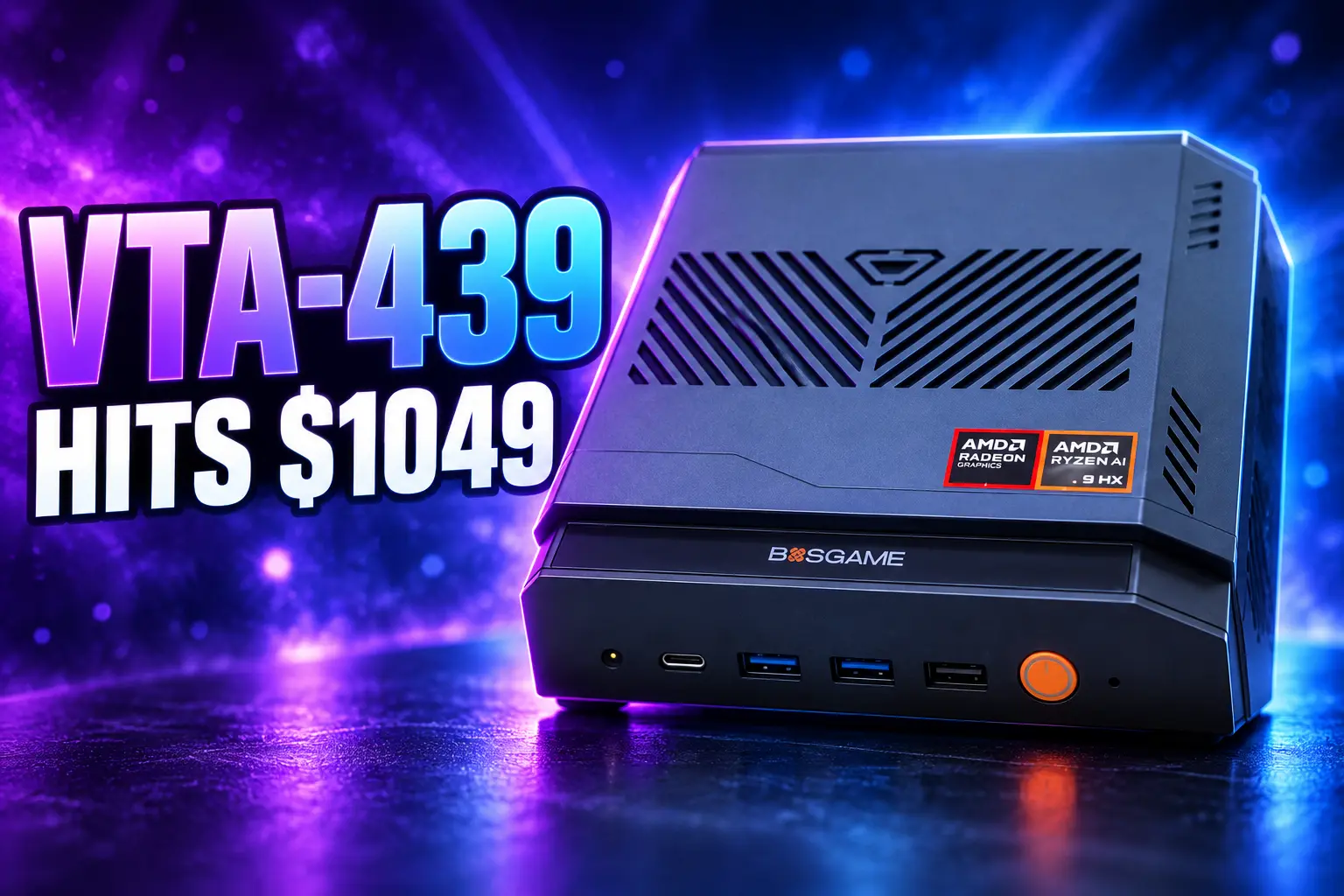
Bosgame’s VTA-439 lists at $1,049 with 32 GB, while the OpenClaw pitch depends on 256 GB slots, an NPU refresh, and an OCuLink eGPU tax.

Bosgame’s VTA-439 mini PC lists at $1,049 with 32 GB of RAM and a 1 TB drive.
The Shenzhen firm, founded in 2019, pitches that kit as a way to run OpenClaw and other local models without paying for AI tokens, on AMD’s Ryzen AI 9 HX 470, in a chassis that can hold 256 GB and an external GPU.
The $1,049 Kit Ships With 32 GB
Bosgame’s store puts the configured 32 GB and 1 TB kit at $1,049, marked down from $1,299, and shows it in stock with US, EU, and UK warehouse plugs. Windows 11 Pro is loaded. The box in the listing is a power adapter, an HDMI cable, and a manual.
That is the machine reviewers keep getting. Michael Larabel ran Ubuntu 26.04 LTS on a 32 GB unit with a 1 TB Kingston NVMe stick. Allen Ngo’s June 23, 2026 lab unit used the same memory size. A home-lab build posted on September 11, 2026 parked a 32 GB VTA-439 next to several 128 GB boxes, which is how the SKU actually shows up once the marketing photos come down.
THE SALE CONFIGURATION
- Street price: $1,049 on Bosgame’s site, down from $1,299.
- Memory and disk: 32 GB DDR5-5600 in two SO-DIMM slots, 1 TB M.2 already fitted.
- Chip: Ryzen AI 9 HX 470 with 86 TOPS total, 55 of them on the NPU.
- Warranty: one year on the Newegg listing of the same kit.
Bosgame still ran a vertical unboxing clip for the VTA-439 on September 6, 2026, three months after the June 4, 2026 launch, with the same small-chassis pitch.
Do you know the VTA-439?
It's an AI mini PC, small in size and doesn't take up much space.
Want to know what's included in this product? Come and take a look!#BOSGAME #VTA439 #MiniPC #CompactPC #DeskSetup #HomeOffice #PCSetup #TechSetup #unboxing pic.twitter.com/2xBqjw3loV
— BOSGAME (@iBosgame) September 6, 2026
Gorgon Point Adds 200 MHz and 5 TOPS
The HX 470 is not a new core design. AMD’s own sheet lists it as Gorgon Point, a Strix Point refresh on TSMC 4 nm in the FP8 package, launched January 5, 2026. It keeps 12 cores and 24 threads, four Zen 5 plus eight Zen 5c, a 2 GHz base, and a 24 MB L3 cache. Boost is 5.2 GHz on the big cores and 3.3 GHz on the dense ones.
Larabel, who had spent two years on Ryzen AI 300 silicon before this unit, clocked the same +200 MHz CPU step over the HX 370 (5.1 GHz to 5.2 GHz) and a matching +200 MHz bump on the Radeon 890M, now listed at 3100 MHz with 16 RDNA 3.5 compute units. The NPU moves from 50 TOPS to 55 TOPS. Combined AI is up to 86 TOPS of combined AI, 31 of that from CPU and GPU. Default TDP is 28 W.
They do get a boost in NPU performance as well, topping out at 55 TOPS and 60 TOPS for the HX 470 and 475, respectively, up from the 50 TOPS found across the rest of the XDNA 2 chips.
Lori Grunin, quoted on AMD’s account, January 2026
Ngo, testing this chassis, measured 75 W PL2 bursts and 65 W PL1 sustained and put the chip “up to 15 percent” ahead of the HX 370. That is a welcome step. It is not a new performance class.
HX 370 TO HX 470
| Spec | Ryzen AI 9 HX 370 | Ryzen AI 9 HX 470 |
|---|---|---|
| Cores / threads | 12 / 24 | 12 / 24 |
| CPU boost | 5.1 GHz | 5.2 GHz |
| 890M clock | 2.9 GHz | 3.1 GHz |
| NPU | 50 TOPS | 55 TOPS |
| Total AI | 80 TOPS | 86 TOPS |
| iGPU | Radeon 890M, 16 CU | Radeon 890M, 16 CU |
A Linux power run on the VTA-439 recorded 6.4 W at idle with the screens off, 7.4 W with them on, 15.9 W in light Balanced use, and 94 W under a sustained CPU load in Performance mode. Dual fans stay quiet until that last number. ACEMAGIC’s F5A uses the same HX 470, so Bosgame does not own the silicon exclusive.
OpenClaw Only Skips Tokens With a Local Model
OpenClaw is a Node.js gateway that stays resident, routes messages, keeps sessions, and calls tools. The process itself idles around 200 to 500 MB. It does not do the heavy inference. It hands that work to Anthropic, OpenAI, DeepSeek, or a local runtime such as Ollama.
Point it at a cloud key and a 4 GB host will run a single agent. Browser automation wants 8 to 16 GB. You still pay the API. The token holiday Bosgame advertises only starts when the model lives on the same box, and that is where the 32 GB kit stops being generous.
A self-host guide last checked in June 2026 puts a local 7-8B Q4 model at 8 to 10 GB of weights and calls it marginal for agent tool calls, because small models invent function formats. Fourteen-billion-parameter Q4 weights take 14 to 16 GB and remain borderline. The 32B models want 24 to 32 GB, which is the band the sale kit occupies with almost no headroom left for the OS, Playwright, and KV cache. Seventy-billion-class work wants 48 GB and up.
OPENCLAW MEMORY BY WORKLOAD
| Workload | Floor | Comfortable |
|---|---|---|
| Cloud LLM, one agent | 4 GB | 8 GB |
| Browser automation | 8 GB | 16 GB |
| Local 7-8B on the same box | 16 GB | 32 GB+ |
| Local 32B Q4 | 24-32 GB | GPU inference box |
| Local 70B+ | 48 GB+ | Dedicated server |
Ollama’s own OpenClaw notes ask for at least a 64K context window for local models, and that context sits in the KV cache on top of the weights. Larabel, comparing the 32 GB VTA-439 with 128 GB mini PCs, wrote that you will not fit the larger models those other systems hold. Bosgame still names Llama 3 8B via Ollama, ComfyUI, and Whisper as the offline set, which matches the 7-8B tier, not a 70B one.
CPU-only decode on a 7B Q4 model is a few tokens per second. Fine for mail you read later, painful if you watch the cursor. A cloud DeepSeek key for agent work is quoted around $1 to $5 a month, cheaper than keeping a GPU warm. The 890M can help, and one Linux Easy Diffusion run on this iGPU produced an image in 18 seconds, faster than the HX 370’s 890M because of the extra clock, still well behind a midrange board.
Two SO-DIMM Slots Carry the Upgrade Path
AMD rates the HX 470 for 256 GB of DDR5-5600 across two channels, and Bosgame fitted two SO-DIMM sockets instead of soldered LPDDR. That is the feature Mac mini buyers cannot touch after checkout, and it is the only way this chassis reaches the 70B RAM band in the table above.
Three M.2 2280 PCIe 4.0 slots sit under the lid, one filled with the 1 TB drive, two empty. Dual 2.5 GbE plus Wi-Fi 7 on an RZ717 radio and Bluetooth 5.4 cover a home lab switch. Front I/O on Bosgame’s listing is one USB4 port with 8K at 60 Hz and 100 W power delivery, plus two USB 3.2 Gen 2 Type-A ports. The rear adds the second USB4-class Type-C on some rundowns, DisplayPort 1.4 at 4K 144 Hz, HDMI at 4K 144 Hz, a USB 2.0 port, and the OCuLink connector.
WHAT YOU CAN ADD LATER
- Memory: two DDR5-5600 SO-DIMMs, AMD ceiling 256 GB.
- Storage: three M.2 2280 PCIe 4.0 bays, one occupied.
- Graphics: OCuLink PCIe 4.0 x4 for an eGPU enclosure.
- Network: two 2.5 GbE jacks plus Wi-Fi 7 for a soft router or NAS link.
Ngo’s verdict leaned on those three full-size M.2 slots, the removable RAM, and OCuLink, which most mini PCs still omit. He also flagged the other side of that industrial shell: no speaker, no microphone, service that needs tools, and a chassis that runs large for the class. Linux on Ubuntu 26.04 with a 7.0 kernel brought up Ethernet and Wi-Fi without drama, which matters if you planned to host the gateway on something other than the bundled Windows image.
OCuLink Feeds the GPU Four Lanes
Bosgame and the June launch notes say the OCuLink port can take cards up to an RTX 5090 class board. The pipe is PCIe 4.0 x4, about 64 Gbps, or roughly 6.7 GB/s when the link actually trains at Gen 4. A desktop 5090 in a x16 slot sees 256 Gbps on PCIe 4.0. Hosts that leave OCuLink on Auto often drop to Gen 3 and cut that figure in half until someone sets Gen 4 in firmware.
The 890M without a dock sits near a GeForce GTX 1650 laptop GPU, which is office 1080p and light games, not a local 70B server. An eGPU is how this box grows into image models and big weights, and it is also how the “save on tokens” sticker turns into a second invoice for an enclosure, a PSU, and a card. Prefill on long agent prompts is where the x4 tax shows up first; decode in a chat window hides it better.
People stacking this SKU against a $1,000 desktop that already has a GeForce RTX 5070 are doing the same math from the other side. A laptop chip in a tiny case at $1,049 has to win on noise, idle watts, and the 256 GB socket, not on rasterization. The 890M will not.
Bosgame Already Sells a 128 GB Strix Halo Box
If the job is large local weights on day one, Bosgame’s own M5 pairs a Ryzen AI Max+ 395 with 128 GB of onboard LPDDR5X and Radeon 8060S graphics. Newegg has listed that 128 GB / 2 TB kit at $3,299.99. Memory there is soldered, so you buy the capacity once. The VTA-439 is the cheaper, slower, serviceable sibling: HX 470 instead of Strix Halo, 32 GB in the door price, slots if you want more.
The M6 under it still uses the HX 370 and the same 890M family, which is why a 5 TOPS NPU bump and 200 MHz of clocks were never going to reorder the catalog. The VTA-439’s job in that stack is the open memory and the third M.2, sold with an OpenClaw headline.
Fill both SO-DIMMs, keep the gateway on NVMe, and this is a quiet 6.4 W idle host for cloud agents or a tight 32B Q4 box. Leave it at 32 GB and a cloud key, and the token bill the listing promised to kill is still on the credit card. The 256 GB ceiling is real. It is not what $1,049 buys.
Frequently Asked Questions
Does the VTA-439 Run OpenClaw on Windows 11 Out of the Box?
No. OpenClaw does not support native Windows; the documented path is Windows 11 with WSL2 running Ubuntu, or a glibc 2.31+ Linux install, and Node.js 22.12 or newer. The VTA-439 ships Windows 11 Pro, so the gateway is a WSL2 or dual-boot project, not a store app.
What TDP Range Does the Ryzen AI 9 HX 470 Allow?
AMD’s configurable TDP window is 15-54 W around the 28 W default. Ngo’s VTA-439 firmware used 75 W short bursts and 65 W sustained, which is why the 120 W adapter and dual fans are in the chassis even though the chip’s nameplate is a laptop 28 W part.
Can You Buy the VTA-439 Without RAM and Storage?
Newegg has listed a barebone VTA-439 at $599.99, memory and SSDs sold separately, with the same HX 470, dual 2.5G LAN, Wi-Fi 7, USB4, and OCuLink. That is the cheaper way onto the 256 GB and triple-M.2 board if you already hold DDR5 SO-DIMMs.
How Many Displays Can the HX 470 Drive?
AMD lists a maximum of four displays, with DisplayPort 2.1 and HDMI 2.1 on the silicon, 7680×4320 at 60 Hz on the DP timing table, and USB Type-C DisplayPort alternate mode. Bosgame’s own rear panel exposes DP 1.4 and HDMI at 4K 144 Hz plus the USB4 8K path, so the four-screen figure is the chip limit, not a promise of four identical 8K tiles on this back panel.

Instagram Plus Tests a Read-Only Mode That Cuts Stories

Altman Asks the Public to Accept Some AI Harm

Google Freezes OSS VRP Product Reports After AI Flood

AI Agents Make Payment Rails the Scarce Prize

Turkey’s Crypto Boom Now Runs Through Three Banks

Fable 5 Came Back Under a Commerce On-Off Switch

Google’s SpaceX GPU Lease Has a Sept. 30 Deadline

Plasma One’s XPL Locks Face a 1.81 Billion Cliff

DGO’s Rs 549 World Cup Pass Cost Fans Sleep and Data

Moonshot AI’s $30 Billion Ask Became a $35 Billion Close
-
 AI4 months ago
Fable 5 Came Back Under a Commerce On-Off Switch
-
 AI4 months ago
Google’s SpaceX GPU Lease Has a Sept. 30 Deadline
-
 CRYPTO4 months ago
Plasma One’s XPL Locks Face a 1.81 Billion Cliff
-
 APPS4 months ago
DGO’s Rs 549 World Cup Pass Cost Fans Sleep and Data
-
 AI4 months ago
Moonshot AI’s $30 Billion Ask Became a $35 Billion Close
-

 NEWS4 months ago
ColorOS 17 Device List Spans Oppo, OnePlus and Realme
-

 GAMING4 months ago
Xbox Cuts 3,200 Jobs After Five Years of Thin Returns
-
 GAMING4 months ago
The RTX 4050 Under Rs 70,000 Hides a Wattage Gap