
AI
Behind JioStar’s OpenAI Bet: Voice Search, Shopping, and AI Shows
JioStar’s OpenAI partnership turns JioHotstar’s voice search into a commerce and content engine, with 60% of users now talking to the app.

JioStar is betting that 500 million conversations with its streaming app will do more than recommend a movie. The conversations, run through a partnership with OpenAI, are meant to order food, surface products that appear on screen, and feed the company’s content commissioning, turning the chat box into a live signal of consumer intent inside the Reliance group.
The 500-million-user streamer, formed in late 2024 from the merger of Reliance’s Viacom18 and Disney’s India operation, is India’s biggest streamer. The OpenAI partnership was announced earlier this year, and JioHotstar’s conversational search rolled out on the same timeline. The company is now putting those conversations to work across commerce, advertising, and content commissioning.
What JioHotstar Built on Top of ChatGPT
JioHotstar’s conversational search runs on OpenAI’s models. Viewers skip the keyboard entirely, asking for “something for a date night” or saying they have “45 minutes to watch something” and getting a recommendation tailored to mood and time budget.
Chief Architect Vijay Seshadri said more than 60% of users who pick the feature now speak to it rather than type. The interface combines voice and imagery, so a viewer can show the system a poster, a screenshot, or a mood board and narrow the request from there. That dual input is what the company says traditional search cannot match, and the voice side runs on OpenAI’s full-duplex voice tech and the risks it flagged.
Each request tells the company what a viewer feels like watching, when, and for how long, a layer of intent that no rating or click ever recorded. JioStar plans to use that signal to reshape what it commissions, where it advertises, and what it sells. The same interface that helps a viewer find a Friday-night thriller is also being wired to let them buy a jacket worn by a character or order a jersey for the team they are watching. Executives say the interface could “become a real-time signal of audience demand, shortening the feedback loop between what viewers want and what studios produce.”
“The future is conversational search,” Ram said, and the case is that engaging search results “lead people to watch content they otherwise wouldn’t have watched, increasing engagement, watch time and our ability to monetize.” Netflix has focused on conversational recommendations, while YouTube, TikTok, and Amazon have integrated commerce into their platforms. JioStar is pitching a single chat surface that handles discovery, shopping, and content data at once, and the rollout is detailed in the official launch of ChatGPT-powered conversational discovery. “AI completely changes that dynamic,” said Fidji Simo, CEO of Applications at OpenAI. “Through our partnership with JioHotstar, we’re bringing personalized AI directly into entertainment and live sports.”
From Discovery to Checkout in One Chat
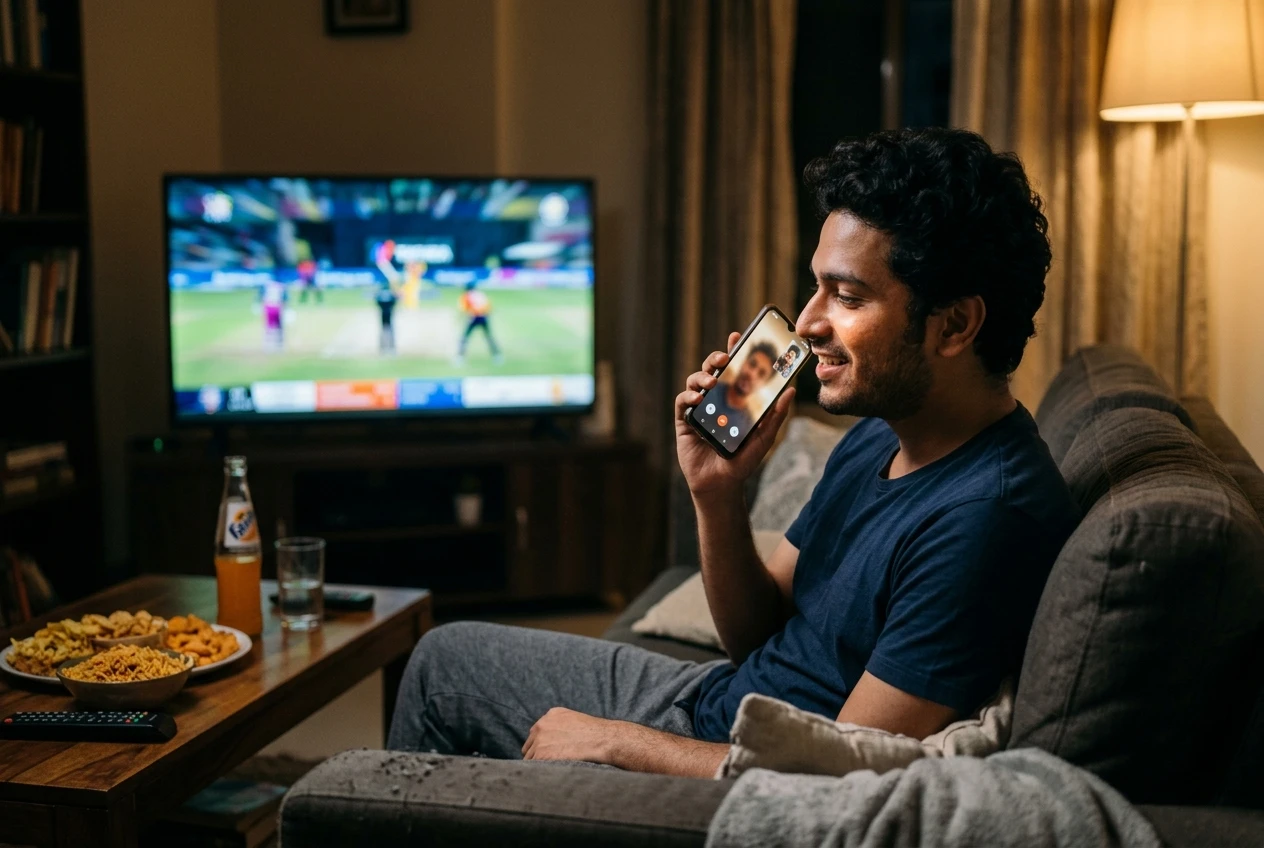
The first place the commerce side went live is food. JioHotstar integrated Swiggy’s delivery network into the app across around 690 cities, letting users order meals without leaving a cricket stream or a movie.
Viewers watching live Indian Premier League matches can check out the menu, place the order, and return to the broadcast. JioStar has also tested letting viewers buy clothing featured on MTV’s reality show Splitsvilla. The company describes both moves as the first step in what Ram calls “content commerce.”
- Swiggy food delivery across around 690 cities during IPL matches and movie premieres
- MTV Splitsvilla clothing tests letting viewers buy outfits seen on the show
- Planned: buy a jacket worn by a character through the chat interface
- Planned: order an IPL team jersey in the same window as the match
“It’s not there yet, but that’s where it’ll naturally come,” Ram said. “There is a good case to make that this is how performance advertising is going to evolve into the future.” India’s e-commerce market is on track to hit $250 billion by 2030, and the Reliance group is positioning itself to capture the e-commerce growth behind that forecast. Vivek Couto, chief executive of the research firm Media Partners Asia, said the screen economy and the retail economy are merging into a “single economy” in India, and JioStar is positioning itself at the seam.
The Tadka Proving Ground
Tadka, the microdrama service inside the JioHotstar app, launched on April 3, 2026. The service offers vertical microdramas with episodes that run 30 to 60 seconds, free and ad-supported, in Hindi, Tamil, Telugu, and other Indian languages. The starting slate counted more than 100 original titles, and the company says daily watch time per viewer has grown fivefold since launch.
The platform has crossed 100 million monthly users, a milestone that took the company less than two months from launch. The launch timing was a deliberate setup: Tadka went live less than a week into the 2026 Indian Premier League season, and JioHotstar held exclusive digital rights.
Across last year’s two-month tournament the platform drew a total audience of 652 million viewers, giving Tadka a user acquisition channel few startups in any country could match. Ambuj Kashyap, JioStar’s executive vice president for micro content, called the milestone “a larger inflection point in the evolution of streaming” and pointed to it as evidence that “premium micro-content” is now “a meaningful new entertainment category.” BDO India projects daily micro-drama viewership in the country could eventually reach 300 million to 500 million people. Research from Ormax and Meta released in March found that 65% of local microdrama viewers had discovered the format only within the past year.
The competitive picture is crowded. Homegrown microdrama services Kuku TV and Story TV have led the category in India and recently outpaced Netflix, Zee5, and SonyLIV in app-store downloads. Kuku now claims more than 10 million paying subscribers across its apps, an early sign that the ad-supported model in Tadka is not the only endgame.
| Service | Owner | Launch | Reach |
|---|---|---|---|
| Tadka | JioStar | April 3, 2026 | 100M monthly users; 100+ titles; 30-60s episodes |
| Kuku TV | Kuku | India pioneer | 10M+ paying subscribers |
| Story TV | Story TV | India leader | Outpaces Netflix, Zee5, SonyLIV in downloads |
| ZEE5 Bullet | ZEE5 | July 2025 | ZEE5 vertical video slate |
| Amazon Fatafat | Amazon | March 2026 | Amazon’s microdrama entry |
| Yash Raj Films | Yash Raj Films | $18M push announced | Bollywood studio entry |
JAMS Makes Every Frame Shoppable
The technical layer behind both conversational search and content commerce is a system JioStar calls JAMS, its video intelligence layer. JAMS makes the existing JioHotstar catalog machine-readable, tagging characters, products, and objects inside each scene, so the assistant knows which jacket appeared in which episode, which car crossed which frame, and which actor is associated with which storyline. Seshadri described JAMS as a “derivative layer” of AI, distinct from generative models, that turns video into structured data the company can search, recommend against, and shop inside. “If you truly start peeling the layers of the onion and understanding what the items within a piece of content are, the separation between content and commerce starts thinning,” Ram said at the APOS 2026 conference.
That semantic understanding is what makes the Swiggy integration, the Splitsvilla clothing tests, and the planned character-wardrobe shopping all reachable through a single voice prompt. The scale underneath is industrial: during the IPL tournament the platform handled peak subscription rates of more than 5 million requests per minute, and JAMS is being built to read, tag, and connect the catalog that those viewers are arriving to find. The JioStar and predecessor businesses, including Viacom18 and Star India, have committed to spend more than $10 billion on content from 2024 to 2026, a budget that JioStar says AI will help stretch without lowering quality.
The AI Studio and the Content Pipeline
JioStar is now building an AI studio in India to produce more than microdramas. The studio is wiring text, image, audio, and video models from multiple AI providers into production workflows, with OpenAI supplying conversational search along with text and voice capabilities. Stephan Bugaj, the Emmy-winning former Pixar and Telltale Games technologist, joined JioStar in February 2026 to lead the AI studio, with the announcement of his new role positioning the hire as the production-side anchor of the AI bet. His pitch is that AI expands what Indian filmmakers can afford to make, not what they are forced to cut.
The studio’s job, Bugaj said, is to use models the way any other piece of the production stack is used, and to refuse the temptation to flood the platform with synthetic content. “We’re not just trying to turn on a big siphon and spray out AI slop all over our platform,” he said.
Tadka, where the per-episode cost of a 60-second microdrama is the kind of budget problem generative video is finally being measured against, is the studio’s starting point. The same workflows, if they work, will move up the slate. Bugaj’s remit covers the full slate, from microdramas to streaming feature films, ad creative, and primetime TV.
The promise of the technology is to be able to do things that are spectacular at the level of a Star Wars or a Harry Potter at a budget that will allow us to still be profitable in India.
Bugaj, JioStar’s SVP of GenAI content and technology, made the remark in an interview about the AI studio’s scope. The studio is built to handle the full slate, from microdramas to streaming feature films, ad creative, and primetime TV, in a market where JioStar is hiring against the AI hiring gap India is racing to close.
The Reliance Bet Behind the Strategy
None of this sits in a vacuum. JioStar is the $8.5 billion joint venture formed in late 2024 when Walt Disney folded its India television and streaming business into a new entity with Reliance Industries’ Viacom18, with Reliance and Viacom18 holding a combined 63.16% and Disney holding 36.84%. The merged app combining JioCinema and Disney+ Hotstar went live in February 2025, and the company says it now reaches more than 750 million viewers a week.
Inside the Reliance group, the streaming business shares a roof with Jio’s telecom arm, Reliance Retail, and the broader consumer footprint that Indian regulators have been reviewing for years. Making JioHotstar the conversational entry point for shopping, food, and content is a strategy that depends on that adjacent retail and telecom base, in a context where Indian CEOs are now pressured to adopt AI faster than they can measure. It also explains why the AI studio is being built in India, why Swiggy is the first commerce partner, and why the chat interface is being taught Indian languages and Indian viewing habits before anything else. JioStar competes in conversational recommendations with Netflix and in conversational commerce with YouTube, TikTok, and Amazon, and the company’s pitch is that it can combine both.
Couto, the Media Partners Asia chief, said the next year of execution will decide whether the conversational interface becomes a habit or a feature. JioStar has said it will keep adding reasons for users to talk to the app, including the Swiggy integration, the AI studio’s output, and the planned character-wardrobe shopping.
JioStar’s bet reaches beyond the chat box. The company is wiring the conversation data into the ad stack, the retail partnerships, and the content commissioning pipeline, on the premise that a spoken request for a Friday-night movie is the same kind of intent an advertiser or a producer can act on. Reliance and Disney each have reason to want the strategy to work, since the streaming business is the consumer entry point for the rest of the group.
Bugaj said the AI studio’s job is to make sure the content the system points viewers at is worth the conversation. Whether 500 million users will keep talking to the app is the open question JioStar’s strategy turns on.
Frequently Asked Questions
What is JioStar’s partnership with OpenAI?
JioStar and OpenAI announced a partnership earlier in 2026, and JioHotstar rolled out ChatGPT-powered conversational search on its app. The deal covers the discovery layer, plus text and voice capabilities for JioStar’s broader AI workflows, and it runs both ways: JioHotstar surfaces ChatGPT-branded recommendations inside the app, while ChatGPT itself can point users to JioHotstar’s catalog for entertainment queries.
What is JioHotstar’s conversational search?
Conversational search is a voice- and chat-driven discovery feature that lets JioHotstar viewers describe their mood, ask for a recommendation for a date night, or say they have 45 minutes to watch something. More than 60% of users who pick the feature now speak to the app rather than type, according to JioStar Chief Architect Vijay Seshadri.
What is content commerce?
Content commerce, in JioStar’s usage, is the practice of letting viewers buy products that appear inside a show or a live sports broadcast through the same interface they use to watch. Swiggy food delivery, available across around 690 cities, and the Splitsvilla clothing tests are the first examples.
What is Tadka?
Tadka is a vertical-video microdrama service that launched inside the JioHotstar app on April 3, 2026, with episodes running 30 to 60 seconds. The platform has crossed 100 million monthly users, with more than 42% of viewership from users under 24.
What is JAMS?
JAMS is JioHotstar’s video intelligence layer, a system that makes the catalog machine-readable by tagging characters, products, and objects inside each scene. It is the data layer underneath both conversational recommendations and content commerce.


Lunit Turns Routine H&E Slides Into a Lung Pre-Screen

Meta’s Muse Agent Wants Your Inbox and Your Card

Police Chase Mules as AI Chatbots Run Romance Scams

Ticketmaster’s Personalized App Is Built to Move Empty Seats

Software Deals Now Hinge on Filing Accuracy, Not Beats

Iowa Counties Warn Workers That ChatGPT Keeps Their Files

Shaalan Beg’s Oncology AI Hits an Enrollment Wall

Exowatt Warns Gas-Fired AI Campuses May Not Last a Decade

Philips Splits Innovation and Hands AI to Partovi

Chrome 153 Puts the Whole Web on a Two-Week Clock

Oracle Cuts 21,000 Jobs in a Year, Cites AI in 10-K Filing

Fable 5 and Mythos 5 Return as US Lifts Anthropic Export Controls

SpaceX’s Google Deal Turns a Rocket Company Into a Cloud Landlord

CD Projekt Red Co-CEO: Redemption Arc Isn’t Done, Witcher 4 in 2027

XPL Rallies 30% Ahead of Plasma One Card Tier Launch

Google Search Profiles Build a Follow Graph Inside Discover

DGO App Brings Rs 549 Mobile Pass for FIFA World Cup 2026 in Nepal

Moonshot AI Targets $30 Billion in China’s Fastest AI Funding Sprint

Oppo’s ColorOS 17 Eligibility List Leaves A-Series Buyers Behind

Microsoft Xbox Layoffs Start in July as Sharma Slams 3% Margin
-
 AI3 months ago
Oracle Cuts 21,000 Jobs in a Year, Cites AI in 10-K Filing
-
 AI2 months ago
Fable 5 and Mythos 5 Return as US Lifts Anthropic Export Controls
-
 AI3 months ago
SpaceX’s Google Deal Turns a Rocket Company Into a Cloud Landlord
-
 GAMING3 months ago
CD Projekt Red Co-CEO: Redemption Arc Isn’t Done, Witcher 4 in 2027
-
 CRYPTO3 months ago
XPL Rallies 30% Ahead of Plasma One Card Tier Launch
-
 NEWS3 months ago
Google Search Profiles Build a Follow Graph Inside Discover
-
 APPS3 months ago
DGO App Brings Rs 549 Mobile Pass for FIFA World Cup 2026 in Nepal
-
 AI3 months ago
Moonshot AI Targets $30 Billion in China’s Fastest AI Funding Sprint