
GAMING
Microsoft Layoffs Hit 4,800 as Chief People Officer Denies AI
Microsoft’s chief people officer says 4,800 layoffs are not about AI. Xbox takes 3,200 of those cuts, with four studios going independent, 14 layers cut

On Monday, Microsoft announced 4,800 layoffs, and the company’s chief people officer moved quickly to draw a line. In a public memo reviewed by multiple outlets, Amy Coleman wrote that “the roles eliminated today are not being replaced by AI.” Microsoft followed that denial with a number that complicates it: 3,200 of those jobs sit inside Xbox, roughly 20% of the gaming division’s global workforce.
Coleman’s own next sentence draws the contradiction she is trying to defuse. AI “is changing how work gets done,” she wrote, and “some of the tasks we do every day can now be automated.” At Xbox, the cuts land on studios, management layers, and a multiplatform strategy that has not produced the returns Microsoft projected when it paid $68.7 billion for Activision Blizzard. A gaming reckoning is arriving while Microsoft spends at record pace on AI infrastructure.
Coleman Tells Microsoft Staff the Cuts Are Not About AI
Microsoft chief people officer Amy Coleman sent the memo to employees on Monday morning, ahead of the public confirmation. The message paired a categorical denial with a softer acknowledgement of the broader anxiety. “I also want to be direct that the roles eliminated today are not being replaced by AI,” Coleman wrote. The next sentence walked that back: “At the same time, it is true that AI is changing how work gets done. Some of the tasks we do every day can now be automated, and that means we all need to keep learning, keep building new skills, and keep adapting as the work evolves.”
Coleman framed the cuts as part of Microsoft’s ongoing business transformation, not a workforce swap with AI tools. “Our business is changing because the world around it is changing,” she told employees. “The way technology is built, deployed, and used is transforming faster than at any point in my time here.” Microsoft said the restructuring aims to help the company focus on delivering differentiated customer value and better align resources with long-term priorities.
This comes down to two commitments: making the decisions needed to drive differentiated customer value, and supporting the people affected by them.
Amy Coleman, Microsoft’s chief people officer, said this in a memo to employees on Monday. The line that landed hardest internally was Coleman’s forward warning: “We are still early on this journey, and there will be more changes ahead; other parts of our business will need to make similar changes.” In an interview with GeekWire, Coleman stopped short of signalling further layoffs companywide. She described a larger shift in how Microsoft manages its workforce, including reskilling engineers for customer-facing and AI-focused positions and exploring voluntary exit programs as a recurring option rather than a one-time offer. In a separate signal of how the AI jobs debate is shifting inside the company, Microsoft’s AI chief walking back his own white-collar warning landed in the same news cycle.
Xbox Takes the Heaviest Cut
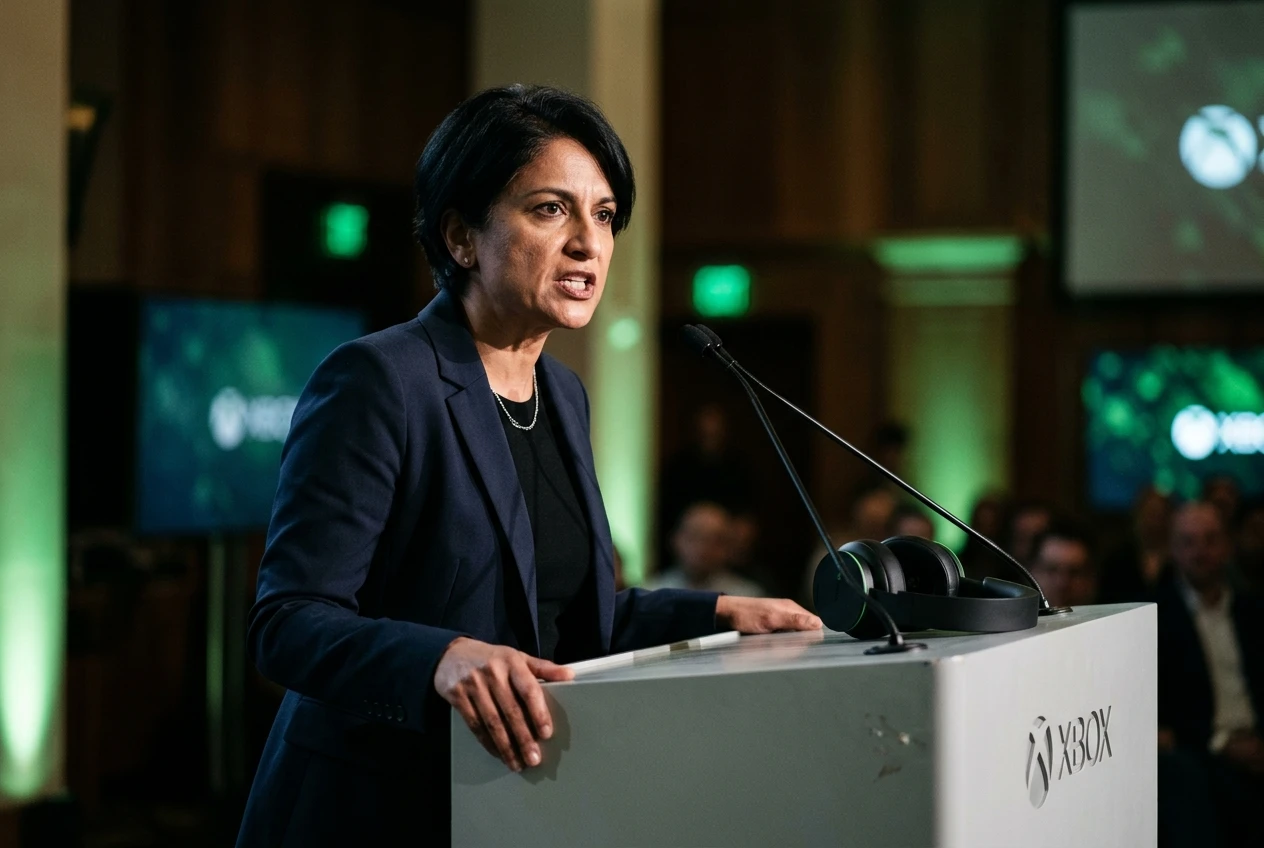
Microsoft is eliminating 4,800 roles, about 2.1% of its global workforce, according to Coleman’s memo. Xbox absorbs the largest share by a wide margin: 3,200 of those roles, or about 20% of the gaming division’s global headcount this fiscal year. Of the 3,200, roughly 1,600 positions end this week, with the remaining 1,600 to follow through the end of fiscal year 2027, per Sharma’s note.
Sharma’s note to her staff was blunt. She called the cuts the most significant restructure in Xbox history and described the division’s margins as 3-10x lower than comparable platform and publishing businesses. Sharma also noted that some work within the division passes through 14 layers of management, a number she intends to reduce to no more than five, and where possible three. Platform teams, she wrote, have grown 40% since the start of the current console generation.
We are beginning the most significant restructure in XBOX history. Our business today is not healthy. We are operating at margins that are 3-10x lower than comparable platform and publishing businesses. In a typical year, we lost 64 cents for every dollar we invested.
Asha Sharma, Xbox CEO, in a memo to employees on Monday. Microsoft is moving four Xbox studios to outside management, with a fifth, Arkane Studios in France, also being sold or spun off:
- Ninja Theory, the UK studio behind the Hellblade series
- Undead Labs, the State of Decay developer
- Compulsion Games, the Canadian studio behind We Happy Few
- Double Fine Productions, the Psychonauts maker
Sharma confirmed that Xbox will not cancel any of its first-party, publicly announced games or projects. Earlier reporting on the three Xbox studio closures had surfaced the changes before the wider cut announcement. Microsoft has not said which studios, if any, will follow the same path in the next phase of restructuring.
The cuts land on a division that entered the latest console generation with a smaller install base and higher costs than Sony and Nintendo, then chased growth in services like Game Pass without the returns Microsoft expected. Sharma pointed to weaker-than-expected Game Pass performance and stiff competition from independent studios Microsoft now has to fight for players’ time and attention. The Verge and Business Insider reported the Xbox reduction as part of a broader reset of the division through fiscal year 2027. About 600 of the cuts are in Washington state, down from 3,200 a year ago, even as the global gaming cuts deepen.
The Math Microsoft Won’t Put Side by Side
The numbers behind Microsoft’s restructuring, drawn from its own communications and confirmed in independent reporting, do not point in a single direction. Microsoft is cutting 4,800 roles while simultaneously standing up the Microsoft Frontier Company, an initiative announced last week to embed engineers inside customers to deploy AI. The Frontier unit carries a roughly $2.5 billion price tag, with around 6,000 existing Microsoft staff deploying Azure AI, Copilot, and Dynamics 365 alongside client engineering teams. Microsoft’s new 6,000-engineer AI deployment unit is the operational counterweight to the layoffs, though it is not framed as a hiring offset. The two tracks sit side by side: a reduction in headcount and an expansion of AI capacity.
The contrast is sharper when Microsoft’s AI infrastructure spending enters the frame. The cuts come amid record capital spending on AI, Wall Street pressure to keep operating expenses in check, and a 30% stock slide that has wiped out roughly $1.2 trillion in Microsoft’s market value over the past nine months, according to GeekWire. Brad Smith, Microsoft’s president and vice chair, told GeekWire that “Microsoft can only be a strong employer if it has a successful business. We have to adapt to change.” On AI’s effect on coding work, Smith said “some things like coding require less time of software developers,” while product management, software design, and customer-facing roles grow. On Monday, shares of Microsoft fell about 1% in early trading. Over the past year, the company redeployed more than 4,000 employees into new roles and offered a voluntary retirement program; about 30% of the roughly 8,750 eligible US employees accepted. The cuts hit a workforce that totals about 220,000 people, CFO Amy Hood said on an April earnings call. In 2025, Microsoft cut more than 15,000 jobs globally in two rounds in spring and summer, the largest reductions in more than a decade.
A Gaming Reckoning Years in the Making
The current Xbox cuts sit at the end of a strategy that began long before Sharma arrived. Microsoft announced its $68.7 billion acquisition of Activision Blizzard in January 2022, in what the 2022 announcement of the Activision Blizzard acquisition framed as bringing the joy of gaming to every device. The deal closed in fiscal year 2023 after regulatory review in the United States, United Kingdom, and European Union, making Microsoft the world’s third-largest gaming company by revenue behind Tencent and Sony. The company had added ZeniMax and Minecraft to its portfolio in earlier moves. The expectation inside and outside Microsoft was that scale, exclusive franchises, and Game Pass subscriptions would fund the next phase of growth. Microsoft’s multiplatform shift, putting first-party titles on PlayStation and Nintendo hardware, opened new distribution but also weakened the exclusivity argument that once justified the acquisition price.
Game Pass, the subscription service at the centre of that bet, has not delivered. Sharma’s memo pointed to weaker-than-expected Game Pass performance and stiff competition from independent studios Microsoft now has to fight for players’ time and attention. Sharma’s earlier margin memo to staff had warned that the gaming unit was closing the year at a 3% margin after five years of heavy spending, a signal Monday’s cuts formalized. The decision to move four studios outside Microsoft also reflects a calculation that smaller, independent teams can run on tighter margins than a corporate structure built around platform-wide integration.
Sharma took over Xbox on February 20, 2026, after Phil Spencer retired following 38 years at Microsoft. Spencer had shepherded the Activision, ZeniMax, and Minecraft acquisitions and nearly tripled the size of the gaming business in his 12 years leading it. Sharma came from inside Microsoft, with prior roles as Chief Operating Officer at Instacart and a Vice President at Meta. Satya Nadella’s note on the new Xbox CEO appointment framed her task as both humble and urgent. Five months later, she delivered the largest restructure in Xbox history. The signal that Monday’s cuts are Phase One is also the signal that Spencer’s three acquisitions are now in Sharma’s hands to monetize or unwind.
Microsoft’s Memo Signals More Cuts to Come
Coleman’s memo and the company statements that accompanied it leave little doubt that Monday’s announcement is a phase, not the full restructuring. “Other parts of our business will need to make similar changes,” Coleman wrote, in a line that has circulated inside Microsoft since Monday morning.
The voluntary retirement program is likely to become a recurring lever. Coleman told GeekWire that Microsoft is exploring how to make voluntary exits a regular part of its operations, not a one-time offer. About 30% of eligible US employees took the first round; with roughly 8,750 eligible workers, the next round could draw a similar share and produce comparable savings. Microsoft did not commit to a date for the next round. The internal framing is that reskilling engineers for customer-facing and AI-focused positions will absorb some of the displacement, with more than 4,000 employees already redeployed over the past year. Future rounds will arrive under the same framing Coleman used on Monday: not AI replacements, but a reshaping of the work that remains.
Frequently Asked Questions
How many Microsoft employees were laid off in the latest round?
Microsoft announced 4,800 layoffs on Monday, July 6, 2026, representing roughly 2.1% of its global workforce. About 600 of those positions are in Washington state, per the company’s Worker Adjustment and Retraining Notification filing.
Are the Microsoft layoffs because of AI?
Microsoft says no. Chief people officer Amy Coleman wrote in a public memo that “the roles eliminated today are not being replaced by AI.” At the same time, Coleman acknowledged that AI “is changing how work gets done” and that employees will need to keep building new skills as tasks are automated.
Which Xbox studios are being closed or spun off?
Microsoft is moving four Xbox studios to outside management: Ninja Theory, Undead Labs, Compulsion Games, and Double Fine Productions. A fifth, Arkane Studios in France, is being sold or spun off. Xbox CEO Asha Sharma confirmed the company will not cancel any of its first-party, publicly announced games or projects.
Who is Asha Sharma?
Asha Sharma is the CEO of Xbox, a role she has held since February 20, 2026. She replaced Phil Spencer, who retired after 38 years at Microsoft. Before joining Microsoft, Sharma was Chief Operating Officer at Instacart and a Vice President at Meta, according to Microsoft’s official announcement.
When did Microsoft last lay off this many workers?
In 2025, Microsoft cut more than 15,000 jobs globally in two rounds in spring and summer, the largest reductions in more than a decade. Monday’s 4,800 cuts are smaller overall, but the 3,200 jobs inside Xbox represent the heaviest single-division hit in the gaming business’s history.


South Korea Retail Investors Face Reckoning After KOSPI AI Rally Collapses

Surrey AI Maps Three Heart Attack Paths and Their Molecular Roots

Germany Locks Neutral Apple ATT Prompts Across Most of Europe

Apple’s 5% EU Fee Quietly Rewrites Alternative App Store Math

Apple’s EU Fee Truce Cuts Complexity but Leaves Rivals Fuming

Pixel 11 Pro Fold Trades Thinness for Durability and Seven-Year Stay

Mayo AI Flags HCM Obstruction From Everyday Ultrasound Videos

Indian Brands Quietly Scale Landmark Screens and Home Tech

Navin Vatsa Turns Grief Into a Lifetime of Quiet Seeing

Google Bets Pixel 11 Agentic AI Will Redefine Phones

Oracle Cuts 21,000 Jobs in a Year, Cites AI in 10-K Filing

Fable 5 and Mythos 5 Return as US Lifts Anthropic Export Controls

SpaceX’s Google Deal Turns a Rocket Company Into a Cloud Landlord

CD Projekt Red Co-CEO: Redemption Arc Isn’t Done, Witcher 4 in 2027

XPL Rallies 30% Ahead of Plasma One Card Tier Launch

Google Search Profiles Build a Follow Graph Inside Discover

DGO App Brings Rs 549 Mobile Pass for FIFA World Cup 2026 in Nepal

Moonshot AI Targets $30 Billion in China’s Fastest AI Funding Sprint

Oppo’s ColorOS 17 Eligibility List Leaves A-Series Buyers Behind

Microsoft Xbox Layoffs Start in July as Sharma Slams 3% Margin
-
 AI2 months ago
Oracle Cuts 21,000 Jobs in a Year, Cites AI in 10-K Filing
-
 AI2 months ago
Fable 5 and Mythos 5 Return as US Lifts Anthropic Export Controls
-
 AI2 months ago
SpaceX’s Google Deal Turns a Rocket Company Into a Cloud Landlord
-
 GAMING2 months ago
CD Projekt Red Co-CEO: Redemption Arc Isn’t Done, Witcher 4 in 2027
-
 CRYPTO2 months ago
XPL Rallies 30% Ahead of Plasma One Card Tier Launch
-
 NEWS3 months ago
Google Search Profiles Build a Follow Graph Inside Discover
-
 APPS2 months ago
DGO App Brings Rs 549 Mobile Pass for FIFA World Cup 2026 in Nepal
-
 AI2 months ago
Moonshot AI Targets $30 Billion in China’s Fastest AI Funding Sprint