
AI
Samsung Posts 19-Fold Profit, but Shares Closed Down 7%
Samsung’s Q2 2026 profit of 89.4 trillion won beat estimates at 19-fold a year ago, yet shares fell 7% as SK Hynix’s HBM lead and Apple price hikes took over.

Samsung Electronics on Tuesday disclosed preliminary operating profit of about 89.4 trillion won for the second quarter of 2026, drawn from sales of approximately 171 trillion won. The figure, which cleared the 84.2 trillion won analyst average, runs roughly 19 times what Samsung earned in the same three months a year ago. It is the third consecutive record high, and the largest single-quarter operating profit Samsung has ever reported.
Shares closed 6.9% lower in Seoul the same day, with the stock briefly down 10% intraday, the kind of move that follows a miss, not a record beat. The result exposed the cost of Samsung’s quarter: a $70 billion-plus 2026 capex plan, a 10.5% bonus provision that stripped trillions of won from the headline, and an analyst warning that the AI infrastructure spend fueling the boom may not keep growing. Across the country, the bigger AI memory winner sits a short train ride south: SK Hynix, which briefly overtook Samsung in market cap last month and has filed for a US listing. Investors are now waiting to see who pays for the squeeze on the other side of the trade.
The 19-Fold Profit, in One Number
Samsung’s earnings guidance, posted on the company’s newsroom on Tuesday in Samsung’s Q2 2026 earnings guidance disclosure, puts consolidated Q2 2026 operating profit at a median of 89.4 trillion won within a stated 89.3 to 89.5 trillion won range. Korean disclosure rules bar the company from publishing a wider band, so the figure is the midpoint of internal estimates. The sales line, 170 to 172 trillion won, also cleared the 169.2 trillion won average analyst estimate by a small margin.
On a year-on-year basis, operating profit for the quarter is expected to jump more than 1,800%+, per the guidance. The latest quarter is the third consecutive record high, following Q1 2026’s 57.2 trillion won operating profit. According to a Bloomberg report on the disclosure, the print “dwarfs Samsung’s performance for all of 2025.” The growth is driven almost entirely by memory chips sold into AI data centers, a market where Samsung, SK Hynix, and Micron are the only three suppliers at scale.
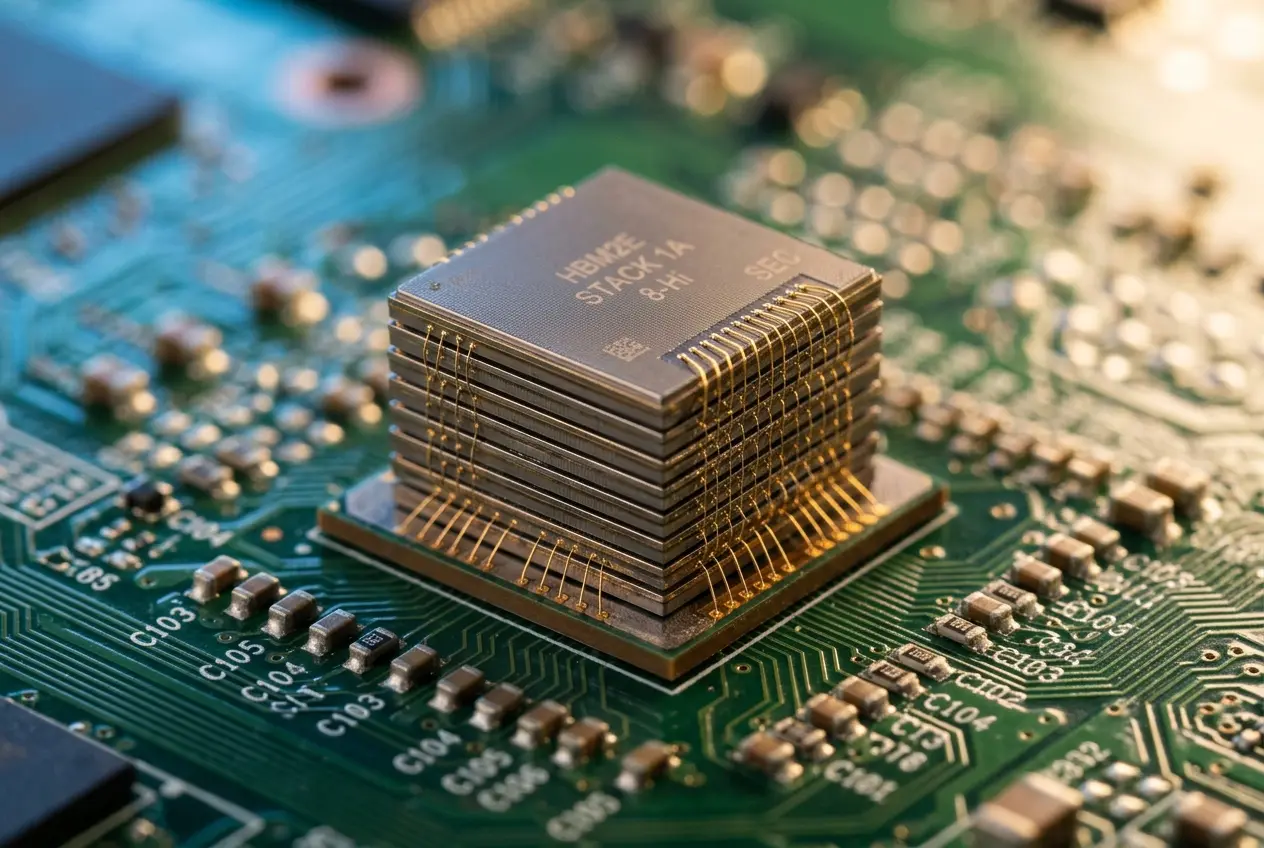
The memory market has spent the past three years inverting. Demand for high-bandwidth memory, the stacked DRAM that lives next to Nvidia’s AI accelerators, has pulled so much factory capacity that older, conventional memory for smartphones and PCs has gone into shortage. The shift, executives including Nvidia’s Jensen Huang and OpenAI COO Brad Lightcap have said, is the bottleneck for AI development, and the shortage is now expected to last through 2027 at the earliest.
- 89.4 trillion won: Samsung’s preliminary Q2 2026 operating profit, the highest in company history
- 171 trillion won: Q2 2026 sales (estimate: 169.2 trillion won)
- 1,800%+: Year-on-year jump in operating profit
- 57.2 trillion won: Q1 2026 operating profit, the second of three consecutive record highs
- 84.2 trillion won: Average analyst estimate Samsung cleared
Why the Stock Sold Off Anyway
Samsung shares closed 6.9% lower in Seoul on Tuesday, per Yahoo Finance, with the stock briefly down 10% intraday. The drop, on a day Samsung posted the largest single-quarter operating profit in its history, looks like a riddle. The 7% slide is the kind of reaction that follows a miss, not a record beat. Per eToro’s market analyst Zavier Wong, speaking to CNBC, the run-up had already pulled the stock to a place where the print had little left to reward.
The same logic shows up in how the quarter was discussed elsewhere. Samsung’s “strong earnings were widely expected and had largely been priced in after its shares rallied ahead of the results,” Albert Yong, managing partner at Petra Capital Management, told Reuters, and he added that “investors remain concerned about the sustainability of the AI boom and the risk of slower AI infrastructure spending by major US technology firms.” A Morgan Stanley note published the day before the earnings release had warned that the recent pullback in chipmaker shares was not yet over.
On top of the macro question sits a local one. Samsung has earmarked 10.5% of its semiconductor division’s annual operating profit for employee bonuses, per CNBC, after scrapping a 1,000% base salary bonus cap following a weeks-long labor union protest. Analysts told CNBC that the bonus provision shaved a meaningful sum from the quarterly figure, and that stripping it out would have pushed the number above 100 trillion won. Counterpoint Technology Market Research director Tom Kang told CNBC that memory prices “may have gone up too high, fueling concerns about demand,” yet Kang’s own monthly checks into memory prices for consumer products, mobile products, and servers “indicated that prices are still rising.” Adding to the rotation, SK Hynix’s US ADR listing landed the same week, Wong pointed out, “pulling some of that rotation appetite elsewhere.”
It acts more like confirmation, and confirmation is what people sell into.
Per eToro market analyst Zavier Wong, speaking to CNBC, the print had already done its job by confirming what the run-up had priced in, and the next leg of the rally now has to come from earnings beats at the other chipmakers, not from Samsung. The same logic sits inside the company: Samsung’s capex load is heavy enough that the next chapter of the story depends on whether AI infrastructure spend holds. The other side of the trade, the device makers forced to absorb higher memory costs, is now the constraint the memory giants have to manage.
SK Hynix Is Still the Bigger AI Memory Winner
On June 22, 2026, SK Hynix briefly overtook Samsung Electronics in market value, capping a 5.6% single-day surge that put the memory specialist at over 2.1 quadrillion won ($1.35 trillion), per Fortune’s account of SK Hynix briefly overtaking Samsung in market value, just ahead of Samsung’s $1.34 trillion. Samsung retook the top spot the next day as both stocks fell in a broad tech selloff, but the lead change stuck in the market’s mind. SK Hynix’s market cap has since pushed above $1 trillion again on the way to a US listing. The flip was not a fluke: SK Hynix now controls about 58% of the high-bandwidth memory market by revenue, per Counterpoint Research cited by Fortune, with Samsung and Micron Technology in second and third place.
The gap is structural. SK Hynix is the exclusive supplier of HBM to Nvidia’s Hopper and Blackwell platforms, per Fortune, and Samsung was slow to qualify its HBM3E and HBM4 parts with Nvidia. The result is a product mix that skews harder toward the highest-margin memory SK Hynix sells.
SK Hynix’s stock performance has outrun Samsung’s by a wide margin. SK Hynix shares are up by almost 900% over the past 12 months, per Fortune, compared with almost 180% for the broader KOSPI index. SK Hynix traded up 9.21% the day it crossed the $1 trillion mark, per CNBC, while Samsung rose only 2.68% the same session. SK Hynix posted a record 97 trillion won ($63.1 billion) in revenue in 2025, up 47% year on year, with net profit of 42.9 trillion won ($27.9 billion), double the year before. The company has filed confidentially for a US listing, with media reports suggesting the debut could come as soon as August.
| Metric | Samsung Electronics | SK Hynix |
|---|---|---|
| Q1 2026 operating profit | 57.2 trillion won | 37.6 trillion won |
| Q1 2026 revenue | 133.9 trillion won | 52.5 trillion won |
| 2026 YTD stock gain | ~165% | ~260% |
| HBM market share by revenue | Second, behind SK Hynix | ~58% (Counterpoint) |
| US listing status | Already US-listed | ADR filing; August debut possible |
The Conventional Memory Tax on Devices
The same AI memory boom that lifted Samsung’s profit is squeezing the device makers on the other side of the trade. Samsung, SK Hynix, and Micron have reallocated factory capacity away from conventional DRAM and NAND flash and toward high-bandwidth memory and high-capacity DDR5 for AI servers, per IDC’s analysis of the downside scenarios for smartphones and PCs. The shift is what IDC’s analysts call a “zero-sum game“: every wafer allocated to an HBM stack for an Nvidia GPU is a wafer denied to the LPDDR5X module of a mid-range smartphone or the SSD of a consumer laptop. The result is an unprecedented conventional memory shortage, and the prices that flow from it.
For smartphones, IDC expects 2026 DRAM and NAND supply growth well below historical norms, at 16% and 17% year on year respectively. In IDC’s moderate downside scenario, the global smartphone market could contract by 2.9% in 2026; in its pessimistic scenario, the contraction could reach 5.2%. Gartner’s Ranjit Atwal, in comments reported by CNBC, projects a sharper cut: global smartphone shipments down 8.4% in 2026 and PC shipments down 10.4%, with smartphone prices up 13% and PC prices up 17% against 2025.
The personal computer market is taking the harder hit. IDC’s moderate downside scenario has the PC market contracting 4.9% in 2026, against a 2.4% year-on-year decline in the firm’s November forecast. In the pessimistic scenario, the decline could reach 8.9%. PC vendors have started moving first: Lenovo, Dell, HP, Acer, and ASUS have warned clients of tougher conditions ahead, confirming 15-20% price hikes and contract resets as an industry-wide response, per IDC.
The squeeze lands hardest on the players with the thinnest margins. IDC points to TCL, Transsion, Realme, Xiaomi, Lenovo, Oppo, Vivo, Honor, and Huawei as the device makers whose thin business models absorb the cost first, with white-box and lower-tier PC vendors, including DIY builders and gamers, set to bear the largest share. IDC warns the structural shift is permanent, not a cyclical mismatch that resolves itself, and the shortage is not expected to ease until at least the end of 2027.
The Buyer’s Side: Cook, the PC Vendors, and Best Buy
Apple, normally treated as the most insulated name in consumer hardware, is now telling customers to expect higher prices. Apple CEO Tim Cook told the Wall Street Journal, in an interview excerpt posted on the Journal’s site and reported by CNBC, that price increases on Apple products are coming because of surging memory and storage costs. It is the first time Apple has publicly committed to a price hike over the AI memory squeeze, and the company has already begun raising prices on MacBooks and iPads, per the same CNBC report. “Even Apple can’t be safe,” Ranjit Atwal, a senior director analyst at Gartner, told CNBC, “as much as they have all the expertise and long-term planning, and everything else.”
Cook declined to say in the interview which products would rise or when, but IDC’s Francisco Jeronimo, in comments to CNBC, expects Apple to push the $999 iPhone Pro and the $1,199 iPhone Pro Max up by $100 while leaving lower-end devices alone. Analysts at BofA Securities agree, and are also expecting price increases for most Mac and iPad models. Apple, per the CNBC report, has in recent months been targeting budget-conscious consumers with new launches like the $599 MacBook Neo and the $599 iPhone 16e, moves that take on new weight as Android rivals face cost pressure of their own.
Unfortunately, price increases are unavoidable. We’re doing our best to mitigate the huge increases that are being passed to us, and we’ve been trying to shield our customers from the increases, but the situation has become unsustainable.
Tim Cook, Apple’s outgoing CEO, said price increases had become unavoidable in a Wall Street Journal interview reported by CNBC, less than three months before he is set to step down. For Microsoft, HP, Dell, Lenovo, Acer, and ASUS, the squeeze is now a pricing reality rather than a warning, with PC vendors confirming 15-20% hikes and contract resets, per IDC. The wider retail channel is bracing too: incoming Best Buy CEO Jason Bonfig said on a call with reporters, in comments reported by CNBC, that the company expects its computing division to be the most affected by price hikes, with average selling prices set to rise in the second quarter. Samsung is signaling on its own foldables too, with the ASMR campaign hinting at a pricier Z Fold 8 doing the work of pointing to the next price tag.
Where the Money Goes
Samsung’s record quarter is already turning into a record payout. The company has earmarked 10.5% of its semiconductor division’s annual operating profit for employee bonuses, per CNBC, after scrapping a 1,000% base salary bonus cap following a weeks-long labor union protest. “A lot of negative news has been building up, so it looks like everyone wants a piece of that profit,” Counterpoint research director Tom Kang told CNBC.
On capex, Samsung has announced plans to spend over $70 billion in 2026 on production capacity and research, per a Bloomberg report on the disclosure. The company has also committed to roughly 400 trillion won to build a new semiconductor manufacturing hub in southwestern South Korea, a site Counterpoint’s Kang called “new ground” outside the country’s traditional chipmaking corridor, requiring utilities, facilities, and supporting infrastructure to be built from the ground up. Samsung Group and SK Group together have committed 800 trillion won for four plants, two per group, to roughly double the country’s memory production capacity within five years. Investors are watching the capex load as carefully as they watch the operating profit, and Anthropic’s reported talks with Samsung’s foundry are part of how the new capacity is being lined up against the AI buildout.
Samsung is not the only name with a claim on the cash. South Korea’s financial regulator said in June, per Fortune, that he regretted letting single-stock leveraged ETFs tracking SK Hynix and Samsung debut earlier in the year, in comments that signaled official discomfort with how fast retail money has piled into the names. Korean insurance surrender payouts jumped 16% in the first quarter, per Fortune, as households cashed out policies to buy into the chip rally. The country’s labor ministry has backed the Samsung union’s bonus push and is also pushing for a larger share of the windfall to flow into wages. Apple, for its part, has signaled it is willing to use its balance sheet to help fund new memory capacity, per Cook’s interview with the Wall Street Journal reported by CNBC.
The next test lands in weeks. Samsung’s full Q2 2026 earnings, with divisional breakdowns and net income, are scheduled for July 30, per the company’s guidance. SK Hynix’s Q2 2026 print is due shortly before that, per filings and media reports, with a US ADR debut expected to follow, and the two prints running back to back in the same week will set the tone for the rest of the year.
- 10.5%: Share of Samsung’s semiconductor operating profit earmarked for employee bonuses after scrapping a 1,000% base salary cap
- $70 billion+: Samsung’s announced 2026 capex on production capacity and R&D
- ~400 trillion won: Cost of Samsung’s planned new semiconductor hub in southwestern South Korea
- 800 trillion won: Samsung Group and SK Group combined commitment for four new chipmaking plants
- 2x in five years: South Korea’s target for memory production capacity expansion
Frequently Asked Questions
How much profit did Samsung report for Q2 2026?
Samsung Electronics reported preliminary Q2 2026 operating profit of approximately 89.4 trillion won, with sales of about 171 trillion won. The figure cleared the 84.2 trillion won analyst average, runs roughly 19 times what Samsung earned a year ago, and is the third consecutive record high. Samsung’s full financial statement, with divisional breakdowns, is scheduled for July 30.
Why did Samsung’s stock fall on record profit?
Shares closed 6.9% lower in Seoul the same day because the result was already priced in after a months-long run-up, per eToro’s Zavier Wong speaking to CNBC, and per Albert Yong of Petra Capital Management speaking to Reuters. The same AI infrastructure spending that lifted the profit is the source of concern about the next leg of the rally, and SK Hynix’s US ADR listing landing the same week pulled rotation appetite away from Samsung.
Is SK Hynix the bigger AI memory winner than Samsung?
By the metrics that drive AI chip demand, yes. SK Hynix controls about 58% of the high-bandwidth memory market by revenue, per Counterpoint Research cited by Fortune, and is the exclusive supplier of HBM to Nvidia’s Hopper and Blackwell platforms. SK Hynix’s market cap briefly overtook Samsung’s on June 22, 2026, and the company has filed confidentially for a US listing.
How long will the memory chip shortage last?
Analysts expect shortages to last through 2027 at the earliest, per a Bloomberg report on Samsung’s disclosure. IDC’s analysis says the shift from conventional memory to high-bandwidth memory is a permanent reallocation of factory capacity, not a cyclical mismatch, with 2026 DRAM and NAND supply growth expected to run at 16% and 17% year on year, well below historical norms.
Will Apple, smartphone, and PC prices rise because of the shortage?
Apple CEO Tim Cook told the Wall Street Journal, in comments reported by CNBC, that price increases on Apple products are unavoidable because of the memory situation, and Apple has already raised prices on MacBooks and iPads. IDC’s analysis has the global smartphone market contracting 2.9% to 5.2% in 2026 in its downside scenarios, and the PC market contracting 4.9% to 8.9%. Gartner, per CNBC, projects smartphone shipments down 8.4%, PC shipments down 10.4%, smartphone prices up 13%, and PC prices up 17% against 2025.


South Korea Retail Investors Face Reckoning After KOSPI AI Rally Collapses

Surrey AI Maps Three Heart Attack Paths and Their Molecular Roots

Germany Locks Neutral Apple ATT Prompts Across Most of Europe

Apple’s 5% EU Fee Quietly Rewrites Alternative App Store Math

Apple’s EU Fee Truce Cuts Complexity but Leaves Rivals Fuming

Pixel 11 Pro Fold Trades Thinness for Durability and Seven-Year Stay

Mayo AI Flags HCM Obstruction From Everyday Ultrasound Videos

Indian Brands Quietly Scale Landmark Screens and Home Tech

Navin Vatsa Turns Grief Into a Lifetime of Quiet Seeing

Google Bets Pixel 11 Agentic AI Will Redefine Phones

Oracle Cuts 21,000 Jobs in a Year, Cites AI in 10-K Filing

Fable 5 and Mythos 5 Return as US Lifts Anthropic Export Controls

SpaceX’s Google Deal Turns a Rocket Company Into a Cloud Landlord

CD Projekt Red Co-CEO: Redemption Arc Isn’t Done, Witcher 4 in 2027

XPL Rallies 30% Ahead of Plasma One Card Tier Launch

Google Search Profiles Build a Follow Graph Inside Discover

DGO App Brings Rs 549 Mobile Pass for FIFA World Cup 2026 in Nepal

Moonshot AI Targets $30 Billion in China’s Fastest AI Funding Sprint

Oppo’s ColorOS 17 Eligibility List Leaves A-Series Buyers Behind

Microsoft Xbox Layoffs Start in July as Sharma Slams 3% Margin
-
 AI2 months ago
Oracle Cuts 21,000 Jobs in a Year, Cites AI in 10-K Filing
-
 AI2 months ago
Fable 5 and Mythos 5 Return as US Lifts Anthropic Export Controls
-
 AI3 months ago
SpaceX’s Google Deal Turns a Rocket Company Into a Cloud Landlord
-
 GAMING2 months ago
CD Projekt Red Co-CEO: Redemption Arc Isn’t Done, Witcher 4 in 2027
-
 CRYPTO2 months ago
XPL Rallies 30% Ahead of Plasma One Card Tier Launch
-
 NEWS3 months ago
Google Search Profiles Build a Follow Graph Inside Discover
-
 APPS2 months ago
DGO App Brings Rs 549 Mobile Pass for FIFA World Cup 2026 in Nepal
-
 AI3 months ago
Moonshot AI Targets $30 Billion in China’s Fastest AI Funding Sprint