
AI
SAP Korea Stages the Autonomous Enterprise Play at the July 14 AI Tour
SAP Korea’s July 14 SAP NOW AI Tour frames an Autonomous Enterprise pitch around three Korean conglomerates on stage and an Agent Lab for agent building.

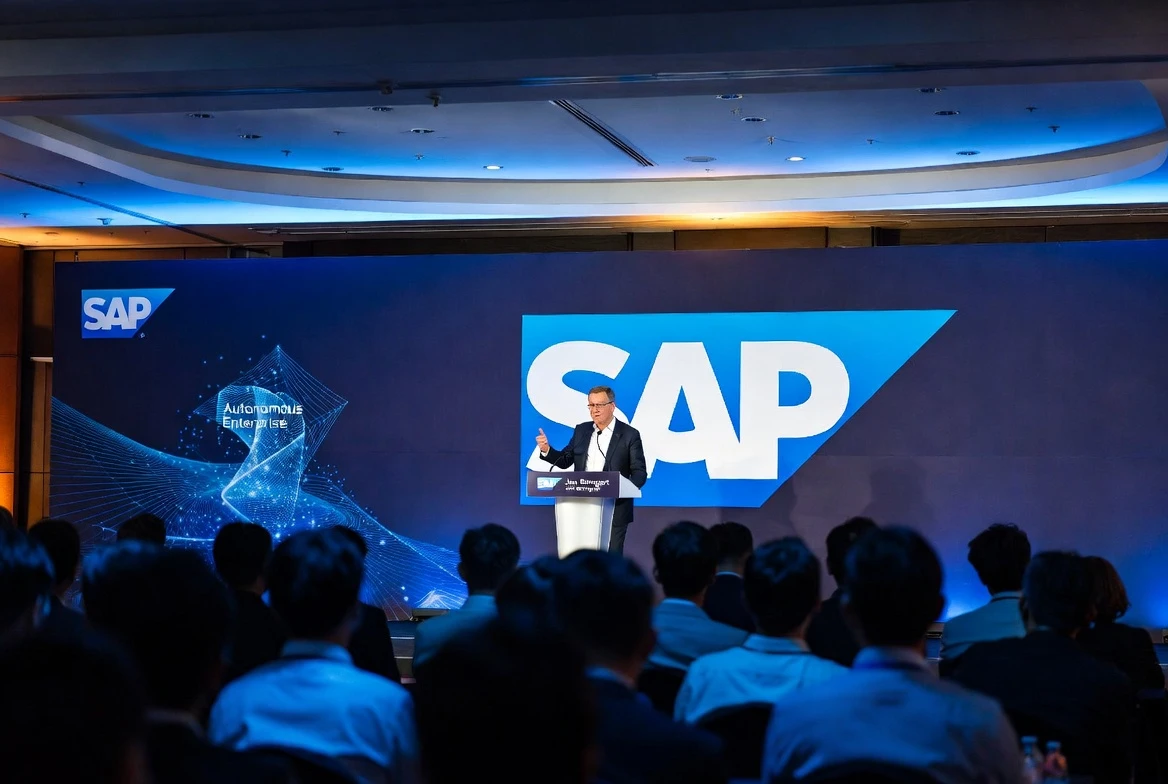
SAP Korea will hold its annual SAP NOW AI Tour Korea 2026 on July 14 at the Grand InterContinental Seoul Parnas in Seoul, anchored on the company’s Autonomous Enterprise strategy.
The full-day event features a keynote from Jan Bungert, chief revenue officer for SAP Business Data Cloud and Business AI, with SAP Korea Managing Director Mary Shinn set to frame the broader agentic AI pitch.
Afternoon sessions include hands-on time in an ‘Agent Lab’ and customer-stage cases from LG Innotek, Samsung Electro-Mechanics and Samsung SDS.
SAP Korea said the program centers on two product umbrellas: the SAP Business AI Platform, which the company introduced at SAP Sapphire 2026 in May, and the SAP Autonomous Suite, a layer of AI agents bundled inside existing SAP applications.
The framing matters because Korea is one of the largest enterprise software markets in Asia, and SAP’s automation pitch lands just as agentic AI is moving from conference slides into production workflows.
Ha Kyung-nam, a senior executive at SAP Korea, will argue that AI has to move from a supplementary tool to a core execution mechanism, not an additional software layer.
Shinn, in her prepared remarks, said the shift will reward companies that anchor AI ‘within a precise business context.’
The Seoul Stage Set
Seoul’s Grand InterContinental Parnas will host SAP Korea’s biggest annual gathering on the morning of July 14.
SAP Korea billed the event as a working day for clients, partners and industry tech leaders to map out how artificial intelligence will reshape core corporate workflows.
The morning centers on keynote addresses from SAP’s global and Korea leadership; the afternoon splits into four specialized tracks.
Two hands-on experience zones run alongside the formal program throughout the day.
Registration is open on the official SAP NOW AI Tour Korea 2026 event page, which lists the Grand InterContinental Parnas as the venue.
The morning keynote, themed ‘Realize the Best Performance as an Autonomous Company,’ will lead into a Korea-strategy slot before the floor opens to three customer cases.
Bungert has spent 2026 framing SAP’s pivot around a May 2026 announcement at SAP Sapphire that bundled the SAP Business AI Platform with the SAP Autonomous Suite under one banner.
The Autonomous Enterprise framing is now SAP’s clearest answer to enterprise customers asking whether AI is a feature on top of an ERP or the substrate underneath one.
- Jan Bungert, chief revenue officer for SAP Business Data Cloud and Business AI, opens with the global Autonomous Enterprise keynote.
- Ha Kyung-nam, senior executive at SAP Korea, follows with the ‘from supplementary tool to execution mechanism’ framing.
- Park Jun-gi, head of LG Innotek’s next-generation ERP team, walks through LG Innotek’s cloud and autonomous journey.
- Park Jun-ho, group leader at Samsung Electro-Mechanics, presents the AI innovation platform built on the group’s S/4HANA migration.
- Ji Ki-sung, vice president at Samsung SDS, lays out the autonomous corporate strategy grounded in business context.
- Mary Shinn, managing director of SAP Korea, closes the morning with a prepared statement on the agentic enterprise.
The Seoul stop is one of fifteen SAP NOW AI Tour dates scheduled across 2026, per SAP’s 2026 SAP NOW AI Tour calendar, alongside Tokyo on July 29 and stops across Southeast Asia, Europe and Latin America into November.
The four afternoon tracks cover end-to-end operational innovation, integration of AI and data, industry-specific use cases, and post-implementation support services.
Each track is calibrated to the agentic conversation: helping working-level practitioners move from pilot AI to operating AI inside production finance, supply chain and HR workflows.
The two hands-on zones, the Autonomous Corporate Guide Tour and the Agent Lab, are open throughout the day, with the lab focused on real-time custom agent building.
What the ‘Autonomous Enterprise’ Actually Means
The phrase ‘Autonomous Enterprise’ is the umbrella SAP used at SAP Sapphire 2026 to describe AI agents running core business processes end-to-end instead of sitting beside them as assistants.
Under the umbrella sit three overlapping layers: a unified environment for building and governing agents, an autonomous software suite that executes them, and a stack of industry-specific solutions with sector data models baked in.
SAP positions the layering as the difference between deploying an AI tool and re-platforming a company on top of AI.
The foundation layer is the SAP Business AI Platform, which the company says unifies SAP Business Technology Platform, SAP Business Data Cloud and SAP Business AI into a single governed environment.
At its core sits the SAP Knowledge Graph solution, which gives AI agents a structured map of business entities, processes and relationships across a customer’s SAP landscape.
Developers use a no-code or pro-code interface called Joule Studio to build agents on top of the platform, with SAP-managed infrastructure handling the runtime.
The middle layer is the SAP Autonomous Suite, which embeds AI agents inside SAP’s existing applications across finance, supply chain, procurement, human capital management and customer experience.
SAP said the suite will deploy more than 50 domain-specific Joule Assistants, which orchestrate a subset of more than 200 specialized agents to execute precise tasks.
The third layer is Industry AI, a portfolio SAP launched at the same Orlando event and that now counts seven autonomous solutions with sector-specific process logic, data models and regulatory requirements.
One case highlighted at Sapphire: a deployment with European energy company RWE aimed at reducing unplanned downtime across its offshore wind turbines.
Another example is the new Autonomous Asset Management scenario, where AI agents review data from thousands of past incidents, identify the likely root cause and generate pre-filled work orders.
SAP also unveiled a new user experience called Joule Work, designed so employees describe a desired outcome in natural language and the system orchestrates the right combination of workflows, data and agents behind the scenes.
Underneath the three layers sits a partner fund SAP announced at Sapphire, designed to help SAP partners deploy SAP-built AI assistants and extend or build new partner agents on the new platform using Joule Studio.
New agent-led transformation tooling, also announced at the Orlando event, is pitched as cutting ERP migration effort by more than 35 percent.
The full SAP Business AI Platform stack is also being given away to RISE with SAP customers in pieces, with SAP saying the package now includes three Joule Assistants activated within a customer’s first year, with full portfolio access for SAP GROW customers at onboarding.
From Supplementary Tool to Execution Mechanism
Ha Kyung-nam’s slot on the Seoul agenda is short but pointed.
The SAP Korea senior executive will argue that AI has to move from a supplementary tool into a core execution mechanism, the framing SAP has built its 2026 customer narrative around.
The phrasing matters because SAP Korea’s 2025 keynote speakers, the company’s chief human resources officer and the president of its data and analytics unit, ran the headline theme ‘Unleash your future with business AI.’
The 2026 pivot is sharper: not a future to unleash, but a mechanism to operate.
SAP’s agency language, anchored in Joule Work and Joule Studio, lets customers describe an outcome and have agents handle the workflow behind the curtain.
Shinn’s prepared remarks echo the same shift.
‘As the industry shifts toward agentic AI, a company’s competitive edge will hinge on its ability to anchor AI within a precise business context to deliver tangible outcomes,’ she said in a statement distributed ahead of the event.
The ‘precise business context’ wording is doing real work in SAP’s Korea pitch.
It is a direct response to the criticism that generic AI chat tools produce accurate-looking but context-light answers when pointed at finance, supply chain or HR data inside a real company, with SAP arguing that agents grounded in the customer’s own SAP landscape can deliver outcomes consumer AI cannot.
Three Korean Conglomerates on Stage
SAP’s three Korean customer slots are not generic promotional case studies.
Each presents a working migration story with measured scope: a subsidiary inside a major chaebol moving from a legacy ERP into SAP’s cloud and agent stack.
The cases are the kind Korean procurement teams use as peer benchmarks when they scope their own S/4HANA projects.
- LG Innotek: Park Jun-gi, head of the company’s next-generation ERP team, presents the cloud-and-autonomous journey inside the LG group’s components subsidiary.
- Samsung Electro-Mechanics: Park Jun-ho, group leader, presents the AI innovation platform built on the SAP S/4HANA migration, the first Korea deployment to use the SAP Premium Supplier framework.
- Samsung SDS: Ji Ki-sung, vice president, presents the context-aware autonomous corporate strategy and the Samsung group’s positioning as Korea’s first RISE with SAP Premium Supplier.
LG Innotek’s project is one of the more advanced Korean ERP migrations running against an agentic roadmap, rather than a conventional lift-and-shift.
Park Jun-ho’s slot at Samsung Electro-Mechanics traces a build of an AI innovation platform through the company’s SAP S/4HANA conversion.
The deployment is the first in Korea to use the SAP Premium Supplier framework, which Samsung SDS earned as Korea’s first RISE with SAP Premium Supplier in 2025.
The Premium Supplier designation lets a partner staff, configure and run SAP S/4HANA Cloud Private projects on behalf of customers without constant SAP oversight.
The joint appearance of LG Innotek, Samsung Electro-Mechanics and Samsung SDS is meant to show the agentic and the migration stories traveling together on stage.
Ji Ki-sung, the Samsung SDS vice president, will present an example of an autonomous corporate strategy grounded in what SAP calls context awareness.
Samsung SDS earned the Premium Supplier designation in 2025, the sixth partner globally and the first in Korea.
Premium Supplier status materially compresses the time and cost of a custom ERP migration.
For SAP Korea, the case stack amounts to a single argument: the autonomous-enterprise story is built on top of existing SAP footprints, not pitched as a replacement.
All three subsidiaries are part of larger groups that have already made multi-year capital commitments to SAP platforms.
The cases are positioned to show that the agentic layer lands on top of the migration, not after it.
That stance is a deliberate choice as Korean enterprise customers weigh whether to extend SAP contracts, hire local systems integrators, or evaluate local rivals head-on.
The Agent Lab and the Partner Fund
The afternoon at Grand InterContinental Parnas is built as much for working-level engineers as for executives.
SAP Korea has set up two hands-on experience zones inside the venue, including an ‘Agent Lab’ where attendees will build and test custom AI agents in real time.
A second ‘Autonomous Corporate Guide Tour’ is meant to walk visitors through a guided tour of the autonomous-enterprise journey end-to-end.
The Agent Lab is the more distinctive piece, because it gives attendees direct access to Joule Studio, the same agent builder SAP partners will use under the company’s new partner fund.
For Korean developers who have watched the agentic conversation from the sidelines, the lab is the first chance to put hands on the tools.
- End-to-end operational innovation for AI-based autonomous enterprise implementation.
- Realization of autonomous enterprises through integration of AI, data and platforms.
- AI-based business innovation in industry-specific use cases.
- Customized sessions for working-level practitioners across function areas.
The €100 million partner fund SAP launched at Sapphire is the structural complement to the lab.
The fund is open to any SAP partner that wants to deploy SAP-built AI assistants, or to build new partner agents on Joule Studio.
RISE with SAP and SAP GROW customers receive early access to Joule Assistants inside their first year, regardless of where they sit on a cloud migration path.
The Korean SAP partner ecosystem is not the only one competing for that money.
Multiple Korean systems integrators that already serve as SAP implementation partners are also building their own agentic platforms on top of the SAP stack.
The €100 million is intended to seed new agents built using SAP’s tools rather than to fund competing ones, with SAP also positioning its partnerships with Anthropic, Amazon Web Services, Google Cloud, Microsoft, NVIDIA and Palantir as the platform layer Joule Studio will plug into.
The Agent Lab’s presence in Seoul is meant to make that bet tangible for any attendee who has not yet seen a working Joule Studio deployment.
What the Pitch Quietly Leaves Out
The 2026 SAP Korea pitch is built on top of unfinished enterprise answers.
SAP’s own SAP Sapphire framing names the trade-off explicitly: ‘For the mission-critical processes of our customers, almost right just isn’t good enough,’ SAP CEO Christian Klein said at the Orlando event.
Klein’s line inverts the optimistic-agent narrative into a clear-eyed caveat about accuracy in production.
SAP is asking customers to trust AI agents not just to suggest actions inside SAP transactions but to execute them.
The Korea event is staged to make that trust transfer feel routine inside Korean conglomerates, where the cost of a wrong financial close or a rerouted order is reputational as well as financial.
The context anchor in Shinn’s quote is the most direct way SAP is acknowledging the gap.
Generic chat-based agents do not know a customer’s chart of accounts, vendor master data or plant-level supply chain parameters.
SAP argues the SAP Knowledge Graph inside the Business AI Platform closes that gap, with the Korea stop the first run at converting that argument into signed three-year contracts with subsidiaries inside the LG and Samsung groups.
As the industry shifts toward agentic AI, a company’s competitive edge will hinge on its ability to anchor AI within a precise business context to deliver tangible outcomes.
Mary Shinn, SAP Korea’s managing director, distributed the line in remarks prepared for the SAP NOW AI Tour Korea 2026 audience.
Context is only one of three friction points the Seoul stop is meant to absorb.
The second is governance: SAP’s biggest 2026 product investment is in agent tooling designed to give auditors a traceable log of which agent did what inside which SAP transaction.
The third is timing: the EU AI Act’s August 2 enforcement deadline is now under six weeks away for global enterprises operating in Europe, a build clock Korean CIOs are racing against inside their own AI road maps.
SAP’s argument is that an SAP-native agent stack can ship governance hooks inside the platform itself rather than as a separate overlay.
Outside the SAP pitch, the broader Korean enterprise AI mood is also more combative than SAP’s prepared remarks suggest.
Three of the country’s largest conglomerates are running their own agentic platforms in parallel with their SAP footprints.
Cloud-first bets are coming due for many of them just as they try to scale AI inside their finance and supply chain functions.
The leadership reckoning around that transition is now visible inside the biggest Korean groups’ tech teams.
SAP can win the day’s headlines, but the multi-year agent contracts the company wants require Korean CIOs to believe that SAP’s business context grounding produces better outcomes than the in-house agent platforms can ship on a faster cadence.
Korea’s AI ERP Race Is Already Moving
SAP will not be the only AI ERP story inside Seoul’s enterprise market in 2026.
Korean conglomerates have spent 2026 building agentic platforms in parallel with their SAP footprints, an acknowledgment that the lines between SAP’s AI tools and those its customers ship are blurring.
The Korean ERP market is large enough that both SAP and its systems-integration partners can grow at the same time, with the open question for SAP being whether its agentic positioning can hold share as customers compare SAP-native agents with homegrown ones inside the LG, Samsung and broader Korean systems-integration market.
The Korea stop lands inside a wider enterprise AI reckoning that has CIOs bracing for cloud-first debt alongside their agentic scale-up.
SAP’s next autumn touchpoint is the SAP TechEd conference, where SAP typically reveals the next year’s roadmap for the Business AI Platform.
The Korea July 14 keynote, more than the regional SAP TechEd follow-on, is built to convert the SAP narrative into signed LG, Samsung and broader Korean enterprise contracts over the rest of 2026.
SAP Korea’s three speakers from LG Innotek, Samsung Electro-Mechanics and Samsung SDS are the visible proof points.
The rest depends on whether Korean CIOs decide that SAP’s business context grounding produces outcomes the in-house agent platforms cannot, with the answer likely visible in SAP Korea’s next quarterly reporting cycle.


D&D Bets Big on WoW and Star Wars to Grow Its Tables

Game Pass Drops Celeste and Crusader Kings on First Net-Loss Day

Gemini Breaks Basic Calls on Foldable Phones in Android Auto

Citadel Clears AI Fund Overhang While Crypto Stays Flat

Morgan Stanley Staking ETPs Crack Open Crypto Yield for Wealth Clients

Snapdragon Price Hike Forces Premium Buyers Toward Last Year’s Phones

Croc 2 Remaster Unlocks Argonaut’s Full Revival Path

Scale AI Names Google Cloud Veteran deSouza CEO for Enterprise Push

Epic Store Hits Brazilian iPhones Amid Apple’s Familiar Friction Play

LORDNINE Helena Server Races Players Toward Real USDT Rewards

Fable 5 and Mythos 5 Return as US Lifts Anthropic Export Controls

SpaceX’s Google Deal Turns a Rocket Company Into a Cloud Landlord

Oracle Cuts 21,000 Jobs in a Year, Cites AI in 10-K Filing

CD Projekt Red Co-CEO: Redemption Arc Isn’t Done, Witcher 4 in 2027

XPL Rallies 30% Ahead of Plasma One Card Tier Launch

DGO App Brings Rs 549 Mobile Pass for FIFA World Cup 2026 in Nepal

Google Search Profiles Build a Follow Graph Inside Discover

Moonshot AI Targets $30 Billion in China’s Fastest AI Funding Sprint

Microsoft Xbox Layoffs Start in July as Sharma Slams 3% Margin

Oppo’s ColorOS 17 Eligibility List Leaves A-Series Buyers Behind
-
 AI1 month ago
Fable 5 and Mythos 5 Return as US Lifts Anthropic Export Controls
-
 AI2 months ago
SpaceX’s Google Deal Turns a Rocket Company Into a Cloud Landlord
-
 AI1 month ago
Oracle Cuts 21,000 Jobs in a Year, Cites AI in 10-K Filing
-
 GAMING1 month ago
CD Projekt Red Co-CEO: Redemption Arc Isn’t Done, Witcher 4 in 2027
-
 CRYPTO2 months ago
XPL Rallies 30% Ahead of Plasma One Card Tier Launch
-
 APPS2 months ago
DGO App Brings Rs 549 Mobile Pass for FIFA World Cup 2026 in Nepal
-
 NEWS2 months ago
Google Search Profiles Build a Follow Graph Inside Discover
-
 AI2 months ago
Moonshot AI Targets $30 Billion in China’s Fastest AI Funding Sprint