
NEWS
Meta AI Glasses Left Bystanders to Write Privacy Rules
With 7 million Meta AI glasses sold in 2025, bystanders, restaurants and a Bluetooth detector are writing the privacy rules Congress never passed.

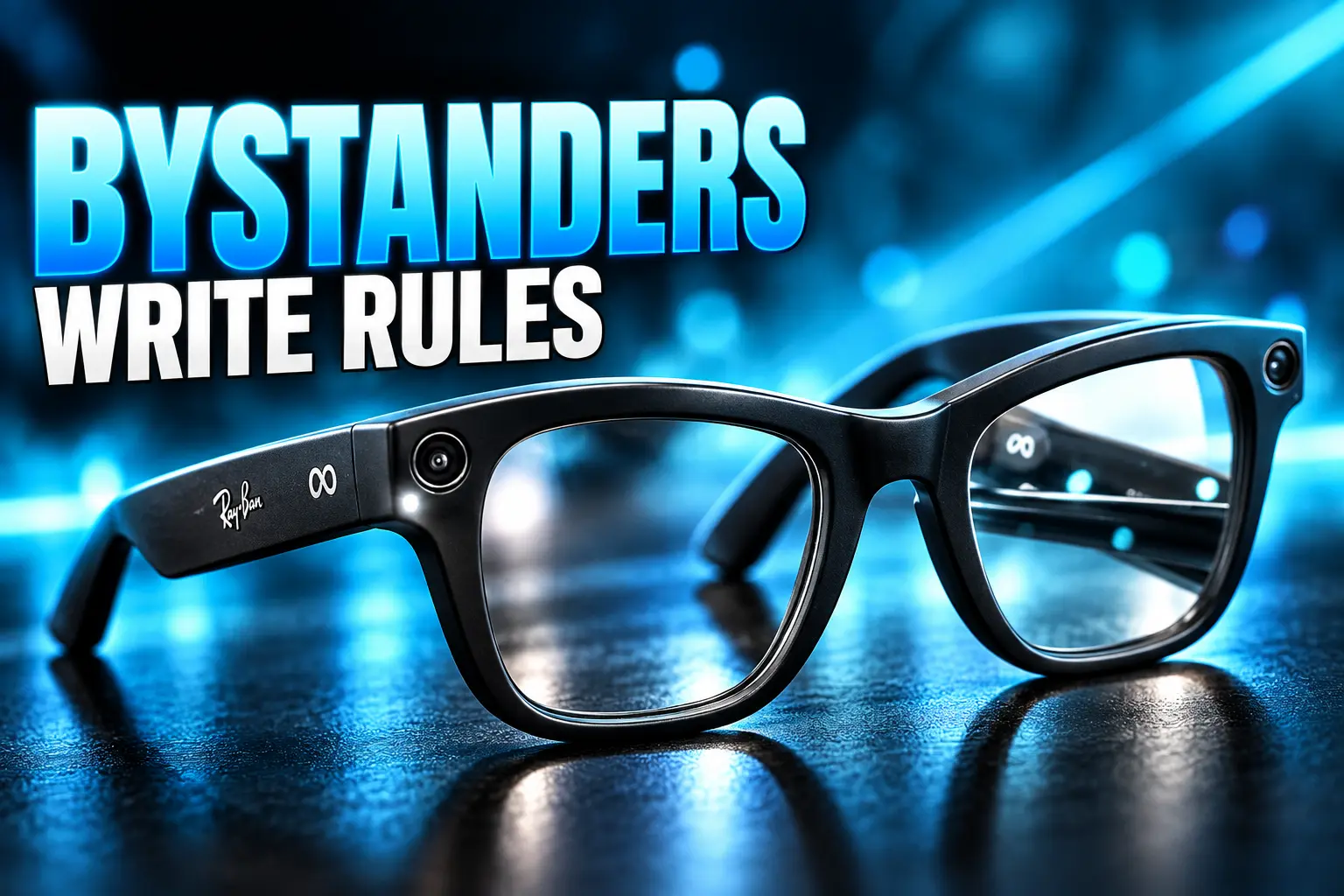
Meta and EssilorLuxottica sold more than 7 million AI glasses in 2025, and U.S. law still has no rule for the people those cameras capture. The frames look like ordinary Ray-Bans. The person standing in front of them is the one the statute forgot.
Buyers got a gadget. Bystanders got a private substitute for a law: restaurant bans, a Bluetooth warning app, a San Francisco class action, and a German lab report that says the recording light is often too dim to see.
I-XRAY and the Dossier Built in a Minute
In October 2024, Harvard students AnhPhu Nguyen and Caine Ardayfio pointed a pair of Ray-Ban Meta glasses at classmates and at strangers on the subway. They did not wait for Meta to ship face ID. They chained tools that already sat in public.
The glasses livestreamed to Instagram. Software watched that stream, cut out faces, and sent them to PimEyes, a face-search engine. A language model then walked people-search sites and built a file: name, phone, home address, relatives. Ardayfio, who ran Harvard’s AR/VR club with Nguyen, said they were able to identify dozens of people, including Harvard students, without those people ever knowing.
THE LOOKUP STACK THEY WIRED TOGETHER
- The camera: Commercially sold Ray-Ban Meta glasses, livestreaming video to Instagram.
- The match: PimEyes, which finds other photos of the same face on the open web.
- The file: People-search sites and an LLM that pull a name, a phone number, an address, and relatives.
- The delay: Ardayfio told interviewers the phone app usually took about a minute to spit the dossier back.
They called the project I-XRAY and refused to release the code. Nguyen said a regular phone camera could do the same damage. Meta answered that Ray-Ban Meta glasses do not include facial recognition, and that the students were running public software on a computer. That was true of the hardware in 2024. It was also the point. The glasses were the last, hard-to-see mile in a stack anyone could rent.
Hamburg’s Lab Says the Capture Light Is Too Dim
Meta’s answer to that mile is a white capture LED. The company says the light was designed to be noticed, that it cannot be switched off, and that covering or breaking it kills the camera. A Meta privacy page for Meta AI glasses still sells that story under the line “Privacy, built in every pair.”
On September 10, 2026, Hamburg’s commissioner for data protection, Thomas Fuchs, published a 53-page teardown of the Ray-Ban Meta Wayfarer. His office took the frames apart, watched what the companion app sent home, and stood people in front of the LED. The finding was blunt. In many settings, especially outdoors in sun, the warning light is not well visible. Only someone close and nearly face-on could count on seeing that a recording had started.
Meta’s own bystander paper says the LED grew from 0.9 mm on Ray-Ban Stories to 2 mm on Ray-Ban Meta, and that it should be visible at least 12 ft outdoors and 24 ft indoors. Hamburg’s lab said real streets do not match that diagram. The same report found software tables named for faces, empty at the time of testing, so the office could not show live identification on the device. It could show that bystanders have no real way to consent.
Street checks keep landing on the same complaint. People treat the frames as sunglasses until someone tells them a camera sits in the hinge. That is why detector apps exist, and why venues now post bans instead of trusting a blink.
THE PRIVACY CLAIM VERSUS THE RECORD
| What Meta tells buyers | What testers and filings show |
|---|---|
| Designed for privacy, controlled by you | A March 2026 suit says intimate footage went to contract reviewers in Kenya |
| A capture LED you cannot miss | Hamburg’s Sept. 10 report says the light often fails in sunlight |
| Cover the LED, and the camera dies | On Sept. 1 Meta disabled cameras on thousands of tampered pairs, less than one tenth of 1 percent of glasses sold |
| No facial recognition on the glasses | I-XRAY already ran PimEyes on the livestream; NameTag code later turned up in the companion app |
Alex Himel, Meta’s vice president of wearables, said the company can now spot a covered or destroyed LED and kill photo and video on those frames. The fix arrived after a year of pickup-artist clips, subway ambushes, and taped-over lights. It still does nothing for a bystander who never saw the LED in the first place.
What Nearby Glasses Can Detect?
Yves Jeanrenaud, a Swiss sociologist who codes in his spare time, did not wait for Congress. In February 2026 he shipped Nearby Glasses, an Android app that listens for Bluetooth Low Energy ads from known camera-glasses makers and taps you when one is close.
The open-source Nearby Glasses detector does not break into the glasses and does not name the wearer. It watches manufacturer IDs that Bluetooth assigns and that devices are required to broadcast: 0x01AB and 0x058E for Meta, 0x0D53 for Luxottica, 0x03C2 for Snap. Default range is an RSSI of -75 dBm, about 10 to 15 meters in the open and 3 to 10 meters indoors. The license is AGPL-3.0. The app stores nothing in the cloud.
Jeanrenaud’s README calls the glasses an intolerable, consent-skipping intrusion and then, in capital letters, tells users not to harass anyone they think is wearing a camera. False alarms are built in. Quest headsets share Meta’s company ID, so a living-room VR session can trip the same alert as a hidden Wayfarer. The app may also miss a pair. That is a poor substitute for a statute, and it is the substitute bystanders actually have.
Copycat listings now squat on similar names in app stores. Jeanrenaud has had to warn people that some of those clones are not his project. The demand is the tell. When the official light fails, people start scanning the air for a radio signature instead.
The San Francisco Suit That Named Bedroom Footage
The other unpaid party is the wearer, and sometimes the person who never put the glasses on but walked through a bedroom while they were recording.
On March 4, 2026, Clarkson Law Firm filed a class action against Meta and Luxottica in the U.S. District Court for the Northern District of California, case 3:26-cv-01897, before Judge Edward M. Chen. The first named buyers were Gina Bartone of New Jersey and Mateo Canu of California. They say they bought the product on ads that called it designed for privacy, then learned that footage used for AI features was routed to human reviewers overseas.
You cannot market a product as built for privacy and then funnel footage of people’s intimate moments to contract workers without their knowledge.
Yana Hart, partner, Clarkson Law Firm
Ryan Clarkson, the firm’s managing partner, said workers thousands of miles away had been watching footage from inside bedrooms while the ads talked about control. The complaint describes clips of people undressing, having sex, and showing financial information. Swedish reporting in early 2026 had already described Nairobi contractors on that pipeline. Clarkson’s page puts 2025 sales at about 7 million pairs, the same figure EssilorLuxottica gave investors, and notes that pairs that start at $299 were sold on a privacy promise. The case later consolidated other filings. It is still live.
Thirteen days after that complaint, Sens. Edward J. Markey of Massachusetts and Ron Wyden and Jeff Merkley of Oregon sent a letter to Mark Zuckerberg. They wanted answers by April 6, 2026 on plans to put facial recognition into the glasses, including whether bystanders could ever delete a biometric file they never agreed to create, and whether Meta would share outputs with Homeland Security.
This frictionless identification and constant monitoring also risks normalizing mass surveillance at a moment when the federal government is using similar tools to intimidate protesters and chill speech.
Sens. Edward J. Markey, Ron Wyden and Jeff Merkley, March 17, 2026 letter
The Electronic Privacy Information Center had already written the FTC and a nine-state privacy group the day a leaked Meta memo became public, calling the planned feature a grave risk to privacy and civil liberties. The memo, as the senators described it, advised launching in a “dynamic political environment” while likely critics were busy elsewhere. Meta shut down on-platform face ID in 2021, citing those same worries. Five years later the company was designing NameTag, a glasses feature that would turn a face into a signature and match it on the wearer’s phone.
In June, researchers found NameTag code in the Meta AI companion app. Meta stripped most of it the next day. Andy Stone, a Meta vice president of communications, called the work purely exploratory and said no final decision had been made. On September 7 an Illinois suit under the state’s biometric law accused Meta of using Facebook and Instagram photos, including of children, to train that unreleased system. Texas Attorney General Ken Paxton has a separate investigation into the glasses. That is not a federal wearable law. The Electronic Communications Privacy Act still dates to 1986. Colorado’s AI privacy statute, the first of its kind, does not police a camera on someone’s nose.
THE 2026 PAPER TRAIL
- February 2026: Nearby Glasses ships on Android, and a leaked Meta memo on glasses face ID becomes public.
- March 4, 2026: Clarkson files the Northern California class action over undisclosed human review of glasses footage.
- March 17, 2026: Markey, Wyden and Merkley demand NameTag answers from Zuckerberg by April 6.
- June 2026: NameTag code is found in the Meta AI app and largely removed the following day.
- August 2026: ICE tells staff to stop wearing Meta glasses on duty.
- September 1, 2026: Meta disables cameras on thousands of pairs with tampered LEDs.
- September 7, 2026: An Illinois biometric suit targets alleged NameTag training on social photos.
- September 10, 2026: Hamburg publishes the 53-page finding that bystanders often cannot see the recording light.
Jitesh Ubrani, a research manager at International Data Corporation, has said restaurants and workplaces already ban this class of product, and that sales keep climbing anyway. Hesitation is growing, he said, but not enough to offset demand. That is the bystander’s problem in one line. The people who never bought a pair do not get a vote at the register.
ICE Took the Ray-Bans Off Its Agents
The federal government spent a year on both sides of the lens. ICE and Border Patrol agents were documented in Meta glasses in at least six states after January 2025, including a Home Depot raid in Los Angeles and a December operation in Evanston, Illinois, where resident Liz Myers said two agents filmed protesters with the recording light on. Agency rules already barred personal recording devices. The hardware showed up anyway.
In August 2026, acting ICE Director David Venturella told the workforce to leave the glasses at home. The memo treated them as personal body-worn cameras that could capture sensitive information. A Homeland Security spokesperson called it a restatement of old policy, not a conversion. The same department has asked for $7.5 million in its fiscal 2027 science budget to build its own smart glasses, with a target of September 2027, so agents can identify people in the field without pulling out a phone. Consumer frames are out. A purpose-built identifier is still on the shopping list. That is the same gap that left federal agents already wearing consumer glasses before any wearable statute existed.
Local fusion centers have started warning officers about the reverse problem. A New York Police Department counter-terrorism memo in January told staff to inspect eyewear in cells after videos from inside lockups landed online. A Maine document in June flagged AI face search that could dox officers from public photos. The people who run cameras for a living do not want a civilian pair aimed at them. They still want a government pair aimed outward.
WHAT WE KNOW
- The consumer ban: ICE has told employees that Meta glasses count as personal recorders and stay out of federal workspaces.
- The budget line: DHS has requested $7.5 million toward agency-built glasses, with a September 2027 target.
- The NameTag status: Meta pulled exploratory face-ID code from the companion app in June and has not announced a launch.
WHAT IS UNCONFIRMED
- A ship date: Whether NameTag, or anything like it, ever reaches Ray-Ban or Oakley frames.
- A funded prototype: Whether Congress actually writes the $7.5 million into a final DHS bill.
- A federal wearable statute: No passed bill names AI glasses, bystanders, or on-face cameras.
Himel has also said Meta wants the glasses treated as assistive devices, and that the company is donating 130,000 pairs to legally blind U.S. veterans. Markey’s letter granted that face ID could help blind users and still asked how a bystander opts out of being scanned. Those two uses share a camera. They do not share a consent model.
Wetherspoons, Gyms and the Ban List
Until a statute shows up, the people in the frame keep making house rules. Wetherspoons has restricted the glasses across hundreds of pubs in England and Ireland. Jeremy King has barred them in his London dining rooms. Soho House has joined that list. Hamburg’s parliament voted in early September to push a ban on public transport, pools, and saunas, and to seek a national bar on face ID in wearables. On September 12 the Dutch Consumers Association called for a European ban, saying the frames can film people in secret and that stickers sold to hide the LED still defeat the promise of a visible warning.
U.S. gyms, restaurants, and offices have been writing the same kind of sign without a federal template. The Electronic Communications Privacy Act does not know what a Wayfarer with a 12-megapixel camera is. State biometric laws, where they exist, were written for office check-in kiosks, not for a stranger’s face on a sidewalk. So the rule becomes a door policy, a class-action caption, a GitHub README, and a lab PDF from Hamburg.
Meta Connect is set for September 23 and 24 in Menlo Park, where the next frames will get a stage. The 7 million pairs from 2025 are already on trains, in kitchens, and in booking lines. The capture LED will still blink. Hamburg has already said many people will not see it. The bystanders those cameras catch are the ones still writing the privacy rules, because Congress never did.

Instagram Plus Tests a Read-Only Mode That Cuts Stories

Altman Asks the Public to Accept Some AI Harm

Google Freezes OSS VRP Product Reports After AI Flood

AI Agents Make Payment Rails the Scarce Prize

Turkey’s Crypto Boom Now Runs Through Three Banks

Fable 5 Came Back Under a Commerce On-Off Switch

Google’s SpaceX GPU Lease Has a Sept. 30 Deadline

Plasma One’s XPL Locks Face a 1.81 Billion Cliff

DGO’s Rs 549 World Cup Pass Cost Fans Sleep and Data

Moonshot AI’s $30 Billion Ask Became a $35 Billion Close
-
 AI4 months ago
Fable 5 Came Back Under a Commerce On-Off Switch
-
 AI4 months ago
Google’s SpaceX GPU Lease Has a Sept. 30 Deadline
-
 CRYPTO4 months ago
Plasma One’s XPL Locks Face a 1.81 Billion Cliff
-
 APPS4 months ago
DGO’s Rs 549 World Cup Pass Cost Fans Sleep and Data
-
 AI4 months ago
Moonshot AI’s $30 Billion Ask Became a $35 Billion Close
-

 NEWS4 months ago
ColorOS 17 Device List Spans Oppo, OnePlus and Realme
-

 GAMING4 months ago
Xbox Cuts 3,200 Jobs After Five Years of Thin Returns
-

 GAMING4 months ago
The RTX 4050 Under Rs 70,000 Hides a Wattage Gap