
CRYPTO
The 225,000 Jobless Claims Spike Became a Peak
June’s 225,000 US jobless claims print proved a local peak. Filings are at 206,000 as the Fed debates a September hike.

206,000 people filed new US jobless claims in the week ending September 5, 19,000 below the Memorial Day spike of 225,000. The Labor Department’s September 10 report also put the four-week average at 206,000, rolling back the spring run-up that traders had treated as a labor-market break.
The Federal Reserve held its policy rate at 3.50% to 3.75% through July and now goes into the September 15-16 meeting with a rate increase on the table, the opposite of the cut trade that spike was supposed to open.
Memorial Day Sent Claims to 225,000
On June 4 the department said initial claims for the week ending May 30 had climbed to 225,000, 13,000 above the prior week’s revised 212,000. Economists had clustered around 213,000 to 215,000, so the miss was wide enough to look like a turn.
Memorial Day sat inside that survey week, and holiday prints are messy. Even 225,000 was still low beside history. The seasonally adjusted initial claims series peaked at 6,137,000 in April 2020 and bottomed at 162,000 in November 1968. Most slowdowns do not get called a deterioration until claims hold above 250,000 to 300,000.
Softer labor was still sold as a path to easier money. More filings would, in that script, pull rate-cut odds forward, press Treasury yields and the dollar, and give Bitcoin a liquidity bid. The June 4 jobless-claims release is where that reading took hold. The four-week average that week was 214,750, and continuing claims for the week ending May 23 were 1.777 million.
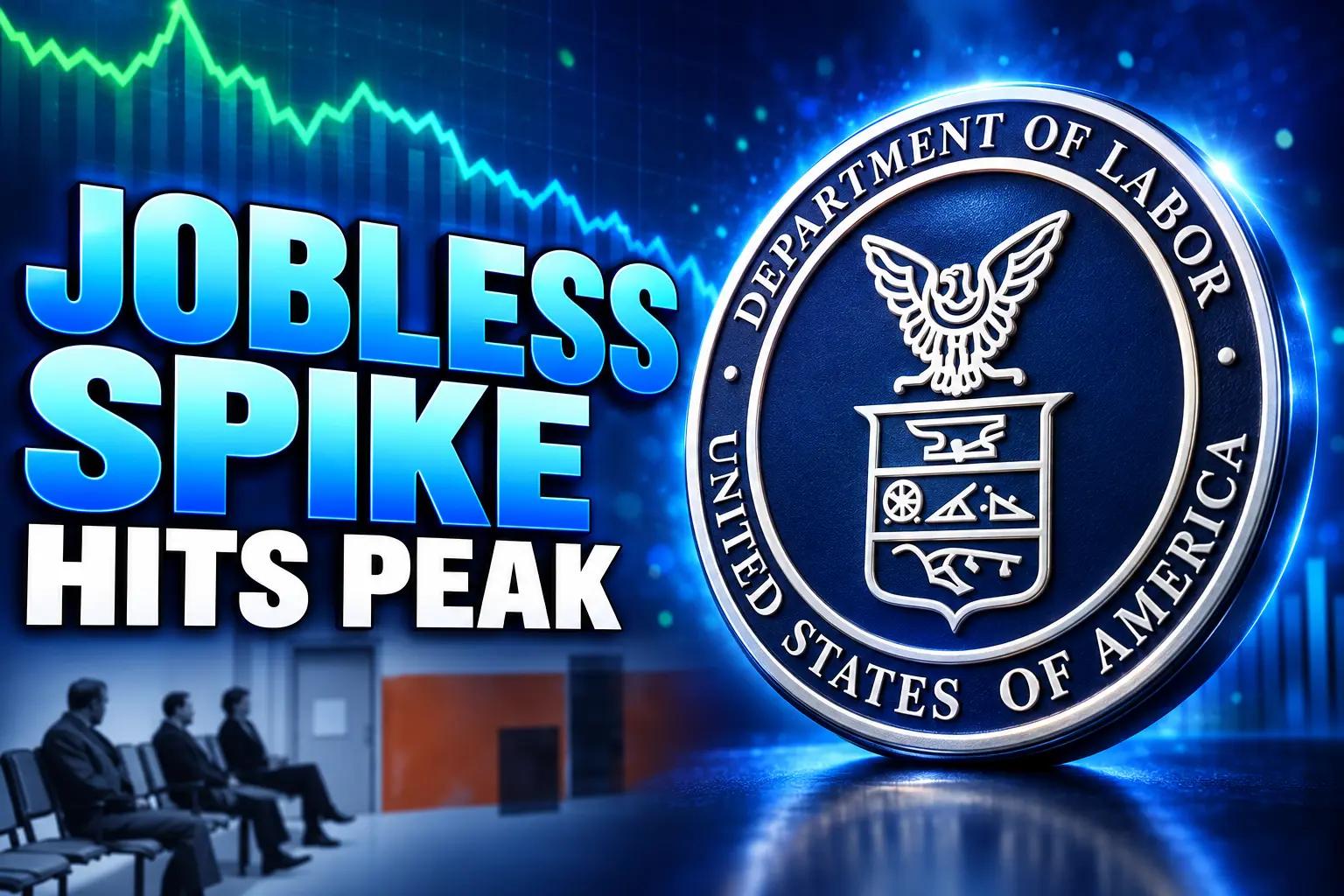
A Mid-July Low Reset the Trend
The next week did not ease the scare. For the week ending June 6, claims rose again, to 230,000 on the revised series. Then the four-week average, the line that strips out one-off noise, peaked at 224,500 in the week of June 20 even as the weekly print itself was already rolling over.
By mid-July the holiday bump was gone. In the week ending July 18 the department’s first print was 187,000, a drop of 22,000 from the prior week’s revised 209,000, later revised to 189,000. That was the lowest weekly reading of 2026, and it sat much closer to the 1968 floor than to the 250,000 band that usually starts a recession argument.
THE WEEKLY CLAIMS PATH
| Week ending | Initial claims | 4-week average |
|---|---|---|
| May 30, 2026 | 225,000 | 214,750 |
| June 6, 2026 | 230,000 | 219,250 |
| June 20, 2026 | 216,000 | 224,500 |
| July 18, 2026 | 189,000 | 208,000 |
| September 5, 2026 | 206,000 | 206,000 |
Filings then bounced in a tight band through August and settled at 206,000 claims for the week ending September 5, 1,000 below the prior week’s revised 207,000 and a touch above the 205,000 estimate. The four-week average fell 1,500 from a revised 207,500 to 206,000. The June alarm never made it into a trend.
Continuing Claims Barely Budged From May
New filings measure people who just lost a job. Continuing claims measure people who are still drawing benefits, which is a cleaner read on whether the rehiring pipeline is working. That second line is where the June scare still has a residue.
For the week ending August 29, continuing claims held at 1.774 million, 1,000 below the prior week and under the 1.780 million estimate. Against 1.777 million in late May, the stock of people on benefits is down only 3,000. Initial claims dropped 19,000 from the Memorial Day week. The people already unemployed did not clear out with them.
That split is the part of the labor tape the June cut trade never priced. Companies can keep weekly filings low by not firing, and still leave the people who did get cut waiting longer for the next job.
Why the Fed Is Debating a Hike
Chair Kevin Warsh did not treat that claims path as a reason to ease. At Jackson Hole on August 28, his 100th day in the job, he put the inflation mandate first and declined to offer the kind of path that markets use as a trade.
We must be confident that underlying inflation is moving to our objective, clearly and at sufficient speed. Otherwise, we have work to do.
Kevin Warsh, Federal Reserve Chair, Jackson Hole
His Jackson Hole remarks on inflation also warned against a regime in which investors look to the Fed for their next trade. The policy rate has sat at 3.50% to 3.75% all year, including a 9-3 hold on July 29 after three 25-basis-point cuts closed out 2025.
THE POLICY TAPE INTO THE MEETING
- Funds rate: The target range remains 3.50% to 3.75% after holds in January, March, April, June, and July.
- July payrolls: Moody’s Analytics lists a 23,000 decline, a rare monthly contraction that briefly cooled hike talk.
- August payrolls: Employers added 162,000 jobs and the unemployment rate held at 4.1%.
- Hike odds: Rate futures after the August consumer-price report priced about an 85 percent chance of a quarter-point increase at the September 15-16 meeting.
Governor Christopher Waller, speaking on September 3, said inflation was still meaningfully above the committee’s 2 percent goal and that recent readings had finally shown some cooling. If that improvement held, he said he would back keeping the rate where it is. If the August data showed the cooling was fleeting, he said it may be appropriate to raise the policy rate at that same meeting.
Bitcoin Climbed From Near $60,000
The June transmission was simple on a whiteboard. Soft claims would pull cuts forward, yields and the dollar would ease, and crypto would catch the bid. The tape ran the other way on policy and still gave Bitcoin a rally.
After the stronger May payrolls print in early June, Bitcoin traded near $60,000, with long liquidations stacking into the move. By September 13 it was changing hands at $77,149, well below the October 2025 high of $126,080 and well above those June lows. The cut that the 225,000 print was supposed to advertise never arrived, and the asset that was supposed to need that cut still climbed more than $17,000 from the early-June pit.
That is the bind for anyone still mapping weekly claims straight into crypto positioning. A hot labor print can still tighten financial conditions through yields and the dollar. A cool print no longer automatically means easier policy when inflation is the constraint Warsh named. Bitcoin’s bounce from June lived beside rising hike odds, which is a poor advertisement for the old claims-to-cuts-to-coins chain.
Low Firing Still Leaves People on Benefits
The weekly claims number is doing less work as a layoff alarm and more work as a last checkpoint before a possible hike. That is a reversal of the June read, and it hides a slower grind underneath.
Firms that got burned in the 2021-2022 labor shortage still treat firing as expensive. They freeze hiring, cut hours, and leave seats empty before they send people to the unemployment office. Initial claims stay low. Continuing claims stop falling. The unemployment rate can hold at 4.1% while the people already out of work wait longer.
Headline filings also miss who is getting squeezed first. Research on AI pressure on new-graduate hiring has pointed at younger workers, not at the insured-unemployment line the Thursday report captures. A claims print at 206,000 can coexist with a nasty market for people who have not yet built tenure.
THE LOW-FIRE, LOW-HIRE SPLIT
- New filings: At 206,000 they remain far below the 250,000 to 300,000 band that usually marks a broad layoff wave.
- People still on benefits: At 1.774 million they have barely moved since the 1.777 million reading that accompanied the 225,000 scare.
- Payrolls: A July decline and an August rebound of 162,000 leave the hiring trend choppy rather than broken.
- Policy read: Low claims are now being used as evidence the economy can take a hike, not as evidence it needs a cut.
Unadjusted claims for the September 5 week were 176,567, and seasonal factors had expected a slightly larger rise, so the adjustment did not hide a layoff surge. The weakness, if it is there, is in duration and rehiring, not in a fresh wave of filings.
The Sept. 16 Vote Lands Before Thursday’s Print
The calendar now stacks the policy decision in front of the next claims number, which is the reverse of how June’s print was used.
THE DATES THAT FLIPPED THE TRADE
- June 4, 2026: The department reports 225,000 initial claims for the week ending May 30, and cut talk follows.
- June 20, 2026: The four-week average peaks at 224,500, then turns down.
- July 18, 2026: The first print of 187,000, later 189,000, takes claims to the year’s low.
- July 29, 2026: The Fed holds 3.50% to 3.75% on a 9-3 vote.
- August 28, 2026: Warsh says the Fed has work to do if inflation is not clearly heading to 2 percent.
- September 10, 2026: Claims print 206,000, with continuing claims at 1.774 million.
- September 15-16, 2026: The FOMC meets, with a quarter-point hike in the futures tape.
- September 17, 2026: The next claims report is due, with estimates around 209,000.
A claims number that was supposed to argue for cheaper money instead became the high-water mark of the year. The committee votes on September 16. The next filings print arrives the morning after, too late to rewrite that decision and late enough to show whether 206,000 was another pause or the floor after a false alarm.
Disclaimer: This article is news reporting and analysis of labor-market data, Federal Reserve policy, and crypto-market prices, and it is for information only. It is not investment advice, a recommendation to buy or sell Bitcoin or any other digital asset, or a forecast you should trade. Readers should consult a licensed financial adviser or other qualified professional who understands their own situation before making any investment decision. Figures for jobless claims, payrolls, interest rates, futures odds, and asset prices reflect the cited official releases and market prints as of the dates named in the article and will change with later revisions and sessions.

Instagram Plus Tests a Read-Only Mode That Cuts Stories

Altman Asks the Public to Accept Some AI Harm

Google Freezes OSS VRP Product Reports After AI Flood

AI Agents Make Payment Rails the Scarce Prize

Turkey’s Crypto Boom Now Runs Through Three Banks

Fable 5 Came Back Under a Commerce On-Off Switch

Google’s SpaceX GPU Lease Has a Sept. 30 Deadline

Plasma One’s XPL Locks Face a 1.81 Billion Cliff

DGO’s Rs 549 World Cup Pass Cost Fans Sleep and Data

Moonshot AI’s $30 Billion Ask Became a $35 Billion Close
-
 AI4 months ago
Fable 5 Came Back Under a Commerce On-Off Switch
-
 AI4 months ago
Google’s SpaceX GPU Lease Has a Sept. 30 Deadline
-
 CRYPTO4 months ago
Plasma One’s XPL Locks Face a 1.81 Billion Cliff
-
 APPS4 months ago
DGO’s Rs 549 World Cup Pass Cost Fans Sleep and Data
-
 AI4 months ago
Moonshot AI’s $30 Billion Ask Became a $35 Billion Close
-

 NEWS4 months ago
ColorOS 17 Device List Spans Oppo, OnePlus and Realme
-

 GAMING4 months ago
Xbox Cuts 3,200 Jobs After Five Years of Thin Returns
-

 GAMING4 months ago
The RTX 4050 Under Rs 70,000 Hides a Wattage Gap