
AI
JLR Cuts Factory Inspection Time 95% With AI-Powered Drones
JLR deployed AI drones at its Electric Propulsion Manufacturing Centre, cutting inspection time by 95 percent. The pilot anchors a wider push into factory AI.

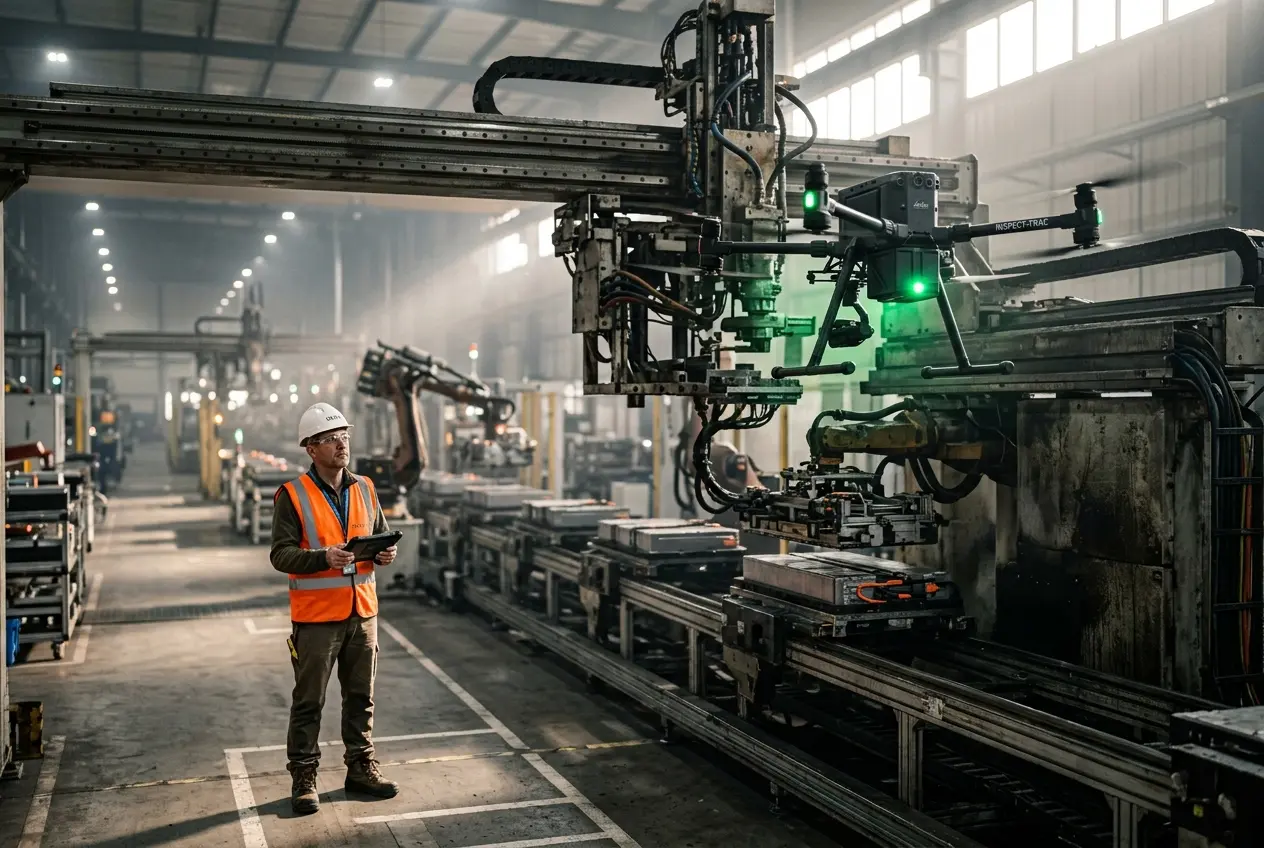
JLR is putting AI-powered drones on the factory floor, and the early numbers are blunt. An inspection pilot at JLR’s Electric Propulsion Manufacturing Centre in Wolverhampton has cut a four-hour process to ten minutes, a 95 percent reduction the British carmaker first reported in December 2025. The shift reframes a routine maintenance task as a data-gathering operation, and it is the most visible piece of a much wider factory-AI buildout at the Tata Motors-owned automaker.
The drone release, the venture investments, and the Reimagine strategy underneath them are part of one bet. JLR is preparing for an electric vehicle era in which, the company argues, the next round of automotive competition will be decided as much by factory intelligence as by the vehicles rolling off the line. The luxury brand is not alone in making that bet, but it is one of the first legacy carmakers to put a hard production-line number on what AI in the plant is worth.
The Four-Hour Inspection That Now Takes Ten Minutes
JLR’s pilot, run at the Wolverhampton Electric Propulsion Manufacturing Centre, or EPMC, uses the Elios 3 drone built by Swiss company Flyability. According to the four-hour-to-ten-minute inspection announcement, the drone reaches the elevated platforms, ductwork and confined industrial spaces that engineers used to access with lifts, harnesses and lengthy safety procedures. A 95 percent reduction in inspection time is the headline number; the underlying change is that nobody has to climb the structure to read it.
The Elios 3 carries lidar sensors that build a live 3D map of the equipment around it, plus a thermal camera that flags overheating components and insulation failures. JLR says the same approach is now being rolled into a second site. At the Logistics Operations Centre in Solihull, a drone fitted with barcode scanners will replace manual stock-taking, a task the company describes as slow, error-prone, and overly dependent on increasingly scarce human expertise. For JLR’s industrial operations team, the goal is the same in both places: replace risky, repetitive human work with a tool a trained operator runs from a tablet on the floor.
Project engineer Shantnu Mehta told the BBC she had not expected flying a drone to become part of her job. Nigel Blenkinsop, JLR’s executive director of industrial operations, framed the rollout in workforce terms as much as productivity ones. The drone, he said, is helping upskill the company’s people into the latest digital technologies, and the team using it is part of what JLR calls its factories of the future. Both quotes sit inside the same December 2025 release that gave JLR’s factory-AI story its first hard number.
- Inspection time: four hours reduced to ten minutes
- Reduction: up to 95 percent
- Drone used: Elios 3 by Flyability
- Site: Electric Propulsion Manufacturing Centre, Wolverhampton
- Next phase: Solihull Logistics Operations Centre for inventory checks
How JLR’s Venture Arm Is Stocking the Factory Stack
The Wolverhampton pilot is the visible layer. The harder-to-see layer is the portfolio JLR’s corporate venture arm, InMotion Ventures, is quietly building underneath it. In the last financial year, InMotion backed three AI companies, and each one fits a different rung of the factory-AI ladder: real-time inspection on the line, white-collar productivity, and the materials-science metrology that decides whether a battery cell is good enough to ship.
Matta, a University of Cambridge spin-out, raised a $14 million seed round led by Lakestar, with InMotion participating alongside Giant Ventures, Redseed, 1st Kind, Unruly Capital and Boost VC. Per the post that explains why the JLR venture arm backed Matta’s factory AI, Matta’s product is a sentient factory platform built around a small edge-AI appliance called the MattaBox that bolts onto existing cameras. The system learns what a normal production cycle looks like, then flags deviations in real time, achieving over 99 percent defect-detection accuracy with ten minutes of training data in a polymer deployment. The two founders, CEO Douglas Brion and CSO Sebastian Pattinson, came out of Cambridge, Imperial College and MIT, and the company is already selling to electronics, defence and apparel customers as well as automotive.
Parable, the second InMotion bet, sits higher up the stack. It is an enterprise AI platform that measures how time is actually spent across a business and surfaces where AI tools are pulling weight and where they are not. Forbes reported the New York-based company raised a $16.5 million seed round led by HOF Capital in November, with InMotion participating. For JLR, the bet reads as a way to gauge the productivity upside of the AI tools the company is rolling out across both factory and office operations.
The third portfolio piece, SirenOpt, targets the materials problem that drone-mounted cameras and edge-AI cameras cannot solve on their own. Per SirenOpt’s announcement of the Hitachi Ventures and InMotion investment, the company’s PlasmaSens platform uses cold atmospheric plasma and machine learning to read the internal structure of materials non-destructively, in real time, on the line. The first target markets are battery electrodes, aerospace parts, power-generation components and semiconductors. In a battery plant, that translates into early warning of cell-level defects without pulling samples off the line and destroying them.
| Company | Focus | Role in JLR’s factory push |
|---|---|---|
| Matta | Edge-AI factory-floor operating system; the MattaBox retrofits onto existing cameras | Brings self-learning quality control directly to the production line |
| Parable | Enterprise AI productivity platform | Measures the actual time and cost impact of AI inside JLR’s operations |
| SirenOpt | PlasmaSens cold-plasma metrology for non-destructive, in-line inspection | Targets battery and EV component quality where camera vision alone is not enough |
SirenOpt’s intelligence platform is setting new standards for advanced manufacturing: delivering real-time, micron-level, non-destructive testing and unlocking significant efficiency gains across numerous industries.
Mike Smeed, managing director at InMotion Ventures, made the case in the company’s investment announcement.
What an Edge-AI Factory Inspection Actually Looks Like
Three separate technologies now meet on a single JLR factory floor. The Flyability drone handles physical access, the MattaBox handles visual pattern recognition, and the SirenOpt PlasmaSens unit handles materials-level inspection that cameras cannot see. Each is sold independently, and the underlying logic is the same: take a slow, manual, sample-based quality check and turn it into a continuous, automated, in-line data stream.
Matta’s design choices explain why that matters. The MattaBox does all of its inference locally, which means no round-trip to a cloud server and no labelled training data set to build before a deployment. In most installations the system is up and running in hours, not months. The implication for a plant like EPMC is that an AI quality layer can be dropped onto an existing production line without rebuilding the line itself.
SirenOpt is solving a different problem, and a harder one. Detecting a defect inside a battery electrode, a turbine blade or a semiconductor wafer is not a computer-vision problem. It is a materials problem, which is why PlasmaSens uses cold plasma to read the material directly. The platform is already deployed across the United States, Japan, Germany, the United Kingdom and Taiwan, and a $2.4 million grant from the California Energy Commission is funding its battery-specific work.
It’s been exciting to learn how to use this technology and the skills I’ve developed will stay with me throughout my career.
Shantnu Mehta, project engineer at JLR, in the BBC’s reporting on the EPMC drone pilot.
The pattern across all three vendors is the same: manual inspection is the bottleneck, and AI tools can be aimed at it without reshaping the rest of the plant. That is the structural argument for the factory-AI rollout. At EPMC, the eye is now a non-destructive drone; on the Solihull inventory floor, it will be a barcode-reading drone; inside battery production, it will eventually be a plasma probe.
Solihull turns the pattern into a workforce question. The Logistics Operations Centre, where a barcode-reading drone will replace manual stock counts, is the first place JLR is rolling the same inspection approach into a warehouse setting. JLR’s framing, per Blenkinsop and Mehta, is retraining, not replacement: upskilling into digital technologies, with new skills that stay with engineers throughout their careers. The drone is the press release. The InMotion portfolio is the wider build.
The £18 Billion Bet Reshaping JLR’s Shop Floor
None of this sits outside JLR’s wider £18 billion investment programme, the five-year Reimagine plan that runs from 2024 to 2028 and that the company confirmed is still on track in its May 2025 full-year statement. The investment spans the Range Rover Electric launch scheduled for 2026, a new generation of Jaguar electric vehicles, dedicated EV production facilities across the UK, and the digital manufacturing stack that ties the rest of it together. The drone pilot, the venture bets and the AI-first rhetoric are all downstream of that plan.
JLR is a wholly owned subsidiary of Tata Motors Passenger Vehicles Limited, which sits inside the wider Tata group. The financial parent matters here. Tata’s technology services arm, TCS, has been building industrial AI and IoT capability for years across manufacturing clients, and JLR’s move is a vertical application of capability that already exists inside the group. The factory of the future, in other words, is not a clean-sheet greenfield project. It is an existing luxury automaker plugging group-level AI capability into century-old UK plants.
The workforce question is the one JLR keeps coming back to. Blenkinsop’s factories of the future line and Mehta’s new-skills line are both about retraining, not replacing, the existing engineering base. The drone pilot at EPMC is small in headcount terms, but it is being run through a wider JLR Open Innovation programme that has worked with more than 2,500 startups globally and produced 36 formal collaborations since April 2022. The intent is to turn a maintenance team into a drone-flying, AI-monitoring, data-reading team, in shifts rather than in a single leap.
Where JLR Sits in the Auto Industry’s Factory AI Race
JLR is not the only automaker chasing this. Renault has been working with Google Cloud to apply machine learning to manufacturing, and the wider auto sector is moving from AI in the vehicle to AI on the line. The pattern across how AI is forcing automakers to rebuild their engineering teams is consistent: vehicle engineering and factory engineering are converging on the same data, model and tooling stack. What changes is where the differentiation sits.
For luxury brands, the factory-AI build is also a margin play. Battery and EV production is capital-intensive and tariff-exposed, and any line that runs faster with fewer defects and less downtime is a hedge against the cost pressures squeezing the rest of the industry. JLR’s stated £18 billion envelope covers more than just AI, but the AI layer is the part of the spend that compounds: every inspection that runs through the MattaBox or the PlasmaSens unit feeds the next round of model improvements. The factory of the future, in JLR’s own framing, is the asset class the company is building around its existing manufacturing footprint.
Competitor deals point the same way. NVIDIA’s industrial push, exemplified by the NVIDIA and LG AI factory deal for physical AI training data, treats the factory itself as an AI training environment rather than a passive deployment site. JLR is not building a factory of the future by accident; it is responding to a competitive shift that is now in the open across the auto industry.
A 95 percent inspection-time cut is the headline. Underneath it, JLR is stitching together an inspection, quality and productivity stack that lives in its own venture portfolio, its own plants, and its own Reimagine plan. The drone is the press release. The Reimagine plan is the programme that frames the rest.
Frequently Asked Questions
What drone does JLR use in its factories?
JLR uses the Elios 3, made by Swiss company Flyability, at its Electric Propulsion Manufacturing Centre in Wolverhampton. The drone carries lidar sensors and a thermal camera, and it cut a four-hour machinery inspection down to ten minutes, a 95 percent reduction the company first reported in December 2025.
How big is JLR’s EV and AI investment programme?
JLR is running an £18 billion investment programme over five years from 2024 to 2028, covering the Range Rover Electric launch, a new generation of Jaguar EVs, dedicated EV plants in the UK, and the digital manufacturing buildout underneath them. The figure was confirmed in JLR’s May 2025 full-year statement.
Who owns Jaguar Land Rover?
JLR is a wholly owned subsidiary of Tata Motors Passenger Vehicles Limited, which is itself part of the wider Tata group, Tata Sons. The ownership has been in place since Tata Motors acquired the company from Ford in 2008.
Where is JLR’s Electric Propulsion Manufacturing Centre?
The EPMC sits on the i54 Business Park in Wolverhampton, in the West Midlands of England. It produces electric drive units and battery packs for the next generation of JLR’s electric vehicles.
What startups has InMotion Ventures backed for factory AI?
InMotion backed three AI companies in the last financial year: Matta, an edge-AI factory operating system spun out of the University of Cambridge; Parable, an enterprise AI productivity platform; and SirenOpt, which makes the PlasmaSens cold-plasma metrology platform for non-destructive, in-line inspection of batteries, aerospace parts and semiconductors.


D&D Bets Big on WoW and Star Wars to Grow Its Tables

Game Pass Drops Celeste and Crusader Kings on First Net-Loss Day

Gemini Breaks Basic Calls on Foldable Phones in Android Auto

Citadel Clears AI Fund Overhang While Crypto Stays Flat

Morgan Stanley Staking ETPs Crack Open Crypto Yield for Wealth Clients

Snapdragon Price Hike Forces Premium Buyers Toward Last Year’s Phones

Croc 2 Remaster Unlocks Argonaut’s Full Revival Path

Scale AI Names Google Cloud Veteran deSouza CEO for Enterprise Push

Epic Store Hits Brazilian iPhones Amid Apple’s Familiar Friction Play

LORDNINE Helena Server Races Players Toward Real USDT Rewards

Fable 5 and Mythos 5 Return as US Lifts Anthropic Export Controls

SpaceX’s Google Deal Turns a Rocket Company Into a Cloud Landlord

Oracle Cuts 21,000 Jobs in a Year, Cites AI in 10-K Filing

CD Projekt Red Co-CEO: Redemption Arc Isn’t Done, Witcher 4 in 2027

XPL Rallies 30% Ahead of Plasma One Card Tier Launch

DGO App Brings Rs 549 Mobile Pass for FIFA World Cup 2026 in Nepal

Google Search Profiles Build a Follow Graph Inside Discover

Moonshot AI Targets $30 Billion in China’s Fastest AI Funding Sprint

Microsoft Xbox Layoffs Start in July as Sharma Slams 3% Margin

Oppo’s ColorOS 17 Eligibility List Leaves A-Series Buyers Behind
-
 AI1 month ago
Fable 5 and Mythos 5 Return as US Lifts Anthropic Export Controls
-
 AI2 months ago
SpaceX’s Google Deal Turns a Rocket Company Into a Cloud Landlord
-
 AI1 month ago
Oracle Cuts 21,000 Jobs in a Year, Cites AI in 10-K Filing
-
 GAMING1 month ago
CD Projekt Red Co-CEO: Redemption Arc Isn’t Done, Witcher 4 in 2027
-
 CRYPTO2 months ago
XPL Rallies 30% Ahead of Plasma One Card Tier Launch
-
 APPS2 months ago
DGO App Brings Rs 549 Mobile Pass for FIFA World Cup 2026 in Nepal
-
 NEWS2 months ago
Google Search Profiles Build a Follow Graph Inside Discover
-
 AI2 months ago
Moonshot AI Targets $30 Billion in China’s Fastest AI Funding Sprint