
AI
Sam Altman Asks G7 Not to Cede AI Decisions to Labs Like OpenAI
Sam Altman asked G7 leaders to set global AI rules rather than let labs like his decide. The plea landed inside a US-EU split over how to govern the technology.

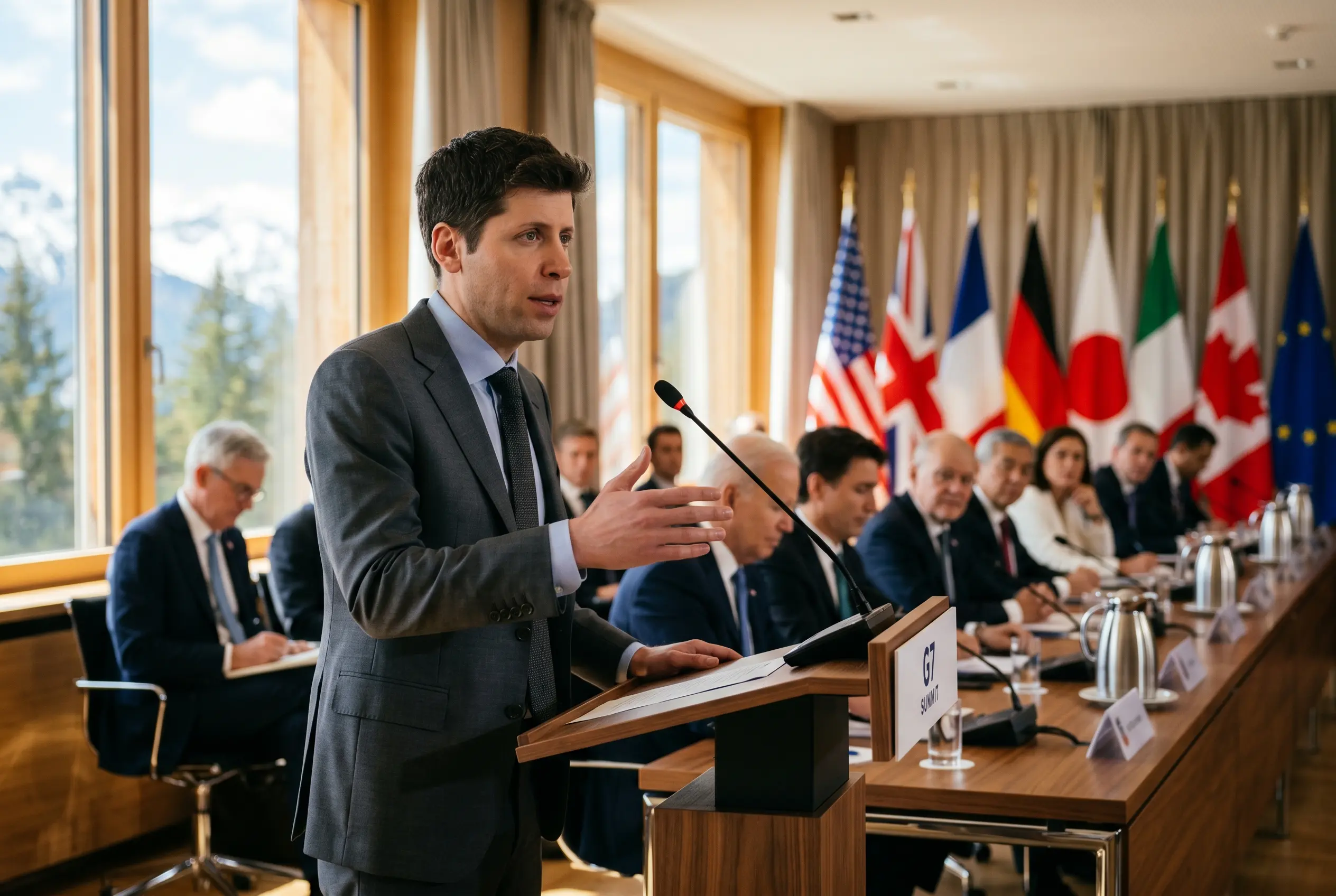
OpenAI chief executive Sam Altman stood in front of G7 leaders on Wednesday and asked them to stop letting companies like his own write the rules for artificial intelligence. Altman told a working lunch in the French Alpine resort of Evian-les-Bains, on the final day of the three-day summit hosted by French President Emmanuel Macron, that democratic governments, not AI labs, should hold the most consequential choices about the technology.
The appeal came from the head of one of the world’s most valuable AI firms. It effectively asked democratic governments to keep the most consequential choices about the technology out of corporate hands, including Altman’s own. The plea lands in the middle of a US-EU split over how tightly the technology should be controlled, and inside a separate fight over whether allies can even access the most advanced models the United States builds.
The Speech in Evian
The June 17 working lunch brought together G7 leaders from Canada, France, Germany, Italy, Japan, Britain and the United States. Invited guests from Brazil, India and Kenya joined them, along with more than a dozen executives from the AI industry’s biggest names. The published theme for the session was “ensuring a safe, rapid and effective deployment of artificial intelligence.”
Altman opened with a line aimed squarely at his hosts. “Do not cede your responsibilities to AI labs like mine,” he said, per excerpts OpenAI released after the session and carried in the wire report of his G7 remarks. “We develop the technology, and the citizens of the free world make the rules,” Altman added. “Technologists have special knowledge about AI, but they don’t have any special wisdom about humanity.”
Altman told the room that the question of whether AI is useful “has been settled.” Within a year or two, he expects, systems of “astonishing power” will reshape human life on a scale unmatched “since the harnessing of electricity.” That capability horizon, he argued, is what makes the governance question urgent. It is also, in his framing, what makes it a question for governments, not labs. The OpenAI chief called for a standing international body to set global testing standards and assess frontier-model risks.
We need an international forum for discussion that establishes globally accepted standards for testing, provides expert and impartial analysis of capabilities and risks, and serves as a venue for cooperation among nations.
Sam Altman, OpenAI chief executive, speaking to the G7 working lunch in Evian-les-Bains, France, on June 17, 2026. The remarks were excerpted by OpenAI and carried in wire reporting.
The Regulatory Divide Altman Walked Into
The European Union has spent two years writing risk-based AI rules that sort systems by how dangerous they are. France, Germany and Italy, three G7 members, all sit inside that framework. The EU’s AI Act, the first comprehensive AI law in force anywhere, places tougher duties on systems judged to carry the highest risk, per the EU’s own description of its AI rules.
The United States has moved the other way. Under President Donald Trump, the administration has rolled back domestic AI rules in hopes of speeding up new ideas and staying ahead of rivals like China. That rollback has been paired with a more confrontational export posture. The Commerce Department issued a directive on Friday placing Anthropic’s two newest models under licensing controls that reach any foreign person, anywhere in the world.
Macron called that posture a contradiction in his own remarks at the session. He said it was a “good thing” that US officials recognise so-called frontier AI models could be dangerous. He criticised the American response as strictly nationalist. He warned that US firms could lose value if they cut off allies from frontier models the way you might switch off a light. He paired his appeal for cooperation with a threat: France will keep funding its own AI industry in case international cooperation breaks down.
| Approach | European Union | United States under Trump |
|---|---|---|
| Domestic AI rules | Risk-based AI Act in force; tougher duties on the riskiest systems | Rolling back rules to speed new ideas; voluntary review in a June 2 executive order |
| Frontier-model access | No comparable frontier-model licensing directive | Commerce directive blocks Anthropic’s Fable 5 and Mythos 5 from non-US customers worldwide |
| Sovereignty stance | Tech Sovereignty package boosting EU chipmaking, cloud, open-source alternatives | “American AI technology stack” pushed abroad with US Commerce Department financing |
| Read of Altman’s call | Macron: align with allies on global guardrails | OpenAI as “an American company” governed by US law; administration has not aligned |
The Anthropic Block Over the Room
Commerce Secretary Howard Lutnick’s directive landed three days before the G7 session. It placed Anthropic’s two newest models, named Fable 5 and Mythos 5, under export controls that reach any location outside the United States and any foreign national inside the country. A license is required to export, re-export, or transfer either model, per the Fable 5 export block and what triggered it. The order reaches both the models and the non-US staff at Anthropic who would otherwise have access to them.
Because Anthropic could not reliably separate the two pools, the company said late Friday it had cut off access for every customer worldwide, including its own non-US staff. The directive was triggered, per a report in The Information, by a phone call from Amazon CEO Andy Jassy to Treasury Secretary Scott Bessent flagging jailbreak concerns Amazon’s researchers had identified in Fable 5. The administration asked the National Security Agency to review the alleged vulnerabilities, and the NSA concluded it was possible to strip away Fable 5’s guardrails.
Anthropic’s CEO Dario Amodei was in the same Evian room as Altman. Anthropic’s own framing, posted the same evening as the directive, called the action a “misunderstanding.” The company argued that the underlying capability is “widely available from other models (including OpenAI’s GPT-5.5).” Anthropic has already sued over a separate Pentagon designation, in place since February 27, that labels the company a supply-chain risk over its refusal to allow military use of its models for domestic surveillance and fully autonomous weapons. Anthropic continues to provide its models to the Department of War at “nominal cost” during that litigation.
The export-control directive opens a second legal front, and Anthropic has not yet filed in court over the Commerce order. The dispute has put Anthropic’s posture at odds with its position inside the room, where the company is asking for the same global standards Altman is.
Who Else Was at the Table
Altman was one of three top Western AI chief executives at the lunch. Google DeepMind’s Demis Hassabis and Anthropic’s Amodei sat alongside him. Meta’s chief AI officer, Alexandr Wang, joined too.
European and Asian lab heads filled out the room. France’s Mistral, Germany’s Black Forest Labs, Italy’s Domyn, Japan’s Sakana AI and United Kingdom-based Synthesia were all invited.
Canada’s Cohere CEO Aidan Gomez told The Associated Press that a “number of proposals” were discussed at the lunch. He said “the consensus was we need something.” He told the room democracies should make sure the G7 produces the second most capable AI, a reference to the US and China being the world’s only two major AI powers. The remark mapped onto a strategy Carney has been building in Ottawa for two years.
Canadian Prime Minister Mark Carney unveiled a national AI strategy on June 4, the same week the European Commission published its European Tech Sovereignty package and the Trump administration signed the June 2 AI executive order. The Carney plan leans on a “Sovereign Tech Alliance” with Germany and on international partnerships, including Cohere’s April acquisition of Germany’s Aleph Alpha. Carney has become the poster child for the so-called “Middle Powers” movement, per a pre-summit analysis of the Western AI sovereignty rift. The Trump administration has not aligned with the Carney approach. Washington is instead pushing what it calls an “American AI technology stack,” exporting US hardware and software, often with US Commerce Department financing, so that other countries, particularly those in the Global Majority, use American infrastructure over Chinese alternatives.
Earlier this month, the EU announced greater AI collaboration with South Korea. European Commission digital chief Henna Virkkunen travelled to Brazil on June 11 to sign a digital partnership with Latin America’s most populous country. The Finnish politician called Brazil “a country which shares very much the same values as the European Union.”
- Sam Altman, OpenAI chief executive (United States)
- Demis Hassabis, Google DeepMind CEO (United States / United Kingdom)
- Dario Amodei, Anthropic CEO (United States)
- Alexandr Wang, Meta chief AI officer (United States)
- Mistral leadership (France)
- Black Forest Labs leadership (Germany)
- Domyn leadership (Italy)
- Sakana AI leadership (Japan)
- Synthesia leadership (United Kingdom)
- Aidan Gomez, Cohere CEO (Canada)
The Policy That Sits Behind the Plea
The Trump administration’s June 2 executive order, titled “Promoting Advanced Artificial Intelligence Innovation and Security,” sets the formal backdrop. It establishes a voluntary framework for “covered frontier model” review, gives the Director of the National Security Agency the job of deciding which models qualify, and creates a path for the government to pick “trusted partners” who get early access. Section 3(c) of the order states explicitly that “nothing in this section shall be construed to authorize the creation of a mandatory governmental licensing, preclearance, or permitting requirement” for new AI models. The order’s review window is 30 days before release.
The Commerce directive sits beside the order’s voluntary framework, and the administration has not reconciled the two in public. European Commission president Ursula von der Leyen put the allied reading on the record when she unveiled the bloc’s Tech Sovereignty package. “We can not afford to depend on others for the technologies that keep our hospitals running, our energy grids stable and our services secure,” von der Leyen said. “This is about protecting our citizens, defending our interests and making our own choices,” she added. Altman’s call for global AI rules has, for now, a narrower audience than the speech suggested.


D&D Bets Big on WoW and Star Wars to Grow Its Tables

Game Pass Drops Celeste and Crusader Kings on First Net-Loss Day

Gemini Breaks Basic Calls on Foldable Phones in Android Auto

Citadel Clears AI Fund Overhang While Crypto Stays Flat

Morgan Stanley Staking ETPs Crack Open Crypto Yield for Wealth Clients

Snapdragon Price Hike Forces Premium Buyers Toward Last Year’s Phones

Croc 2 Remaster Unlocks Argonaut’s Full Revival Path

Scale AI Names Google Cloud Veteran deSouza CEO for Enterprise Push

Epic Store Hits Brazilian iPhones Amid Apple’s Familiar Friction Play

LORDNINE Helena Server Races Players Toward Real USDT Rewards

Fable 5 and Mythos 5 Return as US Lifts Anthropic Export Controls

SpaceX’s Google Deal Turns a Rocket Company Into a Cloud Landlord

Oracle Cuts 21,000 Jobs in a Year, Cites AI in 10-K Filing

CD Projekt Red Co-CEO: Redemption Arc Isn’t Done, Witcher 4 in 2027

XPL Rallies 30% Ahead of Plasma One Card Tier Launch

DGO App Brings Rs 549 Mobile Pass for FIFA World Cup 2026 in Nepal

Google Search Profiles Build a Follow Graph Inside Discover

Moonshot AI Targets $30 Billion in China’s Fastest AI Funding Sprint

Microsoft Xbox Layoffs Start in July as Sharma Slams 3% Margin

Oppo’s ColorOS 17 Eligibility List Leaves A-Series Buyers Behind
-
 AI1 month ago
Fable 5 and Mythos 5 Return as US Lifts Anthropic Export Controls
-
 AI2 months ago
SpaceX’s Google Deal Turns a Rocket Company Into a Cloud Landlord
-
 AI1 month ago
Oracle Cuts 21,000 Jobs in a Year, Cites AI in 10-K Filing
-
 GAMING1 month ago
CD Projekt Red Co-CEO: Redemption Arc Isn’t Done, Witcher 4 in 2027
-
 CRYPTO2 months ago
XPL Rallies 30% Ahead of Plasma One Card Tier Launch
-
 APPS2 months ago
DGO App Brings Rs 549 Mobile Pass for FIFA World Cup 2026 in Nepal
-
 NEWS2 months ago
Google Search Profiles Build a Follow Graph Inside Discover
-
 AI2 months ago
Moonshot AI Targets $30 Billion in China’s Fastest AI Funding Sprint