
AI
AWE 2026’s Socratic Dialogue Returns With One Skeptic Against AI
Kent Bye stood alone against AI hype at AWE 2026’s Socratic Dialogue on AI and XR, warning of wealth consolidation and U.S. privacy gaps the EU AI Act closes.

The AWE 2026 Socratic Dialogue on AI and XR returned to the Augmented World Expo’s main stage on June 18 in Long Beach with the same four panelists who faced off in the 2025 debut: Voices of VR host Kent Bye, Nokia’s Leslie Shannon, Alvin Graylin of Our Next Reality and the Virtual World Society, and Unanimous AI’s Louis Rosenberg. The format carried over, too. What changed was the alignment, and one panelist in particular noticed it.
In the show notes for Voices of VR episode 1749 on the AWE 2026 dialogue, Bye writes that this year he often felt he was the only one on stage pushing back on what he calls unsubstantiated AI hype, even as the rest of the panel argued in the technology’s favor. He uses the post to frame the conversation as a referendum on political context, on missing privacy law, and on the cost of letting AI consolidation continue without checks the EU AI Act already imposes. The full audio runs 1 hour, 6 minutes, 25 seconds and is embedded in the post. It is the second round of a format AWE introduced at last year’s conference and then returned in 2026.
Why AWE Brought the Socratic Dialogue Back
Augmented World Expo’s program lists the 2026 session as a Socratic Style Debate on the Future of Immersive Tech, held on the Grand Ballroom main stage from 2:30 PM to 3:30 PM on June 18, per the AWE 2026 session listing for the Socratic Dialogue. The event description calls the format a ‘debate style that encourages critical thinking and an exploration of ideas’ and notes it was first presented the year before. The organizers framed the 2026 edition as a chance to see whether the four panelists’ positions had shifted.
In 2025, the lineup split cleanly into two camps. Shannon and Graylin argued for AI’s potential to expand XR content creation, hardware, and access, while Rosenberg and Bye argued against what Bye at the time called letting ‘ethical issues’ be solved later. That first exchange, captured on the AWE YouTube channel and in Voices of VR episode 1611, drew enough attention that the conference organizers invited the same four back. The 2026 round is the second of what the agenda describes as a recurring format, not a one-off panel.
The recorded conversation is split into two parts, with the recorded Part 2 video of the AWE 2026 Socratic Dialogue already published under Alvin Graylin’s channel. Bye’s post for episode 1749 serves as the longer companion, with embedded audio, a show-notes reading list, and a transcript link. Together, the recordings form the most complete public record of the debate.
| Panelist | Affiliation | Position at AWE 2025 | Position at AWE 2026 |
|---|---|---|---|
| Leslie Shannon | Nokia | Argued for AI | Argued for AI |
| Alvin Graylin | Our Next Reality / Virtual World Society | Argued for AI | Argued for AI |
| Louis Rosenberg | Unanimous AI | Argued against AI | Not stated in 1749 show notes |
| Kent Bye | Voices of VR podcast | Argued against AI | Argued against AI; reports feeling alone |
The AWE session page describes the format as encouraging audience participation and asks everyone ‘to contemplate complex issues.’ For practitioners, a second-round structure is a natural experiment in how XR’s AI conversation evolves against a year of model releases, regulatory action in Europe, and fresh reporting on hyperscaler economics. What the four panelists actually say at the podium matters less than the fact that the conference put them there in a room built for live argument rather than keynote speeches. Bye’s episode framing reads that room as a referendum on AI’s role in XR. The panelists came back, and so did the format.
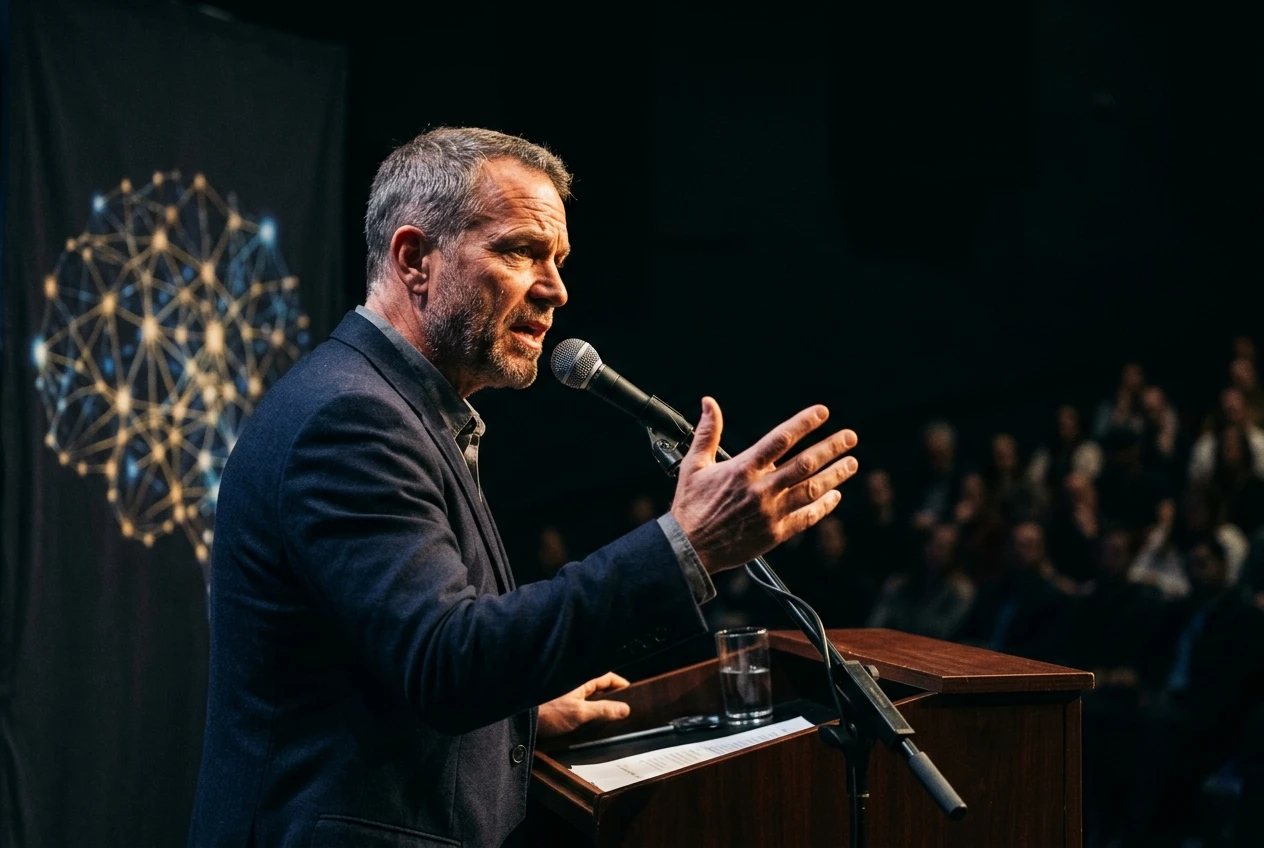
Bye Becomes the Lone Skeptic on Stage
The shift Bye names is positional, not procedural. In 2025 the panel split two-and-two: Shannon and Graylin for AI, Rosenberg and Bye against. In 2026 Bye describes a stage where one panelist standing alone against AI hype is now arguing against a more uniform front of boosters, which he attributes to a year of generative-AI momentum and to AI vendors continuing to ship features into XR products during that period. The result, as Bye describes it, is that the skeptics now feel outnumbered on the main stage.
The 2026 episode is built around that experience. It is also an explicit warning about how that shift will land on the XR industry.
this year it often felt like I was the only arguing against unsubstantiated AI Hype, but also warning about the tendency for AI to consolidate wealth and power, which is especially problematic within a democratically-backsliding political context.
Kent Bye wrote that in the show notes for Voices of VR episode 1749, recorded on the AWE 2026 main stage on June 18. He is the host of the Voices of VR podcast and the moderator of the Socratic Dialogue, and the post frames the second-round conversation around the privacy and political context he believes the XR industry has been slow to address. He is also explicit about what he sees as the cost of that silence: a regulatory vacuum that the EU AI Act closes for European users but that U.S. XR vendors and their customers operate inside every day. Bye points to a year of generative-AI releases and to AI vendors shipping features into XR products without renewed conversation about the social cost. The shift he names comes from the same four panelists returning to the same stage with different bottom lines on AI.
AI as a Wealth and Power Story
Bye grounds his 2026 critique in claims that recurred across the AWE dialogue and across his recent interview series. AI is, he writes, an automation technology designed to consolidate power, a framing he attributes to computational linguist Emily M. Bender and sociologist Alex Hanna. The XR industry’s rush to embed generative AI into headsets, authoring tools, and on-device assistants has carried that consolidation logic into immersive products without consent from end users. Those two claims are the through-line of episode 1749 and of the show-notes reading list Bye assembled for it.
Bender and Hanna are the authors of The AI Con: How to Fight Big Tech’s Hype and Create the Future We Want. Bye’s 2025 conversation with them on Voices of VR episode 1563, covered in his post titled Bye’s earlier conversation with Bender and Hanna on AI hype, walks through the same argument the AWE 2026 panel returns to a year later. Their thesis, as Bye summarizes it in the 1563 post, is that AI hype is itself a policy instrument.
Bye pushes that frame harder in 2026. The ‘democratically-backsliding political context’ he names in episode 1749 is the through-line between the book, the earlier podcast, and the AWE dialogue.
The argument Bye makes is concrete. He notes that the show-notes reading list includes work by Daniel Solove on surveillance capitalism and government surveillance, a paper by Dan McQuillan proposing an anti-fascist approach to AI, and Jonathan Roberge and Michael Castelle’s ‘Cultural Life of Machine Learning.’ The lineup tells readers the panel’s argument is about who owns the AI systems XR vendors are embedding, who captures the value they create, and what recourse end users have when those systems fail. Bye’s own paper, ‘Privacy Pitfalls of Contextually-Aware AI,’ published as part of the Stanford Cyber Policy Center’s proceedings on existing law and extended reality, makes the same point from inside the XR community. The reading list also includes the ‘Stochastic Parrots’ paper by Bender and colleagues on the limits and harms of large language models, a framing the AWE dialogue revisits in real time.
Bye stops short of arguing that XR should reject AI wholesale. The post for episode 1749 frames his position as a demand for the XR industry to have a serious, on-the-record conversation about the political and economic structure of the AI it ships. The notes close with a promise to add more references as Graylin and Rosenberg send them, a signal that the four panelists are still working out where they disagree.
The Privacy Gap Europe Already Closed
The most concrete policy point Bye makes in the post is that the U.S. has no privacy law on AI comparable to what the EU AI Act imposes on European providers and users. He writes that without that safeguard, automated decision-making systems inside XR products carry ‘a high likelihood of violating human rights due to AI errors.’ The gap turns XR’s privacy story from a vendor-controlled feature list into a regulatory question, and it is the gap that the U.S. adopting AI smart glasses ahead of any privacy law has already made visible. Bye ties that vacuum directly to the ‘democratically-backsliding political context’ he names in the post.
The EU AI Act is the through-line of the privacy argument, and Bye frames it as the central reason the Socratic Dialogue matters in 2026. The second-round conversation is anchored to the legal vacuum around how AI capabilities are deployed, and that shift tracks the EU’s enforcement timeline and the slow churn of U.S. state-level AI bills. Bye reads the gap as evidence that the U.S. approach to AI law is not moving in the same direction as Europe’s. For XR vendors selling into both markets, the practical consequence is that EU compliance is the binding constraint and U.S. compliance is a self-set bar. The asymmetry also changes the cost of any AI error that surfaces in a public setting.
| Policy area | EU AI Act | U.S. federal position (as described in episode 1749) |
|---|---|---|
| Automated decision-making safeguards | Curbs high-risk applications with a high likelihood of violating human rights due to AI errors, per Bye’s framing | No comparable safeguard, per Bye |
| Biometric and emotion recognition in public-facing AI | Restricted under the AI Act | No analogue cited |
| Privacy framework for AI | Comprehensive | None in place, per Bye |
What’s on the Skeptical Reading List
The show notes for episode 1749 read like a syllabus. Bye links out to scholarship, journalism, two documentaries, and his own XR-and-AI paper in a single post, and he frames each as a frame for the AWE dialogue. The list is the most concrete evidence of where Bye stands on AI and which voices he wants XR practitioners to read alongside the panel recording. Several of the works are by authors he has already interviewed on Voices of VR.
The list opens with The AI Con by Emily M. Bender and Alex Hanna, the book Bye covered at length in Voices of VR episode 1563 and which carries the line about AI as ‘an automation technology designed to consolidate power.’ Next to it sits Dr. Jonnie Penn’s ‘Inventing Intelligence’ PhD dissertation, placing AI in mid-twentieth-century context rather than 2026 product timelines. The list also includes Daniel Solove’s ‘Privacy in Authoritarian Times,’ which anchors the privacy argument in surveillance scholarship, and Bender’s earlier ‘Stochastic Parrots’ paper on the limits and harms of large language models. McQuillan’s ‘An Anti-fascist Approach to Artificial Intelligence’ and Roberge and Castelle’s ‘Cultural Life of Machine Learning’ round out the set. The pairing makes clear Bye’s argument is grounded in critical-AI studies rather than in a regulatory white paper.
Bye also links two documentaries, ‘Coded Bias’ and ‘Ghost in the Machine,’ which run parallel to the academic arguments as accessible entry points for non-academic XR practitioners. His own paper, ‘Privacy Pitfalls of Contextually-Aware AI: Sensemaking Frameworks for Context and XR Data Qualities,’ is part of the Stanford Cyber Policy Center’s 2023 proceedings on existing law and extended reality. The full list, drawn directly from the episode 1749 show notes, is below.
- The AI Con: How to Fight Big Tech’s Hype and Create the Future We Want, by Emily M. Bender and Alex Hanna
- Dr. Jonnie Penn’s ‘Inventing Intelligence: On the History of Complex Information Processing and Artificial Intelligence in the United States in the Mid-Twentieth Century’ PhD dissertation
- ‘Privacy in Authoritarian Times: Surveillance Capitalism and Government Surveillance,’ by Daniel Solove
- Kent Bye’s ‘Privacy Pitfalls of Contextually-Aware AI’ paper, Stanford Cyber Policy Center’s Existing Law and Extended Reality proceedings
- ‘Coded Bias’ documentary
- ‘Ghost in the Machine’ documentary
- ‘On the Dangers of Stochastic Parrots: Can Language Models Be Too Big?’ by Bender et al.
- ‘An Anti-fascist Approach to Artificial Intelligence,’ by Dan McQuillan
- ‘The Cultural Life of Machine Learning: An Incursion into Critical AI Studies,’ by Jonathan Roberge and Michael Castelle
Ed Zitron’s Hyperscaler Math Lands on the Main Stage
The single most pointed number in the show notes comes from journalist Ed Zitron, whose ‘AI’s Brokenomics’ reporting Bye cites in episode 1749. Zitron’s headline figure is that a $200 OpenAI or Anthropic subscription could be costing the providers $8,000 or $14,000 respectively in underlying compute. The figure is about the unit economics of generative AI, which do not yet pencil out for the hyperscalers selling access at subscription rates. The XR audience for that math is the vendor choosing whether to bake a hyperscaler API into a headset or authoring pipeline.
Zitron laid that case out publicly on CNBC, framing hyperscaler AI companies as having no profitability in sight, and Bye links directly to that appearance in the post. Zitron’s 2026 piece on the AI bubble expands the same case to a $2 trillion revenue gap by 2030. The argument lands on XR vendors because the AI they ship is the AI Zitron is pricing.
The relevance to the AWE 2026 dialogue is the supply side of the AI that XR vendors are embedding. If hyperscalers cannot price their models to recover compute cost, the costs will eventually land somewhere else, and Bye’s argument is that those costs land on end users through data extraction, vendor lock-in, and the absence of the privacy law that would cap what hyperscalers can do with the data they collect. The math is what makes the policy argument concrete: if the API is uneconomic at the contract price, the discount comes out of user data. For XR vendors building on top of hyperscaler APIs, the bill Zitron is pricing will eventually land on a privacy and product roadmap they have not yet drafted. The Bender and Hanna book frames the same problem as automation designed to consolidate power, and Bye carries that frame into the AWE dialogue.
The economics also make the regulatory gap more expensive. A vendor that ships AI features in 2026 without an EU-style guardrail inherits the entire compliance and reputational risk of any AI error that surfaces in a public setting, which is the conversation the Socratic Dialogue is built to have. Bye reads Zitron’s work as a warning that the bill is coming due and that XR vendors are exposed.
How the Argument Reaches XR Vendors
The format of the Socratic Dialogue is built for this kind of recurring argument, and AWE’s decision to bring the four panelists back for a second round signals that the conference organizers see value in tracking how XR’s AI conversation evolves. For vendors shipping products into both the EU and U.S. markets, the post is also a reminder that the policy and economics conversation is no longer a side discussion. The XR industry is now part of the broader AI consolidation story that Bender, Hanna, Zitron, Solove, and McQuillan have been writing about for years. Snap opening $2,195 AR glasses pre-orders this fall is one example of how that conversation is now landing on consumer hardware in real time. Bye frames the second-round dialogue as the place for XR practitioners to weigh in on what AI consolidation looks like inside their own products.
Bye ends the post with a note that he will add references as Graylin and Rosenberg send them, which means the reading list itself is a work in progress. The recorded audio and show notes for episode 1749 are the most current public record of the disagreement on the AWE main stage. The format is built for recurring argument rather than single keynote answers, which is why AWE’s agenda page describes the dialogue as something to be brought back when opinions have changed. Episode 1749 is the second-round record, and the post is also the place where XR practitioners can pick up the references and follow the conversation forward.
Frequently Asked Questions
What was the AWE 2026 Socratic Dialogue on AI and XR?
The Socratic Dialogue on the Future of AI and XR was a debate session held June 18, 2026, on the AWE USA 2026 main stage in Long Beach, California, between 2:30 PM and 3:30 PM. It was the second edition of a format AWE introduced in 2025, moderated by Voices of VR host Kent Bye, with Leslie Shannon of Nokia, Alvin Graylin of Our Next Reality and the Virtual World Society, and Louis Rosenberg of Unanimous AI as panelists.
Who argued for and against AI in the panel?
In the 2025 debut, Shannon and Graylin argued in favor of AI’s role in expanding XR, while Rosenberg and Bye argued against what Bye calls letting ethical issues be solved later. In the 2026 edition, Bye writes in the show notes for episode 1749 that he often felt he was the only panelist pushing back against unsubstantiated AI hype, even as the rest of the panel argued in the technology’s favor.
Why does Bye say the U.S. has no privacy law comparable to the EU AI Act?
Bye argues that the EU AI Act imposes restrictions on biometric identification, emotion recognition, social scoring, and other high-risk automated decision-making that protect European users from AI errors, while U.S. federal law has no comparable safeguard. The episode 1749 show notes frame this gap as the central reason the 2026 dialogue matters: XR vendors in the U.S. operate inside a regulatory vacuum the EU AI Act already closes.
What is the Ed Zitron hyperscaler math cited in the post?
The number Bye cites from Ed Zitron’s ‘AI’s Brokenomics’ reporting is that a $200 OpenAI or Anthropic subscription could be costing the providers up to $8,000 or $14,000 respectively in underlying compute. Zitron has also laid out a bear case on CNBC for hyperscaler AI companies with no profitability in sight. Bye’s reading is that this math exposes XR vendors building on hyperscaler APIs to a bill that lands on user data extraction if it cannot be priced in.
Where can I listen to or watch the AWE 2026 Socratic Dialogue?
The full audio recording runs 1 hour, 6 minutes, and 25 seconds and is embedded in Voices of VR episode 1749, published July 3, 2026. A Part 2 video of the dialogue has been published on YouTube. Both recordings are linked from the episode 1749 show notes on voicesofvr.com.


South Korea Retail Investors Face Reckoning After KOSPI AI Rally Collapses

Surrey AI Maps Three Heart Attack Paths and Their Molecular Roots

Germany Locks Neutral Apple ATT Prompts Across Most of Europe

Apple’s 5% EU Fee Quietly Rewrites Alternative App Store Math

Apple’s EU Fee Truce Cuts Complexity but Leaves Rivals Fuming

Pixel 11 Pro Fold Trades Thinness for Durability and Seven-Year Stay

Mayo AI Flags HCM Obstruction From Everyday Ultrasound Videos

Indian Brands Quietly Scale Landmark Screens and Home Tech

Navin Vatsa Turns Grief Into a Lifetime of Quiet Seeing

Google Bets Pixel 11 Agentic AI Will Redefine Phones

Oracle Cuts 21,000 Jobs in a Year, Cites AI in 10-K Filing

Fable 5 and Mythos 5 Return as US Lifts Anthropic Export Controls

SpaceX’s Google Deal Turns a Rocket Company Into a Cloud Landlord

CD Projekt Red Co-CEO: Redemption Arc Isn’t Done, Witcher 4 in 2027

XPL Rallies 30% Ahead of Plasma One Card Tier Launch

Google Search Profiles Build a Follow Graph Inside Discover

DGO App Brings Rs 549 Mobile Pass for FIFA World Cup 2026 in Nepal

Moonshot AI Targets $30 Billion in China’s Fastest AI Funding Sprint

Oppo’s ColorOS 17 Eligibility List Leaves A-Series Buyers Behind

Microsoft Xbox Layoffs Start in July as Sharma Slams 3% Margin
-
 AI2 months ago
Oracle Cuts 21,000 Jobs in a Year, Cites AI in 10-K Filing
-
 AI2 months ago
Fable 5 and Mythos 5 Return as US Lifts Anthropic Export Controls
-
 AI3 months ago
SpaceX’s Google Deal Turns a Rocket Company Into a Cloud Landlord
-
 GAMING2 months ago
CD Projekt Red Co-CEO: Redemption Arc Isn’t Done, Witcher 4 in 2027
-
 CRYPTO2 months ago
XPL Rallies 30% Ahead of Plasma One Card Tier Launch
-
 NEWS3 months ago
Google Search Profiles Build a Follow Graph Inside Discover
-
 APPS2 months ago
DGO App Brings Rs 549 Mobile Pass for FIFA World Cup 2026 in Nepal
-
 AI3 months ago
Moonshot AI Targets $30 Billion in China’s Fastest AI Funding Sprint