
AI
Nvidia’s Revenue-Sharing Model Reshapes How AI Startups Get Compute
Nvidia CFO Colette Kress announced a July 1 revenue-sharing model letting AI startups tap DSX factory compute for cloud revenue and token credits.

Nvidia has begun offering AI startups and developers something chipmakers rarely hand over: a recurring revenue stake in exchange for access to its hardware. Chief Financial Officer Colette Kress unveiled the revenue-sharing and credit-support model in a Nvidia post introducing the new compute model on July 1, framing it as a way to remove the upfront capital barrier between emerging AI companies and large-scale accelerated compute.
The arrangement runs through Nvidia’s DSX AI factories branding. AI cloud providers procure Nvidia infrastructure for AI-native, enterprise and independent software vendor customers, then resell Nvidia-powered cloud services on that capacity. Nvidia collects standard product revenue from the hardware plus a share of the cloud revenue generated on the supported capacity, plus token credits extended to qualifying developers. The two named infrastructure partners signed up first are Australian neocloud Sharon AI and Firmus Technologies, which is building a 360-megawatt DSX AI factory campus on Batam, Indonesia.
Inside the Revenue-Sharing and Credit Model
The model fits between two groups Nvidia already works with: AI cloud providers and the startups and developers who run on their capacity. AI clouds procure Nvidia infrastructure for AI-native, enterprise and independent software vendor customers, then sell Nvidia-powered cloud services on that capacity. Nvidia takes both standard product revenue from the hardware sale and a share of the cloud revenue on the supported capacity, plus token credits extended to qualifying developers. The structure creates what Nvidia calls a recurring, usage-linked earnings stream tied to how much compute its customers actually consume.
The barrier Nvidia is targeting has been documented inside its own ecosystem. Emerging AI companies historically have had limited access to capital-intensive infrastructure, and even long-term commitments have not always been enough to bring in financing for compute. Kress wrote that the new model gives model builders, inference providers, agent platforms and enterprises scaling AI faster access to full-stack accelerated computing, without waiting through site selection, power procurement, construction and hardware bring-up.
Four kinds of buyers are named inside the program. Model builders, inference providers, agent platforms and enterprises scaling AI all sit inside it. Each gets compute access in exchange for revenue share or token credits, not upfront capital. The structure shortens the traditional path, where a startup had to either raise the capital to build a data center or queue for capacity at an existing cloud provider. Sharon AI and Firmus are the first two infrastructure partners signed up to provide that capacity.
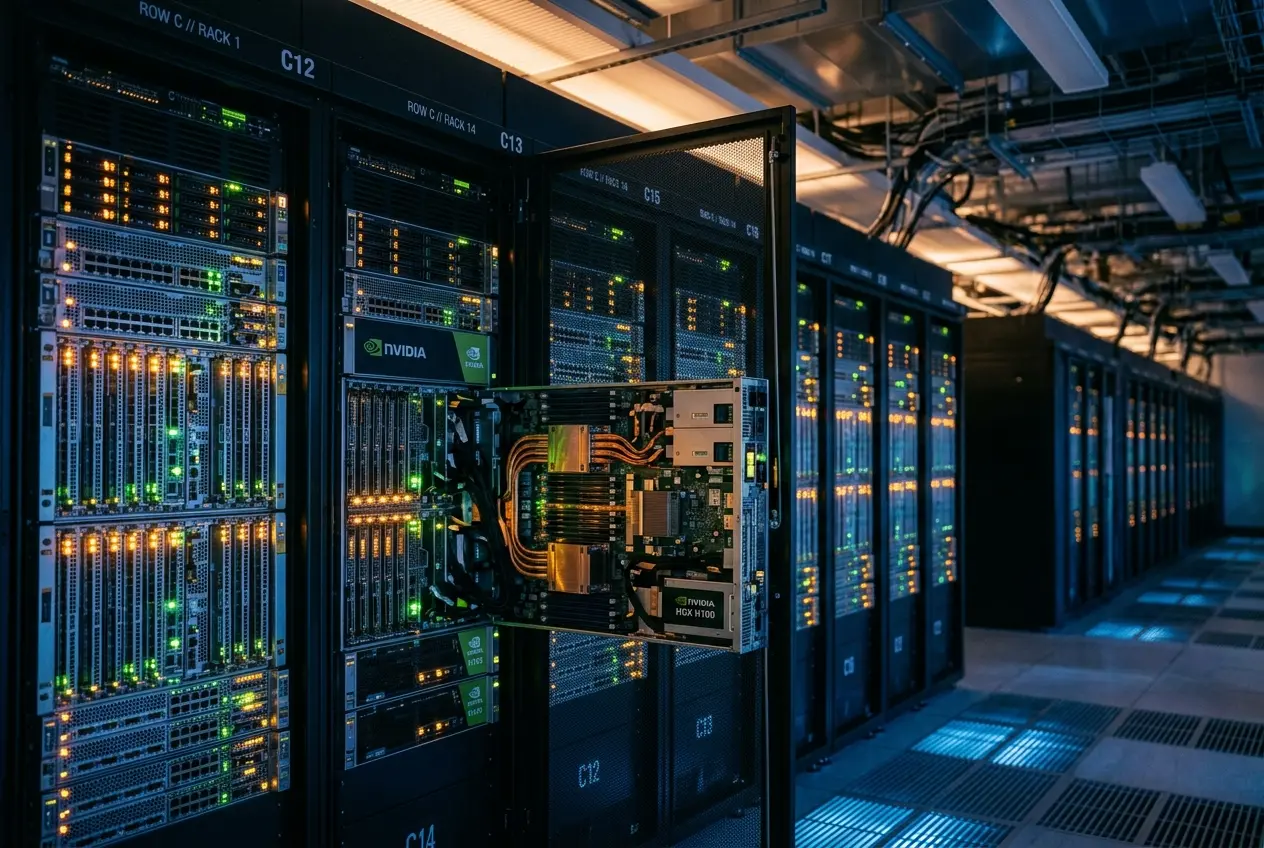
Sharon AI and Firmus Are the Two Named Partners
Sharon AI, an Australian AI cloud provider listed on NASDAQ as SHAZ, is deploying up to 40,000 Grace Blackwell GB300 GPUs under a six-year compute collaboration with Nvidia. The deal adds 72 megawatts of new data center capacity in Australia and uses Nvidia’s DSX AI factory design. After the agreement closes, Sharon AI’s total AI factory capacity expands to 132MW, of which 102MW is already contracted to end customers, per the Sharon AI announcement of the six-year compute deal. The Australian cloud provider expects to have more than 55,000 total Nvidia GPUs deployed by mid-2027, with the Australian compute deal structure detailing vendor credit on top of GPU sales.
Firmus Technologies, also Australian but expanding into Southeast Asia, is building a 360MW DSX AI factory campus on Batam, Indonesia, scaled to up to 170,000 NVIDIA GPUs. Procurement runs through 2034, according to the 170,000-GPU Firmus Indonesia deal terms, with chips including Grace Blackwell, Vera Rubin and Vera AI rolling out across 2027 and 2028. The company itself estimates $25 billion to $30 billion in committed offtake agreements over the first six years, based on customer commitments. The campus is being built with Singapore-based DayOne, which has signed a 450MW power purchase agreement for its Kabil Tech Park site.
| Attribute | Sharon AI | Firmus Technologies |
|---|---|---|
| Headquarters | Australia | Australia, expanding to Indonesia |
| Capacity scale | 72MW added, 132MW total | 360MW campus planned |
| GPU target | Up to 40,000 Grace Blackwell GB300 | Up to 170,000 Nvidia GPUs |
| Deal length | Six-year compute collaboration | Procurement through 2034 |
| Offtake estimate | 102MW already contracted | $25 billion to $30 billion over six years |
| Co-developer | None | DayOne (Singapore) |
| Listed | NASDAQ: SHAZ | Private (Nvidia-backed) |
Why This Landed Now, in the Inference Era
The timing tracks the shift in where AI compute demand sits. Nvidia’s blog frames the move as a response to AI shifting from model development to production inference, where compute demand is accelerating toward continuously operating AI factories that generate tokens at scale. The workload profile differs from earlier training-led AI infrastructure cycles, and it carries different economics: continuous operations mean recurring compute needs, which is exactly the recurring revenue profile Nvidia’s new model is built to capture.
The inference shift also changes who the customer is. Training-led demand drew a narrow buyer base with the capital to absorb large GPU bills. Inference is now being consumed by a much wider group: developers, digital natives, and enterprises building with AI. That broader buyer base is what the credit-support model is built for, since emerging AI companies have historically had limited access to capital-intensive infrastructure.
Inference providers are also already named in Nvidia’s materials. Baseten, Fireworks AI and Together AI appear in the company post as the kind of buyer the new capacity is meant to serve, with workloads spanning model training, post-training, fine-tuning, and high-volume agentic inference for developers, digital natives and enterprises.
The Financial Reach Beyond the Chip Sale
The conventional read on Nvidia’s program is that the company is helping startups get chips. The consequential shift is that Nvidia is becoming a capital partner to the AI clouds that host those startups, with a financial claim on the tokens and product revenue those clouds generate.
The economics are different from a chip sale. A chip sale is linear: Nvidia ships hardware and books revenue. Under the revenue-sharing model, Nvidia books the hardware sale plus a recurring cut of the cloud revenue on the supported capacity. That converts a one-time transaction into an ongoing revenue stream tied to how heavily the cloud is used, not how many GPUs were originally shipped. Kress described the new earnings stream as recurring and usage-linked, and tied the credit support to accelerating Nvidia platform adoption among the AI-native sector.
Nvidia now collects a recurring share of cloud revenue on the supported capacity. That ties its results to how much compute the AI clouds actually deliver, not just how many GPUs they bought.
AI-native companies need access to scalable, energy- and cost-efficient compute infrastructure to compete globally.
The quote is from Tim Rosenfield, co-CEO of Firmus Technologies, in Nvidia’s July 1 blog post on the new program. He framed the Indonesian deal as enabling more customers to access the compute they need to build and scale AI, and described the campus as a “NVIDIA DSX-aligned AI factory.” Firmus was founded in 2019, originally focused on crypto and high-performance compute, and now describes itself as a pure AI factory builder. The eight-year procurement window running through 2034 shows how long these commitments run, and how much of Nvidia’s future revenue the partners are betting on it.
Baseten, Fireworks AI, and Together AI Lead the Customer Roster
The inference providers already named in Nvidia’s materials are Baseten, Fireworks AI and Together AI. They need immediate access to AI cloud capacity to run model training, post-training, fine-tuning, and high-volume agentic inference. Their customers include developers, digital natives, and enterprises building with AI. Nvidia has separately documented Blackwell cutting inference token costs by up to 10x across the same group.
For these providers, the revenue-share model changes how they acquire capacity. They can scale their inference capacity without paying for it upfront, with the cost settled in tokens or future revenue. Nvidia’s earnings from the program grow with the inference volume these providers run on the supported capacity.
What the Model Still Does Not Solve
The revenue-sharing model does not shorten physical build times. Sharon AI’s own projections show more than 55,000 total Nvidia GPUs deployed by mid-2027, and the Firmus Batam campus is targeted to come online in the first quarter of 2027, with deliveries spanning 2027 and 2028.
The model also does not remove the operating-cost barrier. Even with token credits and revenue share covering part of the chip cost, customers still pay for power, cooling, real estate, and the rest of the data center stack. Sharon AI’s deal adds 72MW of new capacity, and the planned build from its Australian counterpart extends well beyond that, neither of which is small in absolute terms. The Australian builder still had to raise $505 million in equity in April 2026 to fund its own side of the build.
The benefit of the model depends on whether the named capacity actually arrives on the timelines the partners have published. For startups that need compute in 2026, none of the new DSX-aligned capacity from these two deals is online yet, and the token credits only stretch so far against actual compute. The next year of deliveries from both partners will be the proof.
- Up to 40,000 Grace Blackwell GB300 GPUs (Sharon AI deployment target under the six-year deal)
- Up to 170,000 Nvidia GPUs (Firmus Technologies Batam campus, procurement through 2034)
- $25 billion to $30 billion (Firmus’s estimated committed offtake agreements over the first six years)
- 132MW (Sharon AI’s total AI factory capacity after the Nvidia expansion)
Frequently Asked Questions
What is Nvidia’s revenue-sharing model for AI startups?
Nvidia’s revenue-sharing and credit-support model, announced by CFO Colette Kress on July 1, lets AI cloud providers procure Nvidia infrastructure for startups, developers and enterprises and then resell Nvidia-powered cloud services. Nvidia collects standard product revenue from the hardware sale and a share of the cloud revenue generated on that capacity, plus token credits extended to qualifying developers. The program runs under Nvidia’s DSX AI factories branding.
Who are Sharon AI and Firmus?
Sharon AI is an Australian AI cloud provider listed on NASDAQ as SHAZ, expanding to 132MW of total AI factory capacity after a six-year collaboration with Nvidia that adds 72MW and up to 40,000 Grace Blackwell GB300 GPUs. Firmus Technologies is an Australian AI factory builder developing a 360MW campus on Batam, Indonesia, with up to 170,000 Nvidia GPUs and a procurement window running through 2034.
How do token credits fit into the program?
Nvidia is granting token credits to qualifying AI startups alongside the revenue share. The credits give startups a way to access compute capacity without an upfront capital outlay, with the cost settled in future revenue rather than cash. Bloomberg first reported the token-credit portion of the program on July 2.
What is a DSX AI factory?
DSX AI factories is Nvidia’s branding for AI cloud data centers designed around its hardware and software stack. Both Sharon AI and Firmus are deploying DSX-aligned campuses, with Firmus describing its Indonesian build as a “NVIDIA DSX-aligned AI factory.” The design standardizes how the data centers are engineered so that customers can run full-stack accelerated computing without building their own infrastructure from scratch.
What does the program mean for startups?
For startups, the model offers a path to large-scale accelerated compute without raising the capital to buy chips or build data centers. The cost is revenue share or token credit, which means giving up a portion of future earnings. Startups whose products generate little token revenue may find the credits less useful than they look, and the model’s benefit depends on whether the named DSX-aligned capacity actually comes online on the timelines the partners have published.


Workers Still Trust Judgment Over the AI Tools They Use

DigitalOcean’s $894 Million Backlog Rewrites the Old Cloud

Companies Froze Job Design and Called AI a People Problem

AI Capex Looks Unique Because the Chips Wear Out

Samsung Medison’s HERA Z10 Aims at the Sonographer Shortage

GPT-6 Astra Ships as OpenAI’s First Critical Cyber Model

Palms Sells Clean Air Without Ending Casino Smoking

OnlyFans Promo Bots on X Now Pass the Humanity Tests

Datamaran Drops the ESG Label After Winning the Argument

Xiaomi’s Own Chip Lands While Apple Argues Over Color

Oracle Cuts 21,000 Jobs in a Year, Cites AI in 10-K Filing

Fable 5 and Mythos 5 Return as US Lifts Anthropic Export Controls

SpaceX’s Google Deal Turns a Rocket Company Into a Cloud Landlord

CD Projekt Red Co-CEO: Redemption Arc Isn’t Done, Witcher 4 in 2027

XPL Rallies 30% Ahead of Plasma One Card Tier Launch

Google Search Profiles Build a Follow Graph Inside Discover

DGO App Brings Rs 549 Mobile Pass for FIFA World Cup 2026 in Nepal

Moonshot AI Targets $30 Billion in China’s Fastest AI Funding Sprint

Oppo’s ColorOS 17 Eligibility List Leaves A-Series Buyers Behind

Microsoft Xbox Layoffs Start in July as Sharma Slams 3% Margin
-
 AI3 months ago
Oracle Cuts 21,000 Jobs in a Year, Cites AI in 10-K Filing
-
 AI2 months ago
Fable 5 and Mythos 5 Return as US Lifts Anthropic Export Controls
-
 AI3 months ago
SpaceX’s Google Deal Turns a Rocket Company Into a Cloud Landlord
-
 GAMING3 months ago
CD Projekt Red Co-CEO: Redemption Arc Isn’t Done, Witcher 4 in 2027
-
 CRYPTO3 months ago
XPL Rallies 30% Ahead of Plasma One Card Tier Launch
-
 NEWS3 months ago
Google Search Profiles Build a Follow Graph Inside Discover
-
 APPS3 months ago
DGO App Brings Rs 549 Mobile Pass for FIFA World Cup 2026 in Nepal
-
 AI3 months ago
Moonshot AI Targets $30 Billion in China’s Fastest AI Funding Sprint