
GAMING
Largest Video Game Study Yet Ties Play to a Small Memory Gain
A meta-analysis of 133 studies and 14,245 participants finds video games modestly boost memory, though the IQ link weakens under controlled testing.

A meta-analysis of 133 studies and 14,245 participants has found that video games give players a small but real edge in memory and other cognitive skills. The review, published in the journal Acta Psychologica, covers two decades of research on gaming and the brain. It resolves part of a long-running argument, not all of it.
The headline number, a five-to-seven-point IQ gap between gamers and non-gamers, comes from studies that cannot fully separate cause from effect. When the same research team looked only at controlled experiments, the kind where people get randomly assigned to play or not, that gap shrank to two or three points.
133 Studies, 14,245 Brains, One Small Signal
The team behind the review, led by researcher Rumei Zhao, searched two decades of literature for anything measuring video game play against cognitive ability. They found 133 qualifying studies published between January 2005 and August 2025, covering 14,245 participants in total.
Each study was graded for quality before being sorted into three separate meta-analyses: research that simply correlates hours played with test scores, research comparing self-identified gamers against non-gamers, and controlled experiments that randomly assigned people to play or not play. Results then got pooled into five broad cognitive domains, including spatial ability and visual attention.
| Meta-Analysis Type | Effect Size | What It Suggests |
|---|---|---|
| Correlational studies | r = 0.22 | Gamers score roughly five to seven IQ points higher on average |
| Gamer vs. non-gamer comparisons | Small, statistically significant | Experienced players outperform on spatial ability, attention and cognitive control |
| Controlled experiments | d = 0.088 | Assigning someone to play raises scores about two to three points |
All three designs pointed the same direction. None of them pointed there by much.
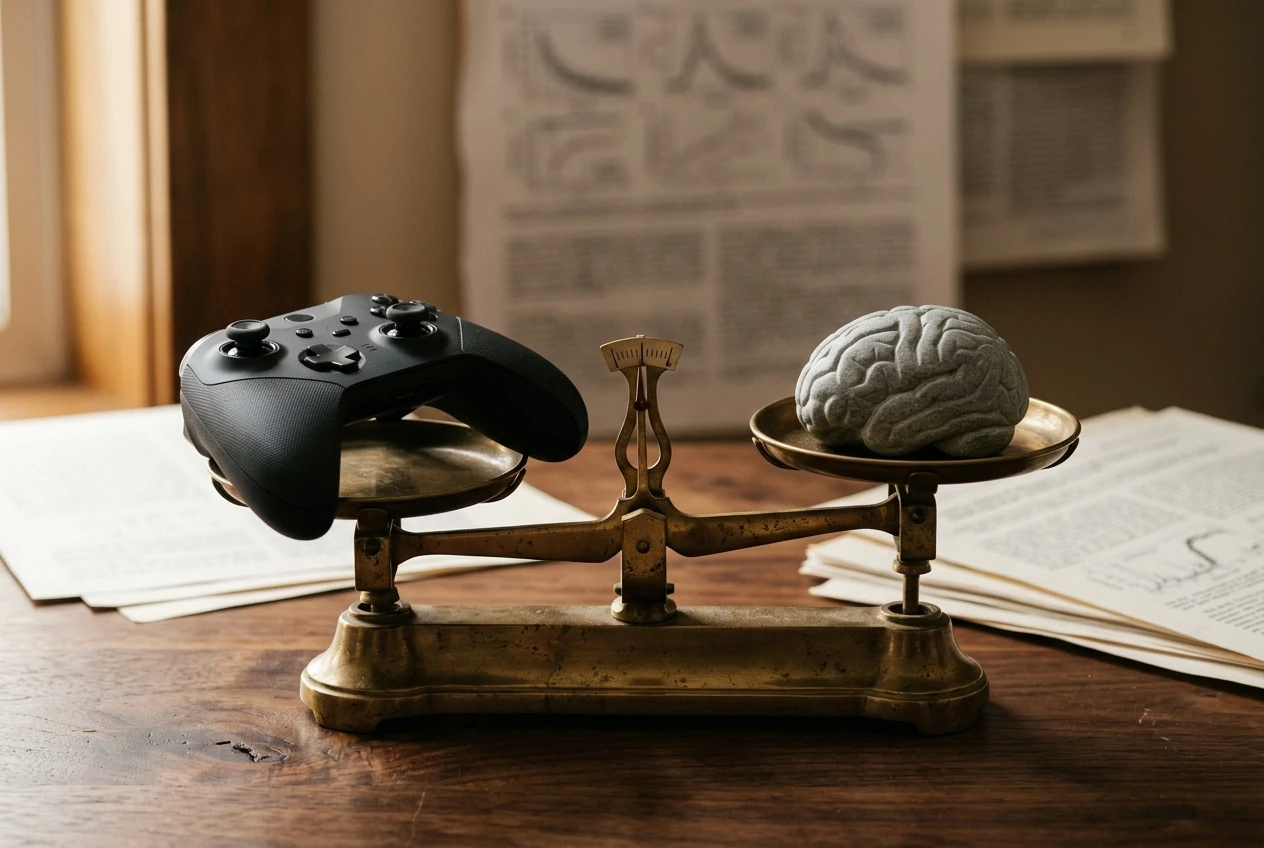
Memory Is the Only Skill That Clears the Bar
Five cognitive domains went into the analysis: memory, attention, spatial ability, cognitive control and general intelligence. Only one showed a statistically significant association on its own.
a significant association was found only for memory
That is how Zhao and her co-authors put it in the published paper. Their theory is straightforward. Gaming repeatedly exercises memory in a way it does not consistently exercise other skills, since most titles require players to track objectives, item locations and shifting rules as they go.
Not every prior study agrees. A 2019 comparison in a peer-reviewed journal found regular gamers recalled fewer objects on a standard memory test than non-gamers, the reverse of what the new pooled review found. That kind of scatter across individual studies is exactly why researchers run meta-analyses in the first place: one study can go either way, but 133 of them pooled together tend to average out the noise.
Does More Time Gaming Actually Raise Your IQ?
Not by much, and maybe not at all once other explanations get ruled out. The correlational data show a five-to-seven-point IQ gap favoring gamers, but that number drops to two or three points in controlled experiments, the design best equipped to test cause and effect.
The gap between those two numbers matters more than either number alone. Correlational studies compare people who already play games against people who do not. They cannot rule out the possibility that people with sharper memories and better cognitive control were simply more drawn to gaming to begin with.
Zhao’s team raised that possibility directly. Controlled experiments strip out most of that self-selection by assigning people to play regardless of their starting ability. Those experiments still found a positive effect. It was about a third the size of the correlational one.
A 2022 study tracking over 5,000 children for two years found a comparable pattern: kids who gamed more than average gained 2.55 extra IQ points over that period, even after controlling for genetics and family income. That figure sits much closer to the new review’s controlled-experiment number than to its bigger correlational one. University of Colorado Boulder researchers reached a similar split last August, describing the gaming-cognition link across their own data as small but statistically real, the same phrase that runs through the new review.
A separate line of research on AI chatbots found the opposite dynamic. Constant, effortless answers were tied to a drop in independent mental effort, part of why researchers have described AI making thinking feel effortless as carrying a real cost. Games, by contrast, appear to demand the effort rather than remove it.
Where the Effect Doesn’t Move
Zhao’s team also checked whether the gaming-cognition link changes under different conditions. Mostly, it does not.
- Gender – the effect size held steady across male and female participants
- Cultural background – Eastern and Western samples showed a similar pattern
- Health status – the association did not shift for participants with health conditions
- Intervention duration – longer training periods did not produce a bigger effect
- Game type – genre made little difference to the pooled result
A result that barely shifts across gender, culture, health status and game genre points to something structural in how games engage the brain.
Kids, Plasticity and a Recent Contradiction
Zhao’s team argues games may matter most for children and adolescents, whose brains show more plasticity than adult brains. The theory holds that a young, still-developing brain adapts more readily to the repeated demands of gameplay, whether that means tracking a mini-map or managing resources under time pressure.
A federal study of nearly 2,000 American children lends some support. Kids who gamed three-plus hours a day scored higher on tests of impulse control and working memory than kids who had never played, using data from the Adolescent Brain Cognitive Development (ABCD) Study.
“This study adds to our growing understanding of the associations between playing video games and brain development,” said Nora Volkow, director of the National Institute on Drug Abuse.
A much smaller study complicates the plasticity story. University of Houston researchers tested 160 urban preteens, most from lower-income households, who reported gaming an average of two and a half hours a day. Neither how long they played nor which genre they preferred showed a measurable link between gaming and cognitive ability on a standardized test.
- Zhao’s review argues younger, more plastic brains should show the strongest gaming-linked cognitive gains.
- C. Shawn Green, a University of Wisconsin-Madison psychology professor involved in the Houston study, said cognitive boosts seen in young adult gamers do not show up the same way in much younger children.
Older Brains Get a Different Pitch
At the other end of life, the pitch changes. Zhao’s team frames gaming as a possible support tool for older adults trying to slow cognitive decline.
A meta-analysis focused specifically on adults with mild cognitive impairment, an intermediate stage between normal aging and dementia, found real gains from video-game-based interventions. Pooling five randomized trials and roughly 215 participants, researchers recorded a 2.58-point improvement on the Montreal Cognitive Assessment and a 1.80-point improvement on the Mini-Mental State Examination compared with control groups, enough to meaningfully enhance global cognitive function and executive functioning.
A separate trial backed by the National Institute on Aging found recognition memory improved after two weeks of play, using nothing more exotic than Angry Birds and Super Mario on a tablet.
The evidence base is still thin. Five trials and 215 people mark an early stage of evidence, and the Frontiers authors say the next step is longer trials with standardized protocols, since current follow-up periods remain short.
Frequently Asked Questions
Does Gaming’s Memory Boost Last After You Stop Playing?
In a National Institute on Aging-backed trial, recognition memory kept improving for Super Mario players even after two more weeks without play, while Angry Birds players saw no further gains past the initial two weeks. Researchers tied the difference to Mario’s richer, more explorable environment.
Do Different Game Genres Train Different Cognitive Skills?
Genre-specific research outside the main meta-analysis suggests yes. Puzzle games have been linked to sustained attention, while action and first-person shooter titles show a stronger tie to attentional speed and cognitive flexibility. The 133-study review found genre made little difference once every game type got pooled together, which suggests the specific skill trained depends on what a person actually plays.
Can Video Games Help Prevent Dementia?
Mild cognitive impairment, the stage researchers tested games on, converts to dementia at a rate of 10 percent to 15 percent a year, far above the 1 percent to 2 percent rate in the general older population. That gap is why researchers are testing games at this specific stage, though current trials remain too small and short to call it prevention.
Is There a Downside to Gaming for Cognitive Health?
The same reward mechanics that make games engaging, frequent feedback and unpredictable payoffs, can also encourage compulsive play. Researchers studying gamification have flagged similar risks in other apps, including nutrition tools that push users toward disordered habits. None of the 133 studies in the new review measured addiction risk directly, so the cognitive gains and the behavioral risks come from separate bodies of research.
Do People Keep Playing Brain-Training Games Long Term?
Not reliably. In one older-adult trial testing a commercial brain-training game, 63 percent of participants said they had no plans to keep playing once the study ended, even though the game was designed to build cognitive skills. Enjoyment predicted whether people stuck with a game more reliably than any proven cognitive benefit did.


AMD’s Data Center Revenue Jumps 57% as Its Stock Bets on Execution

Microsoft Loses an Xbox Lawsuit Just as Sony Kills Physical Discs

Bethesda Union Says HR Tore Down Its Memorial for Laid-Off Staff

Google Pixel 11 Pro Fold Price Leaks Point Toward a $2,000 Foldable

Smart Scales Promise Lab-Grade Body Fat Numbers, and the Science Pushes Back

Amap’s Ride-Hailing Hits 1,000 Cities Amid Security Warnings

Ulys’s Automatic Toll Billing Draws Scammers to 7 Million Drivers

Google’s Veo AI Video Tools Threaten VFX Jobs Far Beyond Hollywood

Music Industry Unveils AI Labels, but Streaming Giants Haven’t Signed On

Apple Sues OpenAI and Two Ex-Employees Over Stolen Trade Secrets

Microsoft Xbox Layoffs Start in July as Sharma Slams 3% Margin

Google Search Profiles Build a Follow Graph Inside Discover

Oppo’s ColorOS 17 Eligibility List Leaves A-Series Buyers Behind

Oracle Cuts 21,000 Jobs in a Year, Cites AI in 10-K Filing

Google DeepMind and A24 Sign $75 Million AI Partnership Deal

OCC Issues AML Consent Order Against Wise and Crypto.com Sponsor Bank

DGO App Brings Rs 549 Mobile Pass for FIFA World Cup 2026 in Nepal

Anthropic Tells Senators Alibaba Ran the Largest Claude Distillation Attack

Apple Strikes Preliminary Deal For Intel To Make iPhone And Mac Chips

Google Home Spring Update Adds Gemini 3.1 And Old Nest Cam AI
-
 GAMING1 month ago
Microsoft Xbox Layoffs Start in July as Sharma Slams 3% Margin
-
 NEWS1 month ago
Google Search Profiles Build a Follow Graph Inside Discover
-
 NEWS1 month ago
Oppo’s ColorOS 17 Eligibility List Leaves A-Series Buyers Behind
-
 AI3 weeks ago
Oracle Cuts 21,000 Jobs in a Year, Cites AI in 10-K Filing
-
 AI3 weeks ago
Google DeepMind and A24 Sign $75 Million AI Partnership Deal
-
 CRYPTO2 months ago
OCC Issues AML Consent Order Against Wise and Crypto.com Sponsor Bank
-
 APPS1 month ago
DGO App Brings Rs 549 Mobile Pass for FIFA World Cup 2026 in Nepal
-
 AI2 weeks ago
Anthropic Tells Senators Alibaba Ran the Largest Claude Distillation Attack